Ramp Software Engineer Interview Prep Guide
Everything Ramp actually asks Software Engineer candidates — concept walkthroughs, worked examples, and the real interview questions, drawn from candidate reports. Free to read.
Last updated
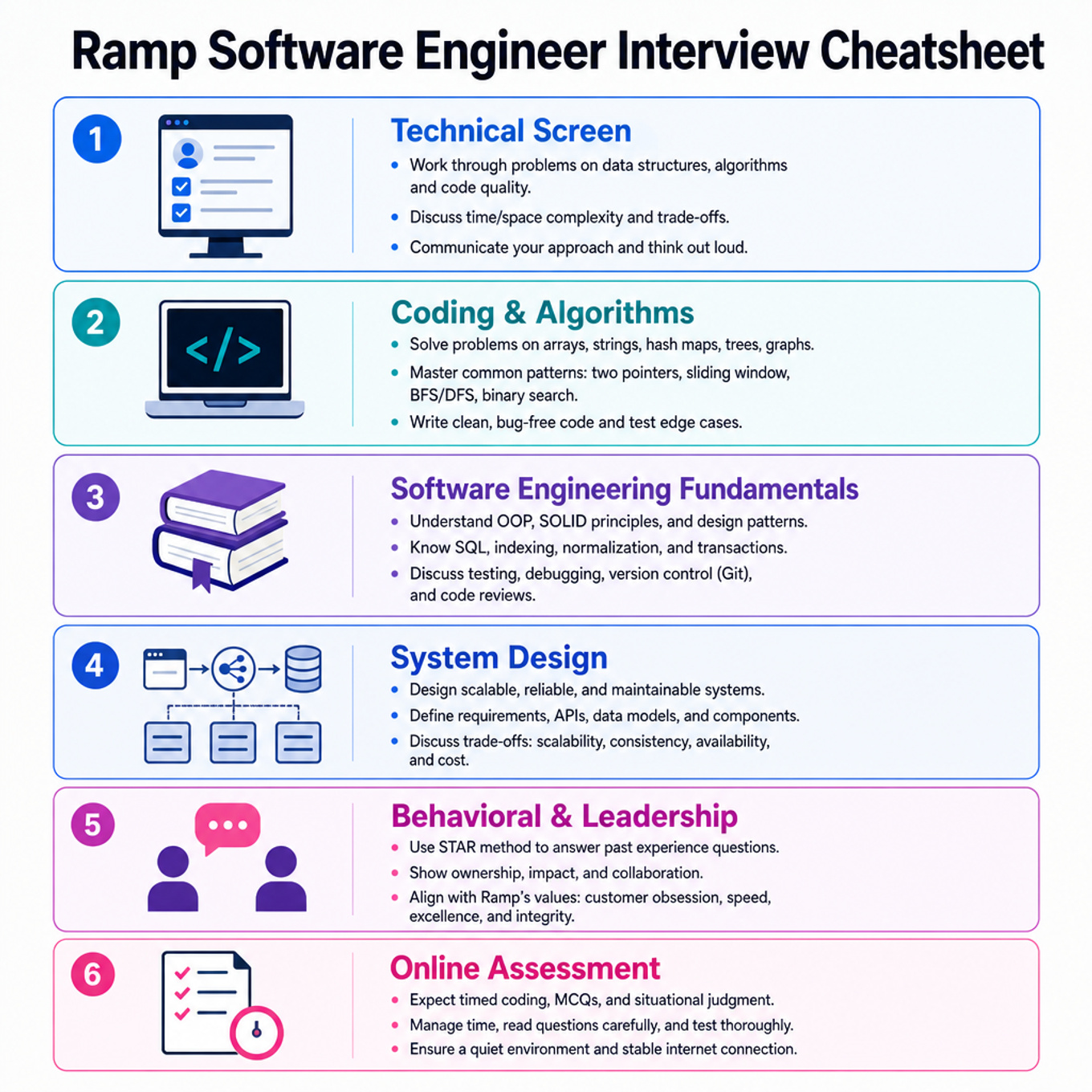
You're weakest in system design (1/5) and also rated coding, behavioral, and software fundamentals 2/5, so focus first on Ramp-style graph/API crawling, in-memory APIs, concurrency/transactions, and system design basics. Merely review sliding-window mechanics and two-pointer-style scanning since you marked those solid, but keep rate limiting at normal depth because Ramp uses it heavily. The Ramp-specific concepts highlighted are financial API idempotency, real-time analytics/storage, rate limits and quotas, merchant fuzzy matching, and distributed financial pipeline scheduling. With 1–3 months and many viewed but no solved signals, budget steady weekly practice: timed coding, one system design drill, and one ownership story pass each week.
Technical Screen — 66 min
Coding & Algorithms
Graph Traversal With Cycle Detection
Focus areaFocus area — You selected graph and grid traversal, rated BFS shaky, and have no solved signals yet, so this needs focused repetition.
What's being tested
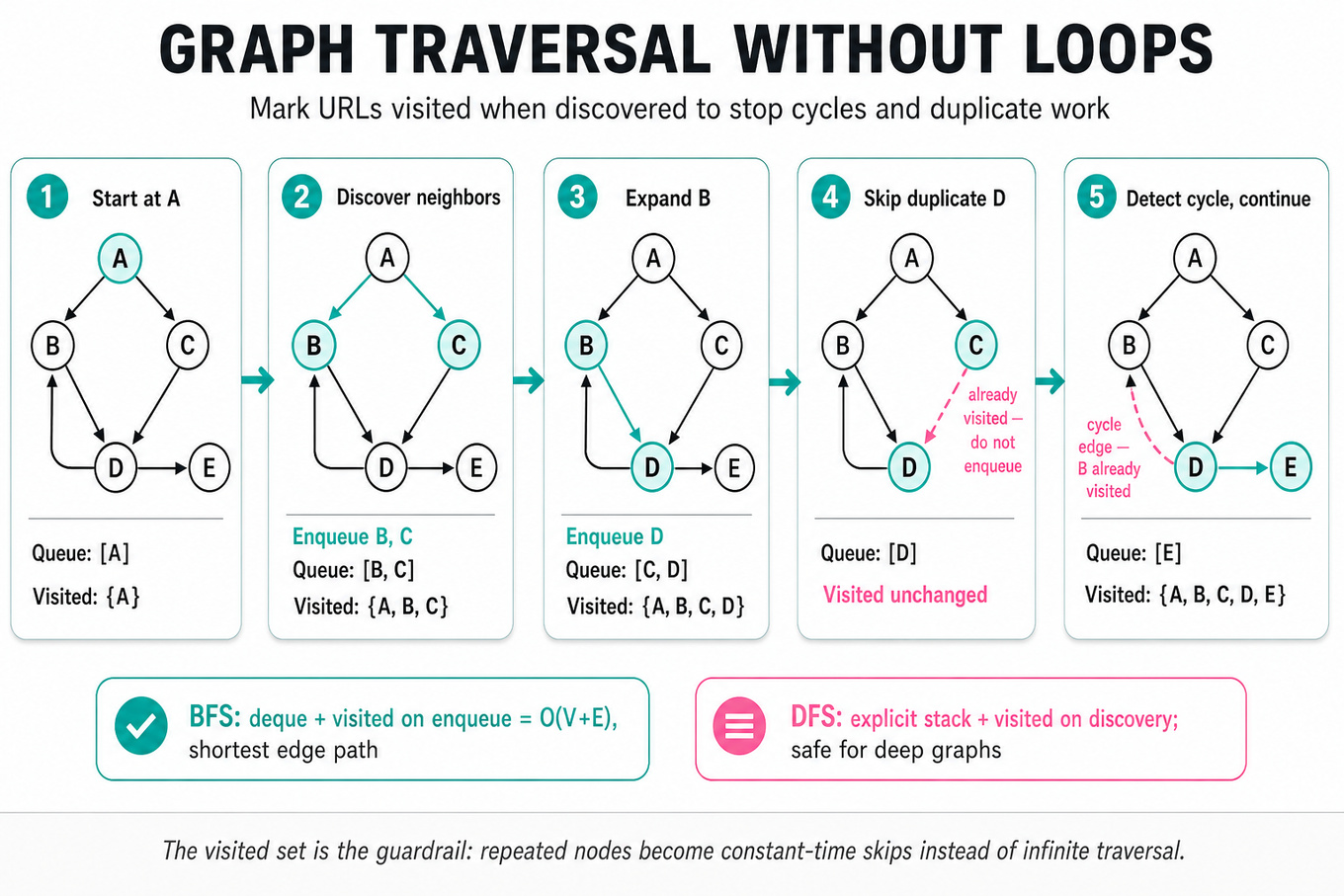
These exercises test graph traversal over an implicitly defined directed graph, where URLs are nodes and API-provided links are edges. You must demonstrate cycle detection with a visited set, correct BFS/DFS control flow, and resilient handling of transient HTTP failures, malformed JSON, timeouts, authorization, and termination conditions.
Patterns & templates
- BFS uses
`deque`; mark URLs visited when enqueued to prevent duplicate work and guarantee shortest-edge-path discovery, with traversal. - DFS uses recursion or an explicit stack; prefer an iterative stack for unbounded maze depth and avoid recursion-limit failures.
- Maintain
`visited`: set[str]; normalize URLs consistently before lookup, and distinguish a repeated node from a failed HTTP attempt. - Retry only transient failures such as
500,502,503, or504, using bounded exponential backoff; never retry malformed success payloads indefinitely. - Parse and validate JSON defensively: confirm expected fields and types, treat invalid responses as errors, and preserve the original URL for diagnostics.
- Propagate authorization headers or tokens on every request; configure connect/read timeouts so one slow endpoint cannot block traversal forever.
- Stop immediately on the explicit success predicate, such as a
congratsmessage; otherwise return a clear “not found” result after exhaustion.
Common pitfalls
Pitfall: Marking URLs visited only after processing allows cycles to enqueue duplicates repeatedly; mark them when discovered instead.
Pitfall: Treating every HTTP error as retryable can create infinite latency; use bounded attempts and classify permanent versus transient failures.
Pitfall: Assuming links are already absolute or JSON is well-formed; resolve relative URLs and validate the response schema before traversing.
Practice these
The practice cards below cover the canonical variants — solve all of them and time yourself.
Practice questions
HTTP API Maze Crawling
Focus areaFocus area — Coding is 2/5, BFS/grid traversal is shaky, and Ramp screens often wrap graph traversal inside HTTP API mazes.
What's being tested
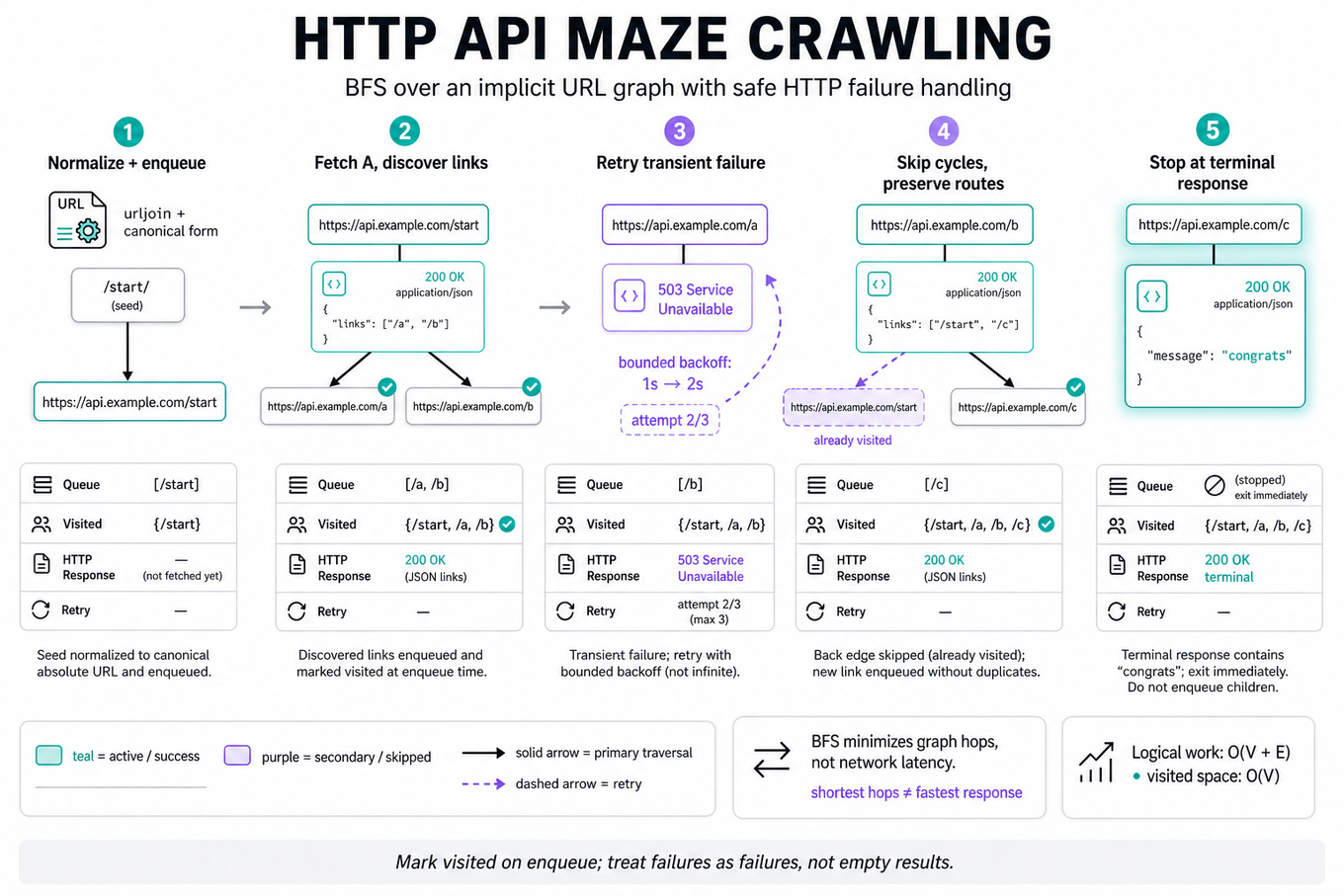
These problems test graph traversal over an implicit, HTTP-backed graph: each endpoint is a node, and its JSON-listed URLs are outgoing edges. You must combine BFS or DFS with URL normalization, cycle detection, bounded retries, timeout handling, and safe JSON parsing without confusing transient failures with a successful exit.
Patterns & templates
-
Use a
dequefor BFS when shortest hop count matters; use a stack for DFS when memory is constrained and any exit is acceptable. -
Maintain a
visited: set[str]and mark URLs when enqueuing; this prevents cycles and duplicate HTTP requests. -
Separate
fetch(url)from traversal: handle timeouts, retryable5xxresponses, invalid JSON, and non-success statuses in one place. -
Apply bounded exponential backoff, such as
min(base * 2**attempt, cap); never retry indefinitely or retry permanent4xxerrors. -
Resolve relative links with a URL parser such as
urljoin; normalize trailing slashes, fragments, and equivalent URL forms consistently. -
Stop immediately when the response contains the exact exit signal, such as a
"congrats"message; do not enqueue children from terminal nodes. -
Track complexity as
O(V + E)logical traversal work, plus network cost;visitedrequiresO(V)space and requests should be bounded.
Common pitfalls
Pitfall: Marking a URL visited only after processing its response allows duplicate queue entries and can amplify requests in graphs with converging paths.
Pitfall: Treating malformed JSON, timeouts, or
503responses as successful empty results can silently discard the only route to the exit.
Pitfall: Claiming BFS guarantees the fastest real-world result without clarifying that it minimizes graph hops, not latency or number of HTTP failures.
Practice these
The practice cards below cover the canonical variants — solve all of them and time yourself.
Practice questions
Software Engineering Fundamentals
-
Financial API Idempotency And Replay Safety (Focus) — covered in depth under Online Assessment below.
-
Concurrency Control For In-Memory Financial State (Focus) — covered in depth under Online Assessment below.
-
Fault-Tolerant HTTP JSON Clients (Focus) — covered in depth under Online Assessment below.
-
Production Hardening And Engineering Trade-Offs (Focus) — covered in depth under Online Assessment below.
System Design
- Distributed Job Scheduling For Financial Pipelines (Focus) — covered in depth under Online Assessment below.
Behavioral & Leadership
Ownership And Impact Storytelling
Focus areaFocus area — Behavioral is 2/5 and you selected ownership, failure, impact, and mentoring, so prepare concise senior-level project stories.
What's being tested
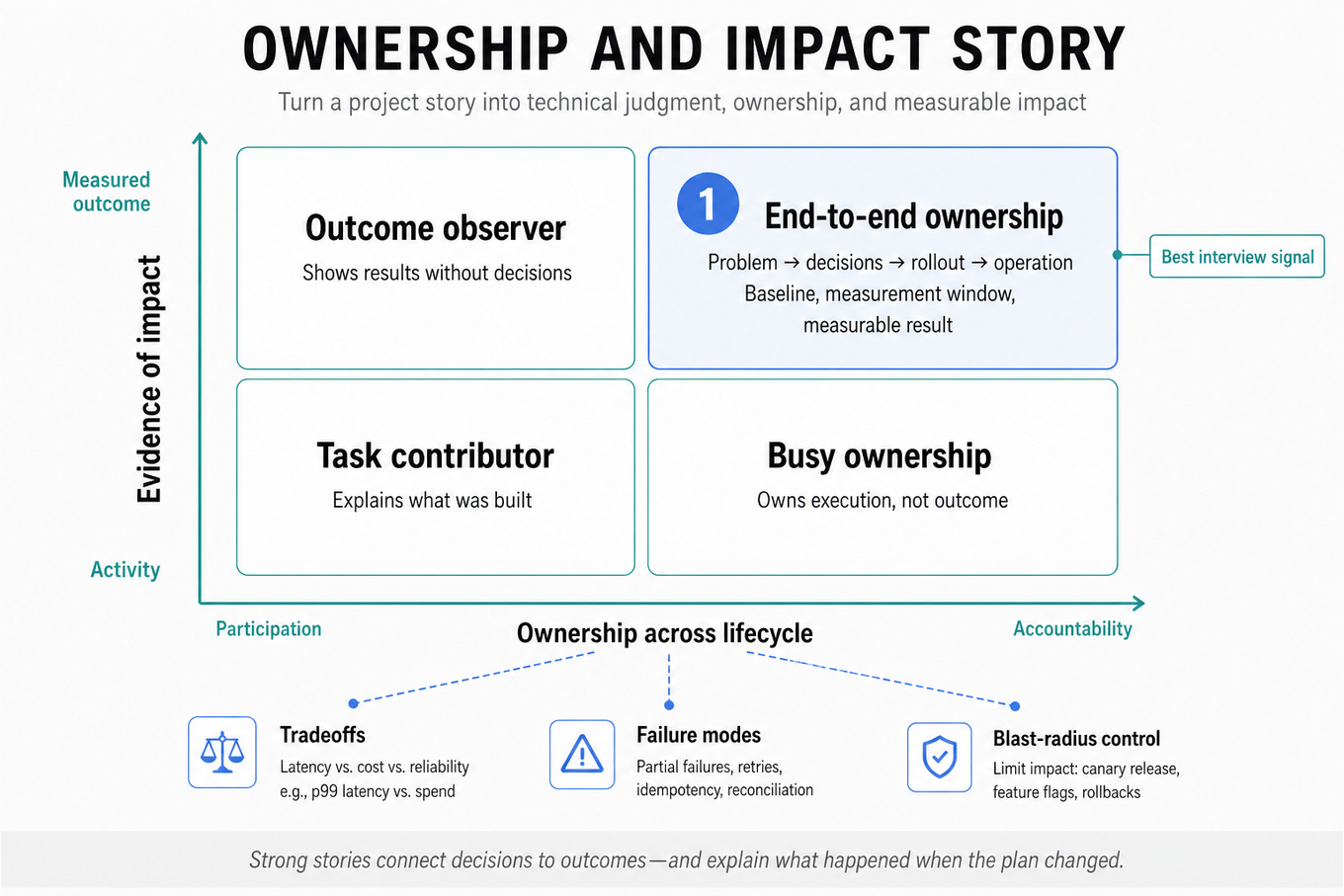
“What Project Are You Proudest Of?” tests whether you can explain end-to-end ownership of a software project: the problem, your specific technical decisions, execution through ambiguity, and measurable outcome. The interviewer is probing for technical judgment, not merely participation—how you diagnosed constraints, chose an architecture, handled failure modes, and influenced collaborators without overstating your role. Ramp operates financial workflows where reliability, correctness, security, and operational clarity matter, so a strong story connects engineering decisions to concrete improvements such as lower `p99` latency, fewer incidents, safer deployments, or improved reconciliation accuracy.
Core knowledge
-
Ownership means being accountable for the outcome across discovery, implementation, rollout, and operation—not personally writing every line. Distinguish your decisions from team contributions, and explain what you did when the original plan stopped working.
-
Use a problem-solution-impact structure: establish the user or system pain, describe constraints and alternatives, explain the implementation, then quantify results. “Built a service” is weak; “reduced timeout rate from 2% to 0.2% at 10× traffic” is credible.
-
Anchor impact in engineering metrics: availability, error rate, throughput,
`p50`/`p95`/`p99`latency, deployment frequency, rollback rate, mean time to recovery, cloud cost, or queue depth. State the baseline, measurement window, and whether the result was directly or indirectly attributable to your work. -
Explain tradeoffs explicitly. A synchronous
`Postgres`transaction may provide straightforward consistency but increase tail latency; an asynchronous queue improves resilience and throughput but introduces retries, duplicate delivery, observability needs, and eventual consistency. -
Demonstrate correctness under failure using concrete mechanisms: idempotency keys, unique constraints, transactional outbox, bounded retries with exponential backoff, dead-letter queues, and reconciliation jobs. For financial operations, “it usually works” is insufficient; explain how incorrect or duplicated writes are prevented.
-
Show how you reduced blast radius with feature flags, canary releases, backward-compatible schema migrations, rate limits, timeouts, circuit breakers, and staged rollouts. A good story includes what happens when a dependency is slow, unavailable, or returns malformed data.
-
Include operability as part of ownership. Mention structured logs, correlation IDs, dashboards, alerts tied to actionable symptoms, and runbooks. For an incident, distinguish detection time, diagnosis time, mitigation, permanent remediation, and the follow-up that prevented recurrence.
-
When describing a distributed design, identify the relevant consistency model. Strong consistency can simplify read-after-write behavior but costs latency or availability; eventual consistency scales well but requires user-visible status states, reconciliation, or compensating actions.
-
Make collaboration technical and specific. Describe how you aligned with another engineer on an API contract, negotiated schema ownership, reviewed a concurrency design, or used a design document to resolve disagreement. Avoid turning the answer into a project-management narrative.
-
Be precise about scope and counterfactuals. State whether you led the design, implemented the critical path, migrated existing traffic, or fixed production behavior. If several changes shipped together, explain how logs, staged rollout, comparison against baseline, or controlled exposure supports your impact claim.
-
For a project that changed direction, explain your debugging method: reproduce the issue, narrow the hypothesis, inspect traces and metrics, isolate the smallest failing component, test a fix, and verify regression coverage. Naming the discarded hypothesis often demonstrates more judgment than claiming the first design was perfect.
Worked example: What Project Are You Proudest Of?
In the first 30 seconds, I would choose one project with a clear engineering challenge and ask whether the interviewer wants the overview first or the technical deep dive. I would state the baseline, my role, the constraints—such as preserving API compatibility, avoiding duplicate financial writes, or maintaining a `p99` latency target—and the result I will measure. I would organize the answer around four pillars: why the existing system failed, the architecture and alternatives considered, my implementation and collaboration, and rollout plus operational impact. For example, I might describe replacing a fragile synchronous workflow with an idempotent, event-driven processing path backed by `Kafka`, a transactional outbox, and explicit status transitions. I would flag the central tradeoff: asynchronous processing improved resilience and throughput, but required idempotent consumers, retry handling, reconciliation, and a user-visible pending state. I would identify my personal ownership precisely, such as designing the state machine, implementing the consumer, adding metrics, and leading the staged migration while teammates owned adjacent clients. I would close with the measured outcome—lower timeout and duplicate-write rates, stable correctness checks, and improved recovery time—rather than claiming success from launch alone. If I had more time, I would also discuss load-test results, failure injection, rollback behavior, and what I would redesign after operating the system for several months.
A second angle
The same project can be framed less as an architecture win and more as an incident-to-prevention story when the interviewer emphasizes judgment under pressure. Start with the production symptom, explain how you separated application bugs from dependency or data issues using traces and logs, and describe the smallest safe mitigation. Then focus on the permanent fix: stronger invariants, better alerting, an idempotency boundary, and a regression test that captures the failure mode. This angle is especially useful when the project’s impact is reliability or correctness rather than a new feature.
Common pitfalls
Pitfall: Claiming impact without a baseline. “It made the system faster and more reliable” is not persuasive; give before-and-after values, the measurement method, and any confounding changes such as a traffic decrease or unrelated infrastructure upgrade.
A strong candidate avoids taking credit for the entire team’s work or, conversely, hiding behind “we.” The tempting answer lists everyone’s contributions equally; a better answer names collaborators, then clearly separates your decisions, implementation, and moments where you unblocked the outcome.
Pitfall: Describing architecture without operational depth. Saying “we used a queue for scalability” skips duplicate delivery, ordering, poison messages, backpressure, retries, and recovery; explain which guarantees were required and how the design enforced them.
Connections
The interviewer may pivot from ownership into system design, incident response, distributed-systems correctness, API evolution, observability, or testing strategy. Be ready to explain how the same project would behave under a dependency outage, a schema migration, a traffic spike, or a partial rollback.
Further reading
-
Site Reliability Engineering — Google’s practical treatment of service-level indicators, error budgets, incident response, and reliable system operation.
-
Accelerate, Nicole Forsgren, Jez Humble, and Gene Kim — connects deployment and operational capabilities to measurable software-delivery performance.
-
Designing Data-Intensive Applications — deep coverage of replication, consistency, streams, transactions, and failure tradeoffs.
Practice questions
Online Assessment — 66 min
Coding & Algorithms
In-Memory Object-Oriented API Design
Focus areaFocus area — OA coverage plus low coding confidence make evolving APIs, indexes, IDs, quotas, and clean object models high priority.
What's being tested
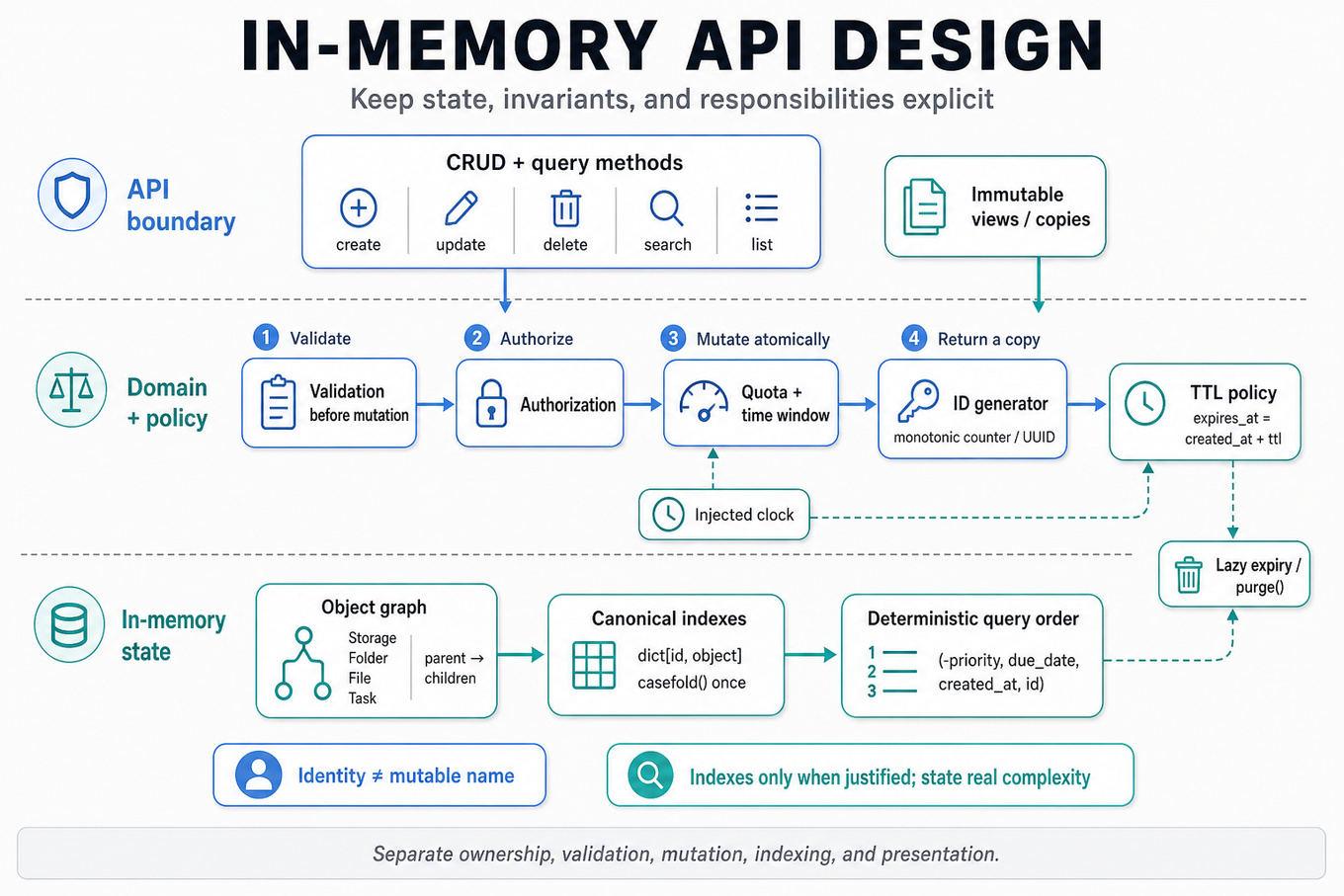
These problems test object-oriented API design for stateful, in-memory systems: modeling entities, enforcing invariants, and exposing clean CRUD/query methods. You must demonstrate nested data structures, deterministic sorting/search, ID generation, permissions, expiration, quotas, and evolving APIs without tangled state management.
Patterns & templates
-
Use layered classes such as
`Storage`,`Folder`,`File`,`Recipe`, or`Task`; keep ownership, validation, and mutation responsibilities explicit. -
Represent hierarchy with
`dict[id, object]`plus parent-child collections; maintain indexes when queries must be faster thanO(n)scans. -
Normalize case-insensitive fields once with
lower()orcasefold(); preserve original display text while comparing canonical values. -
Generate IDs centrally using a monotonic counter or UUID; never derive identity from mutable names, positions, or timestamps alone.
-
Implement prioritized sorting with a stable composite key, for example
(-priority, due_date, created_at, id); specify tie-breaking explicitly. -
Model TTL using
expires_at = created_at + ttl; inject a clock for tests and remove expired entries lazily or viapurge(). -
Enforce quotas and time windows atomically within one method; validate before mutating so rejected operations leave state unchanged.
-
Return copies or immutable views from getters; otherwise callers can bypass permissions, indexes, and invariants through shared mutable references.
Common pitfalls
Pitfall: Mixing storage, authorization, search, and formatting in one method makes API changes fragile; separate domain operations from presentation.
Pitfall: Forgetting empty collections, duplicate names, missing parents, expired objects, equal priorities, and edits by unauthorized users causes hidden-test failures.
Pitfall: Claiming
O(1)lookup while scanning nested lists undermines the design; state the actual complexity and add indexes only when justified.
Practice these
The practice cards below cover the canonical variants — solve all of them and time yourself.
Practice questions
Focus area — You selected text indexing/fuzzy matching and rated tries, n-grams, edit distance, and BK-trees new; Ramp data needs merchant matching.
What's being tested
A strong answer demonstrates how to turn messy merchant names into fast, predictable search results using text normalization, inverted indexes, n-gram indexes, and bounded edit-distance matching. The interviewer is probing whether you can separate indexing-time work from query-time work, choose data structures based on latency and scale, and explain correctness tradeoffs rather than reaching immediately for brute-force string comparisons. Ramp cares because merchant search can sit on latency-sensitive expense, transaction, and enrichment workflows where false matches are costly and tail latency matters.
Core knowledge
-
Canonicalization reduces superficial variation before indexing: Unicode normalization, lowercasing, punctuation and whitespace normalization, legal-suffix handling such as
INCorLLC, and optional alias expansion. Preserve the original display name and avoid destructive transformations that erase meaningful distinctions. -
An inverted index maps tokens or character fragments to merchant IDs:
token -> postings list. Query processing intersects or unions postings, then ranks candidates; it avoids comparing a query with every merchant and typically scales far better than brute-force scans. -
Character n-grams are useful for misspellings, concatenation, and token-boundary errors. For a string of length and gram size , index roughly grams; trigrams are common, but short names need special handling because they produce few reliable grams.
-
Levenshtein distance counts insertions, deletions, and substitutions. Standard dynamic programming costs per comparison and memory with row reuse; use it only after candidate generation, not across millions of merchants.
-
Candidate generation and ranking should be separate phases. Retrieve a bounded candidate set using exact aliases, token search, n-grams, or a search engine’s fuzzy query, then rank with weighted signals such as edit distance, token overlap, prefix match, merchant popularity, and locale.
-
Approximate nearest-neighbor indexes such as HNSW are appropriate for vector or embedding similarity, but they are not a universal replacement for lexical search. They can miss exact identifiers, require model/version management, and make explainability harder; a hybrid lexical-plus-vector design is often safer.
-
Search analyzers in systems such as
LuceneorElasticsearchdefine tokenization, filters, stemming, synonyms, and n-grams. Keep index and query analyzers compatible, and version analyzer configuration because changing it generally requires a reindex. -
Ranking must protect precision. A fuzzy match for
Amazonshould not confidently select an unrelated merchant merely because it is popular. Require a minimum score or margin between the top two candidates, return “ambiguous” when confidence is insufficient, and expose candidate explanations for debugging. -
Index updates need an explicit consistency model. Immutable merchant attributes can be batch-indexed, while aliases and status changes may require near-real-time updates; use versioned documents, idempotent writes, and an alias swap or blue-green rebuild for safe reindexing.
-
Latency and memory trade off against recall. Increasing edit distance, n-gram expansion, synonym count, or candidate-set size improves recall but expands postings and query work. Define budgets such as
p99under 100 ms and cap fuzzy expansion rather than allowing pathological queries. -
Edge cases include empty or one-character queries, transliteration, Unicode confusables, diacritics, emojis, punctuation-only names, duplicate merchants, renamed businesses, and shared parent brands. Never let an empty normalized query match every document, and distinguish display names from stable merchant IDs.
Worked example
Representative scenario: “Design a merchant search and fuzzy matching index”
In the first 30 seconds, clarify whether the API returns one canonical merchant or ranked candidates, the expected merchant count and query rate, the freshness requirement, supported languages, acceptable p95/p99 latency, and the cost of false positives versus false negatives. I would state an initial assumption of tens of millions of merchant records, read-heavy traffic, sub-100-ms p99, and a requirement to abstain when confidence is low. I would organize the answer around canonicalization and alias data, index and query architecture, candidate generation plus ranking, and operational concerns such as reindexing and observability. I would store stable merchant IDs, original names, normalized fields, aliases, and status in a source of truth, then build a versioned Lucene-style inverted index with exact, token, and character n-gram fields. At query time, I would attempt exact alias lookup first, generate a bounded fuzzy candidate set second, and apply edit-distance and token-based ranking only to those candidates. A key tradeoff is whether to use larger n-gram coverage for recall or stricter expansion limits for predictable tail latency; I would prefer bounded search plus an explicit “no confident match” result. I would measure latency, candidate-set size, acceptance rate, and reviewed false-match rate, while logging analyzer and index versions for reproducibility. If I had more time, I would add multilingual normalization, tenant-specific aliases, staged reindexing, and adversarial tests for short or highly common merchant names.
A second angle
Representative scenario: “Debug a fuzzy merchant match that returns the wrong business”
The framing changes from designing the system to tracing a bad result through normalization, candidate retrieval, scoring, and final acceptance. First compare the raw query, normalized query, analyzer output, and indexed fields; a mismatch there can make ranking changes irrelevant. Then inspect whether the correct merchant entered the candidate set at all, separating recall failure from ranking failure. If it was retrieved but lost, examine token weights, edit-distance thresholds, popularity bias, and missing alias data. I would fix the narrowest layer responsible and add a regression fixture so the correction survives future analyzer or index changes.
Common pitfalls
Pitfall: Treating fuzzy matching as “compute Levenshtein distance against every merchant” is correct but operationally unusable at scale; generate candidates with an index first and use expensive scoring only on a bounded set.
Pitfall: Saying “return the highest-scoring result” ignores ambiguity and false-positive cost. A stronger answer defines thresholds, score margins, abstention behavior, and a review or fallback path.
Pitfall: Naming
ElasticsearchorLucenewithout explaining analyzers, postings, update consistency, and reindexing signals shallow knowledge. Describe what the system stores, how a query executes, and which knobs affect latency and recall.
Connections
An interviewer may pivot to distributed caching, blue-green index deployment, observability and tail-latency debugging, or idempotent event-driven updates. They may also ask how to test ranking quality with golden datasets without drifting into model-training design.
Further reading
-
Lucene Documentation: Indexing and Searching — details inverted indexes, analyzers, postings, and query execution.
-
Elasticsearch Fuzzy Query — concrete controls for edit distance and fuzzy expansion.
-
“Fast Approximate String Matching in a Dictionary” — Schulz and Mihov, 2002 — foundational techniques for dictionary-based approximate matching.
Practice questions
Software Engineering Fundamentals
Focus area — Ramp-like money movement needs safe retries; your transaction and concurrency fundamentals are new, so start from first principles.
What's being tested
This topic tests whether you can design replay-safe APIs in an unreliable distributed environment where clients retry after timeouts, network connections break, and requests may execute more than once. The interviewer is probing for correct use of idempotency keys, durable state, uniqueness constraints, and transactional boundaries—not merely checking whether you can cache a response. Ramp handles financial mutations, so duplicate charges, reimbursements, card authorizations, or transfers are correctness and trust failures, not ordinary availability bugs.
Core knowledge
-
Idempotency means repeating the same logically identified operation has the same externally visible effect as executing it once.
GET,PUT, andDELETEare conventionally idempotent;POSTusually requires an explicit idempotency-key protocol. -
An idempotency key should identify one client-intended operation, not merely one HTTP request. Store
(tenant_id, endpoint, idempotency_key)under a unique constraint; scoping only by key risks collisions across customers or API resources. -
Persist a request fingerprint such as
SHA-256(canonical_method, path, authenticated_actor, normalized_body). If a key is reused with a different payload, return409 Conflictor422 Unprocessable Entity; silently applying the original operation is dangerous. -
The idempotency record needs durable states such as
IN_PROGRESS,SUCCEEDED, andFAILED_RETRYABLE, plus the resource identifier and serialized response. A duplicate arriving duringIN_PROGRESSshould wait briefly, return a conflict, or poll—not start a second mutation. -
Enforce uniqueness in the database, not with an application-level “check then insert.” Concurrent requests can both pass the check;
PostgresUNIQUEconstraints or conditional writes provide the authoritative race-safe boundary. -
Make the business mutation and idempotency-record transition atomic where possible: insert the key, create the payment, and record the resulting resource in one database transaction. If the external processor is involved, local atomicity alone cannot cover the remote side effect.
-
External calls create an ambiguous outcome: a timeout may mean the processor rejected, accepted, or is still processing the request. Use the processor’s own idempotency key, query-by-client-reference, or reconciliation rather than blindly retrying a charge.
-
Separate exactly-once effects from exactly-once message delivery. Distributed systems generally provide at-least-once delivery; achieve effectively-once business behavior through durable deduplication, deterministic operation identifiers, and idempotent consumers.
-
For asynchronous workflows, persist an outbox event in the same transaction as the state change, then publish it asynchronously. Consumers should deduplicate by event or operation ID and advance a state machine monotonically, tolerating duplicate and reordered messages.
-
Define retention deliberately. A seven-day key lifetime may protect against normal client retries, but a delayed replay after expiration can still duplicate a financial action; retain keys according to settlement, dispute, and compliance windows or reject stale operations using resource state.
-
Response replay must preserve status, headers, and body where practical. Never replay sensitive credentials or secrets; encrypt or redact stored responses, restrict access by tenant, and authenticate every retry before looking up the idempotency record.
-
Idempotency does not mean every retry is safe. A request that failed validation can usually be retried with a new key after correction, while a committed payment should return the original result; document which errors are cached versus retryable.
Worked example
Consider a representative Create Payment API with an Idempotency-Key header, where no specific interview prompt is supplied. In the first 30 seconds, clarify whether “payment created” means a local intent or money movement, what retry window is required, whether clients can submit the same key concurrently, and whether a processor supports idempotency. Organize the answer around request validation and canonical fingerprinting, a durable idempotency state machine, the transaction and uniqueness constraint, and safe integration with the external processor. Store the key scoped to the tenant and operation, atomically create a local payment intent, and return the stored result for later identical retries. Explicitly flag the timeout tradeoff: waiting for an external processor inside a database transaction improves simple reasoning but harms connection utilization, so an asynchronous state machine plus reconciliation may be safer. For a concurrent duplicate, let one request own IN_PROGRESS and make the other poll or receive a retryable response rather than invoke the processor twice. If I had more time, I would define retention, observability, regional failover behavior, authorization checks, and recovery for records stuck in IN_PROGRESS.
A second angle
The same concept applies to an asynchronous reimbursement worker, but the key boundary is message consumption rather than HTTP request handling. Use a stable reimbursement ID as the operation identity, record a completed-effect marker, and make retries consult the marker before issuing another processor call. A crashed worker can leave the local status uncertain, so reconciliation must query the processor or use its idempotency facility. The design must also handle duplicate, delayed, and reordered events without moving a reimbursement backward from COMPLETED to PENDING.
Common pitfalls
Pitfall: “Put the idempotency key in a cache for 24 hours.” A cache can evict entries, lose data during failure, or race under concurrent requests; durable storage and a database uniqueness constraint must protect the financial effect.
Pitfall: Treating every repeated key as success. A key reused with a different body is a client bug or possible attack; compare a canonical request fingerprint and reject the mismatch explicitly.
Pitfall: Claiming that a database transaction makes an external charge exactly once. The processor call can succeed while the local transaction fails, so explain processor-side idempotency, query-based reconciliation, and an explicit
UNKNOWNorPENDINGstate.
Connections
An interviewer may pivot to distributed transactions, the transactional outbox pattern, saga orchestration, or at-least-once message processing. Be ready to discuss Postgres locking and isolation, multi-region consistency, dead-letter recovery, and observability metrics such as duplicate rate, stuck-operation age, and reconciliation lag.
Further reading
-
Stripe API: Idempotent Requests — practical treatment of key reuse, replayed responses, and parameter mismatches.
-
Martin Kleppmann, Designing Data-Intensive Applications, Chapters 8–11 — rigorous coverage of retries, distributed transactions, streams, and consistency.
-
Pat Helland, “Life Beyond Distributed Transactions” — useful framing for application-level business operations and recovery.
Practice questions
Focus area — Race conditions, mutexes, atomics, isolation, MVCC, and snapshots are all new in your ratings and map directly to financial correctness.
What's being tested
This topic tests whether you can preserve financial invariants when multiple threads or requests update shared in-memory state concurrently. The interviewer is probing your understanding of linearizability, lock and atomic-operation semantics, race-condition diagnosis, and the tradeoffs among mutexes, optimistic concurrency, and serialized ownership. Ramp handles balances, card limits, reimbursements, and authorization decisions where a rare lost update or double spend is a correctness failure, not merely a performance defect.
Core knowledge
-
Define invariants before choosing synchronization. For an account, a typical invariant is
balance >= 0; for a transfer, total money is conserved: . State exactly which intermediate states may be observed. -
Linearizability means each operation appears to take effect atomically at one instant between invocation and response. A correct
withdraw(account, amount)must validate the balance and apply the decrement within the same synchronization boundary. -
A mutex protects a critical section containing both the read and write.
lock → check invariant → mutate → unlockis correct; locking only the assignment is not. Always release withdefer/finallyor an RAII guard. -
Atomic operations such as compare-and-swap,
fetch_add, andincrementprotect individual machine-level updates, but they do not automatically protect compound logic. “Check balance, then subtract” requires a CAS loop or a lock because the check and mutation must be one logical operation. -
Optimistic concurrency stores a version with the value and updates only when the version is unchanged:
CAS((balance, v), (balance - amount, v + 1)). Retry on contention, but bound retries or fall back to locking under hot-key contention. -
Choose lock granularity deliberately. A single global lock is easiest to prove correct but serializes unrelated accounts; one lock per account improves throughput but makes multi-account transfers require deterministic lock ordering to avoid deadlocks.
-
A read-write lock helps only when reads substantially outnumber writes and read snapshots need protection. It does not make a multi-object operation atomic, and writer starvation or lock-upgrade behavior can create correctness and latency problems.
-
Actor-style ownership gives each account or shard one event loop and processes mutations sequentially. It avoids shared-memory races, but cross-account transfers require a protocol, ordering rule, or coordinator; mailbox ordering alone does not provide global atomicity.
-
For transfers, synchronize the complete operation across both accounts or use a consistent ownership strategy. Lock accounts in ascending stable ID order, validate both balances, mutate both, and publish the result only after the invariant is restored.
-
Idempotency protects against retries, not simultaneous threads by itself. Store a request or transaction identifier with the applied result, and atomically check-and-record it with the state change; otherwise a timeout retry can debit twice.
-
In-memory synchronization does not provide durability or cross-process safety. A process crash loses state, and two service replicas have independent locks. If correctness spans replicas, use an authoritative transactional store, a single writer, or a distributed coordination design.
-
Use integer minor units such as cents, not binary floating point, for money. Validate positive amounts, overflow, account identity, currency, and authorization before mutation; reject malformed or duplicated operations without partially changing state.
Worked example: Design concurrency control for an in-memory account balance
A strong candidate would first clarify whether the process is single-instance, whether operations include transfers, what consistency guarantee is required, and whether state must survive crashes. They would declare an assumption such as: multiple request threads share one process, withdrawals must be linearizable, and no account may become negative. The answer would be organized around the invariant, synchronization boundary, contention strategy, and failure/idempotency behavior. For a simple implementation, they would use a per-account mutex and perform the balance check and decrement while holding it. For transfers, they would acquire both account locks in ascending account-ID order, validate both accounts, mutate both, and release them safely. The explicit tradeoff is that per-account locks improve unrelated-account throughput but require careful ordering and complicate lock lifecycle management, whereas one global mutex is easier to prove but limits concurrency. They would mention metrics such as lock wait time, rejected withdrawals, retry counts, and p99 operation latency. If they had more time, they would also discuss crash recovery, multi-process ownership, and durable transaction records.
A second angle: Prevent double spending across concurrent authorization requests
Here the central framing shifts from protecting a mutable object to guaranteeing that multiple authorization attempts consume one shared spending limit correctly. Ask whether authorizations are reservations, whether they expire, and whether the limit is per card, employee, merchant, or billing period. A strong design uses an atomic conditional update—such as limit_remaining >= amount followed by decrement—or serializes all mutations for that limit owner. It must also attach an idempotency key so a retried authorization does not consume the limit twice. If several replicas can process requests, an in-process mutex is insufficient; the authority must move to a transactional datastore or a single-owner partition.
Common pitfalls
Pitfall: Saying “use an atomic integer” while performing a separate balance check and decrement. An atomic write prevents torn updates, but it does not make the entire conditional operation atomic; use a mutex or CAS loop.
Pitfall: Ignoring the scope of the lock. A correct per-thread or per-object lock does nothing if requests can reach multiple processes or hosts; explicitly identify the shared-state boundary and the system that owns it.
Pitfall: Jumping directly to distributed locks without first stating the invariant and required consistency. Interviewers want a simple design that can be proven correct, followed by justified scaling extensions—not unexplained infrastructure complexity.
Connections
An interviewer may pivot to database transactions, serializable isolation, idempotency keys, deadlock detection, or event sourcing. They may also ask how a single-process design evolves into sharded ownership across service instances while preserving per-account ordering.
Further reading
-
Java Concurrency in Practice — practical coverage of visibility, atomicity, locking, and composing thread-safe operations.
-
“On the Criteria To Be Used in Decomposing Systems into Modules” — useful background for separating state ownership and synchronization responsibilities.
-
“Time, Clocks, and the Ordering of Events in a Distributed System” — foundational treatment of ordering when in-memory concurrency becomes distributed coordination.
Practice questions
Fault-Tolerant HTTP JSON Clients
Focus areaFocus area — Software fundamentals are 2/5 and you selected fault tolerance/API design; Ramp-style services require reliable retries and parsing.
What's being tested
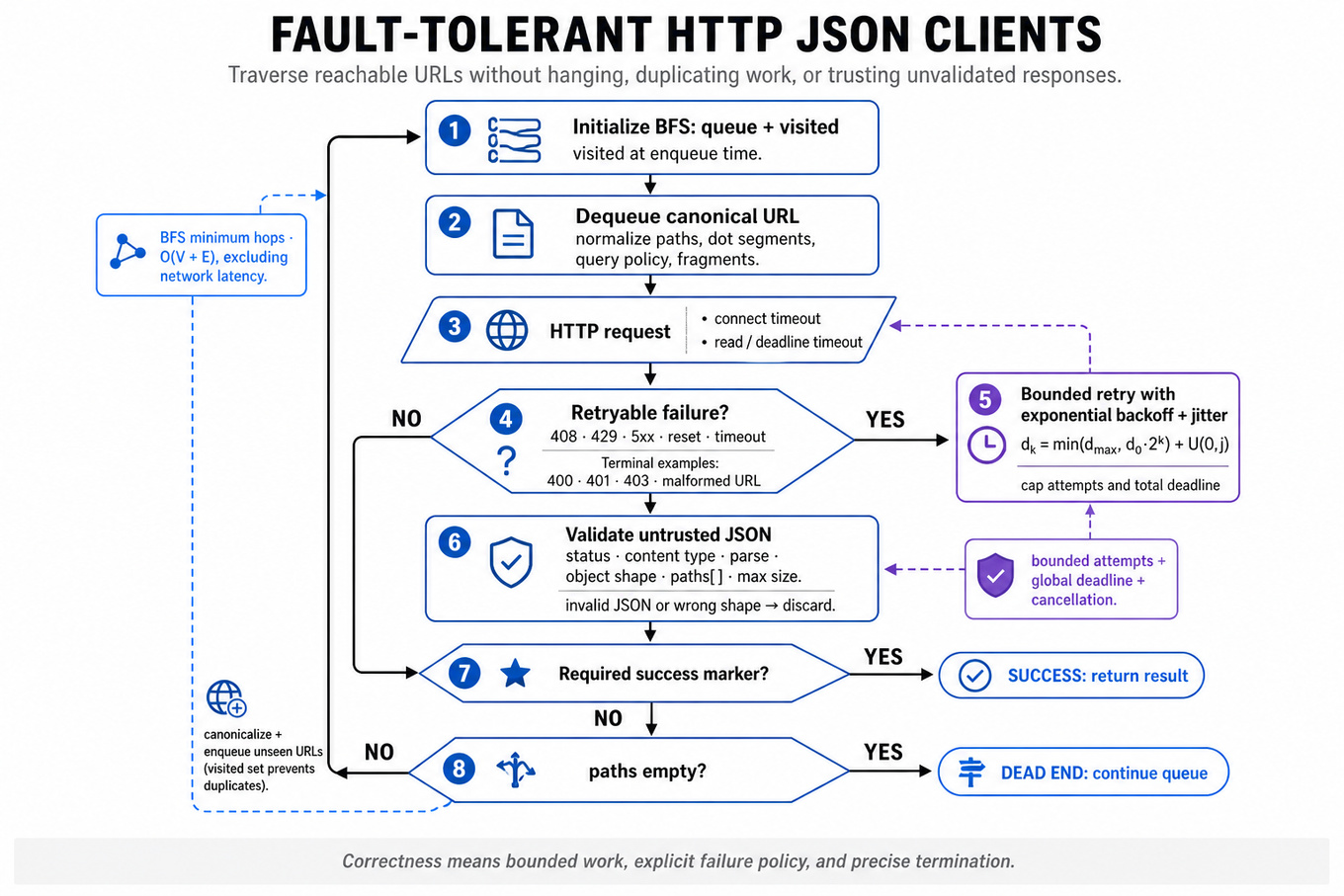
These exercises test whether you can combine graph traversal with a production-quality HTTP JSON client: discover reachable URLs, avoid cycles, parse untrusted responses, and terminate correctly. The interviewer is probing more than BFS syntax; they want explicit reasoning about retries, timeouts, authentication, malformed data, and bounded resource usage. Ramp cares because backend code frequently depends on external services, where correctness includes handling partial failure without hanging, duplicating side effects, or silently returning the wrong result.
Core knowledge
-
Graph traversal models each URL as a node and each returned path as a directed edge. Use BFS for minimum-hop discovery, DFS for lower memory; with URLs and links, traversal is excluding network latency.
-
Maintain a visited set keyed by a canonical URL, not the raw response string. Normalize relative paths with
URL, resolve dot segments, and define whether query parameter ordering, fragments, redirects, and trailing slashes represent the same node. -
A standard BFS uses a queue plus
visitedinsertion at enqueue time. Marking only when dequeuing allows duplicate queue entries and can cause explosive work; worst-case memory is , plus response and queue storage. -
Classify failures into retryable and terminal categories. Retry transient
408,429, and usually5xxresponses, transport resets, and timeouts; do not blindly retry400,401,403, malformed URLs, or invalid JSON. -
Use exponential backoff with jitter, such as . Cap attempts and total elapsed time; jitter prevents many clients from retrying simultaneously after an outage.
-
Set both a connect timeout and a read/deadline timeout. A retry loop without a global deadline can exceed the caller’s latency budget; propagate cancellation so queued and in-flight requests stop when the search is no longer useful.
-
Treat JSON as untrusted input. Check the HTTP status, content type when relevant, parse errors, object shape, field types, missing fields, and maximum response size before using a
pathsarray or success message. -
Define termination semantics precisely: a response containing the required congrats marker is success, while an empty path list is a dead end. Decide whether success is recognized only in the body, in a URL, or through a structured field.
-
Preserve authentication and request context across calls, typically with an
Authorizationheader or token parameter. Never log tokens, and distinguish an expired credential from a retriable server failure. -
Apply bounded concurrency only when the problem permits it. Parallel requests reduce wall-clock latency but require a worker limit, cancellation after success, synchronized visited-state updates, and careful handling of rate limits; sequential BFS is simpler and preserves level order.
-
Make retries safe by considering idempotency. Repeating a
GETis normally safe, but a generic client must not assume every method is harmless; mutation requests need an idempotency key or an application-specific retry policy. -
Separate the transport layer from traversal logic: one function fetches, retries, validates, and returns a typed result; another owns BFS/DFS and termination. This makes malformed JSON, timeout, and graph-cycle tests deterministic and keeps policy decisions visible.
Worked example
For “Find the Exit of an HTTP URL Maze Despite Flaky 503s and Bad JSON,” I would first clarify the success predicate, maximum maze size, URL format, authentication requirements, retry budget, and whether concurrent requests are allowed. I would state that each endpoint is a graph node, its JSON paths are outgoing edges, and malformed or terminally failed nodes are treated as unavailable rather than fatal unless the contract says otherwise. My answer would have four pillars: canonical URL normalization and deduplication, BFS traversal, a bounded HTTP fetch helper with timeout and retry policy, and strict JSON validation with explicit success detection. I would mark URLs visited when enqueuing, so cycles and repeated links cannot create duplicate work. I would use capped exponential backoff with jitter for 503, while enforcing a per-request and overall deadline. The key tradeoff is sequential BFS versus bounded parallelism: sequential traversal is easier to reason about and respects level ordering, while limited concurrency improves latency but complicates cancellation and rate limiting. I would close by saying that, with more time, I would add metrics for attempts, status classes, queue depth, and terminal failures, plus tests using a fake transport for cycles, invalid JSON, and eventual recovery.
A second angle
“Find exit URL via BFS API calls” emphasizes operational resilience around slow 500 responses and timeouts rather than only malformed payloads. The same separation applies, but I would make deadline propagation, retry classification, and cancellation first-class parts of the fetch helper. I would also ask whether the expected answer must be the shortest-hop exit, because that determines whether BFS ordering and early termination are semantically required. If requests can run concurrently, bounded workers and synchronized deduplication become central design constraints.
Common pitfalls
Pitfall: A tempting analytical mistake is to retry every non-
200response or to retry malformed JSON indefinitely. Better reasoning classifies failures by recoverability, caps attempts and elapsed time, and treats invalid application data as a bounded node failure unless the contract explicitly permits recovery.
Pitfall: A communication mistake is jumping directly into queue pseudocode without clarifying what constitutes an exit, how relative URLs are resolved, or whether duplicate query variants are equivalent. State those assumptions in the first minute; otherwise an otherwise-correct implementation may solve a different problem.
Pitfall: A depth mistake is mentioning “use exponential backoff” without specifying jitter, a maximum, and a global deadline. Conversely, designing a full circuit breaker or distributed crawler when the task is a bounded client obscures the required answer; explain the minimal robust design first, then identify production extensions.
Connections
An interviewer may pivot to circuit breakers, rate limiting, structured concurrency, or observability for distributed clients. They may also ask about Retry-After, redirect handling, idempotency keys, connection pooling, or how to test nondeterministic retry behavior with fake clocks and transports.
Further reading
-
RFC 9110: HTTP Semantics — authoritative treatment of methods, status codes, redirects, and request semantics.
-
Google SRE Book: Handling Overload — practical discussion of retries, overload amplification, and defensive client behavior.
-
AWS Architecture Blog: Exponential Backoff and Jitter — clear comparison of backoff strategies and why jitter matters.
Practice questions
Focus area — Low fundamentals plus selected observability and fault tolerance make testing, monitoring, configuration, and safe rollout trade-offs important.

What's being tested
The interviewer is testing whether you can turn a working algorithm or script into a reliable production component: bounded retries, explicit failure handling, safe concurrency, observability, and clear contracts. The maze exercises graph traversal over an unreliable HTTP boundary, while the Python job probes language-level trade-offs and operational hardening. Ramp cares because financial workflows must remain correct under partial failure: a fast implementation that duplicates work, hangs indefinitely, or silently loses data is not production-ready.
Core knowledge
-
Graph traversal must track a
visitedset keyed by stable step ID, not URL string formatting or response position. Breadth-first search usesO(V + E)time andO(V)space; depth-first search uses the same asymptotic bounds but can exhaust recursion depth. -
For an HTTP maze, separate domain outcomes from transport outcomes: an exit response is success, a dead end is a valid node with no successors,
404may be permanent failure, and503is transient only when retry policy allows it. -
Bounded retries need a maximum attempt count or elapsed deadline, exponential backoff, and jitter: commonly . Without bounds, a dependency outage becomes an indefinitely hung request.
-
Use an HTTP timeout budget with connect, read, and total deadlines; never rely on a library’s default. The total request deadline should fit inside the caller’s deadline, and retries must consume the same overall budget rather than resetting it.
-
Idempotency determines whether retrying is safe. A
GETis normally retryable when the server contract makes it read-only; a state-changing request needs an idempotency key or deduplication token to prevent duplicate effects. -
Concurrency limits protect both your process and the dependency. A semaphore or bounded worker pool caps in-flight requests; increasing concurrency can reduce latency until saturation, after which queueing, throttling, and
p99latency worsen. -
Python’s GIL limits parallel execution of Python bytecode in standard
CPython; threads are still useful for I/O-bound HTTP calls, whileasynciocan scale many concurrent waits with careful cancellation and connection-pool limits. CPU-heavy work generally needs multiprocessing or native code. -
Dynamic typing improves iteration speed but moves some failures to runtime. Use type hints,
dataclassesorpydanticmodels at boundaries, static checking withmypyorpyright, and explicit validation for untrusted JSON rather than assuming response shape. -
Structured error handling should preserve context without swallowing failures. Catch narrow exceptions, classify them as retryable or permanent, include request/node identifiers, and return or raise a meaningful terminal error after exhaustion.
-
Observability requires structured logs, counters, and latency histograms: retry count, terminal failure reason, nodes visited, duplicate-node count, timeout rate, and
p50/p95/p99latency. Never log authorization tokens, card data, or sensitive payloads. -
Resource safety means closing responses and sessions, reusing a connection pool, bounding queues, and cancelling outstanding work on shutdown. A
withblock,async with, ortry/finallyis essential when exceptions can occur between acquisition and release. -
Correctness under partial failure requires deciding what “completed” means. For a batch job, checkpoint progress only after durable success, make writes idempotent, and distinguish “not processed,” “failed and retryable,” and “failed permanently” instead of treating all errors alike.
Worked example
For “Crawl an HTTP-served maze to its exit with 503 retries, dead ends and cycles”, I would first clarify the response schema, starting-node contract, exit indicator, authorization requirements, retryable status codes, and whether there is a global request or time budget. I would state that nodes are identified by stable IDs, GET requests are read-only, and the client must terminate even if the graph is cyclic or the service remains unavailable. I would organize the solution around four pillars: graph traversal with a visited set, bounded 503 retries with exponential backoff and jitter, strict timeout and resource management, and explicit success/failure reporting. I would choose iterative BFS or DFS rather than recursive DFS, because the graph may be deep and iterative state is easier to cancel and instrument. I would flag the tradeoff that BFS can find a shallow exit sooner but may hold more frontier state, while DFS uses less frontier memory but can spend time in an unproductive branch. I would ensure authorization is propagated on every request without placing tokens in logs or URLs. I would close by saying that with more time I would add property-based tests for cycles and duplicate edges, deterministic backoff injection, and metrics for retries and visited-node counts.
A second angle
For “From Take-Home Script to Production: Python Trade-offs and Hardening a Data Job”, the central concern shifts from traversing an unknown graph to making execution repeatable, observable, and safe to rerun. I would discuss configuration validation, dependency pinning, type checking, bounded parallelism, checkpointing, and idempotent output writes rather than focusing primarily on graph state. The key tradeoff is whether threads, asyncio, or processes match the workload’s I/O-versus-CPU profile and operational complexity. I would also define behavior for malformed records, partial batches, cancellation, and restart after a host or dependency failure.
Common pitfalls
Pitfall: A tempting answer is “retry every error three times,” which conflates transient overload with permanent authorization, validation, or not-found failures. A stronger answer classifies failures by status and exception, applies retries only when safe, and enforces both attempt and deadline limits.
Pitfall: Candidates often jump directly into code or name libraries without stating assumptions about the API contract, graph identity, or completion semantics. Spend the first 30 seconds clarifying those boundaries, then present a small set of design pillars before discussing implementation details.
Pitfall: Saying “use async for performance” or “add logging and monitoring” is not enough. Explain the actual bound—maximum in-flight requests, timeout budget, retry schedule, queue size, and metrics—and identify how the design behaves during dependency failure or process restart.
Connections
An interviewer may pivot to circuit breakers, rate limiting, and backpressure when discussing repeated dependency failures. They may also ask about idempotent APIs, graceful shutdown, connection pooling, or testing with fault injection and property-based tests.
Further reading
-
Release It! — Michael Nygard’s practical treatment of timeouts, circuit breakers, bulkheads, and stability patterns.
-
Designing Data-Intensive Applications — Martin Kleppmann’s discussion of reliability, partial failure, retries, and idempotence.
-
AWS Architecture Blog: Exponential Backoff and Jitter — clear guidance on preventing synchronized retry storms.
Practice questions
System Design
Focus area — You selected distributed scheduling and system design is 1/5; Ramp pipelines need retries, backfills, ordering, and observability.
What's being tested
This topic tests whether you can design a distributed scheduler that executes dependent financial jobs reliably despite crashes, retries, duplicate messages, delayed workers, and changing workloads. The interviewer is probing your command of state machines, failure semantics, concurrency control, dependency scheduling, and operational safety—not merely whether you can enqueue tasks. Ramp cares because financial workflows require predictable completion, strong auditability, tenant isolation, and correctness when an operation is retried or partially completed.
Core knowledge
-
A scheduler should model each job as a durable state machine:
`PENDING` → `READY` → `RUNNING` → `SUCCEEDED`, with explicit`FAILED`,`RETRY_WAIT`,`CANCELLED`, and possibly`PAUSED`states. Persist transitions so a restarted scheduler can reconstruct truth. -
Represent dependencies as a DAG rather than recursively scanning all jobs. A task becomes runnable when every predecessor succeeds; maintain a remaining-dependency count and decrement it transactionally as upstream tasks complete.
-
Separate job intent from execution attempt. A logical job may have many attempts, each with an attempt ID, worker lease, start time, finish time, error, and retry number. This preserves audit history and makes retry behavior explainable.
-
Use a durable queue such as
`Kafka`,`SQS`, or a database-backed work table, but do not treat delivery as completion. Workers should acknowledge only after committing their result, and the scheduler must reconcile queued, running, and completed records. -
Distributed workers need leases with expiration timestamps and heartbeats. A worker that stops heartbeating becomes eligible for reassignment, but lease expiry can create concurrent execution; use fencing tokens or attempt generations so stale workers cannot commit afterward.
-
At-least-once delivery is usually the practical baseline. Make handlers idempotent using a stable operation key such as
`(workflow_id, logical_job_id, input_version)`, a uniqueness constraint, and transactional result recording; “exactly once” is generally an end-to-end illusion. -
Retry policy must distinguish transient from permanent failures. Use bounded exponential backoff with jitter, for example , plus a maximum attempt count and a dead-letter or manual-review state.
-
Control concurrency at multiple levels: global worker capacity, per-tenant quotas, per-workflow limits, and resource-specific locks. Fair scheduling such as weighted fair queuing prevents one large customer or backfill from starving latency-sensitive work.
-
Preserve ordering only where required. Partitioning by account, entity, or workflow can provide ordered processing, but reduces parallelism; explicitly identify the smallest ordering key that protects financial invariants.
-
Handle backpressure with bounded queues, admission control, and overload signals. Monitor queue age and runnable-job count, not only throughput; a useful freshness measure is
`now - scheduled_time`at execution start, reported by tenant and priority. -
Make scheduling decisions transactionally safe. A
`Postgres`row lock, compare-and-swap version, or atomic claim query can prevent two schedulers from claiming the same job; avoid holding database transactions open while remote work executes. -
Design for reconciliation and auditability. Store immutable transition events, actor or service identity, correlation IDs, input/output versions, and reason codes; a periodic reconciler should detect jobs stuck in
`RUNNING`, missing completions, or violated dependency counts.
Worked example
Representative prompt: “Design a Distributed Job Scheduler for Financial Pipelines.” In the first 30 seconds, clarify whether schedules are one-time or recurring, the expected job volume and latency, dependency shapes, retry tolerance, tenant isolation, and whether external side effects are reversible. Declare an assumption such as at-least-once execution with idempotent job handlers, durable state in `Postgres`, and a queue for dispatch. Organize the answer around four pillars: the workflow and execution state model, dependency-aware dispatch, lease-based worker failure recovery, and observability/reconciliation. Explain that a scheduler transaction claims a `READY` job, assigns an attempt and fencing token, and publishes work, while workers persist success or failure and heartbeat during execution. Explicitly flag the claim-versus-publish tradeoff: committing the database claim before publishing risks lost work, while publishing first risks duplicates, so use an outbox pattern or a transactional queue integration. Mention that external financial effects require an idempotency key because scheduler-level deduplication cannot prevent a timeout after the remote system accepted a request. Close by saying that with more time you would quantify capacity, define tenant fairness, and walk through a scheduler crash at every transition.
A second angle
Representative prompt: “How should the scheduler recover when workers, queues, or dependencies fail?” The framing shifts from the normal architecture to failure timelines and invariants: no permanently lost work, no stale worker committing after reassignment, and no downstream job running before required inputs are durable. Discuss lease expiry, fencing tokens, retry classification, dead-letter handling, and reconciliation scans. Also distinguish a failed prerequisite from a temporarily unavailable prerequisite, since those should produce different downstream behavior and operator actions.
Common pitfalls
Pitfall: Saying “exactly-once processing” without explaining the external side effect boundary is a common analytical mistake. A stronger answer states that delivery is at least once and uses idempotency keys, durable deduplication, and reconciliation to make the business operation effectively once.
Pitfall: Jumping directly to
`Kafka`versus`SQS`misses the design problem. First define job states, ownership, dependency readiness, retry semantics, and correctness invariants; then select infrastructure that supports those requirements.
Pitfall: Treating a worker timeout as proof that the job did not run is a depth mistake. The worker may have completed the financial operation before losing connectivity, so recovery must reconcile with the downstream system or safely repeat an idempotent request.
Connections
An interviewer may pivot to the outbox pattern, sagas, leader election, rate limiting, or event sourcing. Be prepared to compare a custom scheduler with workflow engines such as `Temporal`, `Airflow`, or `Cadence`, especially around durability, long-running timers, retries, and operational ownership.
Further reading
-
Designing Data-Intensive Applications by Martin Kleppmann — strong treatment of replication, stream processing, consistency, and distributed-system failure modes.
-
Release It! by Michael T. Nygard — practical guidance on timeouts, bulkheads, circuit breakers, and production failure handling.
-
Temporal Documentation: Durable Execution — concrete examples of durable workflows, activity retries, timers, and recovery after process failure.
Practice questions