Jane Street Software Engineer Interview Prep Guide
Everything Jane Street actually asks Software Engineer candidates — concept walkthroughs, worked examples, and the real interview questions, drawn from candidate reports. Free to read.
Last updated
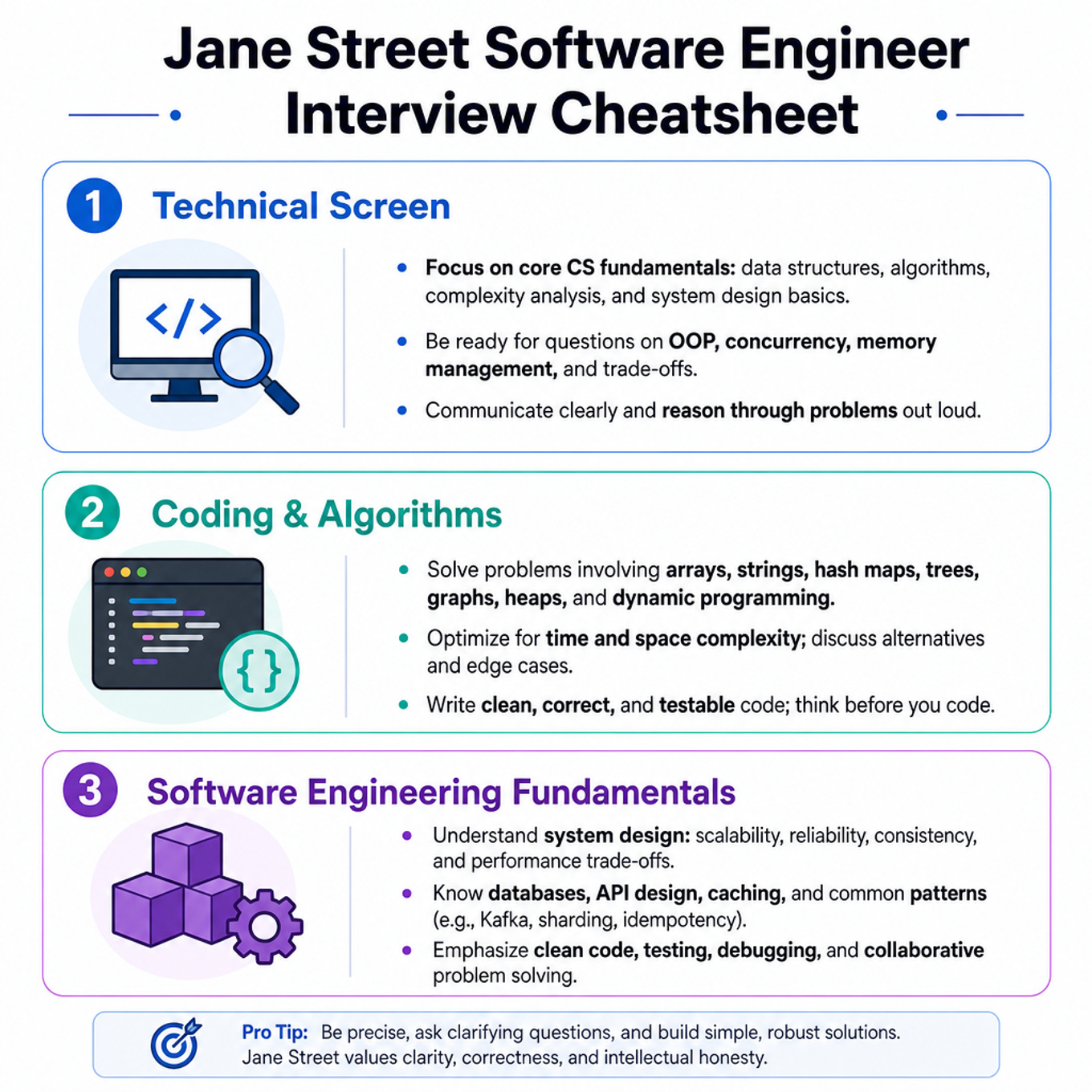
Focus most on dynamic programming, concurrency, and Jane Street-style technical-screen coding: you marked multiple DP patterns shaky, explicitly selected concurrency, and have viewed problems but logged no solved signals. Review parsing/API design, sequence transformations, game simulation, and BFS/pathfinding at a steady pace rather than from scratch because your Coding and Software Engineering Fundamentals ratings are both 3/5. The Jane Street-specific emphasis is exact arithmetic search, clean functional/OCaml-style modeling, and correctness-first reasoning over clever shortcuts. With the technical interview next week, this plan keeps the active study block around 40 minutes per pass, then relies on repeated timed practice.
Technical Screen — 39 min
Coding & Algorithms
Focus area — You selected dynamic programming and marked memoization, knapsack, interval DP, bitmask DP, and LCS shaky.
What's being tested
Dynamic programming screens test whether you can turn exponential recursive search into a polynomial-time algorithm by identifying overlapping subproblems and reusable state. The interviewer is probing your ability to define a precise state, derive a correct recurrence, choose evaluation order, and justify time and space complexity. Jane Street values this because production-quality engineering often requires making correctness, performance, and assumptions explicit rather than pattern-matching to a memorized solution.
Core knowledge
-
Optimal substructure means an optimal solution contains optimal solutions to relevant subproblems; do not assume it blindly—problems involving arbitrary path history may require augmenting the state or may not admit a simple DP.
-
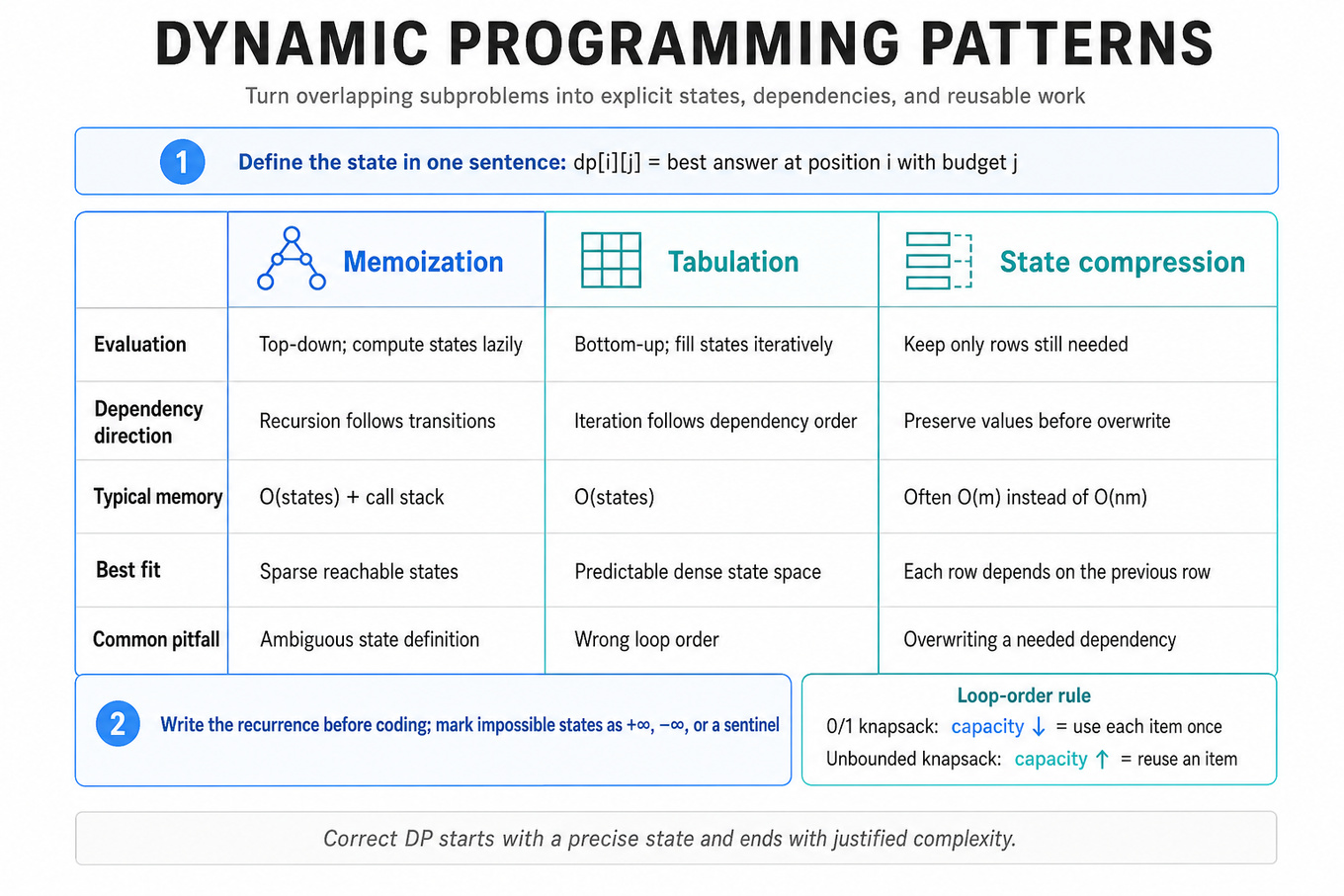
Memoization evaluates a top-down recurrence lazily, usually with recursion plus a cache; tabulation fills a bottom-up table iteratively. Both commonly achieve time.
-
Define the state in one sentence:
`dp[i]`might mean “best answer using the first`i`items,” while`dp[i][j]`might mean “best answer at position`i`with resource budget`j`.” Ambiguous state definitions cause most bugs. -
Write the recurrence before coding. A typical optimization has
while counting problems generally sum alternatives rather than minimize or maximize them. -
Identify base cases and unreachable states explicitly. Use
0for a legitimate zero count, but use`+∞`,`-∞`, or a sentinel for impossible optimization states; never let an impossible state participate as if it were valid. -
Choose iteration order from dependency direction. For 0/1 knapsack, iterate capacity downward so each item is used once; for unbounded knapsack, iterate upward when the same item may be reused.
-
State compression reduces memory when row
`i`depends only on row`i-1`, often from to . Preserve the previous value when in-place updates would overwrite a dependency needed later. -
DAG shortest path is DP in graph form: process vertices in topological order and relax incoming or outgoing edges. Cycles require a different method, such as Bellman–Ford, or an expanded state that makes transitions acyclic.
-
Distinguish path-dependent constraints from local transitions. “Cannot take adjacent elements” needs only the previous decision; “must remember the last two values” requires a larger state, and arbitrary history may require exponential state.
-
For interval DP, states often look like
`dp[l][r]`, with transitions over a split point`k`; compute by increasing interval length. Examples include matrix-chain multiplication and optimal binary search tree variants. -
For string DP, define whether indices represent prefixes or suffixes. Edit distance uses insertion, deletion, and substitution transitions; empty prefixes are essential base cases, and equal characters usually avoid a substitution cost.
-
Separate the value from reconstruction. Store parent choices, decision bits, or recompute a maximizing transition after the table is built; do not retain full solution objects in every state unless constraints make the overhead acceptable.
Worked example
Because no specific interview title was supplied, use the canonical Coin Change prompt: “Given coin denominations and a target amount, return the minimum number of coins needed.” In the first 30 seconds, clarify whether denominations are positive integers, whether each coin is reusable, what to return when the amount is unreachable, and whether the target can be zero. I would define `dp[a]` as the minimum coins required to form amount `a`, then organize the answer around state meaning, recurrence, initialization, and complexity. The recurrence is `dp[a] = 1 + min(dp[a - coin])` over coins not exceeding `a`, with `dp[0] = 0` and all other entries initialized to infinity. I would explain that bottom-up evaluation guarantees every predecessor amount is already known, giving time and space for target `A` and `K` denominations. A key tradeoff is top-down memoization versus tabulation: memoization may avoid unreachable amounts, while tabulation avoids recursion depth and is usually simpler to bound. I would test amount zero, an unreachable target, duplicate denominations, a denomination larger than the target, and a target where greedy selection fails. If I had more time, I would discuss reconstructing the actual coin sequence and whether constraints justify optimizing or validating the input.
A second angle
The same state-design discipline applies to 0/1 Knapsack, but the resource dimension changes from “amount formed” to “capacity remaining.” The crucial framing difference is that each item may be selected at most once, so a one-dimensional in-place table must iterate capacity downward. If repetition is allowed, upward iteration becomes appropriate, demonstrating that loop order encodes the problem’s combinatorial constraint. The interviewer may also ask how to reconstruct the selected items, which requires retaining decisions or using a second pass.
Common pitfalls
Pitfall: Treating a greedy choice as universally valid. Choosing the largest available coin first works for some canonical denominations but fails for arbitrary denominations; derive the recurrence or provide a proof before using greediness.
Pitfall: Giving a recurrence without defining what the indices mean. Saying “
`dp[i]`is the best answer up to`i`” is insufficient unless “up to” and the allowed choices are precise; state the invariant in plain language.
Pitfall: Quoting only the final complexity while ignoring constraints and memory. A strong answer distinguishes from space, explains whether recursion can overflow the stack, and identifies how reconstruction changes storage.
Connections
An interviewer may pivot to greedy algorithms, shortest paths, backtracking with pruning, or amortized analysis. Be ready to explain why a DP state forms a finite acyclic dependency graph and when a more specialized algorithm—such as `Dijkstra’s algorithm` or a monotonic deque optimization—improves the baseline.
Further reading
-
Introduction to Algorithms, 4th ed., Cormen et al. — rigorous treatment of optimal substructure, memoization, tabulation, and shortest paths.
-
Algorithms, 4th ed., Sedgewick and Wayne — practical visualizations and implementations of graph and optimization dynamic programs.
Practice questions
Focus area — Jane Street screens reward exact reasoning; this also reinforces memoization-like search, which overlaps your shaky DP signals.
What's being tested
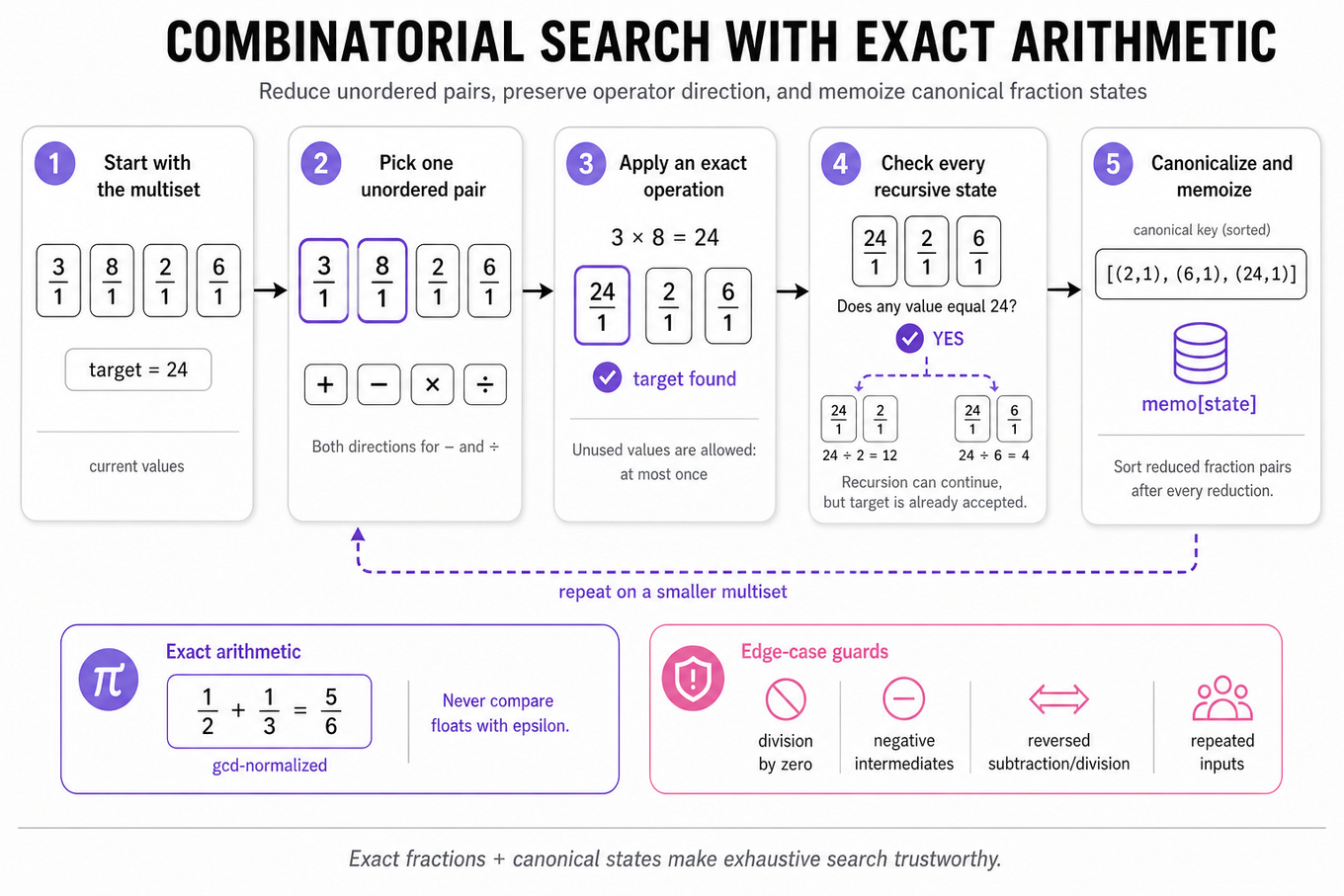
This tests combinatorial search over subsets of numbers, with recursive operator composition and parenthesization. You must control duplicate states, handle division and subtraction correctly, and use exact rational arithmetic rather than floating-point comparisons.
Patterns & templates
-
Enumerate unordered pairs of current values, apply each operator, then recurse on the reduced multiset; this naturally explores every parenthesization.
-
Represent values as reduced fractions, such as
(numerator, denominator), usinggcd; test equality with cross-multiplication or canonical pairs. -
Preserve subtraction and division direction: for values
a,b, consider botha-bandb-a, plusa/bandb/awhen denominators are nonzero. -
Memoize canonical multiset states, sorting fraction pairs after each reduction; this removes duplicate work caused by operand order and repeated inputs.
-
Decide whether numbers may be skipped: “at most once” permits unused values, so check the target at every recursive state or add a subset dimension.
-
With
nnumbers, pair-reduction search is exponential; memoization helps substantially, while unrestricted expression enumeration remains infeasible for largen. -
Guard arithmetic edge cases explicitly: division by zero, negative intermediates, zero targets, repeated numbers, and fractions that must be normalized after every operation.
Common pitfalls
Pitfall: Using
floatand checkingabs(x - target) < epsiloncan accept incorrect expressions or reject exact results.
Pitfall: Exploring only
a-banda/bmisses valid expressions because those operators are not commutative.
Pitfall: Assuming every number must be used changes “at most once” into “exactly once”; clarify this before choosing the recursion state.
Practice these
The practice cards below cover the canonical variants — solve all of them and time yourself.
Practice questions
Coding is 3/5 with no solved signals, so practice implementation details but do not over-allocate versus DP.
What's being tested
These problems test stateful simulation: representing a mutable board or grid, applying legal moves in order, and detecting termination conditions efficiently. You must choose data structures that preserve invariants, handle boundaries and dynamic growth, and support operations such as undo/redo or shortest-path search without accidentally using stale state.
Patterns & templates
-
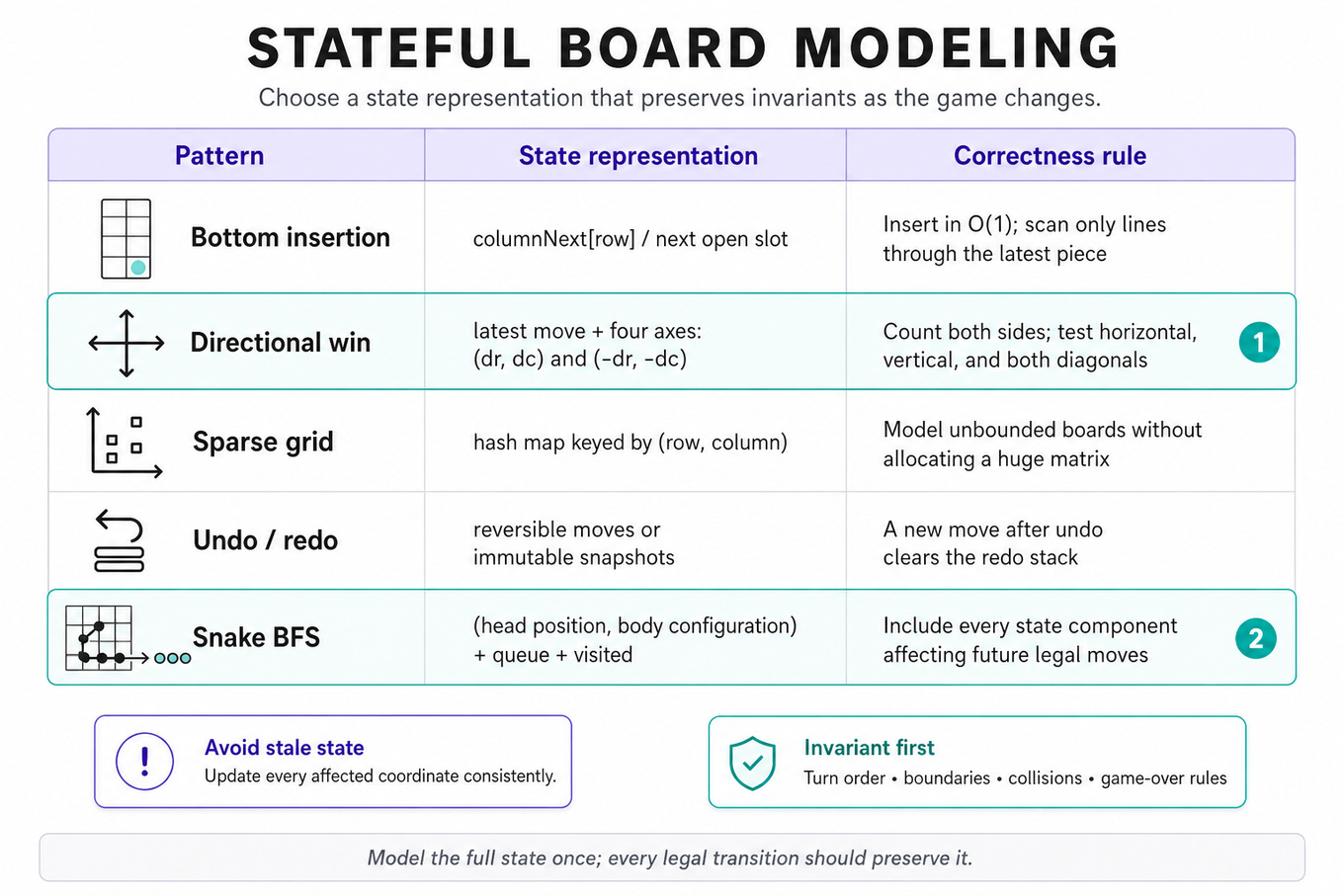
Bottom-insertion board — track each column’s next occupied position; insertion is
O(1), while win checks scan only affected lines. -
Directional win detection — from the latest move, count contiguous pieces in
(dr, dc)and(-dr, -dc); test four axes, not every cell. -
Unbounded grid modeling — use a hash map keyed by
(row, column)for sparse boards; avoid allocating an enormous dense matrix. -
Undo/redo state — store reversible moves or immutable snapshots; clear the redo stack after any new move following an undo.
-
Snake BFS — model
(head position, body configuration)as state; use a queue and visited set, rejecting walls, bodies, and illegal time transitions. -
State invariants — validate turn order, full-column moves, coordinates, collision rules, and whether a move after game-over is forbidden.
-
Complexity accounting — prefer
O(k)win detection around one move overO(rows × columns)rescanning; state space may dominate BFS memory.
Common pitfalls
Pitfall: Checking only the newly placed piece’s row or column misses diagonal wins and runs extending on both sides.
Pitfall: Treating a board shift as merely changing a column height loses piece coordinates; update or model all affected state consistently.
Pitfall: Marking Snake cells visited by position alone can prune valid paths; include every state component that changes future legal moves.
Practice these
The practice cards below cover the canonical variants — solve all of them and time yourself.
Practice questions
You have moderate coding confidence; keep BFS/state modeling fresh for technical-screen variants.
What's being tested
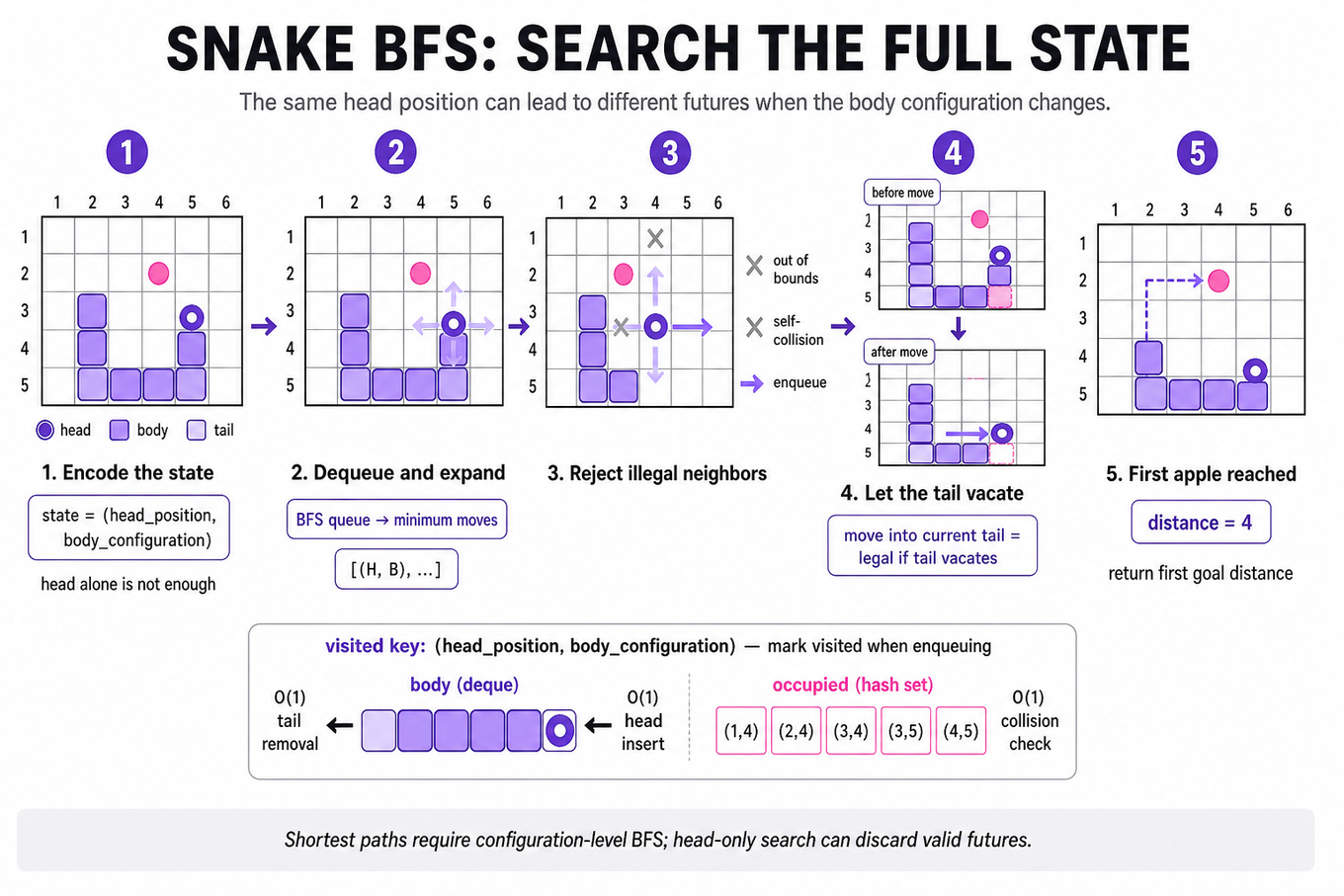
This tests state-space modeling and shortest-path search when the future depends on the entire snake configuration, not just the head position. You must encode legal moves, body collisions, wall boundaries, and dynamic tail movement precisely, then choose a correct BFS state representation with defensible time and space complexity.
Patterns & templates
-
Model each state as
(head_position, body_configuration); two states with the same head may differ because their future legal moves differ. -
Use BFS for minimum moves in an unweighted state graph; mark visited configurations when enqueuing, not when dequeuing.
-
Generate neighbors in four directions, reject out-of-bounds cells, self-collisions, and moves blocked by the body after movement.
-
Treat the tail carefully: moving into the current tail can be legal if that tail cell vacates during the same move.
-
Represent the body with a deque plus hash set for
O(1)head insertion, tail removal, and occupancy checks. -
If the full configuration space is exponential, state the bound explicitly; avoid pretending head-only BFS is correct unless body behavior is irrelevant.
-
Return the first BFS distance reaching the apple; return
-1or a specified sentinel when no legal path exists.
Common pitfalls
Pitfall: Marking only head coordinates as visited merges distinct body configurations and can incorrectly eliminate the optimal path.
Pitfall: Checking collisions against the old body without accounting for simultaneous tail removal rejects legal moves into the departing tail.
Pitfall: Using DFS or greedy Manhattan distance does not guarantee minimum moves and can loop without configuration-level visited tracking.
Practice these
The practice cards below cover the canonical variants — solve all of them and time yourself.
Practice questions
Useful for deterministic implementation questions; normal coverage fits your 3/5 coding rating.
What's being tested
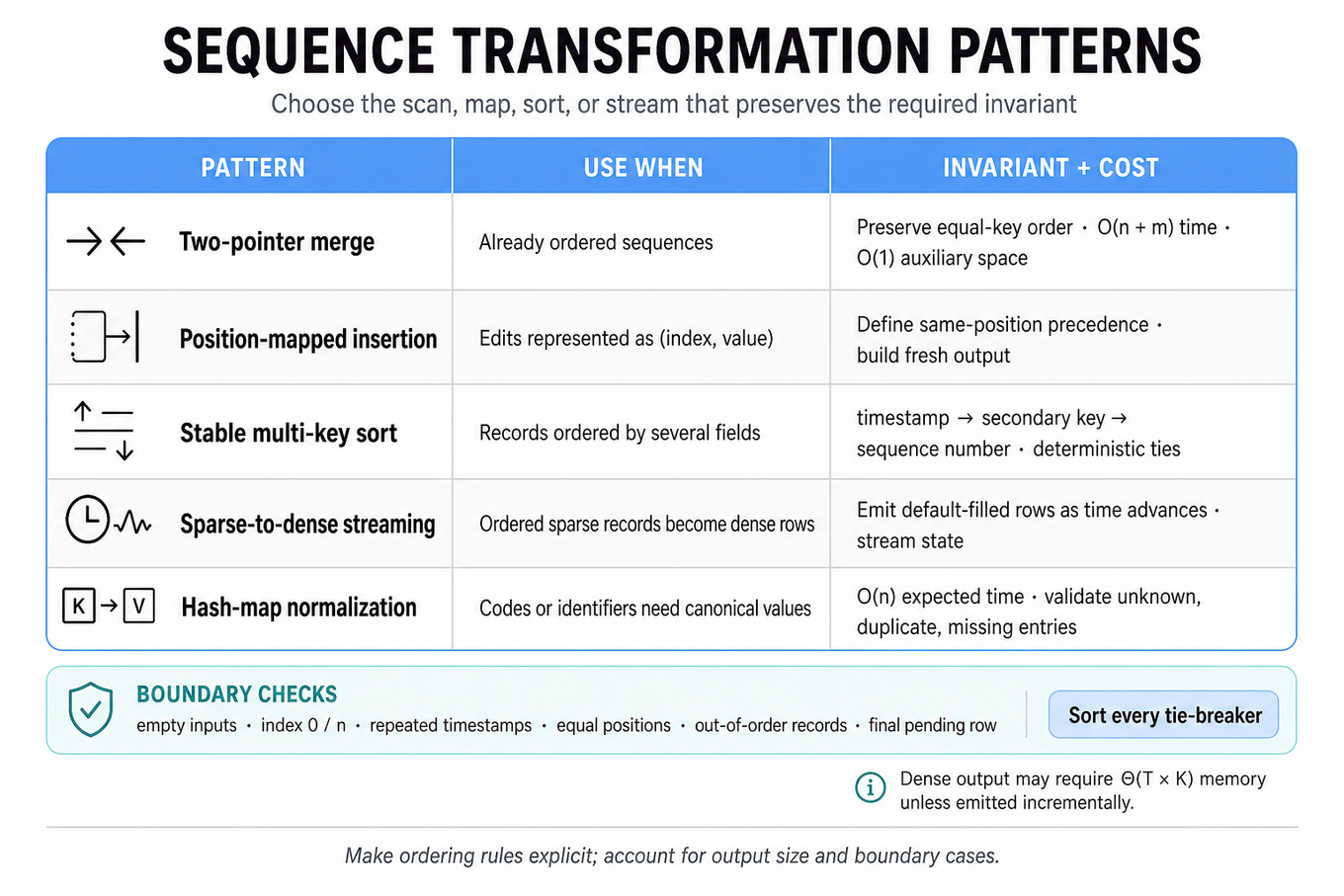
These problems test sequence transformation: merging, normalizing, and ordering records while preserving stated positional or temporal invariants. You should recognize when a two-pointer scan, stable sort, hash map, or streaming state machine gives the required complexity rather than repeatedly inserting or rescanning.
Patterns & templates
-
Two-pointer merge for already ordered sequences —
O(n + m)time andO(1)auxiliary space; preserve equal-key ordering explicitly. -
Position-mapped insertion — represent edits as
(index, value)pairs, merge by index, and define whether same-position inserts use left/right input precedence. -
Stable multi-key sorting — sort by
(timestamp, secondary_key, sequence_number); include a deterministic final tie-breaker rather than relying on incidental input order. -
Sparse-to-dense streaming — track the current timestamp and emit default-filled rows when time advances; avoid storing the entire stream when inputs are ordered.
-
Hash-map normalization — map codes or identifiers to canonical values in
O(n)expected time; validate unknown, duplicate, and missing entries. -
Output-size accounting — distinguish input space from output space; a dense result may inherently require
Θ(T × K)memory unless emitted incrementally. -
Boundary invariants — test empty inputs, insertions at
0andn, repeated timestamps, equal positions, out-of-order records, and the final pending row.
Common pitfalls
Pitfall: Sorting only by timestamp produces nondeterministic results for ties; specify every ordering key and document its precedence.
Pitfall: Mutating a sequence while iterating shifts later positions; compute output indices or build a fresh result instead.
Pitfall: Claiming
O(n)while repeatedly scanning for the next timestamp hides quadratic behavior; state assumptions about sorted input and validate them.
Practice these
The practice cards below cover the canonical variants — solve all of them and time yourself.
Practice questions
Software Engineering Fundamentals
Focus area — You explicitly selected concurrency for extra coverage and have no solved-platform signal in software fundamentals yet.
What's being tested
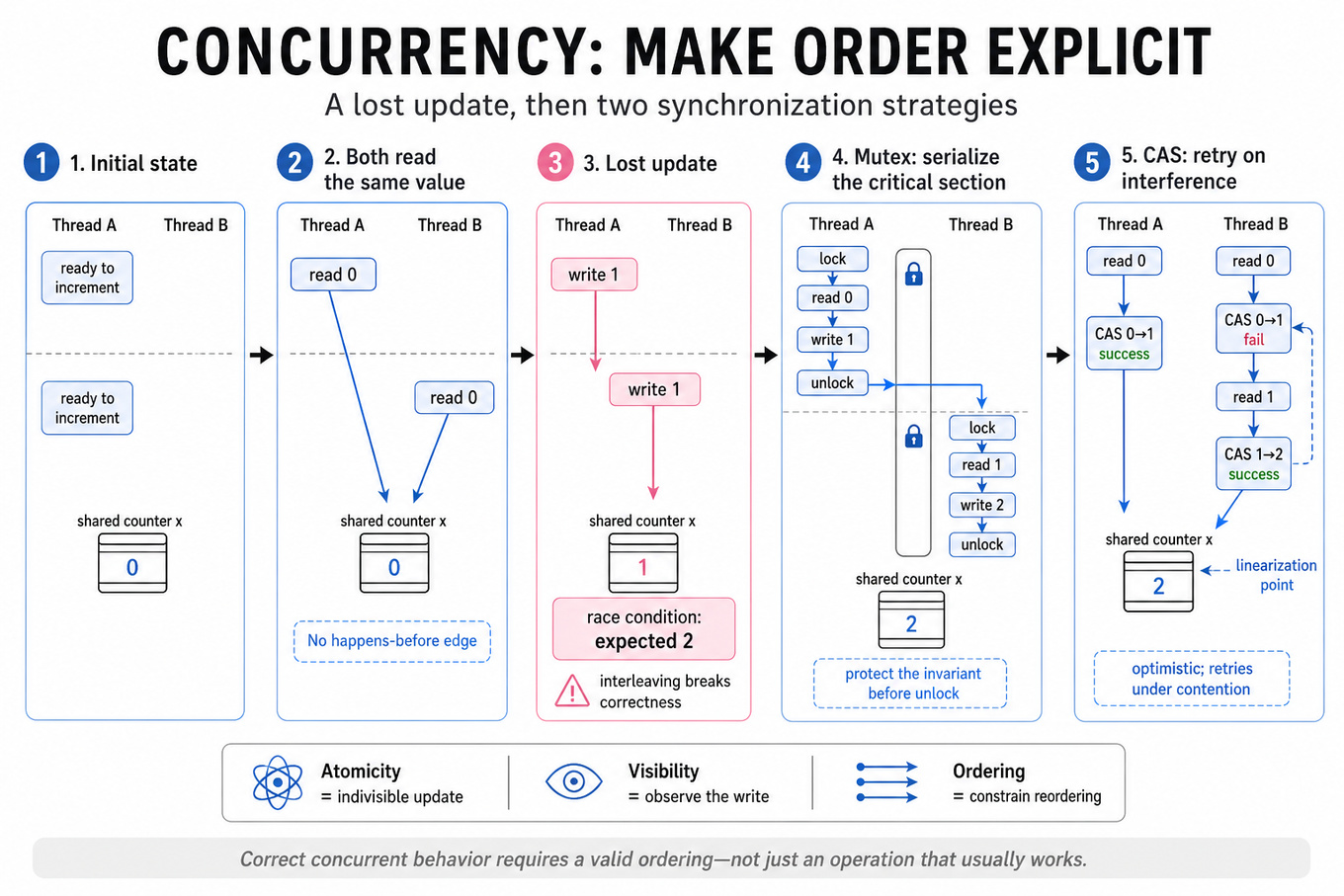
This topic tests whether you can reason precisely about shared mutable state, identify when operations interleave incorrectly, and choose synchronization proportional to the required correctness and performance. The interviewer is probing more than whether you know mutex syntax: you should be able to explain the happens-before relationship, distinguish atomicity from visibility and ordering, and construct an execution that demonstrates a bug. Jane Street cares because concurrent trading and market-data systems must remain correct under high contention while avoiding unnecessary latency, blocking, and nondeterminism.
Core knowledge
-
A data race occurs when two threads access the same memory concurrently, at least one access is a write, and there is no synchronization establishing a valid ordering. A race is a correctness bug even if tests rarely reproduce it.
-
Atomicity, visibility, and ordering are separate guarantees. An atomic increment prevents torn updates, visibility makes another thread observe a write, and ordering constrains reordering; a
volatile-style mechanism may provide visibility without makingx++atomic. -
Use a
mutexwhen a critical section protects an invariant involving multiple fields. The invariant must be restored before unlocking; locking each individual field access can still expose an inconsistent combination of values. -
A compare-and-swap (CAS) loop implements optimistic synchronization: read the old value, compute a candidate, and retry if another thread changed it. It works well for short, low-contention updates but can waste CPU under contention and must handle the ABA problem.
-
Linearizability means each operation appears to take effect at one instant between invocation and response. Identify that linearization point—for example, a successful CAS or a lock-protected map mutation—to prove concurrent behavior matches a legal sequential history.
-
A happens-before edge can arise from
mutexunlock/lock, thread start/join, message passing, or a language-level atomic operation. Without such an edge, observing a write is not guaranteed, even when the hardware “usually works.” -
Deadlock requires mutual exclusion, hold-and-wait, no preemption, and circular wait. Prevent it with a global lock-ordering rule, smaller critical sections,
try_lockwith rollback, or ownership designs that avoid nested locks. -
Condition variables coordinate state transitions, not events. Always wait in a loop—
while (!predicate) wait(cv, lock)—because wakeups can be spurious and another thread may consume the condition before the waiter reacquires the lock. -
Lock-free means system-wide progress: some operation completes in a bounded number of steps, not that every thread completes. Wait-free guarantees per-thread progress and is stronger; both introduce memory-reclamation complexity for removed nodes.
-
False sharing occurs when independent variables occupy the same cache line and different cores repeatedly write them. Padding or per-thread counters can reduce cache-coherence traffic, but measure before adding memory overhead or complicating aggregation.
-
Prefer message passing, immutable snapshots, or ownership transfer when possible. A single-owner event loop can eliminate many races, while a read-copy-update or copy-on-write design can make reads cheap at the cost of allocation and update latency.
-
Testing must include adversarial schedules, not just repeated normal runs. Use thread sanitizers, deterministic schedulers, stress tests with barriers, and model-based checks; a test that “passed 10,000 times” does not establish correctness.
Worked example
Representative problem: Design a thread-safe shared counter. In the first 30 seconds, clarify whether increments and reads must be linearizable, whether the counter can overflow, the expected read/write ratio, and whether approximate results are acceptable. I would organize the answer around the correctness contract, synchronization strategy, contention profile, and testing plan. For exact semantics, a mutex around the counter is the simplest proof: the increment’s linearization point is its update while holding the lock. If contention is low and the operation is only a single integer update, an atomic fetch-add may reduce blocking, but I would explicitly discuss memory ordering and whether the API needs a consistent snapshot alongside other fields. For high-frequency per-thread updates where temporary approximation is acceptable, thread-local counters periodically aggregated by a reader may outperform one globally contended cache line. I would call out overflow and shutdown behavior rather than silently relying on language-specific wraparound. I would close by saying that, with more time, I would benchmark mutex, atomic, and sharded implementations under realistic contention and run a race detector plus linearizability-oriented tests.
A second angle
The same reasoning applies to a shared in-memory order book, but the invariant is more complex than a counter: quantities, prices, and indexes must agree. A lock per price level may improve parallelism, yet operations crossing multiple levels require a lock-order rule or a higher-level serialization mechanism. If readers need a coherent view while writers update frequently, immutable snapshots or a single-writer design may be safer than independently locking every structure. The key question becomes not “which primitive is fastest?” but “what consistency boundary must one observation satisfy?”
Common pitfalls
Pitfall: Saying “the increment is one instruction, so it is safe” confuses instruction-level behavior with a read-modify-write race. Two threads can both read the same value and each publish the same successor, losing an update.
A candidate may recommend volatile or an atomic variable without stating the required semantics. A stronger answer explains whether the operation needs atomic read-modify-write, release/acquire publication, sequential consistency, or merely eventual aggregation.
Pitfall: Treating “use a lock” as a complete design misses deadlock, lock scope, starvation, and contention. Name the protected invariant, lock ownership, lock ordering, and what work must remain outside the critical section.
Over-focusing on lock-free algorithms is another depth mistake. CAS, hazard pointers, epochs, and ABA mitigation are valuable only when measurement shows a mutex or ownership-based design is inadequate; correctness and a clear proof come first.
Connections
An interviewer may pivot to distributed consistency, where process-local mutexes no longer protect shared state, or to transactional memory and database isolation levels. Be ready for memory reclamation, backpressure, actor/message-passing architectures, and performance topics such as cache coherence and tail latency.
Further reading
-
The Art of Multiprocessor Programming — rigorous treatment of linearizability, lock-free algorithms, and concurrent objects.
-
C++ Concurrency in Action — practical explanation of memory ordering, atomics,
mutexes, and condition variables. -
Java Memory Model and Thread Specification — a precise reference for visibility, synchronization, and happens-before reasoning.
Practice questions
Focus area — This is Jane Street-specific; emphasize immutable modeling, recursion, and type-driven clarity before next week’s technical interview.
What's being tested
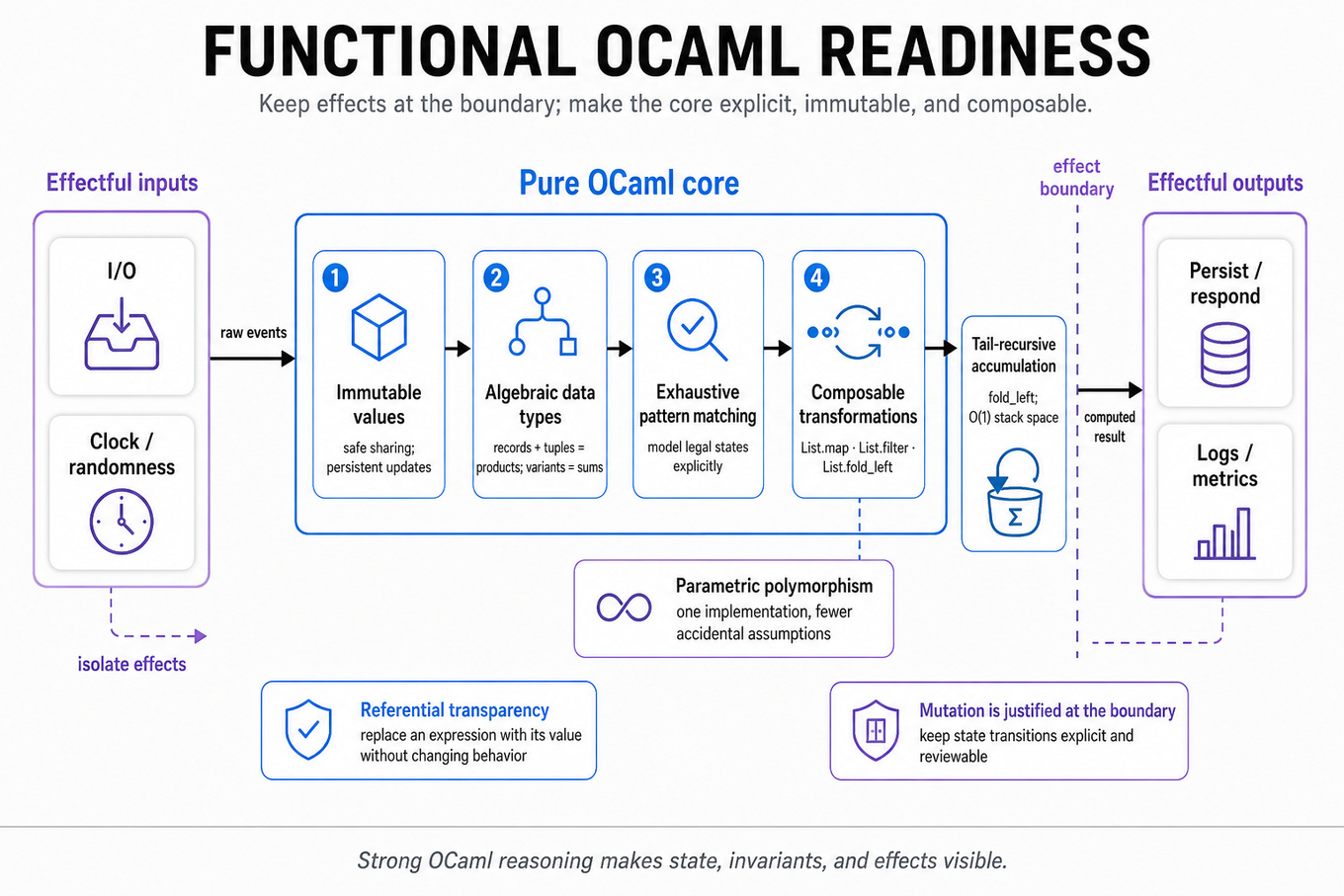
This topic tests whether you can reason about immutable data, higher-order functions, algebraic data types, and pattern matching rather than treating OCaml as syntax memorization. A strong Software Engineer can decompose a problem into small, composable transformations, state invariants clearly, and explain when purity improves correctness or when mutation is justified. Jane Street cares because production code benefits from explicit state transitions, strong compile-time guarantees, predictable performance, and abstractions that remain understandable during debugging and review.
Core knowledge
-
Referential transparency means an expression can be replaced by its value without changing program behavior. Pure functions simplify testing, caching, parallelization, and reasoning; isolate unavoidable effects such as I/O, clocks, randomness, and mutation at system boundaries.
-
Immutability makes sharing safe: multiple callers can hold the same value without coordination. Persistent data structures may allocate updated paths rather than copy everything, typically giving structural sharing and logarithmic updates instead of copying.
-
Algebraic data types combine product types and sum types. In OCaml, records and tuples represent products, while variants represent sums; use them to model legal states explicitly rather than encoding state with nullable fields or undocumented integer tags.
-
Pattern matching should be exhaustive and ordered from specific to general. The compiler’s warning for a missing constructor is valuable; avoid catch-all patterns when they could silently hide a newly added variant and create a correctness bug.
-
Parametric polymorphism lets one implementation work uniformly across types, such as
`List.map` : ('a -> 'b) -> 'a list -> 'b list. Type variables constrain what code can do, often preventing accidental assumptions without runtime type checks. -
Higher-order functions such as
`List.map`,`List.filter`,`List.fold_left`, and`List.fold_right`express reusable traversal structure. Choose`fold_left`for strict accumulation and usually constant stack space; naïve`fold_right`can overflow on large lists. -
Tail recursion requires the recursive call to be the final operation. An accumulator converts many recursive algorithms from stack usage to stack usage; confirm that the compiler can optimize the intended recursive shape rather than assuming it.
-
Option and result types make absence and failure explicit:
`option`represents “a value may not exist,” while`('a, 'e) result`represents success or a typed error. Do not use exceptions for ordinary control flow when callers should handle failure locally. -
Modules and functors provide abstraction boundaries and compile-time dependency injection. A module signature can hide representation invariants, while a functor parameterizes an implementation over a module such as an ordering, hash, or storage policy.
-
Evaluation order and effects matter even in a mostly functional language. Pure expressions can be freely rearranged, but mutation, exceptions, I/O, and lazy computations introduce sequencing requirements; make those dependencies visible in types or APIs.
-
Performance tradeoffs are concrete: lists provide head access but indexing, arrays provide indexing but mutation or copying concerns, and maps offer logarithmic lookup with allocation. Discuss allocation rate, garbage-collector pressure, and asymptotic behavior together.
-
Type-driven design starts by writing the data model and function signatures before implementation. A compiler-guided workflow—define variants, implement one match at a time, compile frequently, then test edge cases—turns many integration errors into local compile errors.
Worked example
No interview-question title was supplied for this concept, so use the representative prompt: “Design a typed expression evaluator in OCaml.” In the first 30 seconds, clarify the expression grammar, whether variables are resolved from an environment, how division-by-zero and missing variables are reported, and whether evaluation must preserve source locations. I would organize the answer around a recursive variant type, an environment abstraction, a total evaluator returning `result`, and tests for each constructor and failure path. A plausible model is `Int of int | Add of expr * expr | Var of string`, with evaluation recursively producing `('a, 'e) result` rather than raising exceptions for expected errors. I would make the environment an abstract module or a function from names to values, depending on whether lookup performance and representation hiding matter. The explicit tradeoff is between a simple association list with lookup and a balanced map with lookup plus more allocation and module complexity. I would state that pattern matching must be exhaustive so adding `Mul` later forces the evaluator and tests to be updated. If I had more time, I would add source spans, property-based tests for arithmetic identities, and benchmarks comparing environment representations.
A second angle
A different representative prompt is: “Implement a generic grouping function over a list.” The same principles apply, but the emphasis shifts from recursive domain modeling to polymorphism, accumulator invariants, and complexity. Clarify whether output order matters, whether keys preserve insertion order, and whether duplicate values are allowed. A list-based implementation may be simplest but can become if every insertion scans existing groups; a map-based implementation can reduce expected or worst-case lookup costs depending on the structure. The key transferable skill is explaining how types, invariants, and data-structure choice jointly determine correctness and performance.
Common pitfalls
Pitfall: Saying “functional means no mutation” is too absolute. A stronger answer distinguishes pure interfaces from localized mutation, noting that arrays, hash tables, and imperative loops can be appropriate when profiling shows allocation or traversal costs dominate.
Pitfall: Treating
`option`and`result`as interchangeable misses their semantics.`option`communicates absence without details;`result`carries a typed error and supports meaningful recovery, propagation, and diagnostics.
Pitfall: Reciting OCaml syntax without discussing invariants, complexity, or edge cases signals shallow preparation. Explain what each pattern guarantees, how large inputs behave, and what the compiler will catch versus what tests must catch.
Connections
Expect pivots to persistent data structures, module signatures and functors, type inference, exception safety, and property-based testing. The interviewer may also connect immutability to concurrency, garbage-collector behavior, or designing APIs that make invalid states unrepresentable.
Further reading
-
Real World OCaml, 2nd Edition — practical coverage of modules, error handling, performance, and production OCaml style.
-
OCaml Programming: Correct + Efficient + Beautiful — rigorous treatment of types, recursion, modules, data structures, and functional design.
-
Types and Programming Languages, Benjamin C. Pierce — deeper foundations for type systems and typed language design.
Practice questions
Software fundamentals are 3/5, so review parser structure and error handling without starting from zero.
What's being tested
These problems test recursive descent parsing, operator-precedence evaluation, and stack-machine interpretation over structured input. You must translate tokens or instructions into well-defined execution steps while preserving operand order, associativity, runtime types, and exact arithmetic. Strong solutions separate parsing, representation, and evaluation so each layer is testable and extensible.
Patterns & templates
-
Recursive descent: use functions such as
parse_expression,parse_term, andparse_factor; encode precedence directly in the call graph. -
Shunting-yard algorithm: maintain an operator stack and output queue; process precedence and associativity in
O(n)time and space. -
Stack-machine execution: pop the right operand first, then the left; compute
left op right, especially for subtraction and division. -
Typed runtime values: represent integers and strings distinctly, using tagged unions or classes; define mixed-type operations explicitly rather than coercing accidentally.
-
Exact arithmetic: use integer arithmetic or reduced rational pairs
(numerator, denominator); avoid floating-point equality and rounding errors. -
Backtracking search: for “use each number once,” recurse over unused indices and operator choices; memoize canonical states when repeated subproblems exist.
-
AST representation: parse into an abstract syntax tree before evaluation when validation, debugging, multiple passes, or future operators matter; construction costs
O(n).
Common pitfalls
Pitfall: Applying operators immediately from left to right ignores precedence and associativity; distinguish
2 + 3 * 4from(2 + 3) * 4.
Pitfall: Popping operands in the wrong order silently breaks noncommutative operators; document stack invariants and test subtraction, division, and malformed input.
Pitfall: Treating strings and integers uniformly causes invalid concatenation, comparison, or output behavior; define runtime type rules before implementing
ADD.
You viewed fundamentals content but have no solved signal; keep interfaces, tests, and errors in the plan.
What's being tested
These problems test API design: turning mutable state and operations into a small, predictable interface with clear invariants, error semantics, and extension points. They also probe modularization—separating parsing, domain logic, storage, and presentation so each component can be tested independently. Jane Street cares because production code is composed, reviewed, reused, and depended on by other engineers; a locally clever implementation is not enough if its contract is ambiguous or its failures are difficult to diagnose.
Core knowledge
-
Define the contract before implementation: specify inputs, outputs, state transitions, ownership, mutation, ordering, complexity, and failure behavior. A useful API makes invalid states difficult to represent rather than relying on every caller to remember hidden rules.
-
Separate layers by responsibility: keep parsing and validation at the boundary, domain logic in a pure or mostly pure core, and I/O or framework adapters outside it. This makes an interpreter, game engine, or reusable library testable without sockets, files, or global state.
-
Design around invariants: for a board, every occupied cell must contain one valid player and gravity must hold; for a stack machine, operands must be consumed in the specified order. Check invariants after mutations during development, then decide which checks remain in production.
-
Choose representations that expose required operations: a
Connect Fourcolumn-height array givesO(1)placement and a flat board gives predictable indexing; a stack machine needs explicit operand order. Avoid abstractions whose convenience hides a costly scan or invalid state. -
Make errors part of the API: distinguish programmer misuse, invalid user input, unavailable resources, and internal bugs. Use typed exceptions or result values consistently; include operation, relevant identifiers, and recovery guidance without leaking secrets or implementation details.
-
Prefer explicit state transitions and ownership: methods such as
play,undo, andredoshould document whether they mutate in place, return a new value, or invalidate prior handles. Define whether snapshots are deep copies, persistent structures, or views. -
Use composition over entangled conditionals: isolate
Parser,Instruction,Machine, andEnvironmentrather than making one function interpret text, mutate storage, and format errors. Interfaces should represent stable capabilities, not every implementation detail. -
Treat undo/redo as a history model: a standard design keeps a past stack and future stack; a new successful mutation clears future history, while undo moves one state from past to future. Failed operations must not alter either stack.
-
Specify compatibility and evolution: preserve behavior for existing callers, add optional fields with safe defaults, and avoid changing exception types or positional meanings casually. For public APIs, use semantic versioning, deprecation periods, and contract tests across versions.
-
Test behavior at multiple boundaries: unit-test pure transition functions, property-test invariants, and integration-test the public API. Cover empty state, full capacity, malformed input, repeated undo/redo, integer overflow, unknown identifiers, and failure atomicity.
-
Document complexity and thread assumptions: state whether operations are
O(1),O(rows × columns), or proportional to history size, and whether concurrent calls are safe. If synchronization is absent, say so rather than implying that a library is thread-safe.
Worked example — Implement Connect Four with bottom push-up
For “Implement Connect Four with bottom push-up,” a strong candidate first clarifies board dimensions, player representation, whether a move means dropping or pushing from the bottom, win directions, draw behavior, and the exact undo/redo contract. They would state the invariants and organize the solution around board representation, legal move application, win detection, and history management. A compact representation might store each column as a sequence and maintain heights, while a rectangular grid makes directional win checks easier to explain and extend. The public API could expose play(column, player), winner(), undo(), redo(), and a read-only board snapshot, while keeping mutation private to the game object. Win detection should check horizontal, vertical, and both diagonal directions from the newly changed cell rather than rescanning every line after every move. The explicit tradeoff is between a simple full-board scan, roughly per move, and localized checks, roughly in the worst direction but typically constant for fixed win length. They would also explain that an invalid move must leave the board and history unchanged. If they had more time, they would add property-based tests for gravity, reversible moves, and sequences where a new move invalidates the redo branch.
A second angle
For “Turning Interview Code into a Reusable Library or API,” the same discipline shifts from game-state correctness to consumer-facing stability. The candidate should identify the minimal public surface, move implementation details behind private modules, and provide typed inputs, outputs, documentation, and examples. They should discuss packaging, dependency boundaries, semantic versioning, and whether errors are exceptions or explicit result objects. A key difference is that compatibility with unknown callers matters more than optimizing one known execution path.
Common pitfalls
Pitfall: Treating error handling as a collection of ad hoc
try/catchblocks is tempting, but it produces inconsistent contracts and partial mutations. Instead, classify failures, define atomicity, and ensure every public operation either completes its documented transition or leaves state unchanged.
Pitfall: Jumping directly into classes and code without clarifying semantics makes a reasonable design look accidental. State assumptions first, name the invariants, and explain why each public method exists; interviewers can then evaluate the design rather than infer its intent.
Pitfall: Saying “use interfaces and unit tests” without identifying boundaries is too shallow. Name the modules, their dependencies, representative edge cases, complexity, versioning behavior, and one concrete tradeoff such as snapshots versus command-based history.
Connections
An interviewer may pivot to design by contract, property-based testing, immutability and persistent data structures, or semantic versioning. They may also ask how the same API behaves under concurrency, serialization, or a network boundary where retries and idempotency become relevant.
Further reading
-
RFC 9457: Problem Details for HTTP APIs — a concrete standard for structured, machine-readable API errors.
-
Designing Data-Intensive Applications, Martin Kleppmann — strong treatment of abstractions, failure modes, consistency, and distributed API tradeoffs.
-
API Design Patterns, JJ Geewax — practical guidance on resource modeling, compatibility, pagination, errors, and evolving public interfaces.
Practice questions