AMD Software Engineering Intern Interview 2027: C++, Computer Architecture, and GPU Systems
Quick Overview
AMD’s 2027 software and graphics postings guide role-specific preparation; historical intern reports and original GPU exercises clarify coding, architecture, and measurement.
Preparing for an AMD software engineering intern interview in 2027 starts with identifying the team behind the posting. AMD has published 2027 software and graphics internship opportunities, but the verified descriptions cover multiple positions. C++ fundamentals matter; a GPU-heavy interview is not established for every software applicant.
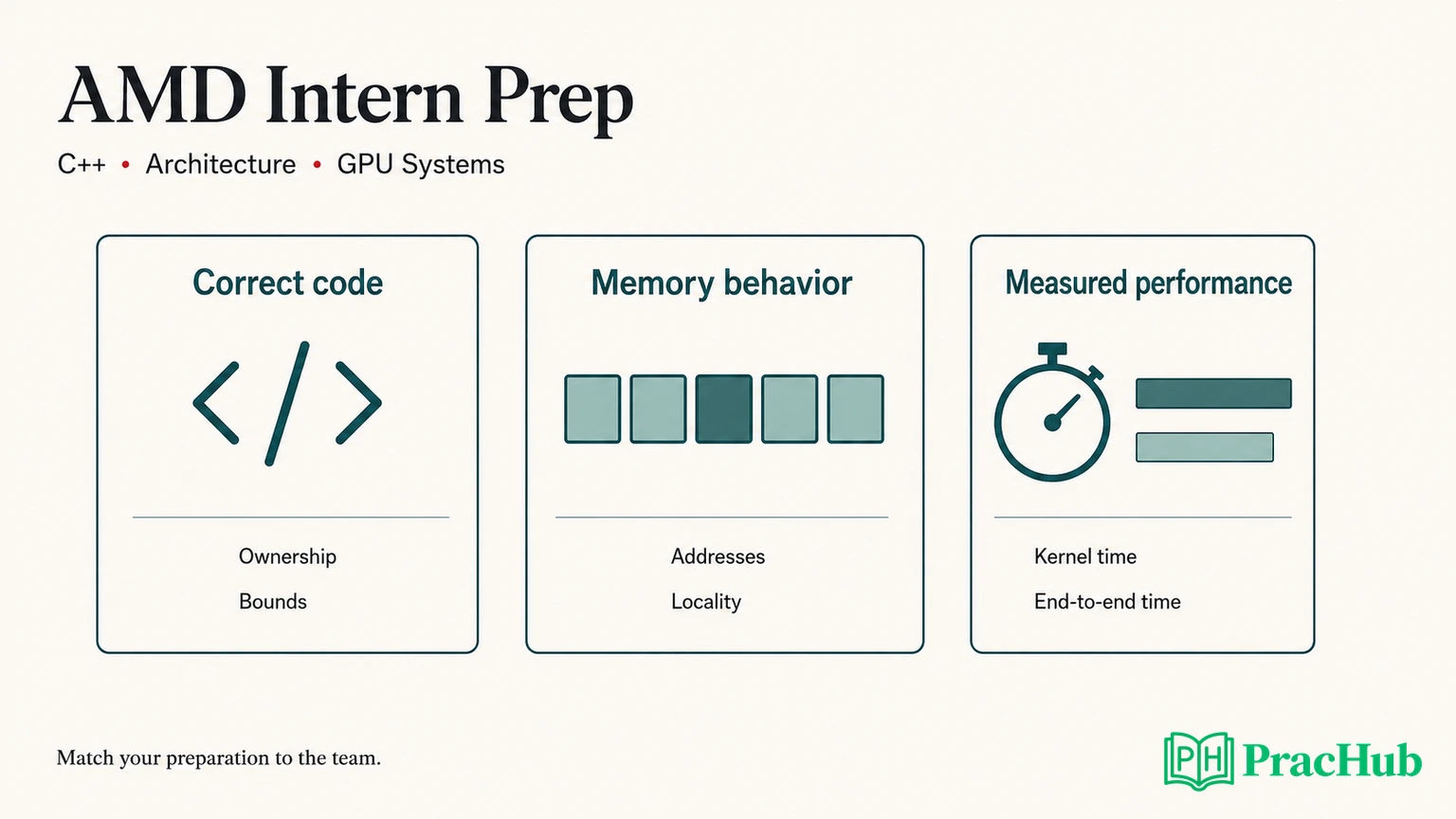
The useful preparation sequence is to explain correct code, connect it to memory and execution behavior, then defend a measurement. This article separates current official role facts from historical candidate reports and original practice exercises. It does not promise a fixed online assessment, round count, or offer timeline.
Start with PracHub’s Explain Virtual Memory, MMUs, and TLBs to practice tracing a memory access. It is a cross-company exercise, not an AMD interview prediction.
What is confirmed for AMD’s 2027 internships?
Official facts, checked September 7, 2026: AMD’s Short Term 2027 Software Engineering Intern/Co-Op, requisition 91368, is based in Markham, Canada. It specifies enrollment in a Canada-based university bachelor’s program in computer engineering, electrical engineering, computer science, or a related discipline.
The 2027 Graphics Software Engineering posting, requisition 91359, also requires a Canada-based university bachelor’s program, with computer engineering, software engineering, software development, computer science, or related fields listed. Both describe full-time, 37.5-hour weeks in an onsite or hybrid arrangement.
Both postings show these work periods:
| Term | Four-month option | Eight-month option |
|---|---|---|
| Winter 2027 | January 11–April 23, 2027 | January 11–August 20, 2027 |
| Summer 2027 | May 3–August 20, 2027 | May 3–December 10, 2027 |
These are employment dates, not application deadlines. The reviewed postings do not establish a closing date, response guarantee, or interview schedule. Their eligibility also should not be generalized to AMD opportunities in other countries. Check your exact requisition before committing to a semester away from university.
Choose the software layer before choosing a syllabus
Official role distinction: requisition 91368 describes software development, automation, and debugging. Its skill examples span C/C++, scripting, operating systems, and application technologies. That breadth is a reason to establish the team’s work before assuming the interview centers on kernels.
Requisition 91359 explicitly describes opportunities across application, kernel, graphics, and AI development, including collaboration across user space, kernel, firmware, and hardware. Its examples include C/C++, object-oriented design, memory management, multithreading, graphics APIs, and architecture. AMD presents these as skills relevant to different opportunities, not a requirement to master the entire list.
Preparation inference: for graphics work, rehearse how an application, API, driver, and GPU cooperate. For compute work, prioritize data layout, kernel correctness, and profiling. For a general software team, strengthen implementation, testing, and project reasoning before investing most of your time in GPU-specific optimization.
When a recruiter contacts you, ask which product or software layer the team owns, whether coding is live, and which language you should use. A broad application can lead to a narrower conversation; preparation should become more specific when that information arrives.
What historical intern reports actually support
Candidate-reported evidence: a San Jose Software Engineer Intern account posted on February 28, 2026 describes conversations with three team members, C++ and STL questions, a bipartite-graph exercise, and behavioral discussion. The visible account does not give a separate interview date, so its posting date is not proof of the recruiting cycle. Glassdoor’s AMD intern reports
A different account, posted January 31, 2026, explicitly describes an October 2025 interview: a recruiter conversation followed by two thirty-minute interviews, mainly technical. These accounts differ in structure. Neither confirms a universal 2027 process or a required assessment platform.
The practical signal is to prepare both ordinary coding and a technical discussion of your experience. For the graph example, explain two-coloring with breadth-first search, restart from every unvisited component, and reject an edge joining equal colors. Under an undirected-graph assumption, a self-loop must fail too. This is reasoning practice based on a historical topic, not a claim that AMD will reuse the question.
Two independent same-cycle 2027 reports were not found in this research. Your invitation remains the source for timing, format, permitted tools, and the scope of the upcoming interview.
C++ answers should connect ownership to observable behavior
A useful original practice prompt is: “A function returns a view of data for another component to process later. Who owns the storage, and how long is the view valid?” Start with the lifetime contract before discussing performance.
For a std::vector, explain why an operation that reallocates storage invalidates pointers into its old allocation. A reference to an element does not extend that element’s lifetime. Using reserve may prevent particular reallocations within the reserved capacity, but it does not make erasure, destruction, or unsynchronized concurrent mutation safe. The C++ standard draft’s vector capacity rules distinguish capacity from size and specify reallocation behavior.
Now connect the answer to GPU work. If a submitted operation consumes memory later, “the function returned” is not evidence that the device finished using it. State the completion condition before allowing a buffer to be reused. Host ownership and device execution order are related design concerns, but they are not interchangeable guarantees.
For an STL discussion, be ready to justify a container using access patterns, mutation, and invalidation requirements. Avoid saying a structure is faster without naming a workload. An interviewer can learn more from your explanation of one invalid pointer than from a list of C++ features you have memorized.
Architecture exercise: calculate the addresses first
Original practice example: imagine a tightly packed, row-major 4×4 array with four-byte elements. Element (row, column) begins at byte offset 4 × (row × 4 + column). Assume valid indices and no padding.
Four neighboring workers reading row zero access offsets 0, 4, 8, 12. Four workers reading column zero access 0, 16, 32, 48. Both groups read four values; the spacing differs. If you cannot write these addresses down, terms such as “coalesced access” can hide a missing mental model.
In GPU programming, coalescing means combining suitable memory accesses from neighboring lanes into fewer memory transactions. The actual transactions depend on alignment, access width, the active lanes, and the target architecture. Four illustrative workers are not a full hardware wavefront, and this example does not prove a particular transaction count or speedup. AMD HIP performance guidelines
The follow-up is more valuable than the arithmetic: suppose a transpose makes input reads contiguous but output writes strided. Explain which addresses each lane reads and writes. A tile staged in shared memory can reorganize access, but introduces synchronization, storage usage, and possible bank-conflict concerns. You must also handle matrix edges that do not fill a tile.
On the CPU side, distinguish a translation problem from a cache problem. A TLB miss concerns address translation; it does not automatically imply a page fault or an absent cache line. Name the layer you would inspect before proposing larger pages or a different layout.
GPU systems preparation needs AMD-specific portability awareness
Official technical guidance: AMD’s HIP porting guide warns against assuming a warp size of either 32 or 64 across targets. HIP exposes CUDA-like programming concepts, but translating API names is not a complete portability review.
A wavefront, called a warp in HIP terminology, groups threads for execution. Threads belong to blocks, and blocks form a grid. This hierarchy matters because cooperation and synchronization have defined scopes; a block barrier does not become a grid-wide barrier simply because the algorithm would benefit from one. HIP programming model
Original follow-up: you inherit a reduction that stores participating lanes in a 32-bit mask. Before porting it, inspect the target’s lane count, mask type, shuffle assumptions, partial groups, and synchronization requirements. Test values around group boundaries. Do not “fix” the program by replacing every 32 with 64; different targets and operations need explicit contracts.
You should also be able to explain why more parallelism is not automatically faster. Register or shared-memory demands can restrict how much work is resident. A change that increases occupancy may still lose through extra instructions or memory traffic. Treat the profiler as evidence for a hypothesis, not as a collection of scores to maximize.
Performance exercise: separate kernel time from application time
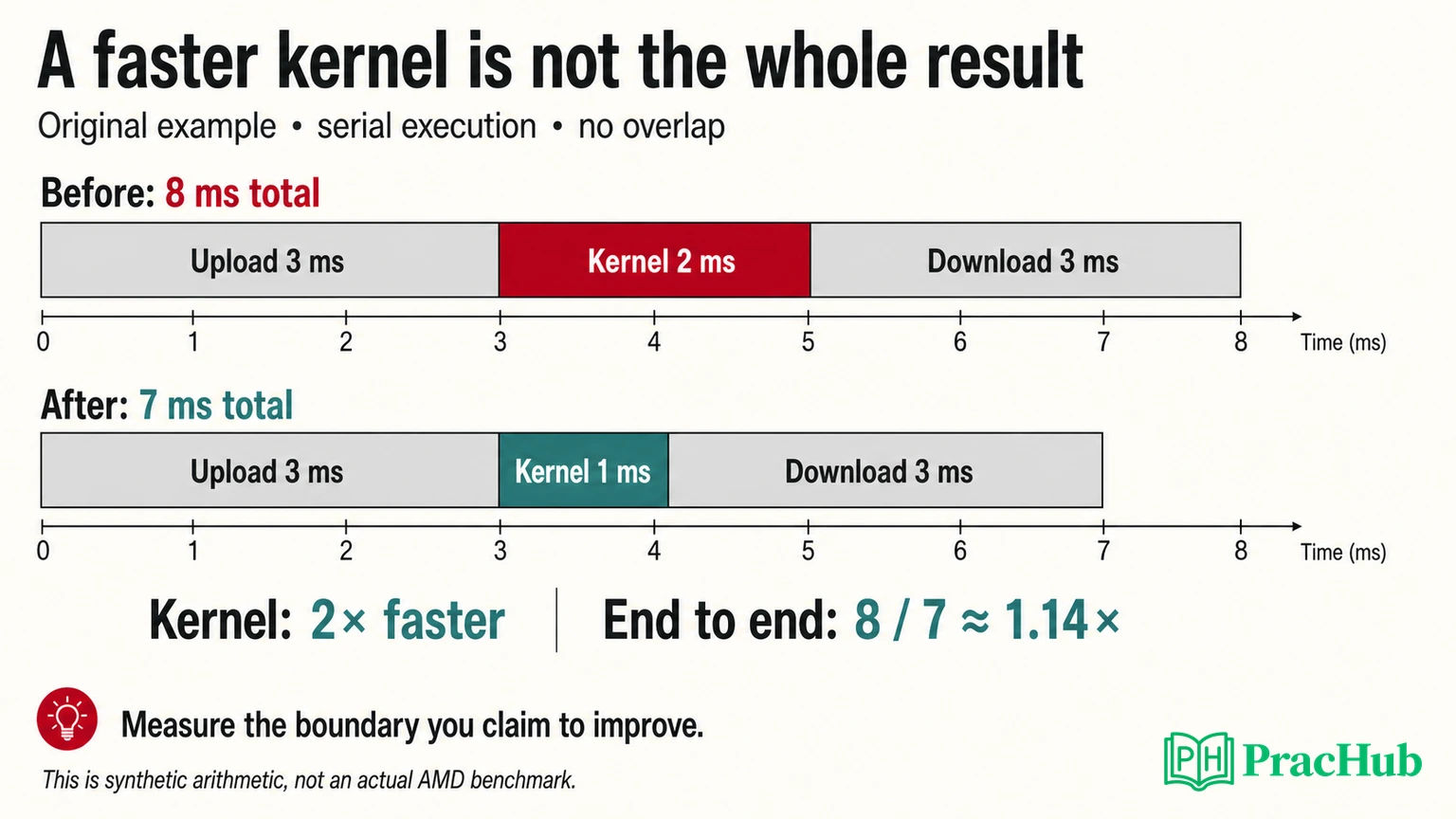
Original numerical example: a serial GPU operation spends 3 milliseconds uploading data, 2 milliseconds executing a kernel, and 3 milliseconds downloading results. Ignore allocation and launch overhead in this simplified model, and assume no overlap. Total time is 8 milliseconds.
You optimize the kernel to 1 millisecond while transfers stay unchanged. Kernel speedup is 2×, but total time becomes 7 milliseconds: 8 / 7 ≈ 1.14× end-to-end speedup. Calling the application twice as fast would misrepresent the result.
Now change the workload: ten operations can reuse data on the device, with one initial upload and one final download. If each kernel still takes 2 milliseconds, the simplified total is 3 + 10 × 2 + 3 = 26 milliseconds, versus 10 × 8 = 80 milliseconds with transfers around every operation. This improvement requires a real opportunity for reuse; it is not available when every result must return to the host immediately.
AMD’s performance guidance recommends examining data movement as well as computation. In a project discussion, distinguish a faster kernel from a better placement of work and data. Both can matter, but they solve different bottlenecks.
Measure completed work, then explain your project
Official runtime behavior: HIP supports asynchronous submission through streams and event-based coordination. A host timer around a launch can measure submission rather than completed execution. For kernel timing, record timing-enabled start and stop events around the work in the same stream, then wait for the stop event before reading elapsed time. For application timing, include the completion of every operation inside the boundary you claim. HIP asynchronous execution and event management
For an original benchmark rehearsal, state the input size, data type, device, build configuration, warmup, repetitions, and whether transfers are included. Check correctness before comparing time. A faster answer with missing elements or unacceptable numerical error is not an optimization.
Then prepare one project story with a clear sequence: the observed symptom, your hypothesis, the evidence collected, the change made, and the result. Include one hypothesis that failed. That detail shows whether you can revise an explanation when measurements disagree with it.
If you have only CPU experience, describe it accurately and explain how you would extend the experiment to a GPU. You can demonstrate useful architecture reasoning without inventing ROCm experience or presenting simulated timings as measurements.
Practice ownership, architecture, and GPU measurement
These verified PracHub records come from other companies and roles. Use them as practice, not evidence of AMD’s interview process. The CUDA and inference exercises are optional extensions for GPU-focused teams; translate their assumptions deliberately when discussing HIP.
| PracHub question | Focus for this preparation |
|---|---|
| Compare C Generic Techniques and C++ Smart-Pointer Ownership | Explain ownership, type safety, and the cost of an abstraction. |
| Explain Virtual Memory, MMUs, and TLBs | Trace translation and distinguish misses from faults. |
| Explain C++ memory, types, and concurrency fundamentals | Connect valid code to lifetime, layout, and synchronization. |
| Optimize CUDA GEMM with tiling and coalescing | Work through addresses, tile edges, and target-specific assumptions. |
| Design and benchmark optimized inference pipelines | Define the measurement boundary before claiming a speedup. |
For an AMD software engineering intern interview in 2027, match depth to the actual team. If GPU work is confirmed, use the GEMM exercise to explain one correct baseline, one proposed change, and one measurement that would tell you whether it helped.
Sources and Further Reading
- AMD: 2027 Software Engineering Intern/Co-Op, 91368
- AMD: 2027 Graphics Software Engineering Intern/Co-Op, 91359
- Glassdoor: AMD Software Engineer Intern reports
- C++ standard draft: vector capacity and reallocation
- AMD HIP: performance guidelines
- AMD HIP: porting CUDA code
- AMD HIP: programming model
- AMD HIP: asynchronous execution
- AMD HIP: event management and elapsed time
Comments (0)