Apple Firmware Engineer Interview: C/C++, Board Bring-Up, and Debugging Scenarios
Quick Overview
Prepare for Apple firmware engineering with verified System Firmware and Diagnostics role evidence, historical report boundaries, and original C, board bring-up, I2C, and debugging exercises.
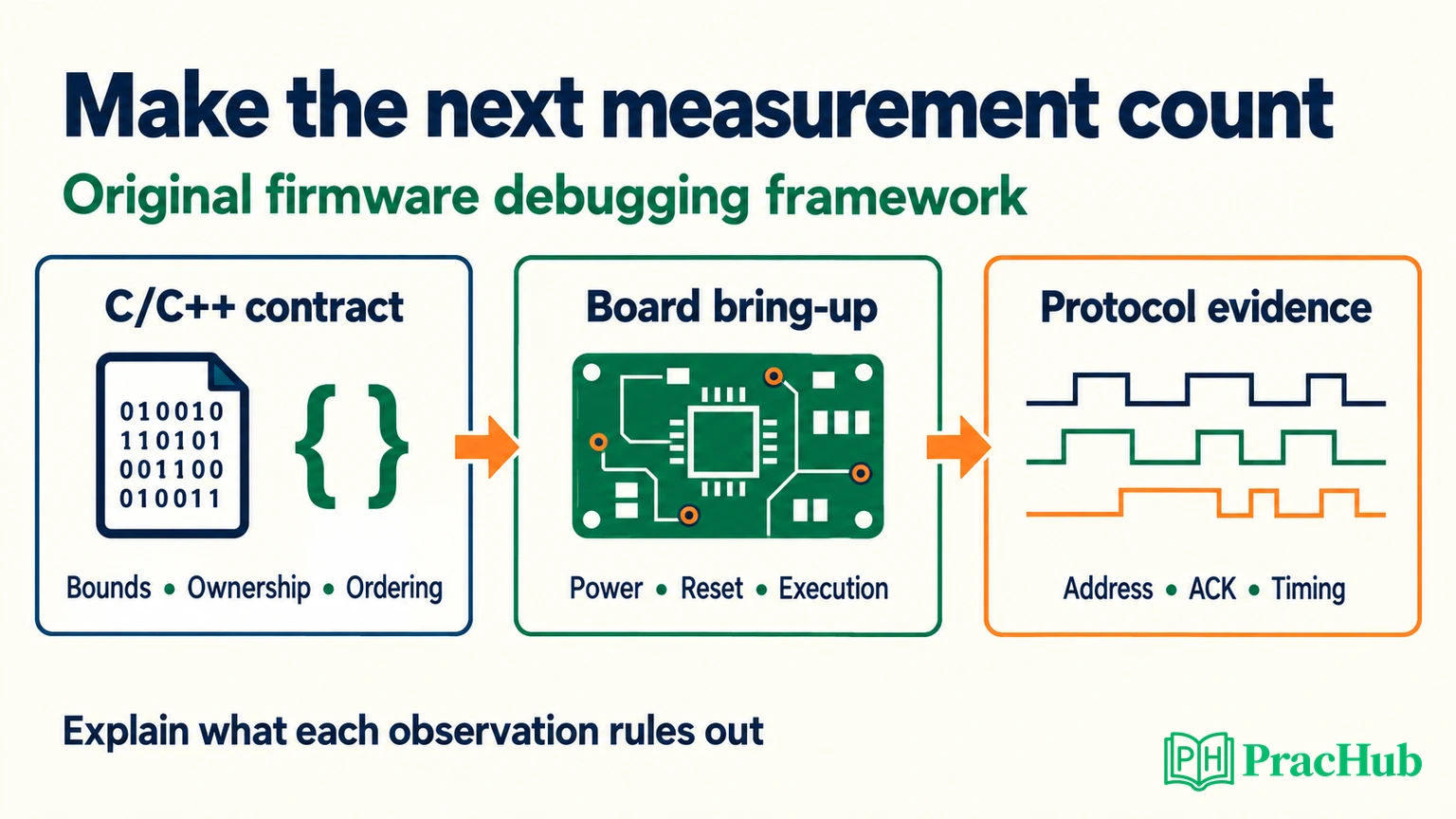
For an Apple Firmware Engineer interview, prepare to connect C/C++ behavior to observable hardware behavior. A useful answer explains what the code assumes, what the board actually does, and which measurement would separate competing explanations. Use that approach when a device is silent, a peripheral does not acknowledge a command, or a diagnostic passes only with a debugger attached.
This guide uses a verified Apple System Firmware and Diagnostics opening to define the preparation scope. For related practice, start with PracHub's Apple Wi-Fi chip debugging question, focusing on the evidence needed to isolate a hardware/software boundary.
Evidence boundary: Official role requirements, historical candidate reports, and preparation recommendations are labeled separately. The code, silent-board investigation, and I2C address example are original exercises. They are not Apple interview questions, internal designs, or product measurements.
What the verified Apple role actually covers
Official role evidence: Apple's Embedded Software Engineer posting, role 200662204 in Cupertino, describes System Firmware and Diagnostics work for manufacturing and testing. It includes firmware and drivers for interfaces, chipsets, and communication protocols, with collaboration across electrical engineering, software, quality, manufacturing, and operations. Apple role posting
The opening asks for C/C++, multithreaded embedded development, and five or more years of relevant experience. Preferred qualifications include reading schematics and layouts, board bring-up, standard hardware protocols, and tools such as gdb, lldb, oscilloscopes, and logic analyzers. These requirements describe this experienced role; they do not establish a universal Apple firmware interview loop.
Preparation inference: Build examples that connect software correctness to repeatable device diagnostics. A story about implementing a driver is stronger when you can explain its register assumptions, observed bus behavior, failure handling, and verification across board revisions.
What candidate reports can—and cannot—tell you
Historical candidate report: In a public firmware-quality discussion begun in 2025, the original poster later described screening questions involving embedded C, testing, communication protocols, debugging, and I/O mapping. Firmware quality is adjacent to the development role above, so this is supplementary context. Candidate discussion
A separate 2025 embedded discussion includes a candidate describing a coding question in C. Other replies discuss different experiences, which reinforces the need to confirm the team's expectations. These accounts do not verify a shared current sequence, question count, or duration. Historical embedded discussion
Two independent same-cycle reports for the exact System Firmware and Diagnostics role were not verified. Use this guide for preparation, then ask the recruiter about the team's scope, coding language, expected tools, and whether the discussion centers on development, validation, or manufacturing diagnostics.
C/C++: explain the contract before writing the function
For firmware preparation, practice pointers, array bounds, integer widths, signedness, object lifetime, and byte order through small functions. State which inputs are valid, what happens on failure, and whether the function allocates or blocks.
Here is an original C exercise: read two ordinary RAM bytes as an unsigned little-endian value, without an unaligned typed load. The caller supplies a readable buffer of at least n bytes and a valid output pointer. Null pointers and short buffers are rejected; failure leaves the output unchanged.
#include <stdbool.h>
#include <stddef.h>
#include <stdint.h>

bool read_le16(const uint8_t *b,
               size_t n,
               uint16_t *out) {
    if (!b || !out || n < 2) {
        return false;
    }
    *out = (uint16_t)(
        (uint32_t)b[0] |
        ((uint32_t)b[1] << 8));
    return true;
}
Bytes 0x34, 0x12 produce 0x1234; 0xFF, 0xFF produce 0xFFFF. Explicitly assembling the bytes avoids assuming that the host's byte order matches the input format. The function neither allocates memory nor retains the input pointer.
The null check cannot prove that a non-null pointer refers to live, sufficiently large storage. That remains a caller contract. Nor should you reuse this function blindly for peripheral registers: register access widths and read side effects may require entirely different operations.
For a C++ follow-up, explain who owns an asynchronous transfer buffer. A stack array that goes out of scope before a completion callback runs is not rescued by a pointer wrapper. An owning object can manage lifetime, but the design still needs a completion or cancellation contract before memory is reused. Name the invariant rather than claiming that “RAII solves concurrency.”
Register access: volatile is not a complete synchronization plan
Compiler documentation: GCC explains that accesses to non-volatile objects are not ordered merely by accessing a volatile object. Its volatile documentation explicitly rejects treating volatile as a memory barrier for ordinary memory writes. This is a compiler reference, not evidence about Apple's toolchain. GCC volatile guidance
For preparation, distinguish four concerns: whether an access occurs, whether an operation is atomic, how operations are ordered, and whether a device sees current memory contents. A volatile register pointer does not answer all four.
Suppose software prepares a DMA descriptor and then rings a device doorbell. Explain the platform's required ownership transfer, cache maintenance where applicable, and ordering operations. Prefer the documented driver or platform accessors; do not prescribe one barrier instruction without knowing the architecture and memory attributes.
Also inspect register semantics before using read-modify-write. In an original register example, two pending status bits are both one and the register uses write-one-to-clear behavior. Reading the status and writing the whole value back clears both bits, even if you intended to acknowledge only one. The correct write depends on the documented mask and reserved-bit rules.
Bring-up scenario: the new board prints nothing
Assume an original lab scenario: a new board revision powers on but emits no expected boot message. The same firmware build works on a known-good revision. You have the schematic, build artifacts, a debugger, and appropriate measurement equipment. No actual Apple board is implied.
First define “prints nothing.” Is the processor failing to execute, is boot stuck before console initialization, or is the serial observation path wrong? A blank terminal cannot distinguish those states.
Record the board revision, firmware hash, flashing method, boot straps, power source, and test setup. Then compare against the documented power, reset, and clock requirements. Check rails and sequencing at the relevant points, reset release, and clock availability before treating a software breakpoint as the only evidence.
Use the debugger to determine whether execution reaches a known milestone, and inspect the program counter or exception state when it does not. A reachable entry point narrows the investigation, but it does not prove that memory initialization or peripheral setup is correct.
| Original observation | Next discriminating check |
|---|---|
| Reset never releases | Compare the reset source and required power/clock conditions with the schematic. |
| Early code executes; console setup never completes | Inspect the wait condition, clock enable, and peripheral status being polled. |
| UART register writes occur; no signal at the SoC pin | Check pin multiplexing, peripheral clocking, and output enable. |
| Signal exists at the SoC pin; terminal stays blank | Trace routing, level conversion, connector, decoder settings, and host interface. |
These are hypotheses to test, not automatic conclusions. A GPIO milestone can help when console output is unavailable, but it must be on a verified pin and should not disturb the subsystem under investigation.
Change one factor at a time where practical. If you simultaneously replace the board, alter the clock, and change the build, a recovered boot does not tell you which change mattered. Preserve failing and passing traces with timestamps so a hardware partner can compare the same boundary.
Protocol scenario: clocks are present, but the device does not ACK
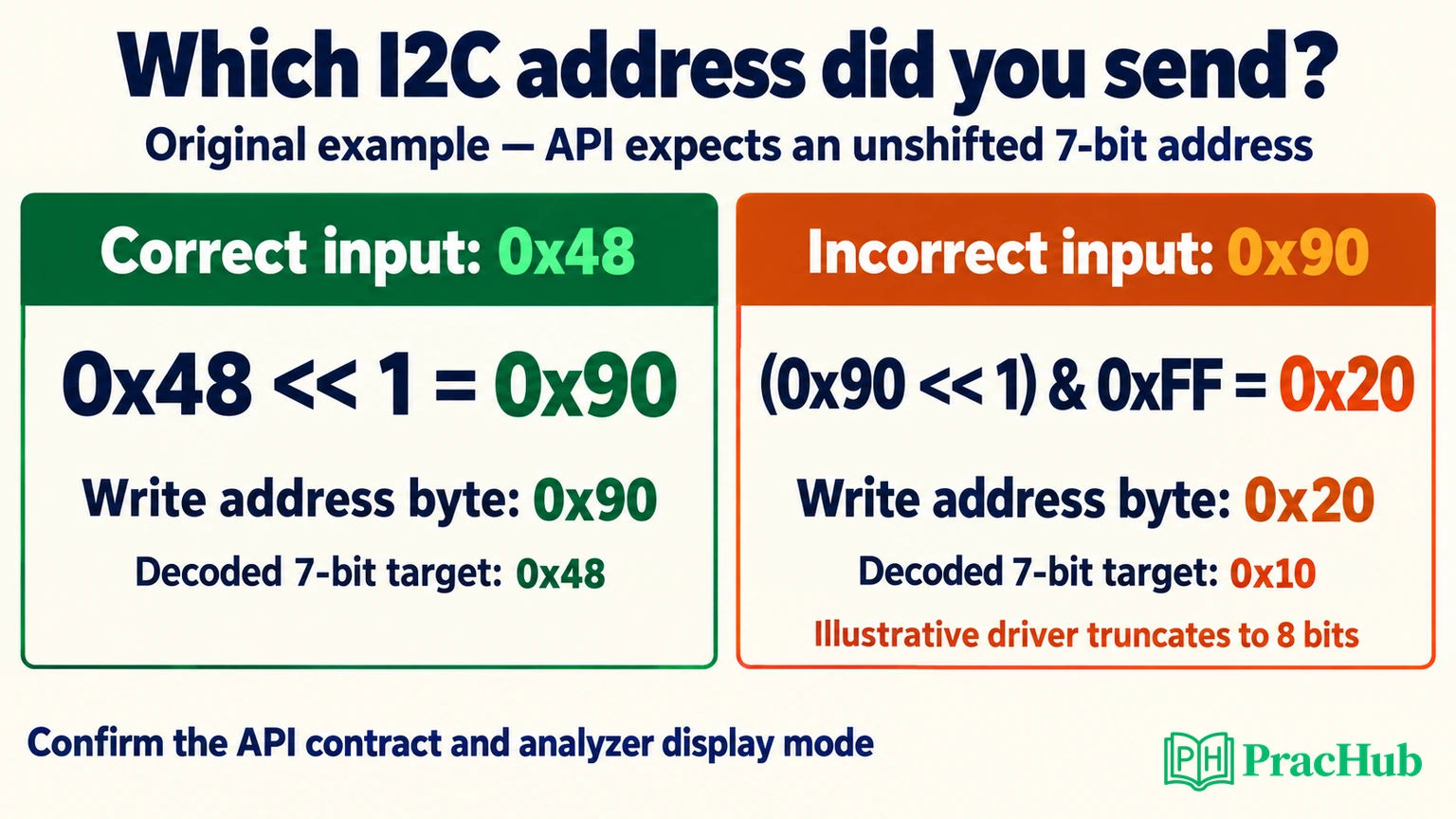
Consider an original I2C exercise with a target whose documented seven-bit address is 0x48. The API expects that unshifted address and constructs the address byte itself. A write transfer should therefore put 0x90 on the wire; a read address byte would be 0x91.
Now suppose an illustrative driver accepts an unchecked integer argument, shifts it left, and truncates the result to eight bits. Passing the already shifted value 0x90 produces (0x90 << 1) & 0xFF = 0x20. That byte addresses seven-bit target 0x10, not 0x48. A production API may reject the invalid argument instead; inspect its actual contract.
Primary protocol reference: NXP's I2C specification defines the acknowledgement on the ninth clock pulse, with the transmitter releasing SDA so the receiver can acknowledge low. An address-phase NACK is an observation about that transfer, not a diagnosis by itself. NXP I2C specification
Check whether the analyzer displays a seven-bit address or the complete address byte. Otherwise, two engineers may read the same trace as 0x48 and 0x90 and mistakenly conclude that their tools disagree.
Then inspect target power, reset state, address straps, bus selection, and readiness timing. Compare the captured address byte with the API input and controller configuration. Clocks on a connector do not prove that the intended target receives a valid transaction.
Use a logic analyzer to inspect transaction structure and an oscilloscope when voltage levels or edge quality are in question. A digital decode can look plausible while electrical margins are poor. Conversely, reducing bus speed and seeing success is useful evidence, but does not identify whether the cause is rise time, timing configuration, or another speed-dependent behavior.
Do not respond to every NACK with unlimited retries. Define timeout, recovery, error reporting, and conditions for retrying. Distinguish an absent target from a temporarily busy one before deciding whether retrying is appropriate.
Debugging scenario: it passes only with the debugger attached
Treat this as a change in experimental conditions. Breakpoints may alter timing, a debug session may change reset behavior, and inspection can affect the system. Start by identifying which debugger action is necessary for the failure to disappear.
For an original hypothesis, initialization reads a peripheral before its documented readiness condition is satisfied. Stepping through the code gives the peripheral time to become ready. Adding a large delay may hide the symptom, but a defensible fix implements the required sequencing and a bounded readiness check.
Test that hypothesis by recording reset release, readiness status, and the first access without relying on the debugger pause. If the evidence instead points to an interrupt race, stale DMA data, or uninitialized memory, change direction. “Timing issue” is a category, not a root cause.
Interrupt and worker-task coordination needs equally precise contracts. Identify the shared state, whether updates can race, what operations are legal in interrupt context, and whether work should be deferred. In a C++ thread example, use a synchronization mechanism appropriate to the memory model. In a device ISR example, also respect the platform's interrupt and hardware rules.
Turn the fix into a manufacturing diagnostic
The verified role's manufacturing context makes reproducibility especially relevant. As a preparation recommendation, describe a diagnostic that records board revision, firmware build, test phase, timeout reason, and relevant status values, so another engineer can reproduce the observation.
Separate detection, recovery, and prevention. Resetting the peripheral may restore the test station, while the underlying sequence error remains. A regression test should recreate the failure conditions and verify the corrected behavior, including the timeout path.
Report evidence honestly: host unit tests, mocked register behavior, device traces, and repeated board runs establish different things. The exercises here validate logic and reasoning; they do not establish performance or reliability on an Apple device.
Five PracHub questions for targeted practice
These Apple and cross-company records develop relevant skills. They are not a verified System Firmware and Diagnostics assessment bank.
| PracHub question | Practice focus |
|---|---|
| How to root-cause Wi‑Fi chip stops after 30 minutes | Separate firmware, power, thermal, and measurement hypotheses. |
| Explain thermal and signal fundamentals | Connect electrical observations to protocol behavior. |
| Implement a robust socket message reader | Practice bounded parsing, partial input, and failure handling. |
| Explain C printf pointers and memory layout | Explain addresses, storage, and debugger observations. |
| Walk Through Your Hardest Debugging Investigation | Present the evidence that ruled out competing causes. |
Start with the Apple Wi-Fi debugging scenario. Define the failure, name three competing explanations, and choose one measurement that would make you change your mind.
Sources and Further Reading
- Apple: Embedded Software Engineer, role 200662204 — official System Firmware and Diagnostics role requirements.
- Historical candidate discussion: firmware quality at Apple — adjacent-role experience, not a current universal process.
- Historical candidate discussion: Apple embedded interview — 2025 reports with team and context limitations.
- GCC: When is a Volatile Object Accessed? — compiler guidance on volatile and memory ordering.
- NXP: I2C-bus specification and user manual — primary protocol reference for addressing and acknowledgement.
Sources checked September 8, 2026. Confirm the current role and recruiter instructions before assuming any specific interview format.
Comments (0)