Atlassian AI-Assisted Coding Interview Guide 2026: Repository Tasks, Agent Use, and Values
Quick Overview
Learn what recent Atlassian candidates report about repository-based AI coding interviews, how HackerRank's agentic IDE works, and how to prepare ethically.
An Atlassian AI-assisted coding interview is not simply a LeetCode problem with a chatbot attached. Recent 2026 internship candidates report receiving an unfamiliar repository in HackerRank, using a built-in coding agent to understand it, and then debugging or implementing a scoped feature while an interviewer watches the reasoning process.
That reported format is current, but Atlassian's public engineering handbook does not yet describe one universal AI-enabled round for every role or region. Your recruiter email and interview invitation remain the source of truth. The safest preparation is to practice repository navigation, bounded prompting, testing, diff review, and clear technical communication instead of trying to memorize a hidden prompt.
Use Atlassian Software Engineer questions to rehearse the coding, code-design, debugging, and systems thinking that still matter when an agent can generate part of the implementation.
Quick Answer
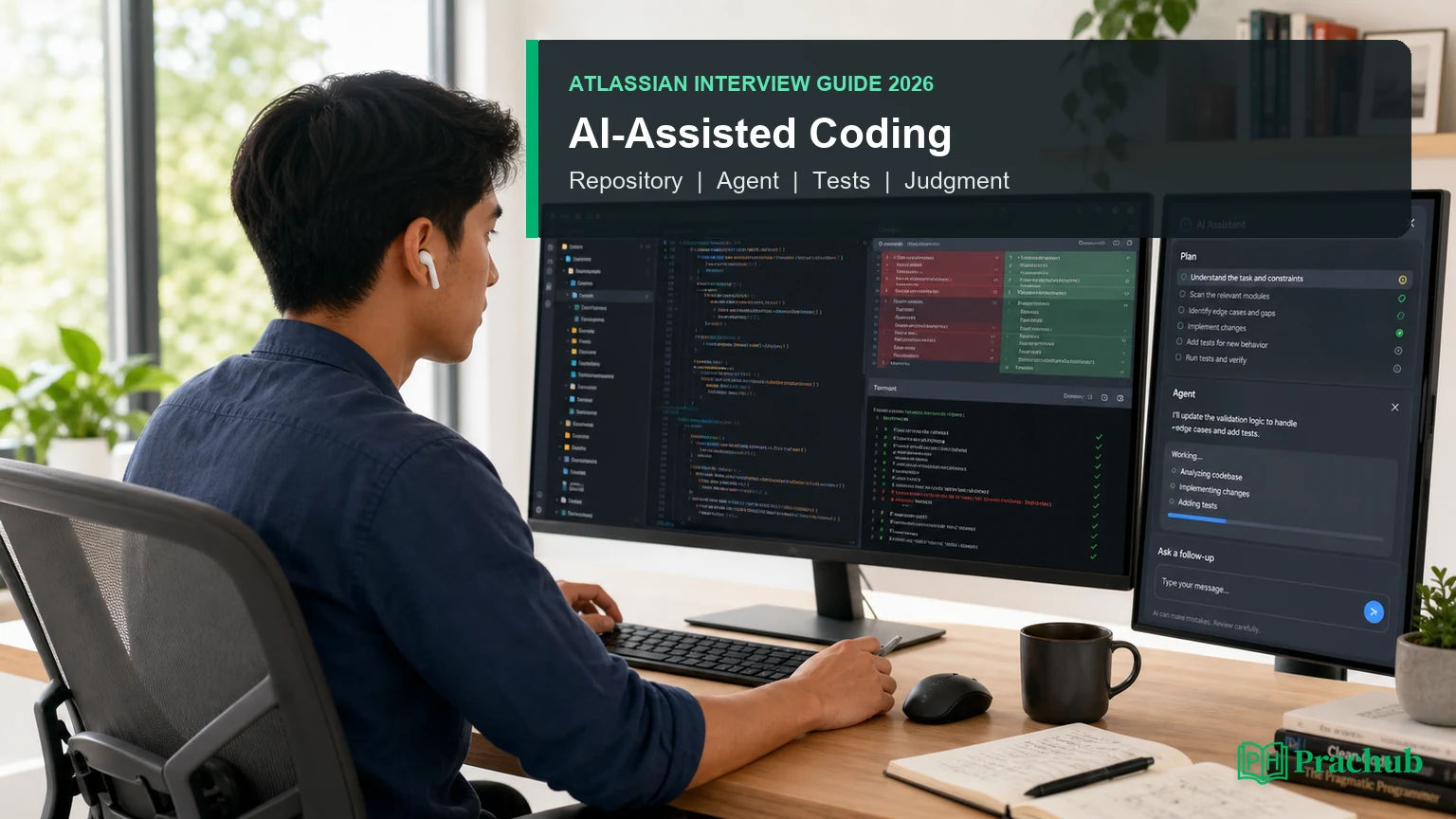
Expect a collaborative engineering exercise, not permission to delegate judgment. A recent Atlassian internship offer report describes repository code in a HackerRank IDE with Plan and Agent modes, followed by debugging or feature implementation. Other recent candidates describe codebase navigation, testing, architecture decisions, and heavy explanation.
HackerRank's official documentation confirms that its Interview product can provide a real repository, file navigation, terminal access, Plan, Ask, and Agent modes, live interviewer observation, diff views, and a saved AI chat transcript. Atlassian officially says its engineering interviews prioritize problem solving, learning agility, clean code, trade-offs, communication, and values.
| Evidence level | What we know | How to prepare |
|---|---|---|
| Official Atlassian guidance | Coding and code design assess thinking, trade-offs, and clean implementation | Explain choices and adapt when constraints change |
| Official HackerRank capability | Repository tasks can include AI planning, code edits, tests, diffs, and recorded interactions | Treat every prompt and accepted change as reviewable work |
| Recent candidate reports | Some 2026 rounds used unfamiliar repositories for bug fixes or features | Practice a complete plan-build-review loop |
| Variable by role and location | Exact stack, duration, agent mode, and follow-up sequence may differ | Read your invitation and confirm permitted tools |
What Is an AI-Assisted Repository Interview?
An AI-assisted repository interview asks you to modify an existing codebase while an interviewer observes how you use an AI tool. The evaluation can include requirement discovery, repository comprehension, prompt quality, implementation choices, testing, code review, and your ability to explain what the agent changed.
This is different from pasting a standalone algorithm into a chatbot. A repository contains conventions, dependencies, tests, partially implemented behavior, and hidden assumptions. The agent can accelerate search and editing, but you remain accountable for scope, correctness, and the explanation.
HackerRank's AI-Assisted Interviews documentation says Plan mode can propose an approach without editing code, Ask mode can answer questions about tagged context, and unguarded Agent mode can edit files after the candidate approves tool calls. Interviewers can watch those interactions and review the transcript afterward.
What Recent Atlassian Candidates Report
One August 2026 Atlassian internship offer report described an interviewer-present round with repository code in HackerRank, Plan and Agent modes, and a task to debug or implement features. The writer believed the goal was to assess how effectively the candidate used AI to understand and fix an unfamiliar codebase.
A separate backend internship discussion described a relatively approachable task but emphasized software-engineering fundamentals, tests, basic placement of components, and continuous explanation. Another AI-enabled interview discussion focused on navigating a new repository, scoping a feature, and reviewing generated output.
These reports are useful evidence of an emerging format, not a guaranteed script. Atlassian can change the platform, task, stack, duration, or round order. Do not assume you may use an external AI tool because a built-in agent was available to another candidate.
What the Interviewer Is Likely Evaluating
Atlassian's official engineering interview handbook says it wants to see not only how candidates code, but how they think. It names problem solving, learning agility, code design, clean code, trade-offs, communication, and collaboration as important signals. The AI-assisted format changes the interface, but not that underlying standard.
- Repository comprehension: Can you find the entry point, relevant modules, tests, data flow, and local conventions before changing code?
- Problem framing: Can you restate the requirement, identify missing details, and define a testable completion condition?
- Agent direction: Do your prompts specify context, constraints, files, acceptance criteria, and validation, or do they ask for a vague full solution?
- Technical judgment: Can you reject an attractive but incorrect suggestion, control scope, and choose a maintainable design?
- Verification: Do you run targeted tests, inspect the diff, check edge cases, and distinguish pre-existing failures from your changes?
- Communication: Can the interviewer follow your plan, decisions, uncertainty, and final review without reading your mind?
The strongest candidate is not necessarily the person who produces the most code. It is the person who maintains a reliable chain from requirement to evidence.
Use a Recon-Plan-Direct-Verify-Explain Workflow
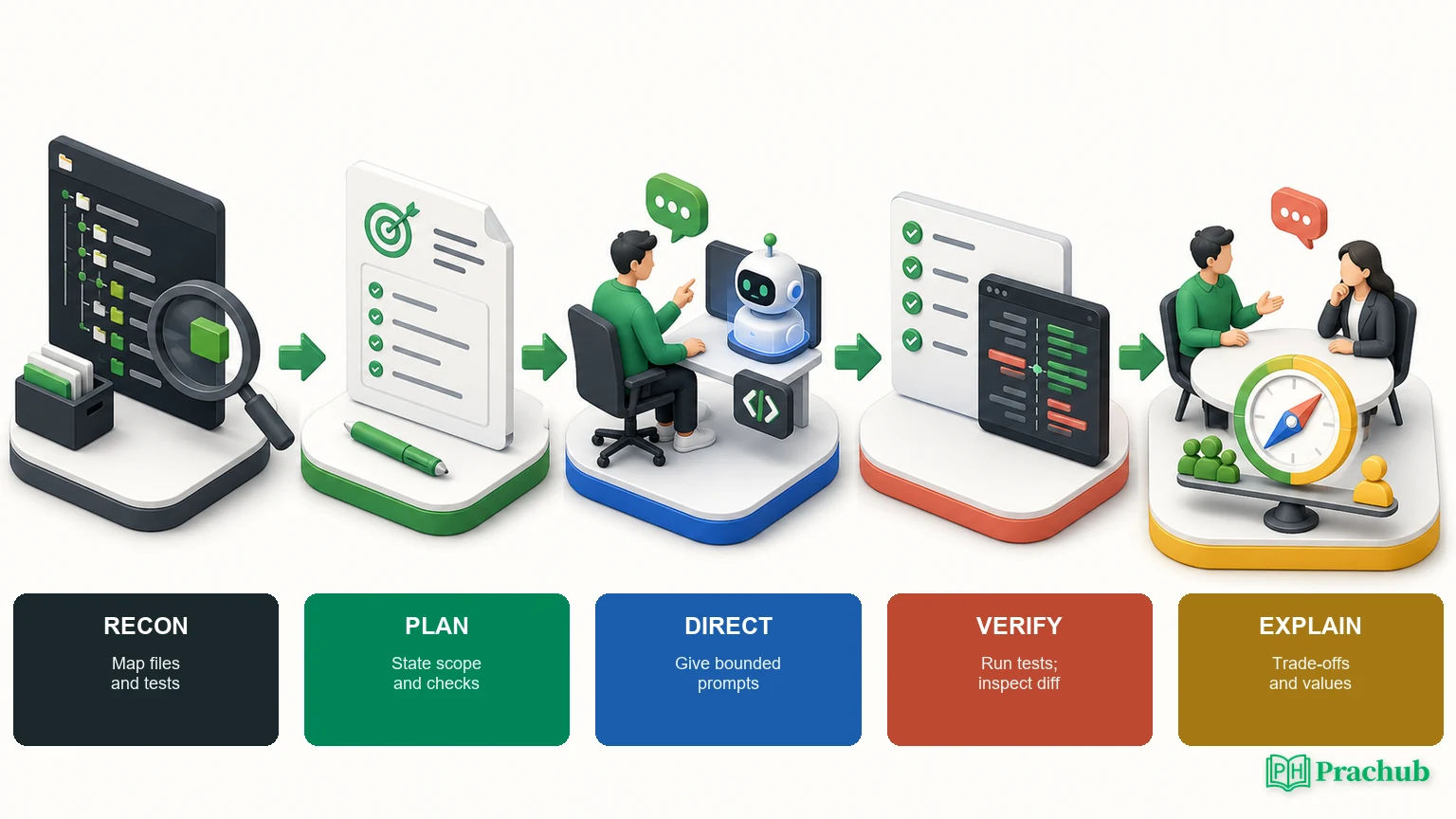
Recon: Begin by reading the task, repository README, package or build files, relevant tests, and the smallest likely execution path. Ask the agent to summarize architecture only after you have enough context to judge whether the summary is plausible.
Plan: State your assumptions and propose a narrow change. Identify the files you expect to touch, the behavior that must remain stable, and the tests that should pass. If the agent's plan is too broad, refine it before allowing edits.
Direct: Give one bounded task at a time. A useful prompt includes the desired behavior, relevant files, constraints, and the required validation. Keep yourself in the loop instead of launching a large autonomous rewrite.
Verify: Inspect the actual diff. Run the narrowest relevant tests first, then the broader suite if time permits. Check error handling, state transitions, concurrency or async behavior, and whether the generated code follows existing patterns.
Explain: Summarize what changed, why the design fits the repository, what evidence supports correctness, and what you would improve with more time. Mention any remaining uncertainty directly.
This workflow matches Atlassian's own observation that strong engineers get more value from AI when work is split into small changes, requirements are explicit, and tests provide a trustworthy specification. Atlassian's research on high-throughput engineers argues that these fundamentals become more important, not less, when agents accelerate implementation.
Prompt the Agent Like an Engineer
Good prompting is precise engineering delegation. It gives the agent enough context to act while preserving a clear review boundary.
- Repository prompt: "Summarize the request path for this feature. Name the entry point, the three most relevant files, and the existing tests. Do not edit anything yet."
- Plan prompt: "Propose the smallest change that satisfies these acceptance criteria. Preserve the public API and existing error behavior. List the tests you would add before coding."
- Review prompt: "Review only the current diff for correctness, missed edge cases, and violations of repository conventions. Do not rewrite unrelated files."
Avoid prompts such as "fix everything" or "implement the task" before you understand the boundaries. HackerRank notes that interviewers can see AI interactions in real time and review the transcript, so the prompt itself is part of the evidence.
Common Mistakes That Lower the Signal
The most damaging mistake is accepting agent output without reading it. A passing visible test can coexist with a broken edge case, an accidental API change, or a large unrelated refactor.
Other common failures include spending too long asking the agent for repeated summaries, changing many files before running one test, hiding uncertainty, or narrating every keystroke instead of explaining decisions. Do not optimize for prompt cleverness. Optimize for a small, defensible, tested change.
If the agent makes a poor suggestion, that is an opportunity. Explain why it conflicts with the repository or requirement, reject it, and redirect the work. Recovering well can show more judgment than receiving a perfect first response.
Show Atlassian Values Through Technical Behavior
Atlassian states that its five values guide who it hires. You can review the behavioral intent in the Atlassian Values Interview Guide, but values should also appear naturally during technical work.
Open company, no bullshit means stating what you know, what you inferred, and what remains uncertain. Build with heart and balance means shipping a useful scoped solution without sacrificing correctness. Don't #@!% the customer means protecting existing behavior and considering failure cases.
Play, as a team means treating the interviewer as a collaborator and responding constructively to feedback. Be the change you seek means improving the plan when evidence changes instead of defending a weak first idea. These behaviors are stronger than forcing value names into every sentence.
Practice with Atlassian Questions from PracHub
These PracHub question-bank records train relevant skills. They are not predictions of your exact Atlassian interview, and the AI-assisted round may use a different repository, framework, or task.
| PracHub question | Practice focus | Why it helps |
|---|---|---|
| Diagnose why a scaled system became slow | Evidence-driven debugging | Trains hypothesis formation, observability, and clear prioritization |
| Implement sequential and parallel URL requests | Async behavior and error handling | Builds implementation discipline around concurrency and tests |
| Design a trie-based URL router with wildcards | Code design and edge cases | Practices APIs, invariants, concurrency, and targeted test coverage |
| Filter Invalid Data Events | Validation and stable behavior | Exercises requirements translation, deduplication, and boundary cases |
| Implement sliding-window rate limiter function | Stateful implementation | Tests data-structure choices, time windows, and correctness under load |
A Seven-Day Preparation Plan
| Day | Focus | What to do |
|---|---|---|
| Day 1 | Repository reconnaissance | Take a small open-source project and map its entry point, modules, tests, and run commands in 30 minutes |
| Day 2 | Bug fixing | Reproduce one issue, write or identify a failing test, make the smallest fix, and inspect the diff |
| Day 3 | Feature work | Add one scoped behavior while preserving APIs and repository conventions |
| Day 4 | Agent workflow | Repeat a task using Plan, bounded implementation, and review prompts; keep a prompt and decision log |
| Day 5 | Verification | Practice targeted tests, edge-case analysis, rollback, and explaining why a passing test is sufficient or insufficient |
| Day 6 | Mock interview | Run a 60-minute repository session and narrate assumptions, decisions, agent corrections, and trade-offs |
| Day 7 | Atlassian alignment | Review the five values, prepare two project stories, and confirm the exact rules in your invitation |
Frequently Asked Questions
Is the Atlassian AI-assisted coding interview a LeetCode round?
Recent reports describe a repository-based bug-fix or feature task rather than a standalone algorithm problem. Atlassian may still use an OA or other coding rounds elsewhere in the process. Prepare data structures, but spend dedicated time navigating and modifying unfamiliar code.
Can I use my own AI coding tool?
Only use tools explicitly permitted in your invitation or by the interviewer. Recent candidates reported a built-in HackerRank agent, but that does not authorize external assistants, copied prompts, or a separate local environment. Ask before the session if the rule is unclear.
Does the interviewer see my prompts and agent actions?
HackerRank's current documentation says interviewers can monitor prompts and responses in real time, accepted edits appear in the shared editor, and the report can include the chat transcript. Assume your prompts, approvals, diff, and explanation are all reviewable.
What if the agent produces incorrect code?
Do not hide it or restart blindly. Identify the failing assumption, show the test or repository evidence, reject or revert the change, and issue a narrower correction. The recovery demonstrates verification, ownership, and learning agility.
Do I need full-stack experience?
Broad familiarity helps you locate routes, services, state, data models, and tests, but one recent successful candidate said full-stack depth was useful rather than mandatory. Focus on transferable repository skills and the stack named in your invitation.
Final Takeaway
Prepare for the Atlassian AI-assisted coding interview as a live engineering collaboration. Understand the repository, control scope, direct the agent with evidence, verify every meaningful change, and explain the trade-offs in a way another engineer can trust.
PracHub helps you build that foundation with Atlassian Software Engineer questions, written solutions, and practice across coding, debugging, design, and values. Use the agent to accelerate your work, but make your judgment the part the interviewer remembers.
Sources and Further Reading
- Atlassian Engineering Interview Handbook
- Atlassian Core Values
- Atlassian: What High-Throughput Engineers Do Differently and Why AI Widens the Gap
- HackerRank AI-Assisted Interviews
- HackerRank Code Repository Questions
- HackerRank Interview Product Overview
- HackerRank July 2026 Release Notes
- Recent Candidate Report: Atlassian SDE Internship Offer
- Recent Candidate Discussion: Atlassian AI-Enabled Backend Interview
- Recent Candidate Discussion: Atlassian AI-Enabled Interview
Research note: This guide was checked on August 25, 2026. Interview formats can vary by role, location, hiring channel, and recruiting cycle; follow your own invitation and recruiter guidance.
Comments (0)