Biostatistician Interview Questions: Study Design, Analysis Plans, and Defensible Conclusions
Quick Overview
Work through a synthetic randomized study with missing week-12 outcomes. Compare observed and full-arm denominators, bound unknown response allocations, and connect the intended effect to analysis-plan decisions and defensible interpretation.
Biostatistician interview questions often begin as method questions: choose a test, calculate a sample size, or interpret a result. A stronger answer first establishes the study question, the observations available, and the assumptions needed to connect them. A correct test can still estimate an effect the study was never designed to answer.
Practice Explain P-value, Confidence Interval, and Multiple Testing Adjustments by explaining the difference between an estimated effect, uncertainty, and the evidence needed for a conclusion. Then use the original study exercise below to connect those ideas to design and analysis planning.
Evidence boundary: An official Celerion role posting lists randomization support, statistical analysis plans, analysis oversight, interpretation, and report writing. It does not disclose an interview sequence. ICH and FDA sources support the cited principles. All study details here are synthetic interview material, with no claim of clinical or regulatory suitability; no candidate report establishes these exact questions. Biostatistician responsibilities.

Define the effect before choosing an estimator
ICH E9(R1) frames an estimand through treatment conditions, population, variable, intercurrent-event handling, and a population-level summary. An estimator is the method used to estimate that specified effect. Changing the question can change which data are relevant. ICH E9(R1).
For our exercise, imagine an investigator comparing assignment to treatment A with assignment to treatment B among eligible adults in a randomized parallel-group study. The outcome is a predefined binary response assessed at week 12. The summary of interest is the difference in response proportions, A minus B.
This is still incomplete until the investigator specifies what response means and how relevant post-randomization events are handled. Ask for the measurement rule, assessment window, treatment conditions, and what happens if a participant discontinues assigned treatment or starts additional therapy. Do not invent a clinically appropriate rule from a convenient dataset column.
A useful interview response is: “I can suggest an analysis after we agree which treatment effect the study is intended to estimate.” Follow that statement with the unresolved endpoint and event-handling questions. Write the provisional question and mark the unresolved choices.
Connect randomization to the actual comparison
Ask what was randomized: individual participants, clinics, treatment periods, or another unit. The analysis needs to respect that design. In this exercise, individual participants are randomized once, with 50 assigned to each arm. There is no cluster or crossover component hidden in the counts.
Randomization does not mean the realized groups must have identical baseline values. Nor does it repair an endpoint measured differently between arms. Explain how allocation, follow-up, endpoint collection, and any masking arrangement support the proposed comparison, then identify what the available evidence cannot establish.
If the interviewer proposes excluding participants who stop treatment, ask how that exclusion relates to the intended question. Compare the original randomized groups with a selected subset only after making the selection rule explicit. A favorable subset result is not automatically evidence for the original assignment effect.
For an observational follow-up, the answer changes. A regression with treatment and age is not a substitute for randomized allocation simply because its output looks similar. State the causal assumptions and potential confounders that a nonrandomized comparison would require rather than transferring the randomized-study justification unchanged.
Turn the analysis plan into reviewable decisions
ICH E9 calls for analysis planning before breaking the blind and records of the relevant timing. That supports a practical distinction between a planned analysis and an outcome-driven change. Statistical principles.
An original interview-sized plan could contain these decisions. It is a discussion aid, not a validated SAP template.
| Decision | Provisional case specification | Question requiring agreement |
|---|---|---|
| Endpoint | Binary response at week 12 | What measurement and visit-window rule define response? |
| Comparison | A minus B response proportion | Which treatment effect and population are intended? |
| Intercurrent events | Specify each relevant event separately | Which strategy answers the clinical question? |
| Missing observations | Retain reason and timing; prespecify assumptions | Which missing-outcome assumptions are defensible? |
| Primary inference | One agreed estimator and interval method | Does the method target the intended effect? |
| Additional analyses | Label their purpose and status | Robustness assessment or additional insight? |
The plan should let another analyst reproduce the intended result without choosing rules after seeing which answer looks favorable. For example, “use the closest available visit” leaves ties and out-of-window measurements unresolved. Ask for the rule and examples before implementation.
If a late data problem requires a change, retain the original specification, the reason, timing, who had access to outcomes, and the effect on interpretation. An unexplained endpoint change can make an attractive result impossible to assess; preserve its reason and timing in the review record.
Audit the missing-outcome ledger
Now suppose the synthetic study has these week-12 observations. A response is known only when the assessment is available; there are no additional outcomes to infer from the exercise.
| Arm | Randomized | Observed outcomes | Observed responders | Missing outcomes |
|---|---|---|---|---|
| A | 50 | 40 | 24 | 10 |
| B | 50 | 45 | 18 | 5 |
Among observed participants, response proportions are 24/40 = 60% and 18/45 = 40%, a 20 percentage-point difference. That calculation describes the observed subsets. It does not identify the response difference among all randomized participants without assumptions about the 15 unknown outcomes.
If every missing participant is assigned nonresponse for a purely illustrative calculation, the proportions become 24/50 = 48% and 18/50 = 36%, a 12-point difference. Do not label that convention automatically conservative or recommend it as the primary analysis. Its interpretation depends on the endpoint, intended effect, and missingness process.
Retain the 40 and 45 observed outcomes alongside both 50-person randomized denominators. Saying “the difference is 20%” obscures both the unit and the population. Say “20 percentage points among participants with an observed week-12 outcome,” then explain what remains unknown.
Separate unknown observations from intercurrent events
In the same exercise, suppose eight participants in A and three in B discontinued assigned treatment before week 12. These numbers do not tell you which participants lack an outcome. Some may have continued follow-up; other participants may have missed an assessment for unrelated reasons.
Ask for participant-level timing and reasons rather than replacing the missing counts with the discontinuation counts. A discontinuation event and an unobserved response are different records. Check their overlap so discontinuation is not incorrectly counted as a missing assessment.
ICH distinguishes strategies for addressing intercurrent events from assumptions needed for missing data. A treatment-policy strategy can use relevant outcomes after a specified event, whereas a hypothetical strategy asks about a defined counterfactual scenario. The intended question determines the choice; the easier dataset is not sufficient justification. Estimand framework.
For this rehearsal, explain two possible questions in ordinary language before choosing any method. One concerns assignment to A versus B with subsequent discontinuations occurring as part of that comparison. Another concerns a clearly specified scenario in which a relevant event did not occur. They need not have the same answer.
Use extreme allocations to expose dependence on assumptions
The counts allow a simple descriptive bound. If none of A's missing participants responded and all five of B's missing participants responded, the full-arm proportions would be 24/50 and 23/50: a 2-point difference. Reverse those allocations and they become 34/50 and 18/50: a 32-point difference.
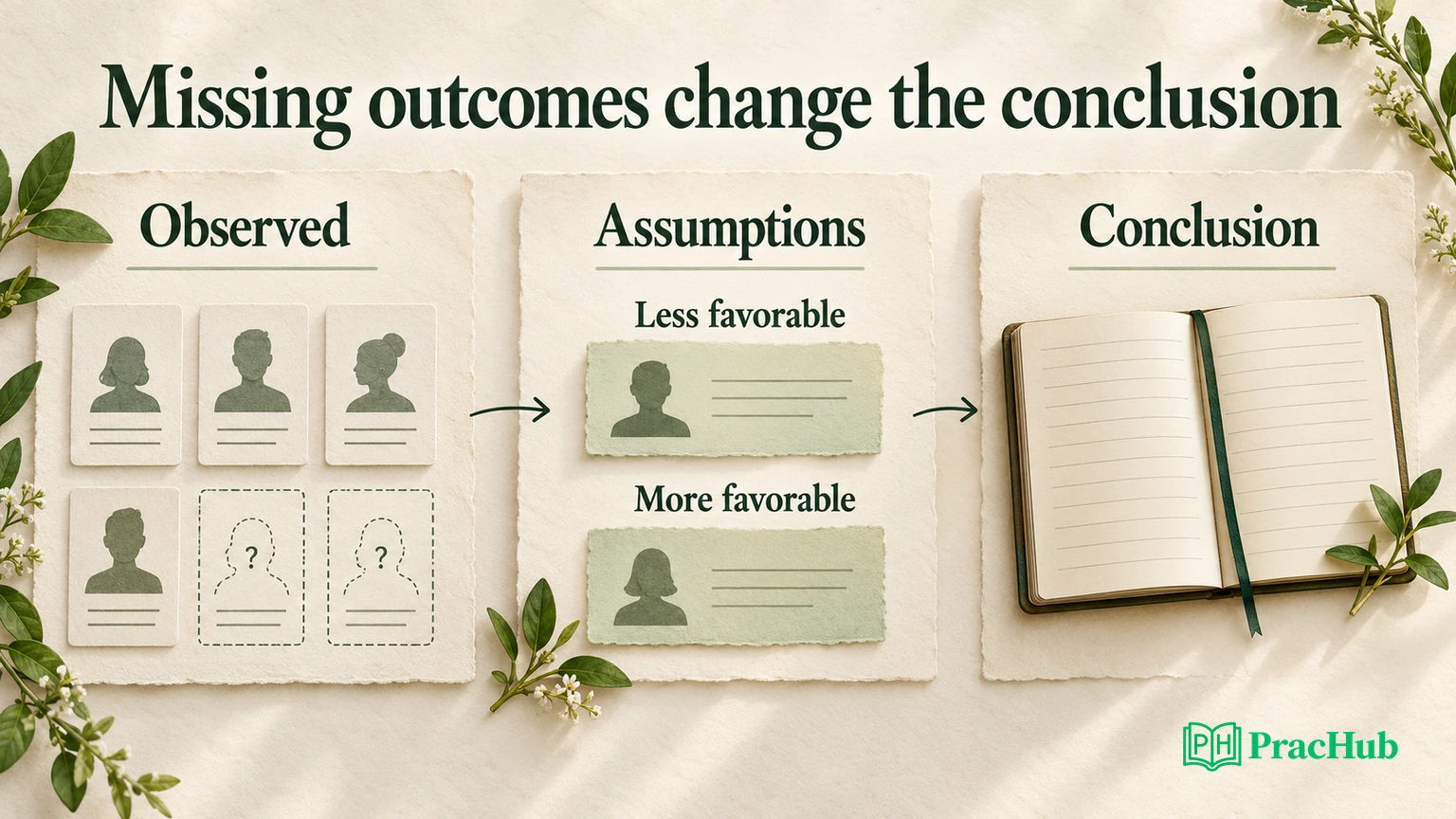
Every allocation between those extremes is compatible with the known responder counts. This calculation reveals how much the unknown outcomes can change the descriptive difference. It is not a confidence interval, a fitted sensitivity model, or a demonstration of statistical significance. The allocation bounds condition on these observed counts; they contain no calculation of repeated-sample uncertainty.
For an original challenge, suppose the interviewer asks whether the descriptive difference exceeds 10 percentage points. Both 2 and 32 are possible under the unknown allocations, so the available counts alone cannot settle that threshold. The threshold is an arbitrary teaching target, not a clinically meaningful effect size.
A formal robustness analysis would need a prespecified method and justified assumptions aligned to the intended effect. Sensitivity analysis examines assumptions for the same estimand. Supplementary analyses can add insights about that estimand or investigate other questions; they do not automatically replace a planned robustness assessment. Changing populations until a result looks stable does not isolate a particular assumption. Sensitivity and supplementary analysis.
Challenge covariate and endpoint choices
FDA's covariate guidance discusses prespecified prognostic baseline covariates to improve efficiency in randomized trials. Its scope is not a blanket justification for adjusting away confounding in observational studies or adding any variable that improves a fitted result. Covariate guidance.
If the case adds baseline severity, ask when it was measured, how it was planned for analysis, and which effect scale is intended. A post-treatment variable can carry a different interpretation. Do not add it to the primary model simply because it reduces a p-value.
Likewise, if week 12 is unfavorable but week 8 looks better, preserve the prespecified endpoint rather than silently substituting the attractive visit. FDA's multiple-endpoints guidance addresses grouping, ordering, and error control when making conclusions across multiple endpoints. Multiple endpoints.
In the interview, distinguish exploratory findings from planned confirmatory conclusions. You can investigate a surprising subgroup or time point while explaining that the analysis has a different evidential status. More tables do not create more independent support for the original claim.
Write a conclusion that survives review
A defensible case conclusion begins with what was observed: “Among observed week-12 outcomes, A had a 60% response proportion and B had 40%. Outcomes were unavailable for 10 of 50 and 5 of 50 randomized participants respectively.” Follow with the limitation: “The full-arm descriptive difference depends on unobserved outcomes, and this exercise has not fitted an inferential analysis.”
Then state the next decision. Confirm the intended treatment effect, resolve endpoint and event-handling rules, investigate missingness reasons, and agree an analysis and robustness assessment before interpreting efficacy. Do not turn the exercise into a treatment recommendation or claim that one endpoint captures the full benefit-risk profile.
For a project discussion, show how you documented such decisions and resolved disagreements with clinical and programming colleagues. Name your own contribution, the review evidence, and any unresolved limitations. A reproducible number and a defensible conclusion require different work, and the interviewer should be able to follow both.
Rehearse the transferable statistical reasoning
These PracHub prompts provide adjacent statistical and experimental reasoning. They do not replace clinical-trial expertise or establish a biostatistics employer's question bank.
| PracHub question | What to practice |
|---|---|
| Explain P-value, Confidence Interval, and Multiple Testing Adjustments | Separate estimands, estimates, intervals and error control. |
| Interpreting confidence intervals to choose a treatment | Challenge what uncertainty permits you to conclude about treatment. |
| Design causal study for reminder impact | Define allocation and outcome collection before a causal comparison. |
| Diagnose and fix selection bias in experiments | Explain how post-randomization selection changes the comparison. |
| Handle missing data and outliers robustly | State why a convenient missing-data default needs justification. |
Return to Explain P-value, Confidence Interval, and Multiple Testing Adjustments and give a short explanation of why the 2-to-32-point allocation range is not a confidence interval. Use the two-arm ledger to explain one observed comparison, one missing-outcome assumption, and one remaining uncertainty before choosing a test.
Comments (0)