Lambdia Review: Quant Questions, Worked Solutions, and Math Games
Quick Overview
Review Lambdia’s quant catalog, an openly readable probability derivation and one Quant Sprint answer. An original finite-state selection example and answer audit distinguish timed recognition from conditional reasoning, with separate browser, email-sample and paid-book access.
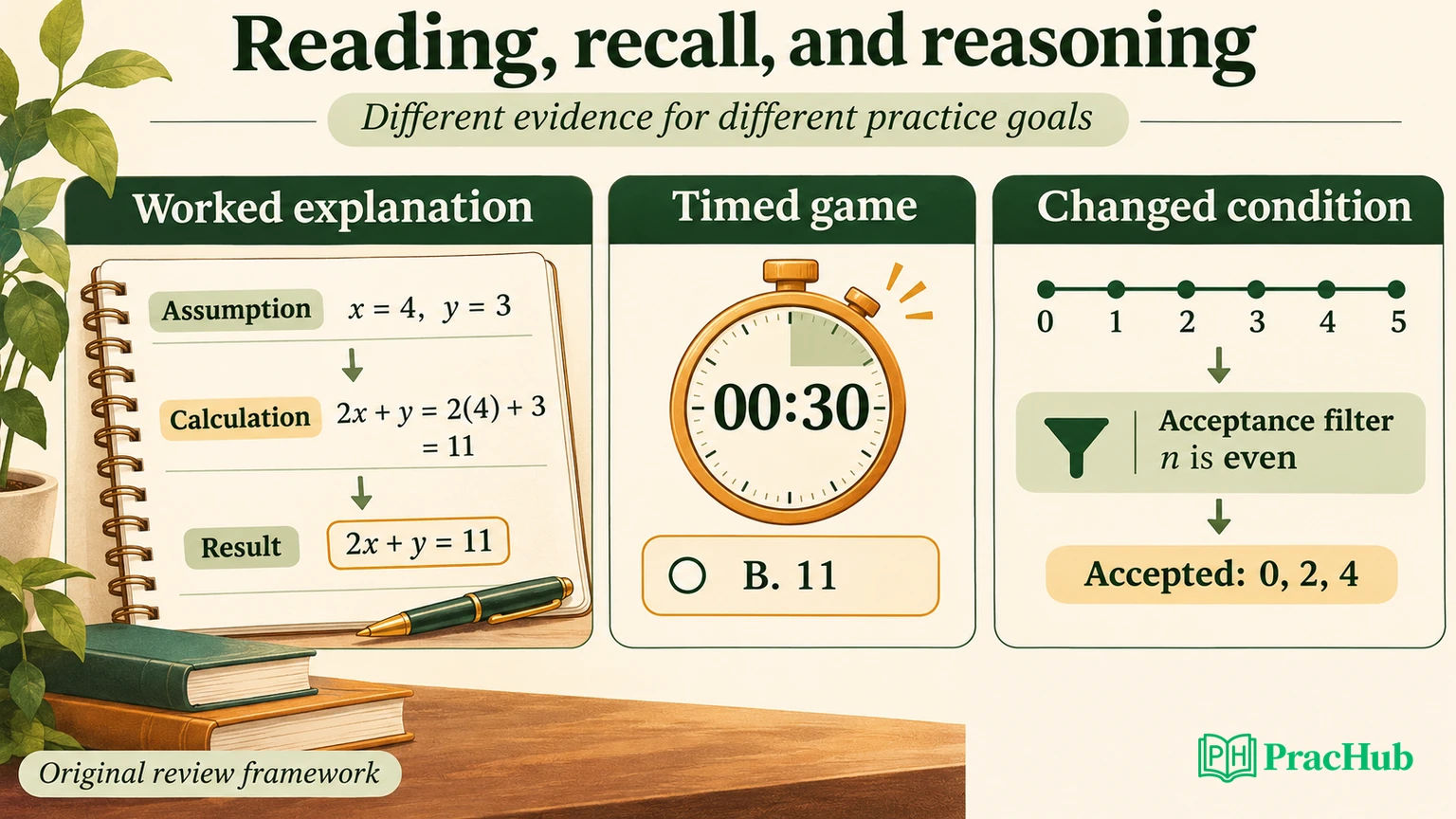
Lambdia is useful to inspect if you want quant questions explained through assumptions and worked reasoning, alongside a timed browser game. We could read a complete probability explanation and answer one game item without an account. A correct timed choice establishes less than a spoken derivation or a recalculation under a changed information rule.
PracHub publishes this review and owns the complementary practice links. Our expected-value and market-making question provides another task. The finite-state counterexample below is original educational work, independent of Lambdia’s games, articles or paid book.
What Lambdia currently puts in the browser
Provider positioning, checked November 3, 2026: Lambdia organizes quant preparation around probability, brainteasers, mental arithmetic, markets and related mathematics. Public navigation includes topic, level and format filters, classic problems, firm pages and games.
The homepage displayed a count of 165 worked questions. We did not count the collection, audit every answer or establish that the visible category counts represent disjoint sets. The number is a dated catalog statement, not a measurement of preparation coverage.
The site also connects its material to trading-desk interviews. We did not verify question provenance with employers or independently confirm the promotional testimonials. No same-cycle candidate reports establish hiring outcomes in this review.
We inspected current public pages, one complete explanation, one game answer and the book and sample routes. We did not create an account, buy a PDF or submit an email address.
A complete explanation exposed the assumption behind the answer
Direct observation: the Monty Hall problem page linked to a full explanation. It opened without login. The article used cases and conditional probabilities to explain the familiar switching result and contrasted it with a different host rule.
That sample is useful because it makes the observation process part of the problem. Knowing the famous numerical answer is not enough when the host’s knowledge or selection policy changes. The article supplied a derivation rather than only an answer key.
This observation covers the sampled explanation. We did not validate every equation across Lambdia, compare the library against a curriculum or test whether reading it improves retention. A strong sample can justify inspecting another topic; it does not establish the quality of the entire catalog.
Our interpretation: use worked solutions to identify the assumption that carries an argument. Before reopening the explanation, state that assumption in your own words and rebuild the calculation. If you can only repeat the conclusion, you have evidence of recognition rather than a reusable method.
The timed game gave immediate feedback on one choice
The public Practice game opened as Quant Sprint. Its introductory screen described a clock, a streak and right-or-wrong answer consequences. We selected Play and received a question showing a short position followed by a price increase.
We chose that the position lost money. The page displayed Correct, a score increase of twenty-five and a streak of one, then advanced to a different question. We stopped after that single answered item. No account, purchased attempt or complete game score was involved.
The saved result records this question and its returned feedback. It does not measure our overall quant readiness, question difficulty distribution or the game’s long-term scoring behavior. We did not deliberately submit a wrong answer to test the time penalty or play every advertised category.
A short-position direction question can test fast recognition. It does not require a spoken explanation of financing, transaction costs or risk, and our observed item did not establish those abilities. Choose the practice format against the skill you want to demonstrate.
For an interview, follow a quick choice with an explanation of the position and the direction of its payoff. For a probability item, define the sample space. These additions supply evidence that a multiple-choice result alone cannot capture.
Original counterexample: the same price has a different conditional payoff
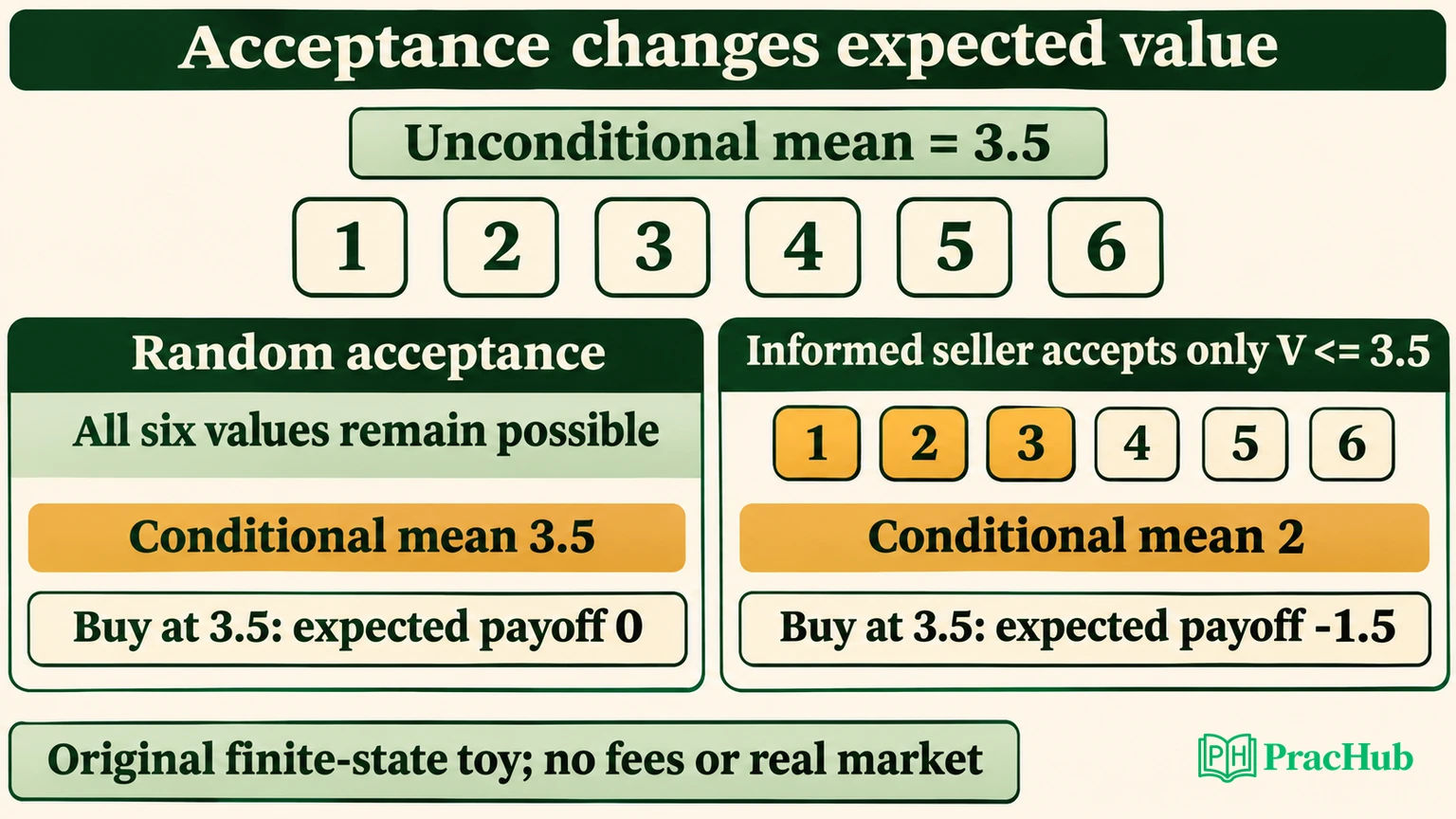
Our invented game has a hidden value V, equally likely to be one, two, three, four, five or six. You may buy one claim paying V at the end for a fixed price of 3.5. There are no fees, financing, inventory limits or real securities. It is a finite probability exercise, not a trading recommendation.
Before any selection, the mean value is 3.5. If participation is independent of V, buying at 3.5 has expected payoff zero. The arithmetic is the sum of the six equally likely payoffs divided by six.
Now change one rule. The seller sees V and accepts your purchase only when V is at most 3.5. An accepted purchase therefore implies V is one, two or three. Their conditional mean is two, giving expected payoff two minus 3.5, or negative 1.5 per accepted purchase.
The prior distribution and offered price did not change. The acceptance rule selected which values reached you. Using the unconditional mean after observing acceptance answers the wrong question.
| Acceptance policy | Values among accepted purchases | Conditional mean | Expected payoff at price 3.5 |
|---|---|---|---|
| Independent of hidden value | 1, 2, 3, 4, 5, 6 | 3.5 | 0 |
| Informed seller accepts only V at most 3.5 | 1, 2, 3 | 2 | −1.5 |
We checked these values with an exact-fraction Python calculation. It enumerated the six states, filtered the informed-acceptance states and confirmed the conditional means and payoffs. This is exact arithmetic for the supplied toy rules, not a simulation of actual markets or a Lambdia exercise result.
Do not confuse payoff per accepted trade with payoff per opportunity
The conditioning event also changes the denominator. In the informed-seller toy, acceptance occurs in three of six states. Expected payoff per accepted purchase is negative 1.5. If rejected opportunities have zero payoff, expected payoff per offered opportunity is half that, negative 0.75.
The two numbers answer different questions. A candidate who quotes one without specifying the unit leaves the decision ambiguous. The exact-fraction calculation checked both quantities and their relationship.
Suppose the interviewer changes the seller policy again. Perhaps acceptance is independent of V, or the seller sees only noisy information. You need the new acceptance probabilities before recalculating the posterior. Repeating negative 1.5 would be as unjustified as repeating the unconditional mean.
A useful spoken answer starts with the prior, names the evidence and explains how the rule selects states. Only then does it calculate the conditional expectation. This ordering makes it easier for an interviewer to locate an incorrect assumption or arithmetic step.
The worked reading and timed game can support different parts of that process. Reading can expose a derivation; timed choices can rehearse recognition. To test transfer, change the information rule and derive a result without options. We did not test that learning transfer in Lambdia.
An independent answer audit for worked solutions
Use the following audit on the sampled explanation or a future problem. It is our original study tool, not a Lambdia scorecard or a certification rubric. Its purpose is to make an answer inspectable.
| Check | Evidence to put in your answer |
|---|---|
| Sample space | Which hidden states are possible and how they are weighted |
| Information | What each participant knows when choosing an action |
| Selection rule | Why this observation or accepted action occurs |
| Quantity | Conditional mean, payoff per acceptance or payoff per opportunity |
| Changed condition | A recalculation after one rule changes |
For our toy, a deliberately incomplete answer is “the mean is 3.5, so the purchase is fair.” It states an unconditional calculation while ignoring informed acceptance. Adding the word “conditional” does not fix it; the accepted states and their weights must change.
A better revision identifies the three remaining values, computes their mean and states the payoff unit. If you disagree with a worked solution, compare those inputs before comparing final numbers. Different assumptions can explain different answers without either calculation containing an arithmetic mistake.
Then try a boundary case. If no state satisfies a proposed acceptance rule, there is no accepted-purchase conditional mean to report. Do not silently treat an empty conditioning set as zero. Our toy at 3.5 avoids that boundary, but the question is useful when generalizing it.
Browser reading, email samples and the Playbook are separate paths
The Playbook page promotes a downloadable PDF and displayed a $59 offer against a higher comparison price. We did not proceed to checkout, buy it, inspect the full PDF or test updates and refunds. Promotional urgency and testimonials do not verify the product’s effect on interview outcomes.
The page used both 411 and 412 in descriptions of its page count. We did not resolve that variation or treat it as evidence about a particular edition. Confirm the current deliverable if that detail matters to a purchase.
Selecting Sample chapters opened a free-sample form asking for an email address. It described a thirteen-page sample and a subsequent interview-technique email series. We did not submit the form or download a sample. “Free” in that path therefore did not mean an immediately opened anonymous PDF.
| Resource | What we reached | Boundary preserved |
|---|---|---|
| Full sampled browser article | Public derivation without login | Other articles not comprehensively audited |
| Quant Sprint | One answered item and feedback | No full run or readiness claim |
| Sample chapters | Email form with series disclosure | No address submitted or sample inspected |
| Playbook | Sales page and displayed offer | No purchase, PDF or refund test |
Assess the paid book against the deliverable you need. The paid page’s contributor and reviewer descriptions are provider claims that we did not independently authenticate. They do not replace inspection of the actual material you intend to use.
What the observed formats can and cannot tell you
Lambdia’s useful public distinction is between seeing the reasoning and answering under a clock. Our sample demonstrated both surfaces in a small way. Neither observation establishes a complete mock interview, employer-specific evaluation or calibrated readiness diagnosis.
If your weakness is conditional probability, a fast answer streak may conceal it. Work the selection counterexample aloud and state which denominator you are using. If your weakness is rapid arithmetic, a carefully read derivation alone may not address the timing problem.
Preserve a short record of the original answer, the rule you overlooked and the corrected calculation. A later attempt is informative when it repairs that reasoning under a changed condition. We did not measure retention or compare Lambdia with a controlled alternative.
Practice the gaps the product leaves open
These independent PracHub prompts extend the probability and decision reasoning. They are not Lambdia game items, Playbook exercises or independently verified employer attributions.
| PracHub question | What to examine |
|---|---|
| Quant Trading Game: Expected-Value Betting and Market Making on Coins, Dice, and Cards | Define what information a counterpart has before calculating a price. |
| Calculate Expected Payoff from Two Dice | State the sample space and compare an unconditional payoff with a selected one. |
| Calculate the Probability That Two Dice Sum to Seven | Distinguish ordered dice outcomes from the number of possible sums. |
| Use Bayes to interpret a broken radar alarm | Write the observation mechanism before applying conditional probability. |
| Compute expansion profits and expected value | Connect an expectation calculation to the stated decision and constraints. |
Who should inspect Lambdia next
Lambdia is worth sampling for candidates who want public quant explanations with explicit assumptions and a separate timed game. Start with an accessible article before deciding whether you need an account, email sample or paid book. The reviewed pages do not establish an employer’s current process or a hiring guarantee.
Try the expected-value prompt and write two answers: one before acceptance is observed and one afterward. Explain why the seller’s rule changes the state set. That concrete derivation will tell you more about your next practice need than a remembered numerical answer alone.
Comments (0)