Levels.fyi Level Mapping: Google L4 vs Meta E4 vs Amazon L5
Quick Overview
Google L4, Meta E4, and Amazon L5 are often treated as equivalent mid-level software engineering roles, but their scope, interview signals, and compensation structures differ. This guide uses July 2026 Levels.fyi data to compare reported US total compensation, explains what each company evaluates in coding, system design, and behavioral rounds, and provides a 14-day company-specific preparation plan using PracHub.
Google L4, Meta E4, and Amazon L5 often appear next to one another in Big Tech level comparisons.
That does not mean the jobs, interviews, or offers are interchangeable.
All three are commonly treated as mid-level software engineering roles. Yet Google may reward broad algorithmic strength and calibrated technical judgment, Meta may put more pressure on coding speed and ownership, and Amazon may weigh Leadership Principles as heavily as technical execution.
Before using salary data to set your expectations, test whether you are ready for the interview that produces that level. Start with real interview questions and written solutions, then compare the current Google SWE question set, Meta SWE question set, and Amazon SWE question set.
Levels.fyihelps you understand what a level may pay. PracHub helps you practice what you must demonstrate to earn it.
Quick Answer: Are Google L4, Meta E4, and Amazon L5 Equivalent?
They are roughly comparable mid-level roles, but they are not exact equivalents.
A useful shorthand is:
- Google L4: SWE III, a mid-level engineer expected to work independently on meaningful problems.
- Meta E4: A mid-level engineer expected to execute quickly, own projects, and operate with increasing autonomy.
- Amazon L5: SDE II, a mid-level engineer expected to deliver independently and demonstrate strong ownership through Amazon's Leadership Principles.
The overlap is real:
- Independent execution
- Solid coding fundamentals
- Ownership of moderately complex work
- Clear technical communication
- Ability to handle ambiguity without constant direction
- Impact beyond completing isolated tickets
The differences are also real:
- Interview structure
- Coding pace
- Design expectations
- Behavioral evaluation
- Team scope
- Compensation mix
- How interview feedback affects leveling
Treat the mapping as a starting hypothesis, not a promise.
What Levels.fyi Level Mapping Actually Means
Levels.fyi exists partly because software engineering titles are inconsistent.
One company calls a role "Software Engineer III." Another calls a similar role "SDE II." A third uses only an internal code such as E4.
The Levels.fyi Standard SWE Level Framework explains that cross-company comparisons usually rely on recurring dimensions such as:
- Ambiguity
- Scope of work
- Impact
- Technical knowledge
- Ability to execute
- Communication
- Process improvement
That framework is more useful than comparing title numbers.
Google L4 is not comparable to Amazon L4 simply because both contain the number four. Amazon L4 is generally entry level, while Google L4 is a step above Google's entry-level L3.
Similarly, Meta E4 is not automatically "lower" than Amazon L5 because four is smaller than five.
Compare scope, not digits.
2026 Compensation Snapshot
The following figures were displayed by Levels.fyi for United States software engineering roles when this guide was reviewed in July 2026.
They are crowdsourced averages, not guaranteed offers.
Google L4 Compensation
The Google L4 salary page listed average annual total compensation of about $291K:
- Base salary: about $193K
- Annualized stock: about $76K
- Bonus: about $22K
Levels.fyi labels Google L4 as SWE III.
Meta E4 Compensation
The Meta software engineer salary page listed average annual total compensation of about $287K for E4:
- Base salary: about $187K
- Annualized stock: about $86K
- Bonus: about $14K
Meta E4 sits between entry-level E3 and senior-level E5.
Amazon L5 Compensation
The Amazon software engineer salary page listed average annual total compensation of about $272K for L5:
- Base salary: about $179K
- Annualized stock: about $90K
- Bonus: about $2K
Levels.fyi labels Amazon L5 as SDE II.
Why Similar Total Compensation Can Feel Different
The headline TC numbers are close, but the packages are not identical.
You still need to compare:
- Base salary
- Initial equity grant
- Vesting schedule
- Signing bonus
- Annual performance bonus
- Refresher grants
- Stock-price assumptions
- Location adjustments
- Benefits
- Promotion timeline
Amazon's traditional stock vesting is especially important. Levels.fyi currently shows a back-loaded 5%, 15%, 40%, 40% schedule for Amazon RSUs, while Google commonly uses front-loaded schedules. Comparing only "annual TC" can hide meaningful differences in when compensation arrives.
Use salary data to build a range, not to predict an exact offer.
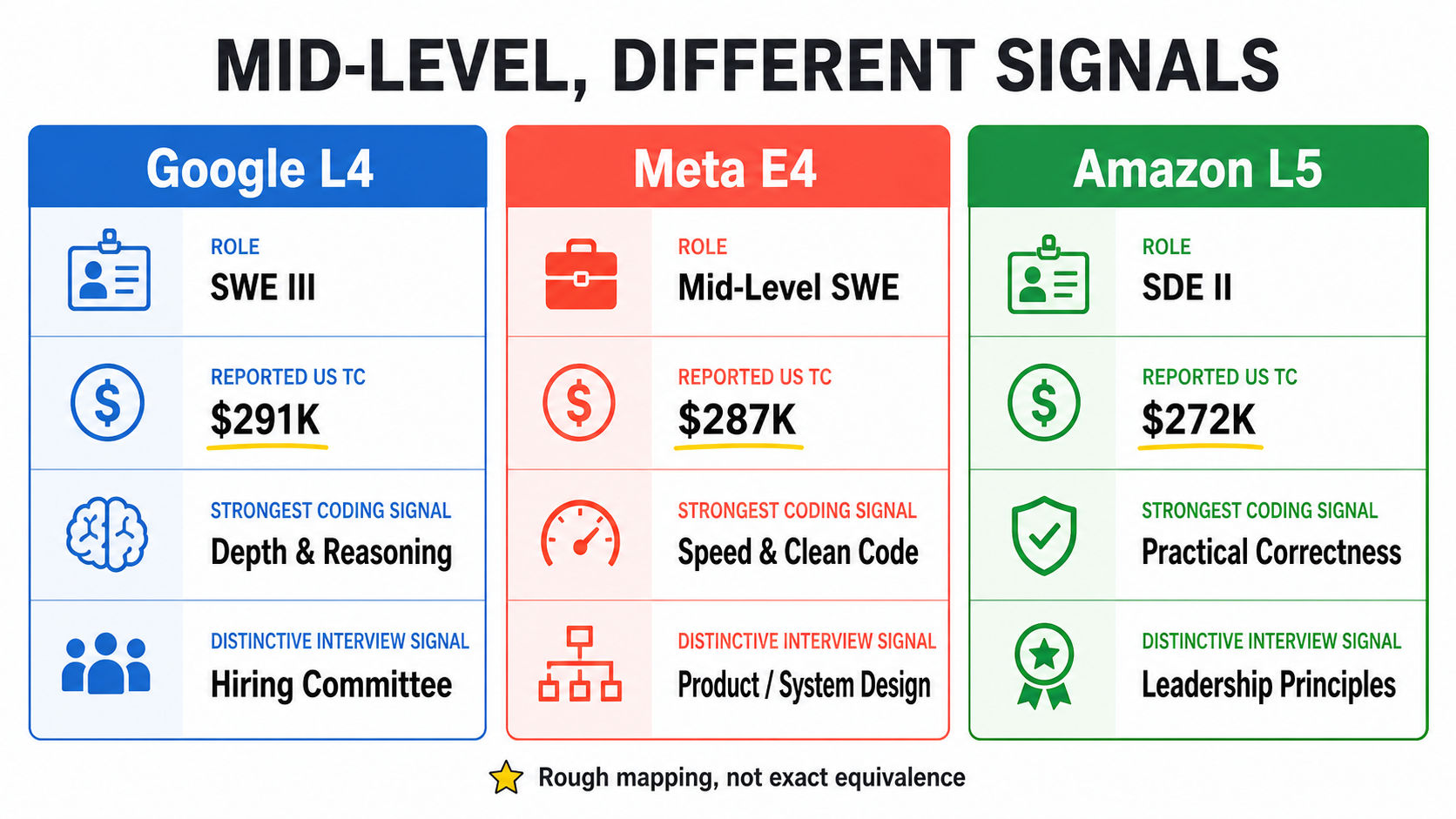
Google L4, Meta E4, and Amazon L5 occupy a similar mid-level band, but each company rewards different interview signals.
Google L4: Scope and Interview Expectations
Google L4 is commonly labeled SWE III.
It is usually a mid-level individual contributor role for engineers who can solve meaningful technical problems with limited day-to-day guidance.
What Google L4 Scope Usually Signals
An L4 engineer is generally expected to:
- Own well-defined projects or substantial components
- Break ambiguous technical tasks into workable plans
- Write production-quality code
- Make sound design decisions within a team
- Communicate tradeoffs clearly
- Collaborate across engineering and adjacent functions
- Show impact beyond individual task completion
You do not need to demonstrate organization-wide technical leadership. That is closer to the bar for staff and higher levels.
You do need to show that you can operate independently.
What the Google L4 Interview Emphasizes
Google's interview process varies by team and hiring period, but the current PracHub Google SWE guide highlights:
- Data structures and algorithms
- Correct, readable coding
- Complexity analysis
- Clear problem-solving communication
- Googliness and leadership signals
- System design for some mid-level and higher loops
- Hiring committee review and team matching
At L4, do not assume that solving the coding prompt is enough.
Interviewers also look for:
- Good clarifying questions
- A structured approach
- Recognition of edge cases
- Ability to improve an initial solution
- Clean implementation
- Calm response to hints
Google L4 Preparation Priority
Spend most of your technical time on:
- Timed medium-level coding questions
- Trees, graphs, hashing, intervals, heaps, and dynamic programming
- Explaining complexity and alternatives out loud
- One or two system design sessions if your recruiter confirms a design round
- Behavioral stories that show collaboration, learning, and influence
Use the Google SWE question set to practice questions in company context instead of relying only on a generic list.
Meta E4: Scope and Interview Expectations
Meta E4 is also a mid-level individual contributor role.
The role often rewards engineers who can move quickly, own a feature or technical area, and deliver visible results with increasing independence.
What Meta E4 Scope Usually Signals
An E4 engineer is generally expected to:
- Execute independently on team-level projects
- Handle moderately ambiguous product or infrastructure work
- Write clean code quickly
- Own implementation from planning through launch
- Work effectively across functions
- Learn from feedback without requiring constant direction
- Show measurable project impact
Meta is known for a fast execution culture. Your examples should show both judgment and momentum.
What the Meta E4 Interview Emphasizes
The current PracHub Meta SWE guide describes a loop built around:
- Fast algorithmic coding
- Clear communication under time pressure
- System or product design
- Behavioral ownership
- Project impact
- Handling ambiguity
- Increasing use of AI-enabled coding formats in some 2026 loops
Meta coding interviews often reward pace more visibly than candidates expect.
You may need to:
- Understand the problem quickly
- Select the right pattern without a long warm-up
- Produce correct code with limited debugging support
- Dry-run edge cases manually
- Explain while continuing to make progress
Meta E4 Preparation Priority
Spend most of your technical time on:
- Solving two medium problems inside a 45-minute block
- Arrays, strings, trees, graphs, heaps, and interval patterns
- Writing code without depending on an IDE
- Product-oriented system design fundamentals
- Behavioral stories about speed, ownership, conflict, and growth
Use the Meta SWE question set to calibrate your pace against real interview-style prompts.
Amazon L5: Scope and Interview Expectations
Amazon L5 is commonly labeled SDE II.
Like Google L4 and Meta E4, it is generally a mid-level engineering role. However, Amazon's evaluation model makes behavioral preparation unusually important.
What Amazon L5 Scope Usually Signals
An L5 engineer is generally expected to:
- Deliver medium-sized projects independently
- Own technical decisions within a defined area
- Write maintainable production code
- Participate in system and API design
- Raise risks early
- Work backward from customer needs
- Demonstrate operational ownership
- Influence teammates through clear reasoning
An L5 story should show more than participation.
The interviewer wants to understand what you decided, what changed because of your actions, and what measurable result followed.
What the Amazon L5 Interview Emphasizes
The current PracHub Amazon SWE guide emphasizes:
- Coding and algorithms
- Software engineering fundamentals
- Low-level or object-oriented design
- System design
- Leadership Principles
- Behavioral deep dives
- A Bar Raiser in the final loop
At Amazon, behavioral questions are not a soft closing conversation.
They are scored evidence.
Expect interviewers to ask:
- What was your exact contribution?
- What data supported the decision?
- What tradeoff did you make?
- What did you do when others disagreed?
- What would you change?
- How did the customer benefit?
Amazon L5 Preparation Priority
Spend your preparation time across three equal tracks:
- Timed coding with edge-case testing
- Practical system and object-oriented design
- Six to eight detailed Leadership Principles stories
Use the Amazon SWE question set and behavioral interview practice together. Strong code cannot rescue vague ownership stories in an Amazon loop.
Google L4 vs Meta E4 vs Amazon L5: The Real Differences
The levels overlap, but the preparation strategy should not.
Coding
Google L4: Prioritize depth, correctness, algorithmic reasoning, and improvement from a basic solution to a stronger one.
Meta E4: Prioritize speed, clean implementation, pattern recognition, and consistent performance across multiple coding rounds.
Amazon L5: Prioritize correctness, practical engineering judgment, edge cases, and communication alongside behavioral evidence.
System Design
Google L4: Design expectations vary. Confirm with the recruiter. Some L4 loops are heavily coding-oriented, while others include design depending on role and experience.
Meta E4: Expect product or system design to matter in many experienced-hire loops. Scope quickly and communicate tradeoffs clearly.
Amazon L5: Prepare for system design, low-level design, or both. Tie decisions to customer impact, operational concerns, and maintainability.
Practice with current system design questions, then narrow to the company-specific category.
Behavioral Evaluation
Google L4: Show collaboration, learning, leadership without authority, and thoughtful decision-making.
Meta E4: Show ownership, speed, direct communication, adaptability, and measurable impact.
Amazon L5: Build detailed STAR stories mapped to Leadership Principles, with evidence that survives repeated follow-up questions.
Leveling Risk
Interviewing for one level does not always guarantee that exact outcome.
A company may:
- Confirm the target level
- Down-level the offer
- Occasionally up-level a strong candidate
- Decline because the evidence is inconsistent
- Reconsider level during team matching or offer approval
The details vary by company and hiring process.
The practical lesson is the same: prepare for the next level's signals, not only the minimum bar for the current one.
How Interview Performance Can Change the Level
Leveling is not determined by years of experience alone.
Your resume sets an initial hypothesis. The interview produces evidence.
Strong Coding Is Necessary but Not Sufficient
For a mid-level role, interviewers expect more than memorized patterns.
They want to see:
- Independent problem decomposition
- Sound assumptions
- Clean execution
- Recovery after mistakes
- Testing discipline
- Communication
- Technical judgment
A candidate who solves every question but needs constant steering may be assessed below the target level.
Design Reveals Scope
System design is one of the clearest places to distinguish levels.
A weaker response lists components.
A stronger mid-level response:
- Clarifies requirements
- Defines scale
- Chooses a workable data model
- Explains APIs
- Identifies bottlenecks
- Makes explicit tradeoffs
- Handles failure cases
- Knows where not to over-engineer
That is why random coding practice alone can leave a candidate underprepared for L4, E4, or L5.
Behavioral Stories Prove Ownership
Behavioral interviews reveal whether your past scope matches your target level.
Prepare stories that show:
- A project you owned
- A difficult technical tradeoff
- A disagreement you resolved
- A production issue you handled
- A failure and what changed afterward
- A measurable improvement
Use behavioral and leadership questions to practice follow-ups, not just polished opening answers.
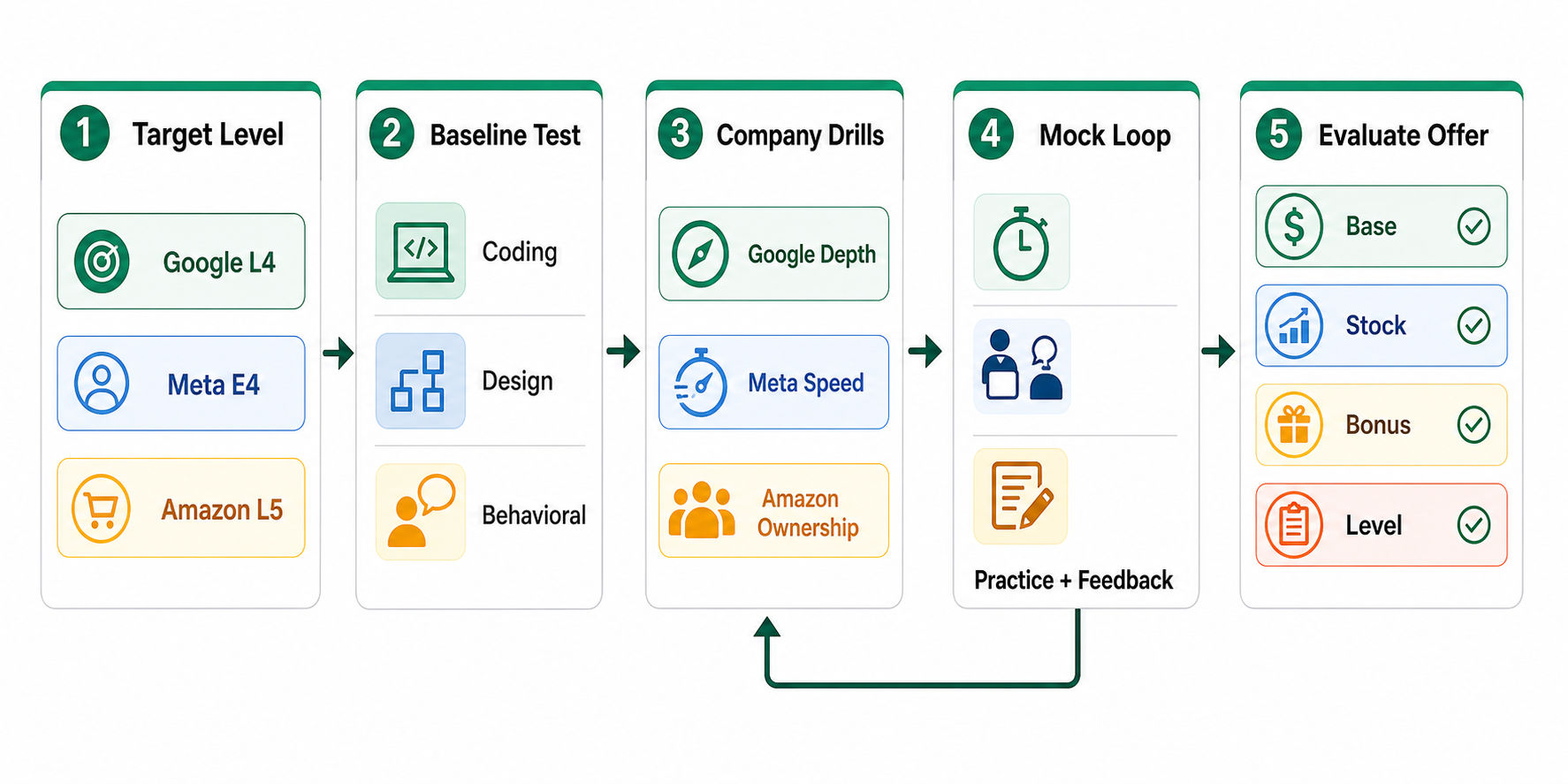
Use this workflow to turn a target level into company-specific practice, mock interviews, and offer evaluation.
A 14-Day Mid-Level Interview Prep Plan
Do not divide your time equally across every topic.
Use the first two days to diagnose, then spend the remaining days on the company-specific gap.
Days 1-2: Establish the Baseline
Complete:
- Two timed coding questions
- One system design prompt
- Two behavioral questions
Score yourself on correctness, speed, independence, communication, and follow-up depth.
Days 3-5: Repair Coding Gaps
Focus on the patterns that caused the most delay.
For Google, emphasize depth and reasoning.
For Meta, emphasize pace and clean execution.
For Amazon, combine coding with testability and practical tradeoffs.
Days 6-8: Build Design Judgment
Practice three designs:
- A product system such as news feed or chat
- An infrastructure system such as rate limiter or job scheduler
- A design associated with your target company
State assumptions and tradeoffs out loud.
Days 9-10: Build the Behavioral Bank
Write six stories.
Each story should include:
- Situation in one or two sentences
- Your specific responsibility
- The decision or conflict
- Your actions
- A measurable result
- What you learned
For Amazon, map every story to one or more Leadership Principles.
Days 11-12: Run Company-Specific Mocks
Use the company set that matches your target:
Simulate the expected pace and follow-up style.
Days 13-14: Review, Do Not Cram
Reattempt missed questions.
Review one-page notes for:
- Coding patterns
- Design framework
- Behavioral stories
- Questions for the interviewer
- Level and compensation assumptions
Sleep matters more than one final random hard problem.
How to Use Levels.fyi Without Misreading the Data
Levels.fyi is powerful when you filter carefully.
Match the Exact Level
Do not compare a Google L4 offer with Google's company-wide SWE median.
Use the level-specific page.
Match the Location
Compensation varies by country and metro area.
A Bay Area package is not automatically the correct benchmark for a remote role or another city.
Check Recency
Stock prices, hiring conditions, and compensation bands change.
Prioritize recent submissions and note when the aggregate page was last updated.
Separate New Offers From Ongoing Compensation
An existing employee's compensation may include refreshers, promotions, or stock appreciation.
A new-hire offer can have a different structure.
Compare Components, Not Only Total
Two packages with the same headline TC can produce different cash flow and risk.
Compare base, bonus, vesting, refreshers, and liquidity.
Treat the Number as a Range
Crowdsourced data is evidence, not a contractual band.
Your actual offer depends on:
- Location
- Team
- Experience
- Interview performance
- Competing offers
- Hiring urgency
- Negotiation
- Equity assumptions
Use the data to ask better questions, not to demand one exact number.
FAQ
Is Google L4 the Same as Meta E4?
They are often mapped as comparable mid-level software engineering roles, but they are not identical.
Google L4 is labeled SWE III, while Meta E4 uses a different internal framework and may emphasize faster coding execution and product ownership. Compare role scope and interview expectations, not only the labels.
Is Google L4 the Same as Amazon L5?
They are commonly treated as rough equivalents in cross-company maps.
Amazon L5 is SDE II and places unusually heavy weight on Leadership Principles and ownership evidence. Google L4 tends to emphasize broad algorithmic reasoning, coding quality, and calibrated technical judgment.
Is Meta E4 the Same as Amazon L5?
They occupy a similar mid-level band, but their interview signals differ.
Meta E4 often emphasizes speed, autonomy, and product or system thinking. Amazon L5 combines coding and design with rigorous behavioral evaluation.
Which Level Pays the Most?
At the time of this July 2026 review, Levels.fyi displayed average annual total compensation of roughly $291K for Google L4, $287K for Meta E4, and $272K for Amazon L5 in the United States.
These are changing crowdsourced averages. Location, stock value, vesting, and offer timing can reverse the comparison for an individual candidate.
Can I Be Down-Leveled After the Interview?
Yes, some companies may offer a lower level when the interview evidence does not consistently support the target scope.
Processes vary, so ask your recruiter how leveling decisions work and whether the role can be considered at more than one level.
Should I Prepare for System Design at These Levels?
Yes, but confirm the exact loop.
Meta E4 and Amazon L5 candidates commonly benefit from system design preparation. Google L4 design expectations can vary by role and recruiter guidance. All three candidates should at least understand requirements, APIs, data models, scaling basics, and tradeoffs.
How Should I Choose Between Google, Meta, and Amazon?
Do not choose on headline TC alone.
Compare:
- Role scope
- Team and manager
- Technical domain
- Growth path
- Work style
- Location
- Compensation structure
- Interview confidence
The best offer is the one that fits both your current strengths and the engineer you want to become.
Final Takeaway
Google L4, Meta E4, and Amazon L5 are useful comparison points, not interchangeable products.
Levels.fyi gives you the compensation and leveling map.
Your interview determines whether the company sees enough evidence to place you on that map.
Start with the PracHub question bank, choose Google, Meta, or Amazon, and run one timed coding question plus one behavioral question today. The result will tell you more about your target level than another hour of comparing salary charts.
Sources and Further Reading
Related Articles
Codeforces vs LeetCode for Interviews: Competitive Programming or Targeted Prep?
Codeforces vs LeetCode for interviews: compare problem style, difficulty, speed, communication gaps, and the best 2026 prep strategy.
Is Coding Interview University Enough for Technical Interviews in 2026?
Is Coding Interview University enough in 2026? Review its free CS roadmap, time commitment, interview gaps, and the practice you still need.
Interview Cake Review 2026: Is the Coding Interview Course Still Worth It?
Interview Cake review for 2026: current pricing, course strengths, refund terms, limitations, and whether it is still worth buying for coding interviews.
Anduril Software Engineer Interview Guide 2026: Coding, Systems, and Mission Fit
Anduril software engineer interview guide for 2026: prepare for coding, systems design, project depth, role-specific skills, and mission fit.
Comments (0)