Optiver Likelihood List Assessment 2027: Probability Ranking, Charts, Timing, and Preparation
Quick Overview
An evidence-aware 2027 guide to Optiver's Likelihood List assessment: what official sources confirm, what current candidates report, how to rank outcomes from charts and tables, and how to prepare under time pressure.
The Optiver Likelihood List assessment is a ranking exercise: you compare possible outcomes and order them from most to least likely. Public 2027 role information confirms that selected applicants complete online assessments and must take them within the stated invitation window. Current candidate reports add a useful format clue—Likelihood List asks candidates to rank outcomes with limited time—but they do not establish one universal question count, score, cutoff, or timer for every office and role.
The most transferable preparation is therefore not memorizing a leaked replica. It is a four-step habit: lock the denominator, test whether one event contains another, compare conditional rates or trends, and commit with a short reason. That process is fast, auditable, and resilient when the scenarios rotate.
This guide separates official facts, same-cycle candidate reports, and preparation inferences. For practice, start with the Optiver interview questions on PracHub. These are training prompts, not a prediction of your private assessment.
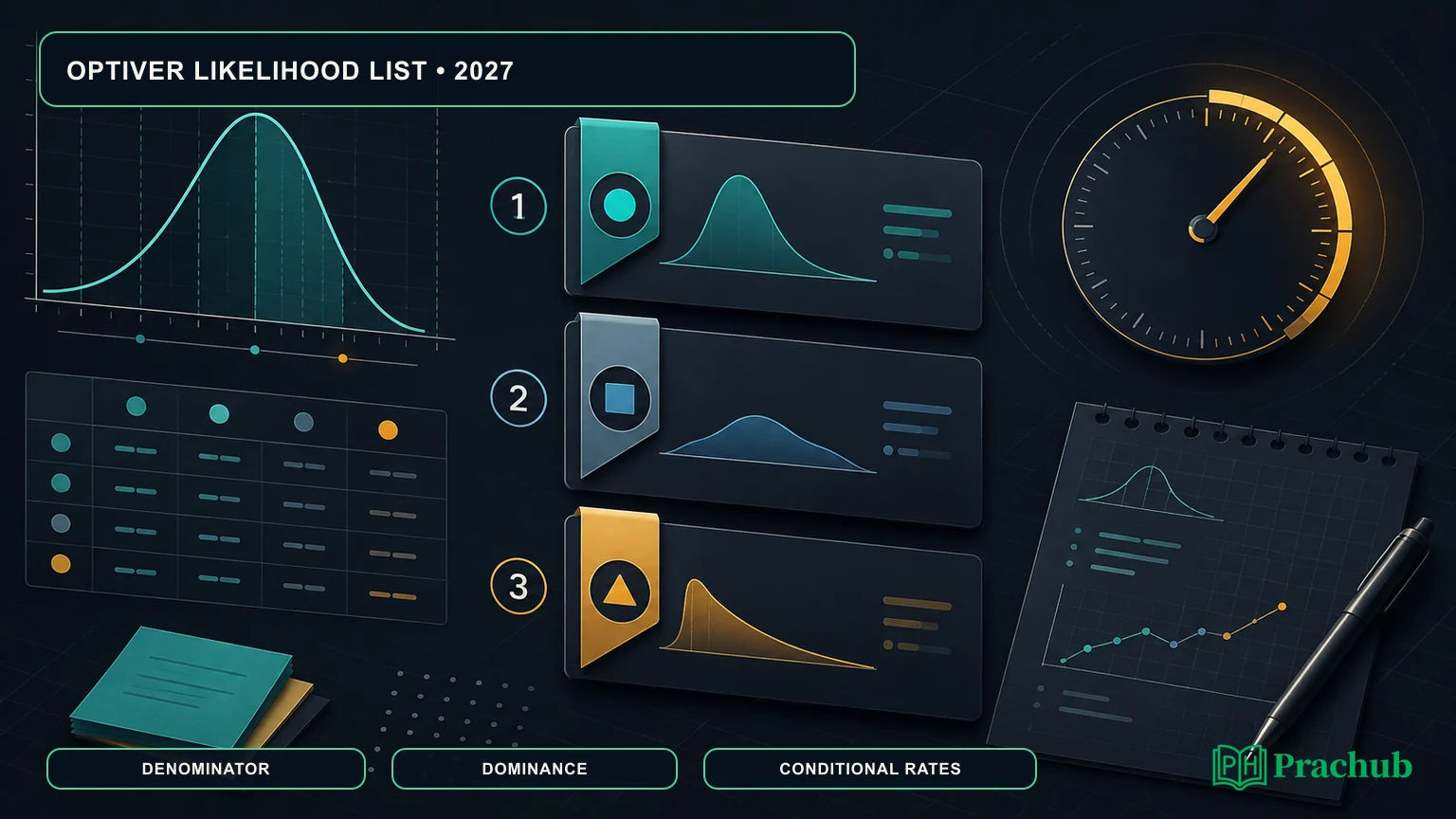
A candidate-ready ranking workflow: define the set, compare evidence, and record the decision.
Quick answer: what is confirmed for 2027?
Use the evidence level below when deciding what to prepare. “Official” means Optiver states it publicly; “candidate-reported” means a recent account or invitation description; “unknown” means there is not enough reliable public evidence to generalize.
| Evidence level | What it supports | What it does not prove |
|---|---|---|
| Official Optiver role and recruitment pages | Selected applicants complete online assessments; the invitation controls the available window; assessment results may be reused for a similar role. | A universal Likelihood List question count, order, score, cutoff, or per-item timer. |
| July–August 2026 candidate reports | Likelihood List appears as a distinct module that ranks possible outcomes; several candidates describe tight time pressure. | That every 2027 candidate sees the same module mix or exactly the same clock. |
| Your invitation and portal instructions | The binding rules for your attempt, including access window and any visible instructions. | A guarantee that an online discussion or third-party practice replica matches the real assessment. |
Optiver’s Europe recruitment FAQ also says an assessment can be completed only once every eight months, that a previous result may be reused for a similar role, and that a reset or retake is not offered within eight months after an attempt starts. Read the current FAQ and your invitation before acting; do not infer a retake policy from a practice site.
What “Likelihood List” is testing
The module name points to an ordering decision, not necessarily an exact decimal calculation. A prompt may give a table, chart, sequence of observations, or a set of events and ask you to place outcomes in descending likelihood. The fastest reliable answer usually comes from relationships that are stronger than a full computation:
- Subset or dominance: if event A can happen only when event B happens, then A cannot be more likely than B under the same sample space.
- Denominator discipline: compare rates using the same population, time window, and condition. A large count from a large group is not automatically the largest probability.
- Conditional reading: ask “among whom?” or “after what condition?” before comparing two percentages.
- Calibration: a chart that looks dramatic may be noisy when the sample is small; a modest but repeated gap may be the stronger signal.
Candidate reports commonly distinguish Likelihood List from modules such as Beat the Odds, NumberLogic, Intervals, Orderbooks, or Zap-N. That distinction is useful for organizing practice, but it is not an official promise that every role uses the same bundle. Prepare the reasoning pattern first, then follow the exact labels in your invite.
A worked ranking example (practice only)
Imagine two fair six-sided dice. Rank these outcomes from most to least likely:
- At least one die is a 6.
- The sum is at least 9.
- The sum is exactly 12.
There are 36 equally likely ordered pairs. “At least one 6” has 11 outcomes, “sum at least 9” has 10, and “sum exactly 12” has 1. The ranking is therefore at least one 6 > sum at least 9 > sum exactly 12.
The useful lesson is not the dice result. It is the audit trail: state the denominator, count only after translating the words into events, and check whether a narrower event is contained in a broader one. This is a made-up practice example, not a reported Optiver question.
If the prompt supplies a chart instead of a clean sample space, use the same structure. Write the population in one short phrase, identify the relevant slice, and only then compare bars or percentages.
How to read charts and tables quickly
When the visual is dense, scan in this order:
| Signal | Question to ask | Fast action |
|---|---|---|
| Denominator | What does one row, bar, or percentage represent? | Rewrite the population and time window in a few words. |
| Direction | Is a larger value actually “more likely,” or is it a loss/error rate? | Mark whether high or low is favorable before ranking. |
| Condition | Is the comparison unconditional or filtered by a prior event? | Compare like-with-like; do not mix slices. |
| Trend | Is the change repeated, or is it one noisy point? | Prefer the persistent pattern when the question asks for likelihood. |
| Bounds | Are any outcomes impossible, mutually exclusive, or exhaustive? | Use 0/1 bounds and totals to eliminate options first. |
For a table, read headers before cells. For a chart, read the axis and units before the bars. If two options remain close, state the smallest assumption that breaks the tie rather than inventing precision. A ranking question rewards a defensible order; it does not require a fake third decimal place.
Timing and triage when the scoring rule is unknown
Some candidate invitations describe limited time per question and roughly 25 minutes for the Likelihood List module. Treat that as a current report, not a universal 2027 contract. Because Optiver does not publish a single public scoring rule, do not assume that skipping, partial credit, or random guessing has a particular payoff unless your portal says so.
Use three passes:
- Classify (about a few seconds): identify the denominator, the event type, and whether a subset or impossible outcome settles the order.
- Compare: use dominance first, then conditional rates, then a quick count or expected-value calculation only if the visual leaves a real tie.
- Commit and log: select the order, retain one-line reasoning, and move on. Return only if the invitation explicitly allows review.
This is a decision protocol, not a promised timer. Practice it with a stopwatch that is slightly stricter than your comfort level, but always replace the rehearsal clock with the live instructions.
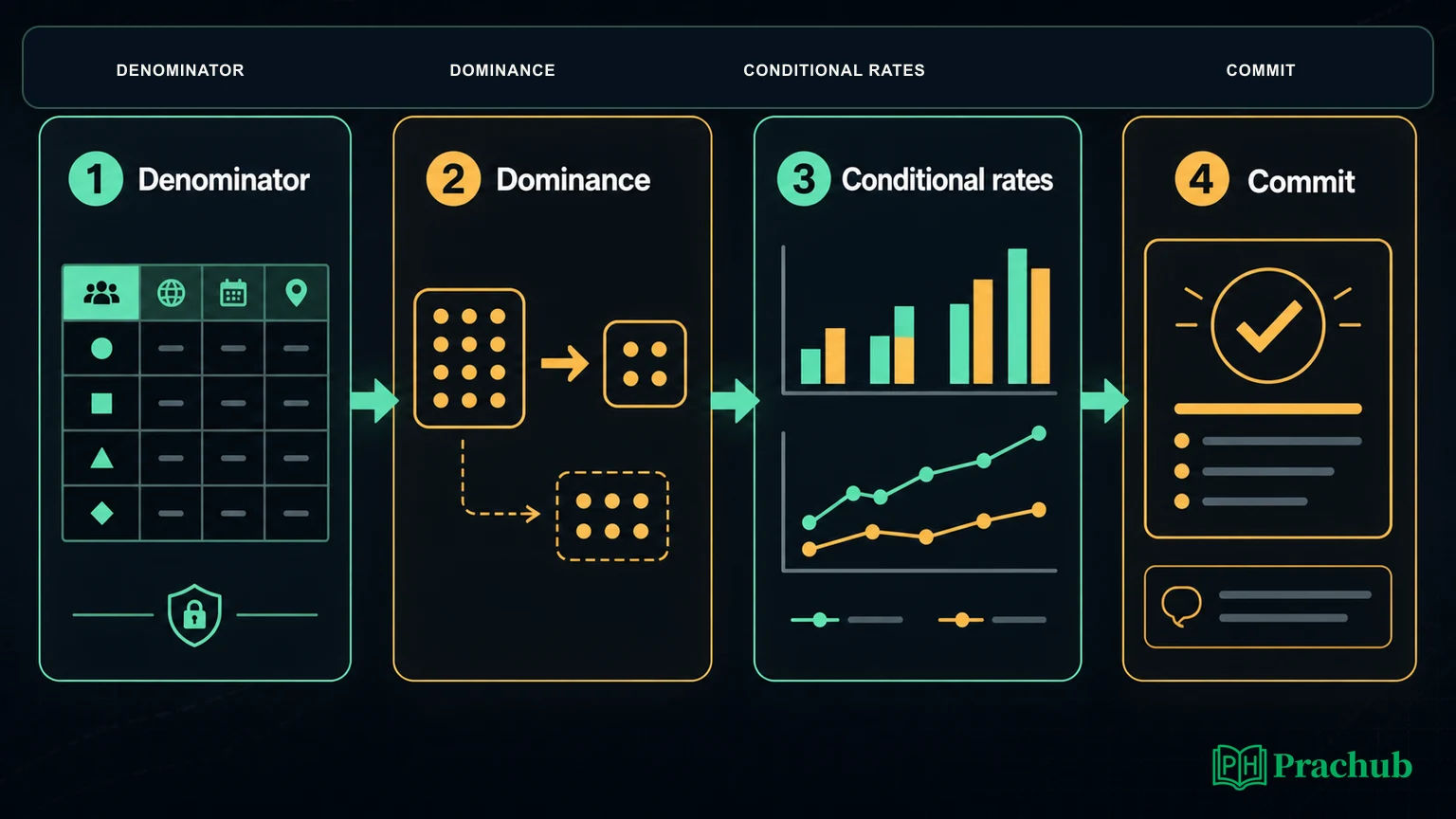
A compact decision map for turning a chart or table into a ranked answer.
Probability toolkit that pays off fastest
Focus on concepts that reduce mistakes under time pressure:
- Conditional probability: (P(A\mid B)=P(A\cap B)/P(B)). Say the condition aloud; it prevents denominator drift.
- Expected value: (E[X]=\sum_x xP(X=x)). Use it when a prompt asks which repeated choice has the better average outcome, not when it only asks for event likelihood.
- Independence: if events are independent, (P(A\cap B)=P(A)P(B)). Do not assume independence merely because two columns sit next to each other.
- Complements: “at least one” is often faster as (1-P(\text{none})); “exactly” usually needs a narrower count.
- Variance and sample size: a high-variance estimate can look extreme by chance. Treat uncertainty as a reason to inspect the sample, not as permission to reverse every trend.
- Odds and calibration: convert odds to probabilities only when the prompt’s definition is clear. Keep base rates separate from a conditional update.
You do not need advanced stochastic calculus to apply these ideas. There is also no public evidence that one advanced topic is a universal Likelihood List requirement. Let the role description and your invitation set the depth.
Common traps
- Comparing raw counts: 40 of 100 is more likely than 45 of 200, even though 45 is the larger count.
- Ignoring overlap: two outcomes can share cases; adding their percentages may exceed 100%.
- Flipping a condition: “probability of A given B” is not “probability of B given A.”
- Reading the story instead of the axes: labels, units, and time windows outrank an intuitive narrative.
- Overfitting a replica: an online post can be stale, copied, or role-specific. Use it to learn a method, never as a guaranteed question bank.
- Inventing a cutoff: no verified public Optiver source supplies a universal Likelihood List pass line for 2027.
Practice with Optiver questions on PracHub
These five prompts are selected for the ranking and calibration skills above. Their wording is practice material; it does not establish the contents of your assessment.
| PracHub question | What to practice |
|---|---|
| How to rank statements by likelihood | Translate verbal statements into comparable events and test dominance. |
| Market-Making Estimation Game: Optimal Confidence-Interval Strategy Over 5 Rounds | Calibrate ranges, sample uncertainty, and decision trade-offs. |
| Compute probabilities and expectations in random processes | Combine event probabilities with expected-value reasoning. |
| Analyze EV, arbitrage, and bet sizing across games | Separate likelihood from payoff and compare repeated choices. |
| Compute odds under time pressure | Build a short calculation path without losing the denominator. |
A focused five-day preparation plan
| Day | Work block | Evidence of readiness |
|---|---|---|
| 1 | Review complements, conditional probability, independence, and expected value. | Explain each concept without looking at notes. |
| 2 | Do ranking drills from tables and small charts. | State the denominator and rank before calculating. |
| 3 | Mix dominance, overlap, and noisy-sample questions. | Record why an attractive distractor fails. |
| 4 | Run two timed sets using the three-pass protocol. | Track avoidable errors, not just the final score. |
| 5 | Rehearse the actual setup and reread the invitation. | Confirm browser, time window, rules, and a calm stopping point. |
The plan is deliberately short. If your invitation names a different module mix, allocate practice time to that mix rather than forcing every topic into five days.
Assessment-day checklist
Before starting, confirm the access deadline and the rules shown in the invitation or portal. Use a stable connection, close unrelated tabs, and keep permitted scratch work ready. Do not use outside assistance if the assessment forbids it. During the module, read the instruction screen as the source of truth for navigation, review, and submission behavior.
After submitting, do not infer a result from how difficult one question felt. Optiver does not publicly publish a universal 2027 Likelihood List cutoff or a guaranteed feedback timeline. If you need a retake or have a technical issue, contact the recruiting channel named in your invitation; the public FAQ’s eight-month rule makes an impulsive restart especially risky.
FAQ
How many Likelihood List questions are there?
There is no verified public count that applies to every 2027 role or office. One July 2026 candidate invitation describes roughly 25 minutes overall and limited time per question, but your own invitation controls.
Is it the same as Beat the Odds?
Candidate invitations and reports list them as separate module names. They may share probability fundamentals, but that does not mean they use the same interface, scoring, or scenarios.
Do I need advanced mathematics?
Start with conditional probability, complements, expected value, event relationships, and chart reading. The public role description emphasizes quantitative and logical reasoning, but it does not publish an advanced-topic checklist for Likelihood List.
Is there a known pass cutoff or retake?
No universal public cutoff is verified. Optiver’s Europe FAQ says prior results may be reused for a similar role and that resets or retakes are not available within eight months after an attempt starts; follow the current FAQ and your recruiter’s instructions.
Final takeaway
Prepare for the Optiver Likelihood List assessment as a fast evidence-ranking problem. Define the population, exploit dominance and bounds, compare conditional rates, and commit without pretending that an unverified replica is the official test. Use the Optiver company hub on PracHub for targeted practice, then let your invitation—not a rumor—set the live rules.
Sources and Further Reading
- Optiver Quantitative Trading Internship 2027 (official role page)
- Optiver Europe Recruitment FAQ (official)
- Optiver Students and Graduates (official)
- r/quantfinance: Optiver assessment discussion, July 2026
- r/quantfinance: Optiver QR intern OA preparation, July 2026
- r/quantfinance: Optiver QR intern OA, August 2026
- Optiver interview questions on PracHub
Evidence checked September 4, 2026. Candidate reports are anecdotal and may vary by role, office, and cycle; official invitation and portal instructions take precedence.
Comments (0)