Scale AI Credo Interview: Turn Your Projects into Evidence for the Current Values
Quick Overview
Use current Scale AI values to select and defend project decisions, distinguish measured results from assumptions, and rehearse original follow-up prompts.
A Scale AI Credo interview is easier to prepare for when you can explain a decision, show what happened afterward, and name what your evidence does not establish. Agreeing with a value is a starting point. Your project history needs to make that agreement visible through choices, trade-offs, and follow-through.
Use the current values on Scale's careers page, then select projects where you personally changed an outcome. For practice, start with Scale AI Software Engineer questions on PracHub and identify a project discussion you can answer from your own experience.
This guide separates official values, a candidate report with uncertain cycle dating, and original preparation exercises. It does not claim a universal Credo format, scoring formula, or list of questions you will receive.
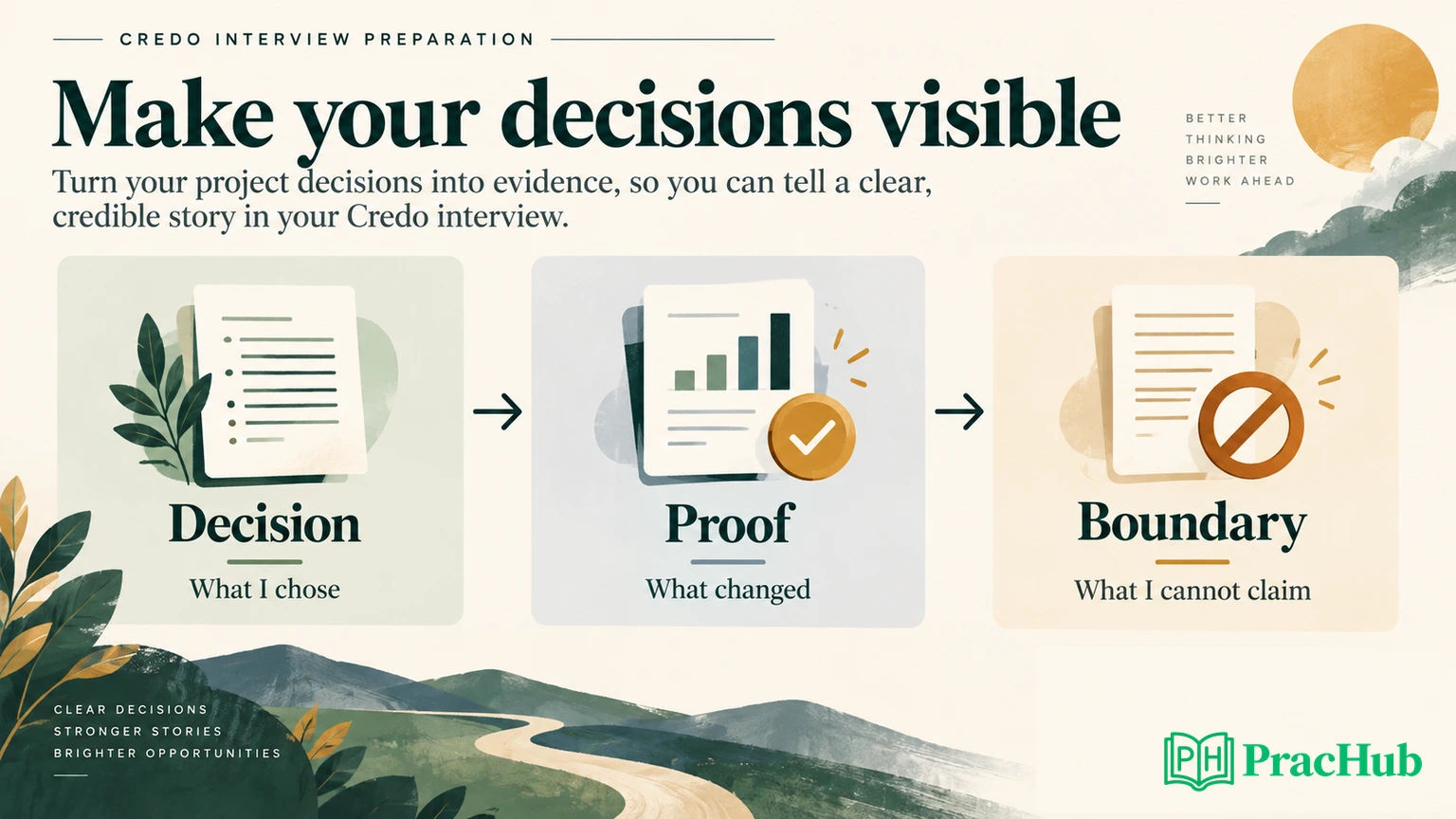
Start with the current Credos, then look for decisions
Official fact, checked September 8, 2026: Scale's careers page lists six internal values: Earn Customer Love, Team Flow, Quality is Our Cheat Code, Find the 20%, Write the Market, and Three Moves Ahead. The page describes a framework for decisions and teamwork. It does not publish a Credo interview scorecard.
Use that live page as your reference before the interview. A preparation article that uses different labels may describe an earlier version; do not combine several lists into an invented current framework.
Candidate report: an FDE interview account describes a Credo component and conversations about projects built end to end. The retrieved page versions display different year labels, so we could not establish its interview cycle confidently. It is also an adjacent-role account. It supports the existence of that experience, not a promise about your loop.
We did not verify two independent same-cycle accounts establishing the current Credo format. The exercises below are therefore preparation recommendations. Confirm the scope of your scheduled conversation with recruiting.
Instead of writing a speech for each value, search your project history with these prompts. These are our evidence prompts, not Scale's rubric.
| Project decision to recover | Evidence to prepare |
|---|---|
| Customer trust — When did you challenge a requested feature to solve the underlying problem? | User observation, alternative offered, and acceptance or rejection |
| Whole-team success — When did your local improvement create work elsewhere? | Handoff, shared decision, and downstream workload |
| Consistent quality — What check became part of the delivery system? | Failure it catches, owner, and evidence it kept working |
| Concentrated impact — What did you stop doing to finish the important work? | Competing options and a reason for the cut |
| Frontier work — What unfamiliar capability did you test against a useful baseline? | Experiment, limitation, and partner relevance |
| Downstream consequences — What happened after the immediate result? | Follow-on cost, dependency, or reversal trigger |
A project may cover several themes. Choose the one most clearly supported by your actions rather than forcing all six into every answer.
Build a project dossier you can defend
Choose a project with a consequential fork: two plausible approaches, incomplete information, and a decision you actually helped make. A small internal tool can provide better evidence than a large launch where your contribution was narrowly assigned.
Write down the user's problem before the technical solution. “We built an evaluation dashboard” describes an artifact. “Reviewers could not identify which model changes broke an important workflow” explains why the artifact mattered. Establish who those reviewers were and how you learned about the problem.
Next, separate your authority from your influence. You might have proposed a smaller pilot while a manager approved it and another engineer implemented the queue. Keep those roles intact. Saying “I proposed, compared, and measured” can show substantial ownership without claiming the whole team's implementation.
Record the rejected option too. If your story contains only the chosen solution, you lose the chance to explain judgment. Identify what made the alternative attractive, which constraint changed the decision, and what new information would have changed your mind.
Finally, collect the evidence you could describe without exposing confidential material: a definition of the metric, an anonymized incident pattern, a decision log, or the acceptance check you introduced. You usually need to explain these artifacts, not bring private documents into the interview.
Keep a boundary beside each result. Was it a measured production outcome, a pilot observation, an estimate, or stakeholder feedback? An estimate is useful when labeled. It becomes misleading when retold as a measured gain.
Worked example: quality and speed in an AI review pilot
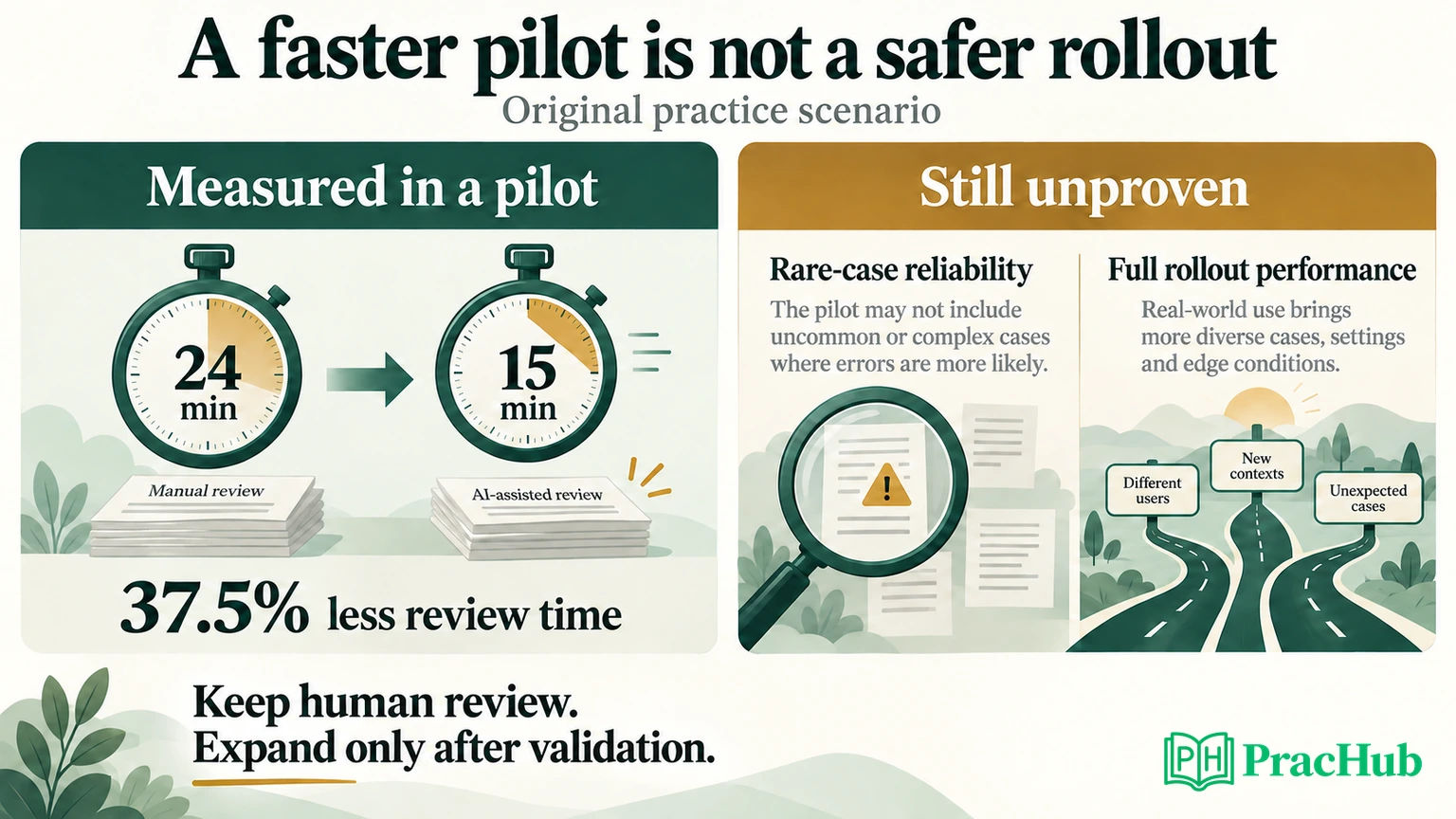
Original fictional practice scenario: your team is building a tool that drafts evaluation summaries for human reviewers. A customer wants broader automation before a demonstration. Reviewers currently spend an average of 24 minutes per case. The deadline is close, and the new system has not been evaluated adequately on rare cases.
Three choices are available: automate the entire review, delay everything, or pilot a narrower drafting workflow while keeping human approval. None is automatically correct. The evidence and consequences should explain your choice.
In this example, you propose the narrow pilot. You remove a polished dashboard from the first release, keep the review checklist, and agree that the output will not trigger downstream actions automatically. Another engineer builds the integration; a reviewer lead defines the acceptance examples. You own the pilot scope and measurement.
The pilot covers 30 cases. Average review time falls from 24 to 15 minutes: a nine-minute reduction, or 37.5% relative to the original average. Reviewers still correct outputs. The small cohort does not establish broad reliability, and the comparison is not a randomized experiment.
A weak answer would claim that you “automated evaluation and improved quality by 37.5%.” That confuses review time with output quality and expands a limited pilot into a general success claim.
A defensible version is more precise:
In our limited pilot, average review time fell from 24 to 15 minutes. I chose drafting assistance with human approval because we lacked evidence for full automation. I cut the dashboard work to finish the review path. The pilot suggested a time benefit, but it did not prove reliability on rare cases or isolate the tool's effect from reviewer learning.
Treat this as a model of evidence boundaries, not a script to adopt. Replace every fact with your own project facts.
The connection to Scale's current values lies in the decisions: preserving a quality check, concentrating effort, and considering what automation would enable downstream. The metric supports only the claim it actually measures.
Handle the follow-up that challenges your success story
Rehearse questions that could weaken your preferred interpretation. These original prompts are useful because they force you to distinguish what you knew at decision time from what you learned later.
“Why not automate everything if speed mattered?” Explain the missing evidence and the consequence of an incorrect summary. In the fictional pilot, an unreviewed output could propagate an incorrect evaluation. Keeping human approval limits that pathway while you investigate reliability. Name the condition under which you would reconsider the scope.
“How do you know your work caused the improvement?” You do not know that from this comparison alone. Reviewer learning, easier cases, or different staffing could contribute. A stronger follow-up evaluation could compare matched case types with consistent measurement. State the limitation before proposing the next experiment.
“What quality bar did you actually protect?” Avoid answering with the time metric. Explain the acceptance examples, who reviewed failures, and what happened to rejected drafts. If quality outcomes were not measured, say so. Do not invent an error rate because the question exposes a gap.
“What did another team sacrifice?” Describe the reviewer lead's setup work and ongoing correction load. Your team's faster release may have shifted effort to someone else. Acknowledge that cost and explain whether the measurement included it.
“What would make you reverse the decision?” Identify an observable trigger, such as recurring critical errors or correction work eliminating the time benefit. Use a trigger your team actually agreed on; if none existed, make its absence part of the lesson.
Your answer can improve under questioning. Revising a claim from “the tool saved time” to “we observed a time reduction in this cohort” shows better calibration without erasing the work.
When customer requests conflict with team priorities
A second useful project pattern begins with a request that sounds straightforward: a customer wants a custom export immediately. Your team can build it quickly, but the proposed format creates a manual reconciliation task for another team every week.
Original preparation scenario: compare three options before describing the outcome: a one-off export, a reusable format with a longer delivery time, or a temporary export with an explicit end date and owner. The important evidence is how you surfaced the recurring burden and helped people decide who would carry it.
Do not make the other team the obstacle in your story. Recover their strongest objection. Perhaps they supported the customer goal but could not absorb an unbounded support obligation. Explain the shared decision criterion, such as the customer's immediate deadline alongside the continuing maintenance cost.
If you selected the temporary path, follow the story past delivery. Did the owner retire it? Did the replacement arrive? Was the manual work measured? A commitment to clean up later is weaker evidence than a completed retirement or an honest explanation of why it slipped.
This pattern lets you discuss customer trust, whole-team outcomes, and consequences together. It also prevents the answer from treating customer focus as automatic agreement with every request.
Explain learning without inventing a breakthrough
The frontier-oriented value can tempt candidates to inflate routine work. You do not need to claim a novel research contribution if your role was evaluating whether a new capability helped a user.
For an actual experiment, explain the previous baseline, the capability you investigated, and the decision the comparison enabled. Perhaps a new model handled a useful subset of documents but failed on longer inputs. The useful story may be why you limited its use instead of announcing a broad replacement.
If your experience is a class project, name the class context and the absence of production users. If you have no relevant example, discuss how you would investigate the question while distinguishing that proposed approach from past behavior.
For a weakness or failed project, identify the mechanism you changed afterward. “I communicate more” is difficult to examine. “I began recording acceptance criteria before implementation, and the next handoff surfaced a disagreement earlier” gives the conversation something concrete to explore. Preserve uncertainty about whether the change will generalize.
Practice five questions against your own evidence
Use these PracHub records as practice material, not predictions of your Scale interview. The first is filed under Scale AI; the remaining prompts are cross-company and cross-role practice selected for feedback, shared priorities, customer trade-offs, and deadline decisions.
| PracHub question | Evidence to rehearse |
|---|---|
| Present a Metrics-Driven Technical Project | Separate measured outcomes from estimates and identify your own contribution |
| Discuss learning and feedback experiences | Show how feedback changed a decision or working method |
| Cross-Team Conflict Resolution & Product Launch | Explain the other team's objection and the shared decision |
| Transform Customer Feedback into Valuable Product Enhancements | Compare customer benefit with implementation and ongoing cost |
| Describe deadline pressure, challenges, and decision changes | Defend what you cut, what you protected, and why you changed course |
For each attempt, give a concise first answer and ask a partner to challenge one result. Have them request the rejected option, the measurement boundary, and a contribution made by someone else. Review whether your facts stayed consistent across the follow-ups.
Before the interview, return to the current careers page and your invitation. Check the value labels and any recruiter instructions. Then open Scale AI Software Engineer questions, choose one project prompt, and practice explaining one decision with evidence you can stand behind.
Comments (0)