Soreno Review: Finance Interview Rehearsal, Spoken Feedback, and Practice Limits
Quick Overview
Review Soreno’s finance practice entry, public self-guided case and reference feedback, alongside untested voice and scoring claims. An original normalized profit bridge and answer rubric separate clear delivery, accounting relationships and causal inference, with dated trial and renewal limits.
Soreno is positioned around spoken interview rehearsal and feedback that quotes the learner’s answer. Its public finance article and role entry make that use case identifiable. We inspected a self-guided case with clarifications and a reference opening, but did not execute a voice mock. Check delivery and technical reasoning separately when evaluating the feedback.
PracHub publishes this review and owns the complementary practice links. Our profit-decline question offers an independent task. The normalized margin bridge and answer-review rubric below are original educational work, separate from Soreno’s model answers, scorecards or actual company interviews.
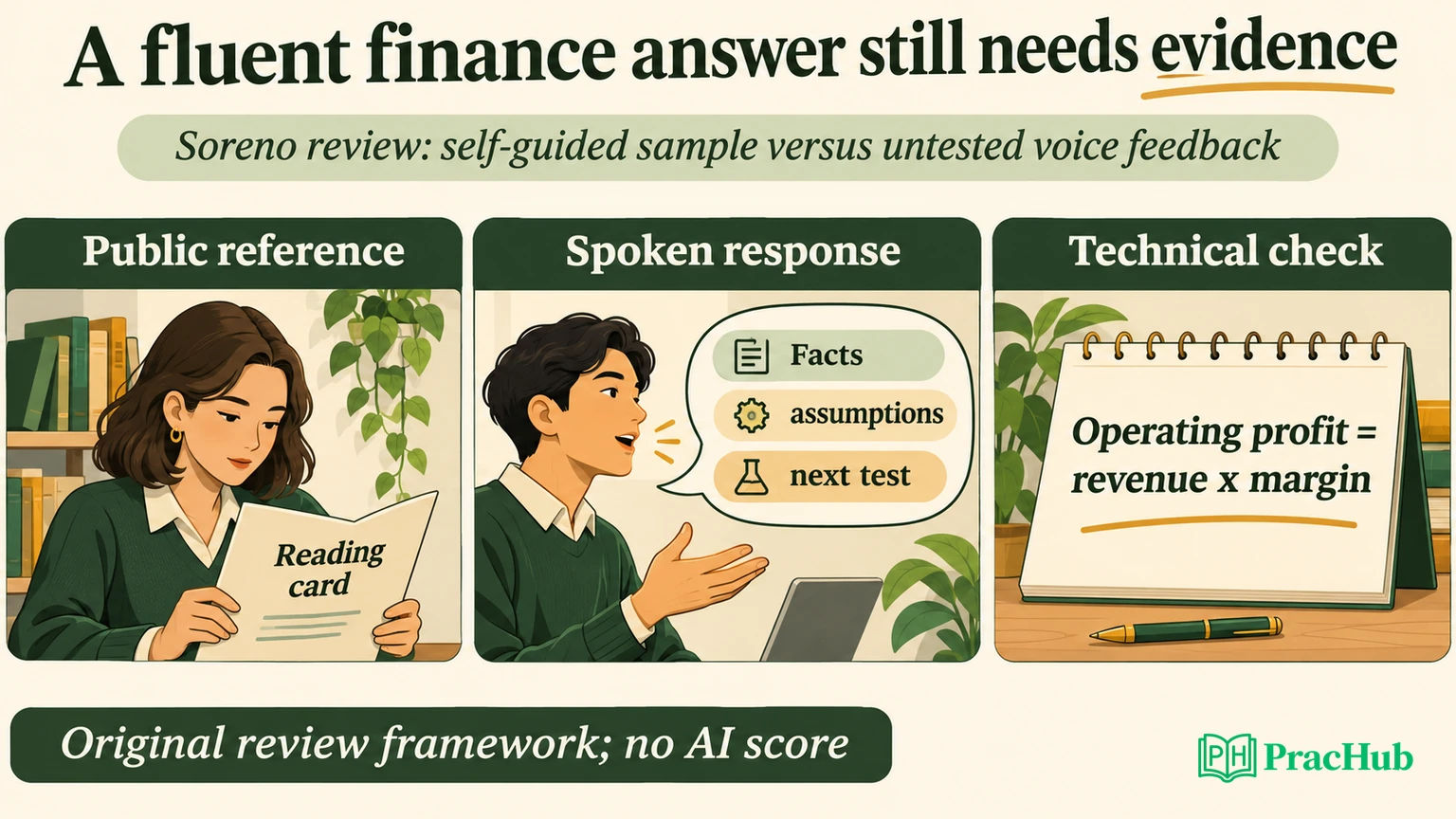
Finance positioning within a broader rehearsal product
Provider description, checked November 3, 2026: Soreno’s homepage emphasizes consulting cases, fit practice and spoken AI follow-ups. Its sales-and-trading article presents finance-oriented questions and links to practice. That article was dated October 15, 2026 when inspected.
We did not independently audit its employer references or adopt its descriptions as current interview processes. Role pages and official career links can help organize preparation, but they do not establish which questions a particular interviewer will ask. No independent candidate outcomes support this product review.
The homepage also displays testimonials, usage counts and illustrative feedback scores. We did not verify those outcomes or generate the displayed scores. Promotional examples describe the intended feedback style, not the results of our session.
The finance start route entered onboarding
Direct observation: selecting the finance article’s practice link opened the Soreno app. It first asked which role to prepare for. We selected the generic Sales & Trading Analyst option to inspect the route; the next screen asked about preparation difficulties.
We stopped before answering that personal-experience question. No account was created, no private career information was supplied and no voice session began. We did not authorize a microphone or camera, upload a resume, activate a trial or submit payment details.
The route exposed finance-oriented onboarding; we did not complete a mock. We did not inspect the app’s question selection, live follow-up depth, transcription or feedback calibration. Those remain concrete account-side trial questions.
The free sample is self-guided reference practice
The pricing page linked to a free sample case. Its Harvest Market example supplied a revenue-growth and margin-decline problem. We opened two predefined clarification buttons and revealed the reference opening. We did not type notes or run its structuring timer.
The buttons returned prepared information about business size and cost shares. Revealing the opening exposed a structured reference, not a generated response to our own answer. A separate continuation link led toward the account-based AI interviewer.
The preset clarifications and reference opening were usable without registration. It does not demonstrate speech recognition or an AI evaluation. The page’s animated example moving from seventy-three to eighty-four was also promotional material; neither number was earned in our review.
One reference phrase deserves an independent check: it described the situation as a “cost problem, not a sales problem.” Increased revenue and lower margin justify investigation, but total revenue alone cannot exclude price or mix effects. Our critique concerns that narrow inference, not the quality of an untested voice interviewer.
Original calculation: sales can grow while profit falls
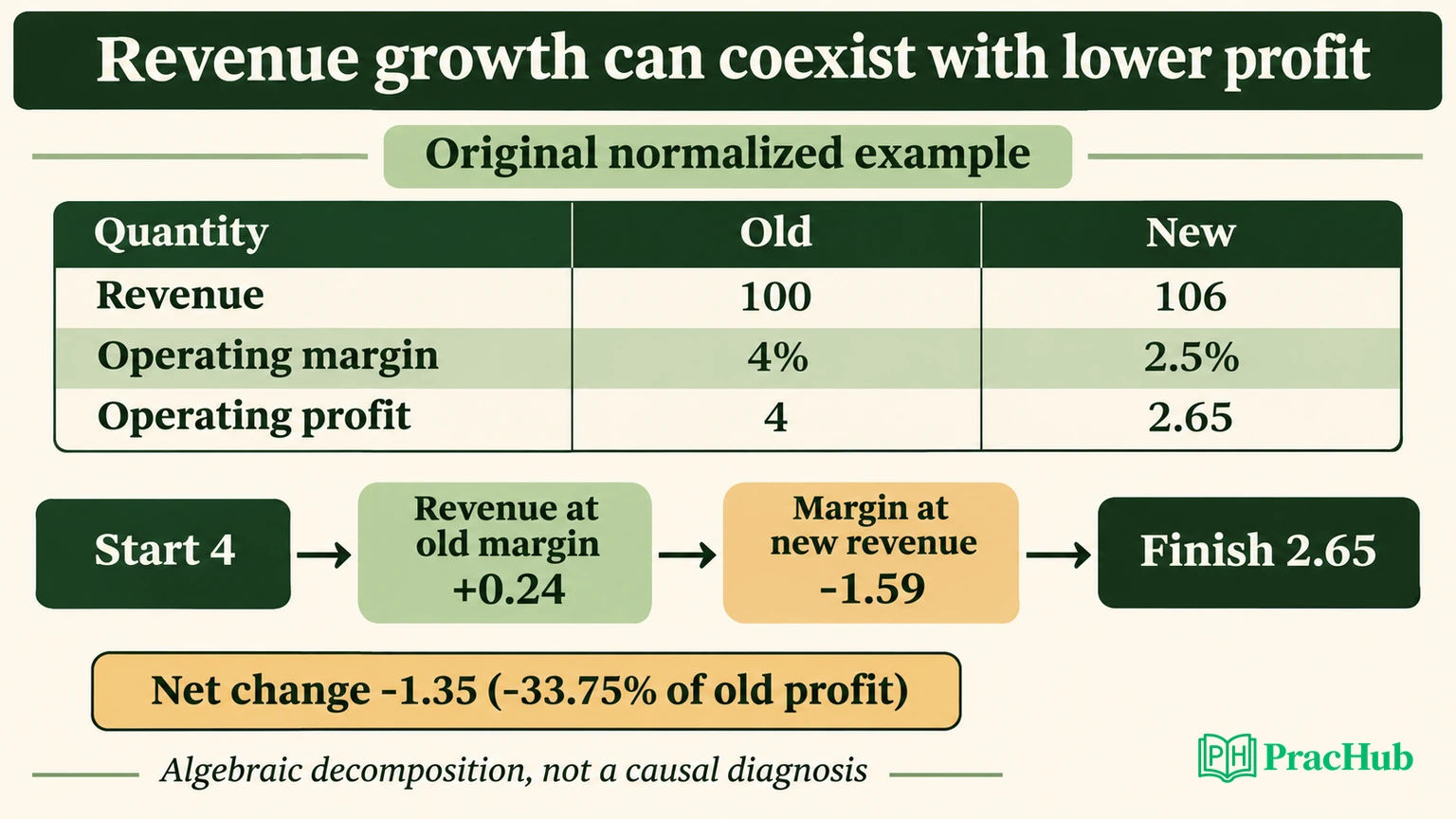
Take the sample’s stated six-percent revenue growth and operating margins of four percent and 2.5 percent. For a transparent calculation, normalize old revenue to one hundred units. This is our constructed scale, not a reconstruction of the sample’s rounded dollar figures.
Old operating profit is one hundred times 0.04, or four. New revenue is 106, and operating profit is 106 times 0.025, or 2.65. Profit fell by 1.35 units, which is 33.75 percent of the original profit, even though revenue increased.
The margin decline is 1.5 percentage points, or 150 basis points. That differs from the relative margin decline of 37.5 percent and from the profit decline of 33.75 percent. These numbers describe related quantities with different denominators.
| Quantity in the normalized example | Old | New | Change |
|---|---|---|---|
| Revenue | 100 | 106 | +6% |
| Operating margin | 4% | 2.5% | −1.5 percentage points |
| Operating profit | 4 | 2.65 | −1.35, or −33.75% |
We checked these values with exact-fraction Python arithmetic. The calculation uses only the stated rates and chosen scale. It is not a Soreno score, an observed company’s financial result or evidence about what caused the decline.
Name each quantity and its denominator in a spoken answer. Saying “margin fell thirty-three percent” would mislabel the profit calculation. Saying “sales grew, so the business improved” would overlook the lower profit under these assumptions.
Build a profit bridge without turning it into a causal story
Our original bridge first changes revenue while holding the old margin fixed. Moving from one hundred to 106 at four percent margin adds 0.24 profit units. Next, changing the margin on 106 from four percent to 2.5 percent subtracts 1.59 units. The net is negative 1.35, matching the table.
The bridge decomposes the accounting relationship algebraically. It does not show that a particular sales team created 0.24 of value or that labor caused all of the remaining loss. Revenue combines price, volume and mix; a margin combines several underlying quantities.
The order also matters to the labels. If you change margin first on old revenue, the margin term is negative 1.5. Applying revenue growth at the new margin then adds 0.15. The same total decline results, but the allocation differs because the interaction is assigned differently.
| Bridge order | First contribution | Second contribution | Total |
|---|---|---|---|
| Revenue first, then margin | +0.24 | −1.59 | −1.35 |
| Margin first, then revenue | −1.50 | +0.15 | −1.35 |
Both decompositions are arithmetically valid under their definitions. Neither establishes a causal explanation. We checked both with exact fractions. No statistical model, causal experiment or business intervention was performed.
A cost ratio can change for more than one reason
A higher cost share of revenue is useful evidence about the accounting relationship. It is not automatically evidence that every underlying unit cost rose. A change in selling price, product mix or service mix can alter a cost-to-revenue ratio as well.
To investigate, ask for the unit definitions and a comparable breakdown. How much of revenue growth came from price, volume or new services? Which cost categories changed in absolute terms and per relevant unit? Were the periods and classifications consistent?
Those questions do not mean that cost control is irrelevant. They identify the evidence needed to separate a hypothesis from a conclusion. The public sample’s cost-share clarifications provide more context than revenue alone, but we did not complete a causal diagnosis or the rest of the case.
State the known facts, the inference and the evidence that could change it. This is the same discipline needed for a market view or a pitch: confidence in delivery should not erase the assumptions behind the recommendation.
Two original spoken answers, with different evidence
Our deliberately weak answer is: “Sales are up, so the issue must be costs. Cut labor and the margin will recover.” It names an action before defining the operational mechanism, constraints or consequences. We did not submit it to Soreno.
A stronger original response would state that normalized operating profit fell from four to 2.65 despite six-percent revenue growth. It would distinguish the margin movement from the profit decline, identify price/mix and cost hypotheses, and request a breakdown before selecting an intervention.
That response is more defensible because its conclusion is narrower and its next analysis is explicit. It does not claim that presenting those words would earn a particular Soreno grade or an employer offer. Both examples are our own paper practice assets.
For a sales-and-trading explanation, preserve the same separation. Define the observation, the interpretation and the condition under which the view fails. We did not test whether Soreno’s finance interviewer asks those follow-ups or grades them accurately.
An independent rubric for evaluating feedback
Use this original rubric beside a transcript and calculation. It is not Soreno’s internal scoring system or a numerical assessment of the product. It asks whether a proposed improvement changes the substance of the answer.
| Dimension | Evidence worth checking |
|---|---|
| Quantity and unit | Revenue, margin and profit are named correctly |
| Arithmetic | Rates, denominators and totals reconcile |
| Inference | Accounting description is separated from a causal claim |
| Decision | Recommendation follows the stated evidence and constraints |
| Communication | Assumptions and the next test are audible and concise |
Inspect the correction attached to a quoted vague phrase. Check whether the proposed replacement also preserves the meaning and conditions. Adding a confident dollar figure helps only if its inputs and unit are correct.
Likewise, filler-word or eye-contact analysis concerns delivery. It does not establish that a margin bridge is valid or a market claim is supported. Soreno advertises those delivery features, but we did not record a session or evaluate their measurements.
If you later run a trial, save one original answer, the exact feedback and your corrected calculation. Then change an input or an assumption and answer again. A revision that transfers gives more inspectable learning evidence than copying a polished reference response.
Read the trial and renewal terms together
The current pricing page displayed $79 weekly, $199 monthly and $579 yearly, explicitly in US dollars. The yearly amount was billed once a year, rather than as a single month at its equivalent rate. We did not inspect checkout or pay.
The page described a seven-day trial with usage limits and stated that checkout asks for a payment method. It said the selected plan renews after the trial at the checkout price unless cancelled. “Free week” therefore should not be described as unlimited anonymous practice or a nonrenewing grant.
We did not activate the trial, verify its usage counter, test cancellation or request a refund. Public pages describe broad content access and quoted feedback, while the exact applicable limits and renewal details should be confirmed in the actual account and checkout.
| Public path | What we observed | Boundary |
|---|---|---|
| Finance article | Questions, source links and practice entry | No employer-process audit |
| Finance app entry | Role selection and a preparation question | No account or live mock |
| Self-guided sample | Preset clarifications and reference opening | No generated evaluation |
| Trial offer | Duration, limits and renewal described | No activation, payment or cancellation test |
Practice the gaps the product leaves open
These independent PracHub prompts extend finance and business reasoning. They are not Soreno questions, scoring references or verified descriptions of a current employer’s process.
| PracHub question | What to examine |
|---|---|
| Identify Causes and Solutions for Fashion Profit Decline | Separate a profit decline calculation from hypotheses about its cause. |
| Compute incremental profit, breakeven, and revenue sensitivity | Keep incremental profit, revenue sensitivity and the decision unit explicit. |
| Evaluate Two Partnerships with Unit Economics and Break-Even Analysis | Connect a recommendation to unit economics and a stated break-even condition. |
| Prepare responses to UBS behavioral and stock-pitch prompts | Explain finance motivation and a pitch without claiming unsupported certainty. |
| Quant Trading Game: Expected-Value Betting and Market Making on Coins, Dice, and Cards | State the payoff and information rules before giving a numerical answer. |
Who should inspect Soreno next
Soreno is worth a focused trial if you want spoken finance or case rehearsal with advertised answer-specific feedback. The public sample lets you inspect reference reasoning before considering an account. It does not establish the quality of finance voice interviews, transcription or scoring.
Start with the profit-decline prompt. Calculate the normalized bridge, identify what it does not prove and state the next evidence request aloud. Judge any future feedback by whether it improves that reasoning as well as the delivery. Confirm trial limits and renewal before activating a plan.
Comments (0)