Terraform Interview Questions for Platform Engineers: State, Modules, Drift, and Safe Changes
Quick Overview
Prepare for Terraform platform engineering interviews with production scenarios covering state, modules, drift, imports, locking, and safe infrastructure changes.
A Terraform interview rarely goes wrong because a candidate forgets the syntax for an output block. It goes wrong when the interviewer says, “We renamed a module and the plan wants to replace production,” and the candidate reaches immediately for -target, -lock=false, or a manual state edit.
Platform engineering interviews test whether you can reason about desired configuration, Terraform state, and real infrastructure as three related but distinct things. They also test whether your workflow keeps a routine pull request from becoming a high-blast-radius incident.
This guide covers the Terraform interview questions that reveal that judgment: state and locking, reusable modules, drift and imports, safe refactors, plan review, and recovery. You can pair it with PracHub's technical interview question bank and its focused Terraform state, modules, and drift concept guide.
Quick Answer: What Should You Know for a Terraform Interview?
A strong candidate can explain more than how to write HCL. You should be ready to describe why state exists, how a remote backend and locking support team workflows, how module boundaries affect ownership, how to reconcile drift, and how to review a plan before applying it.
The highest-signal answers follow one pattern: inspect first, explain the blast radius, choose a reversible path, and verify the result. An interviewer is listening for evidence that you will not improvise against production state under pressure.
What Platform Engineering Interviewers Are Scoring
Terraform questions usually sit inside a larger platform, SRE, DevOps, or cloud-infrastructure interview. The tool matters, but the underlying scorecard is broader.
| Signal | What a strong answer demonstrates | Common weak answer |
|---|---|---|
| State reasoning | Separates configuration, state bindings, and provider reality | Treats state as a disposable cache |
| Change safety | Reviews replacements, dependencies, blast radius, and verification | Equates a successful plan with a safe change |
| Collaboration | Uses remote state, locking, CI, approvals, and clear ownership | Runs production applies from a laptop |
| Module design | Creates stable contracts around meaningful platform capabilities | Wraps every resource in a thin generic module |
| Incident judgment | Preserves evidence, checks active writers, and recovers deliberately | Force-unlocks or edits state before diagnosis |
A useful answer framework is Desired, Observed, Binding, Plan, Guardrail, Verify. State what the code intends, what exists, how Terraform maps the two, what the plan proposes, which safeguards you need, and how you will prove the change worked.
Terraform State Interview Questions
Why does Terraform need state?
Terraform state records the relationship between resource addresses in configuration and objects managed through provider APIs. That binding lets Terraform understand that aws_instance.app refers to one specific remote object, calculate dependencies, and plan changes efficiently.
A precise answer avoids calling state the absolute source of truth. Configuration describes the desired state, the provider exposes observed reality, and the state snapshot connects Terraform addresses to that reality. A normal plan refreshes its view of managed objects before comparing them with configuration.
Why use remote state and locking?
Local state is acceptable for a small experiment, but it does not support a reliable team workflow. A remote backend gives collaborators a shared state location and may provide encryption, versioning, backups, access controls, and locking.
Locking prevents two state-writing operations from proceeding against the same state at once. Not every backend supports it, so “we use remote state” is not a complete answer. Name the backend's locking behavior and make the CI system the normal apply path.
What would you do with a stuck state lock?
First determine whether another run is active. Check the CI queue, the backend's lock metadata, the workspace, the lock holder, and recent apply logs. If a legitimate writer still owns the lock, wait or stop that run cleanly.
Use terraform force-unlock LOCK_ID only when you have confirmed that the lock is stale and belongs to a failed operation you control. HashiCorp warns that force-unlocking a lock held by another writer can create concurrent state writers. Disabling locking is not a normal workaround.
Can sensitive values still appear in state?
Yes. Marking a value sensitive suppresses it in portions of CLI and UI output; it does not automatically remove the value from state. Protect state and saved plans as sensitive artifacts, encrypt the backend, restrict access, and avoid placing backend credentials in checked-in configuration or command arguments that Terraform may persist.
Terraform Modules Interview Questions
What makes a good Terraform module?
A good module represents a useful platform capability with a stable contract, such as an application load-balanced service, a standard data store, or an account baseline. Inputs express intentional choices, outputs expose only what consumers need, and validation captures assumptions.
A module should not hide every provider feature or become a thin wrapper around one resource. HashiCorp recommends relatively flat module composition because deeply nested module trees make ownership, upgrades, and dependency reasoning harder.
How do you version modules safely?
Pin or constrain external module versions so upgrades happen deliberately. For registry modules, use a version constraint; for Git sources, reference a reviewed tag or commit instead of an unbounded default branch. Commit the provider dependency lock file and run upgrades through a pull request with a reviewed plan.
A mature answer also describes compatibility. Introduce additive inputs and outputs before removing old ones, document breaking changes, test representative consumers, and canary a module upgrade in a lower-risk workspace before broad rollout.
Why can moving a resource into a module cause replacement?
Terraform identifies a managed object by its resource address. Moving aws_s3_bucket.logs to module.storage.aws_s3_bucket.logs changes that address. Without migration information, Terraform may interpret the old address as removed and the new one as a separate resource.
Use a configuration-based moved block so the refactor is reviewable and repeatable:
moved {
  from = aws_s3_bucket.logs
  to   = module.storage.aws_s3_bucket.logs
}
Then inspect the plan and confirm that Terraform reports a move rather than a destroy-and-create operation. For shared modules, retain historical moved blocks long enough to preserve consumer upgrade paths.
Terraform Drift and Import Questions
What is drift, and how do you detect it?
Drift exists when managed infrastructure changes outside the expected Terraform workflow. A console hotfix, an autoscaling control plane, or another automation system can all create a difference between configuration, state, and the provider's current values.
Start with a normal plan or use terraform plan -refresh-only when you specifically want to inspect changes detected in remote objects without proposing infrastructure changes. HashiCorp recommends refresh-only workflows over the deprecated terraform refresh command because they give you a review step.
Should Terraform revert drift or accept it?
That is a governance decision, not a command-line reflex. Ask who made the change, whether it was an emergency mitigation, whether another controller owns the field, and whether reverting it would cause an outage.
If Terraform should remain authoritative, update or reapply the intended configuration after reviewing impact. If the manual change should become the new desired state, update configuration and reconcile state through a reviewed plan. If another system legitimately owns the field, redesign ownership rather than normalizing permanent ignore_changes everywhere.
When should you use import?
Use import when an existing remote object should become managed by Terraform. Define the destination resource and a configuration-based import block, then review the plan. Confirm that one remote object maps to exactly one Terraform address and that the proposed configuration will not immediately mutate or replace it.
Import is not a substitute for modeling. After the binding exists, clean up the generated or handwritten configuration, add ownership and tests, and decide whether the import block remains as history or is removed according to your team's policy.
A Safe Terraform Change Workflow
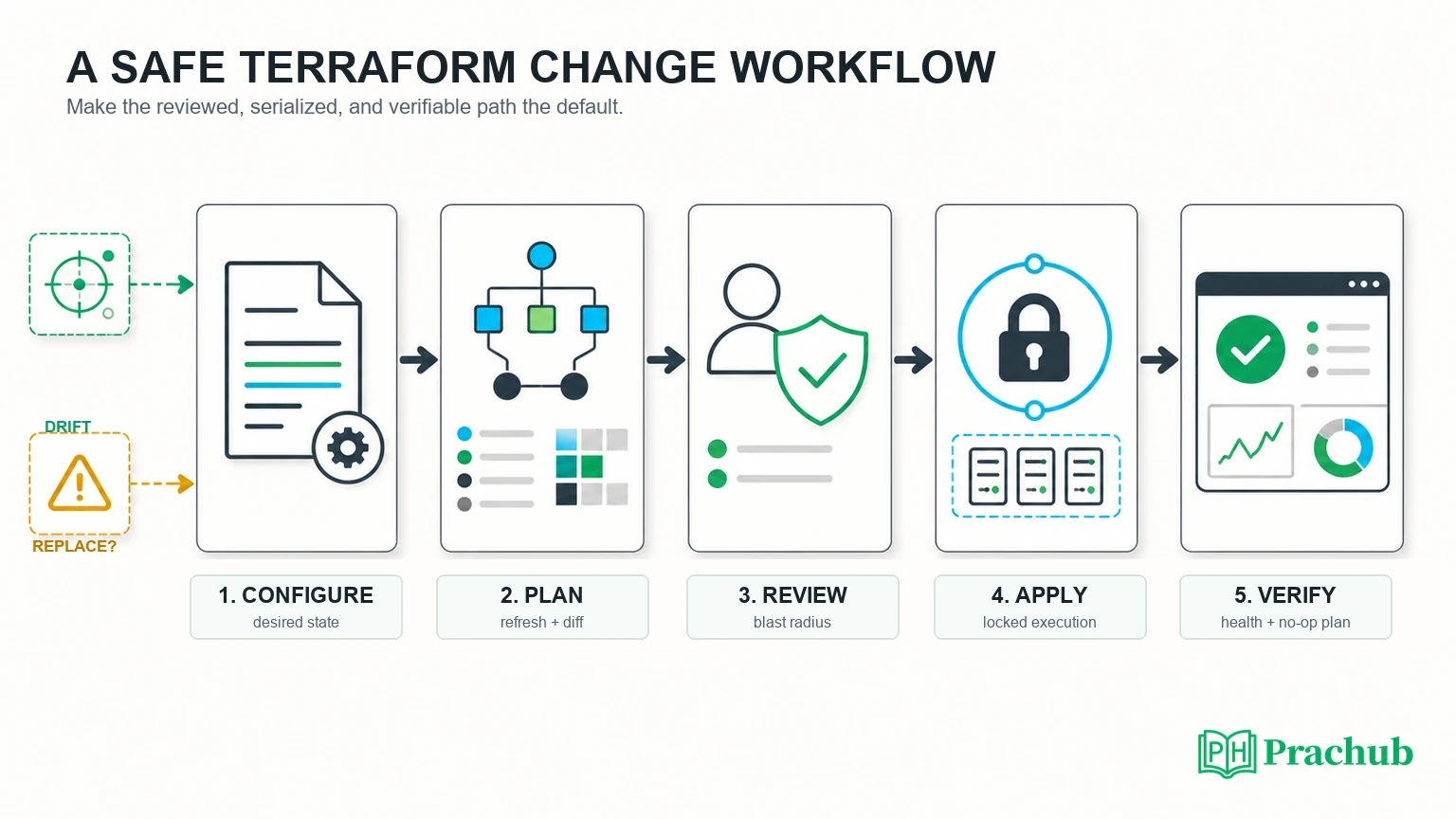
A production Terraform workflow should make the safe path the easy path. The pull request runs formatting and validation, initializes against approved dependency versions, creates a plan for the correct workspace, and exposes the plan for human or policy review.
Reviewers should look beyond the add/change/destroy totals. Inspect every replacement, state move, IAM change, network rule, data-store modification, and dependency fan-out. Ask whether unknown values hide risk and whether the plan was produced with the same variables, credentials, backend, and code that the apply step will use.
For higher-risk environments, save the reviewed plan and apply that exact artifact rather than generating a different plan later. Treat the plan as sensitive because its file can contain values hidden in terminal output. Serialize applies per state, require approvals based on blast radius, and keep an audit trail.
After apply, verify service health and infrastructure invariants rather than stopping at “Apply complete.” Check monitoring, endpoint health, capacity, security controls, and a fresh plan. A no-op follow-up plan is useful evidence that configuration, state, and observed resources have converged.
How to Answer Common Terraform Scenarios
“A module upgrade wants to replace a production database.”
Pause the apply. Identify the exact attribute causing replacement, compare provider and module versions, and inspect whether an address change or default-value change created the diff. Decide whether a moved block, explicit compatibility input, staged migration, or provider-specific procedure removes the replacement.
“An engineer made an emergency console change.”
Preserve the incident context, run a refresh-only plan, and decide whether the hotfix should be codified or reverted. Do not let the console change become an undocumented permanent exception. Reconcile through code review, verify service health, and capture why the normal workflow was bypassed.
“An apply failed halfway through.”
Do not assume Terraform provides a transactional rollback. Inspect the apply log, state, and provider reality, then generate a fresh plan. Terraform may have recorded successful operations before the failure. Prefer a controlled forward fix unless a resource-specific rollback is clearly safer.
“Two teams need the same infrastructure outputs.”
Avoid putting unrelated ownership domains in one giant state merely to share identifiers. Separate state by lifecycle and ownership, expose a narrow contract, and consider provider data sources or a dedicated configuration store. Remote-state outputs are convenient, but access to them can imply access to the full state snapshot depending on the platform.
“A pull request has only one line changed.”
Line count is not blast radius. A one-line module version bump, CIDR change, for_each key change, or default update can affect hundreds of resources. The plan, resource graph, ownership boundary, and runtime verification determine risk.
For adjacent platform topics, review PracHub's guides to CI/CD interview questions and cloud security interview questions.
Practice Platform Engineering Questions on PracHub
These questions train the same deployment, infrastructure, ownership, and failure-recovery judgment used in Terraform interviews. They are practice material, not a prediction of any exact interview prompt.
| PracHub question | Practice focus | Why it helps |
|---|---|---|
| Design Safe Configuration and Deployment for Hundreds of Services | Configuration ownership, rollout safety, and rollback | Builds the control-plane reasoning behind safe infrastructure changes. |
| Design a CI/CD Pipeline with Scheduler | Plan execution, isolation, scheduling, and artifacts | Connects Terraform review and apply stages to a production CI system. |
| Present Your Infrastructure and Platform Experience | Architecture, ownership, impact, and trade-offs | Prepares the project deep dive that often follows technical Terraform questions. |
| Describe Leading an Infrastructure Initiative | Migration leadership, risk, and stakeholder alignment | Turns platform work into a concise senior-level behavioral story. |
A Seven-Day Terraform Interview Preparation Plan
| Day | Focus | What to do |
|---|---|---|
| Day 1 | State model | Explain configuration, state bindings, and provider reality without notes. |
| Day 2 | Remote operations | Review your backend, locking, encryption, access, backup, and recovery design. |
| Day 3 | Modules | Critique one module's boundaries, inputs, outputs, versions, and upgrade path. |
| Day 4 | Drift and import | Practice a refresh-only diagnosis and an import plan for one existing resource. |
| Day 5 | Safe refactor | Move a resource into a module with a moved block and inspect the plan. |
| Day 6 | Production scenarios | Answer the five scenarios above aloud using Desired, Observed, Binding, Plan, Guardrail, Verify. |
| Day 7 | Mock interview | Run a 45-minute platform mock: architecture, failure recovery, and one project deep dive. |
Frequently Asked Questions
Do platform engineers need to memorize Terraform syntax?
Know the core blocks and commands well enough to read a configuration and discuss a plan. Interviewers usually gain more signal from your explanation of state, module design, drift, locking, and safe rollout decisions than from obscure syntax recall.
What is the difference between terraform plan and terraform apply?
plan reads current information, compares it with configuration and state, and proposes actions without changing infrastructure. apply executes an approved plan. In automation, applying the exact saved plan can prevent a later, unreviewed plan from replacing the reviewed one.
Is terraform refresh still recommended?
No. HashiCorp deprecates the standalone refresh command and recommends refresh-only plan or apply modes, which allow review before state is updated.
When is -target appropriate?
Targeting can help with exceptional recovery or troubleshooting, but it is not a normal method for partitioning routine changes. It can produce an incomplete view of dependencies, so explain why it is necessary and always follow with a full plan.
How do you prevent secrets from leaking through Terraform?
Use a secured, encrypted remote backend; restrict state and plan access; supply credentials through approved secret mechanisms; avoid committing state, plan files, or sensitive variable files; and understand that marking output as sensitive does not remove its value from state.
Final Takeaway
The best Terraform interview answers are not collections of commands. They show that you understand resource identity, shared-state coordination, module contracts, drift ownership, and production change control.
Practice explaining the risky moments: a stale lock, an unexpected replacement, a manual hotfix, a partial apply, and a broad module upgrade. Then use PracHub interview questions and written solutions to rehearse the surrounding platform, CI/CD, and infrastructure scenarios under realistic constraints.
Sources and Further Reading
- HashiCorp: Terraform State
- HashiCorp: State Storage and Locking
- HashiCorp: State Locking
- HashiCorp: Terraform Plan Command
- HashiCorp: Manage Resource Drift
- HashiCorp: Use Modules in Your Configuration
- HashiCorp: Refactor Modules
- HashiCorp: Import Resources
Research note: This guide was checked on August 22, 2026. Terraform features and interview emphasis can vary by version, platform stack, role, and company.
Comments (0)