Angular Interview Questions for Frontend Engineers: Change Detection, RxJS, Signals, and Performance
Quick Overview
Prepare for modern Angular frontend interviews with evidence-backed answers on component boundaries, change detection, Signals, RxJS ownership, routing, testing, SSR, and measured performance.
Angular interview questions for frontend engineers test whether you can explain what schedules rendering work, who owns reactive state and subscriptions, where dependencies are scoped, and how you prove a performance fix. Strong answers connect Angular mechanics to a user-visible symptom instead of reciting APIs.
Use the Frontend Engineer interview questions on PracHub to rehearse those explanations aloud. PracHub questions are practice material, not predictions of the questions in your exact interview.
Angular interview answer frame: Name the version, state owner, rendering notification, subscription lifetime, concurrency rule, and performance evidence. This guide covers Angular-specific decisions and links out for full browser-rendering and Core Web Vitals treatment.
What Angular interviewers are actually testing
An Angular interview is usually a boundary test. The interviewer wants to know whether you can choose the right owner for state, predict the framework's work, and debug a production symptom without random changes.
| Area | Baseline answer | Strong frontend signal |
|---|---|---|
| Components and DI | Knows decorators and services | Defines view boundaries, provider scope, and dependency lifetime |
| Change detection | Says Angular checks the component tree | Names the notification that schedules a check and the subtrees that can be skipped |
| Signals | Knows signal() and computed() | Separates source state, derived state, and imperative synchronization |
| RxJS | Lists operators | Chooses cancellation, concurrency, ordering, and cleanup semantics from the product requirement |
| Performance | Suggests OnPush or lazy loading | Profiles first, isolates the measured cost, changes one cause, and remeasures |
As of September 2026, the current Angular component configuration documents OnPush as the Angular 22 default, and zoneless Angular is the default for new applications from Angular 21 onward. Existing projects can use Eager change detection, ZoneJS, NgModules, Karma, or decorator-based APIs. State the version boundary before generalizing.
How should you explain Angular component and dependency boundaries?
An Angular component should own a coherent view, its presentation state, and the interactions that belong to that view. Move UI-independent validation, data access, and business rules into plain functions or injectable services. This keeps the component testable without turning every helper into a global service.
Angular dependency injection is hierarchical. Resolution starts with the current element injector, walks through its ancestors, and then searches the environment-injector hierarchy. The nearest matching provider wins. A component-level provider therefore creates an instance scoped to that component instance and its relevant descendants; a root provider fits application-wide services or shared state.
A strong design answer names three things:
- Ownership: Which component or service is allowed to change the state?
- Visibility: Which descendants should be able to inject or receive it?
- Lifetime: Should it die with one component, one route, or the application?
This exposes accidental global state, duplicated requests, and services that outlive their UI.
How does Angular change detection work?
Change detection synchronizes component views with application state. In current Angular, clean OnPush subtrees can be skipped until Angular receives a relevant notification. Those notifications include a bound input change, an event handled in the subtree, a signal used by the template changing, AsyncPipe receiving a value, or an explicit call such as markForCheck().
The common interview claim that “OnPush checks only when an input changes” is incomplete. Events and reactive template consumers also schedule work. Conversely, mutating an object while preserving its input reference can leave an OnPush view stale because the boundary did not receive a new value.
How would you debug a stale OnPush view?
Use a mechanism-first sequence:
- Confirm the Angular version and the component's actual strategy.
- Identify the state owner and the exact write that should update the view.
- Check whether an input object was mutated instead of replaced.
- Confirm that the template reads the signal or Observable through an owned bridge such as
AsyncPipe. - In a zoneless application, find the Angular notification that should schedule the check; arbitrary asynchronous work alone is not a notification.
- Use
markForCheck()only when integrating a boundary that Angular cannot otherwise observe, then verify the smallest affected subtree.
ChangeDetectorRef.detach() and detectChanges() can support deliberate local rendering schedules, but they increase ownership complexity. Present them as measured, narrow tools—not as the first fix for an unclear stale-view bug.
What are Angular Signals, and when should you use them?
Angular Signals represent reactive values whose consumers are tracked when the values are read. A writable signal owns source state; a computed signal derives read-only state and is lazy and memoized; an effect synchronizes with an imperative, non-signal system.
Prefer computed for relationships between pieces of state. Using an effect to copy one signal into another introduces two writable truths and can create circular updates or extra change-detection work. Effects fit boundaries such as logging, browser storage, canvas rendering, or a third-party widget that cannot consume signals directly.
private readonly query = signal('');
readonly normalizedQuery = computed(() => this.query().trim().toLowerCase());
readonly hasQuery = computed(() => this.normalizedQuery().length > 0);
This model makes ownership visible: one private writable source and public derived reads. Remember that asReadonly() prevents callers from using set() or update(); it does not make a nested object deeply immutable.
Are Signals replacing RxJS?
No. Signals and RxJS solve overlapping but different problems. Signals are a good fit for current state and synchronous derivation in the Angular view graph. RxJS Observables model sequences over time, including cancellation, concurrency, retries, and combinations of external events.
| Requirement | Prefer Signals | Prefer RxJS |
|---|---|---|
| Current UI state | Writable source plus computed derivations | Possible, but often more ceremony |
| Multiple values over time | Limited history semantics | Natural Observable model |
| Cancellation and concurrency | Implement at an external boundary | Operators encode the policy |
| Template consumption | Direct signal read | AsyncPipe or a signal bridge |
| HTTP search stream | Store final selected state | Debounce, cancel, retry, and combine requests |
toSignal() subscribes immediately to expose an Observable's current value; create and reuse it once. Without initialValue or requireSync, its type can include undefined; its injection context owns cleanup. Use toObservable() when signal state needs to enter an RxJS pipeline; stabilization means several signal writes can produce only the final emitted value.
How do you choose among RxJS flattening operators?
Start from the product's concurrency rule, not the operator name.
| Operator | Concurrency policy | Typical interview example |
|---|---|---|
| switchMap | Cancel the previous inner subscription when a new value arrives | Search suggestions where only the latest query matters |
| mergeMap | Run inner work concurrently; completion order may differ | Independent reads or writes that may overlap safely |
| concatMap | Queue work and preserve source order | Ordered saves or sequential commands |
| exhaustMap | Ignore new values while current work is active | Prevent repeated submit or login attempts |
Angular HttpClient Observables are cold. Multiple subscriptions can issue multiple requests, and unsubscribing can abort an in-flight request. That makes switchMap useful for latest-query search, but it is wrong when every write must complete. If sharing a result, explain its lifetime; a careless replay cache can keep an infinite source alive after the UI disappears.
Who owns an RxJS subscription?
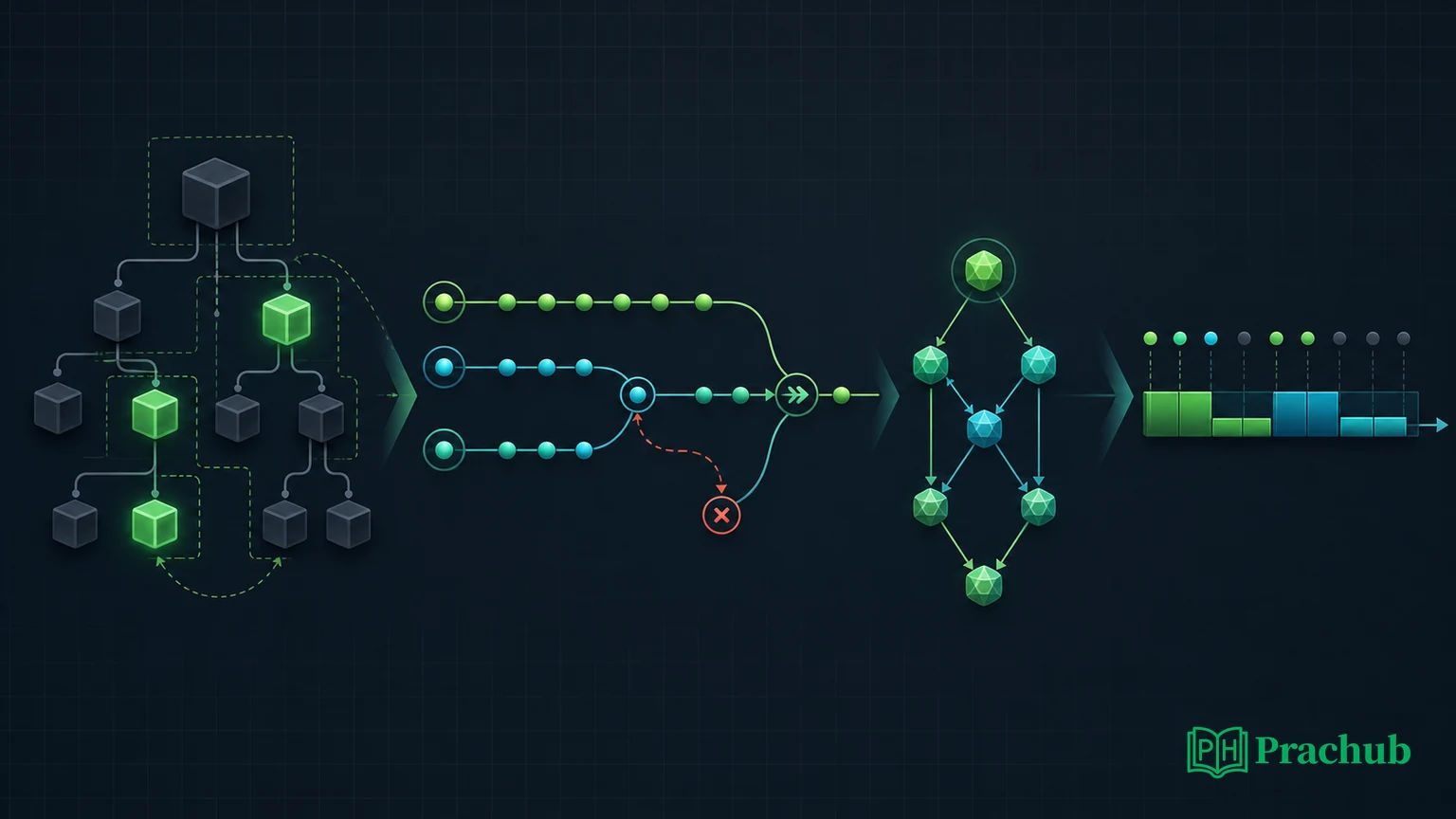
Make the owner explicit:
- Template owner: use
AsyncPipe; it marks the view and unsubscribes when the view is destroyed or the source reference changes. - Signal owner: create one
toSignal()bridge and reuse it rather than resubscribing from repeated calls. - Imperative owner: use
takeUntilDestroyed(); pass aDestroyRefwhen calling outside an injection context. - Long-lived service owner: define when the source starts, when it stops, whether late subscribers replay, and how errors recover.
What should you say about routing, forms, and testing?
These topics reveal whether your reactive explanation survives application boundaries.
Routing: Angular's lazy-route APIs, loadComponent and loadChildren, create chunks through dynamic imports. Eager loading is reasonable for a primary landing page; lazy loading often fits other routes, but deeply nested lazy boundaries can create request waterfalls. Route guards improve navigation UX, but browser-side guards are never the sole authorization control.
Forms: Reactive Forms provide an explicit model, synchronous access, Observable streams, and predictable testing. Discuss validation ownership and remember that disabled child controls are omitted from a FormGroup's .value; use getRawValue() when the full model is required. Signal Forms are stable in Angular 22, but Reactive Forms remain the portable answer for older projects.
Testing: Test observable behavior rather than implementation trivia. New Angular CLI projects default to Vitest, while Karma/Jasmine remains common in existing codebases. Use TestBed and ComponentFixture for rendering, RouterTestingHarness with real route configuration, and the HTTP testing controller's expectOne, flush, and verify sequence for requests.
For deeper test-scope practice, use the separate frontend testing interview guide.
How do you diagnose an Angular performance regression?
Begin with an observed symptom and a measurement environment. “The page feels slow” is not yet a diagnosis. Record the affected route, device class, data size, interaction, and metric, then separate initial-load cost from runtime rendering cost.
- Reproduce and profile. Follow Angular's performance guidance and use Angular DevTools or the Angular track in Chrome DevTools to find expensive change-detection cycles, lifecycle hooks, and component work.
- Classify the bottleneck. Initial JavaScript, network waterfalls, repeated requests, long computations, DOM size, layout/paint, memory retention, and hydration mismatches require different fixes.
- Trace ownership. Find the component, subscription, signal derivation, or provider whose lifetime produces the cost.
- Change one cause. Consider route-level lazy loading,
@defer, stable@for trackkeys, moving slow derivations tocomputedor a pure pipe, narrowing a provider, or reducing render frequency. - Remeasure. Compare the same scenario and check for regressions in interaction, accessibility, memory, and loading behavior.
SSR and hydration are not automatic performance wins. Hydration can reuse server-rendered DOM instead of recreating it, but direct DOM manipulation, invalid HTML, or server/client divergence can cause mismatches. Choose server, client, or prerendered routes from freshness, personalization, build cost, server cost, and SEO requirements.
For browser-stage analysis, see the browser rendering interview guide. For Core Web Vitals, field-versus-lab evidence, caching, and budgets, use the web performance interview guide.
Practice with five PracHub frontend questions
| Practice question | Main Angular or transferable signal | Follow-up to rehearse |
|---|---|---|
| Describe Angular features | Components, DI, templates, change detection, RxJS, routing, and forms | Connect each feature to an ownership boundary |
| Debug an Angular UI from User Reports | State, lifecycle, change detection, cleanup, and async races | Identify the missing notification or stale request |
| Design a Debounced Product Search Box | Debounce, cancellation, ordering, keyboard behavior, and stale responses | Justify switchMap from the latest-query policy |
| Build a Real-Time Event Feed Dashboard | Transferable reactive-stream ownership, derived state, cleanup, and burst control | The prompt uses React; reframe the same constraints in Angular |
| Diagnose Cold-Load and Massive-Table Performance in a Web App | Critical path, profiling, memory, rendering, pagination, and virtualization | Separate evidence for load cost from interaction cost |
A five-day Angular interview plan
- Day 1: Draw a component and injector tree; explain provider visibility and lifetime.
- Day 2: Reproduce a stale-view bug using mutation, then fix the ownership boundary without random change detection.
- Day 3: Implement a debounced search and justify each flattening, error, and cleanup choice.
- Day 4: Model the same feature with Signals for UI state and RxJS for external event sequences; explain the bridge.
- Day 5: Record a performance trace, change one measured cause, and present before-and-after evidence.
Frequently asked questions
Which Angular version should I prepare for?
Prepare the current model and the employer's likely production model. In September 2026, current Angular documentation is on Angular 22, where OnPush and zoneless defaults differ from many older applications. Ask the interviewer for the project's version, then label statements about ZoneJS, NgModules, testing tools, and legacy change-detection defaults.
What is the difference between OnPush and zoneless change detection?
OnPush controls when a component subtree is eligible to be skipped. Zoneless controls how Angular schedules synchronization without relying on ZoneJS patches. They are related but independent ideas: a zoneless application still needs Angular notifications, and an OnPush component can be checked after events, signal updates, AsyncPipe, or explicit marking.
Should I use Signals or RxJS for state management?
Use Signals for current local state and derived values that the Angular view reads. Use RxJS for event sequences that need cancellation, concurrency, retries, or multi-source composition. Many production features use both: an RxJS pipeline owns external timing, while a Signal exposes the latest state to the template.
Which RxJS operators matter most in Angular interviews?
Know the semantics of map, filter, debounceTime, distinctUntilChanged, catchError, and the four flattening operators. More important than the count is explaining whether new work cancels, overlaps, queues, or is ignored—and who owns cleanup when the component or route ends.
How should I answer an Angular performance question?
State the observed symptom, reproduce it under a fixed scenario, profile with Angular or Chrome DevTools, classify load versus runtime cost, trace the responsible owner, change one cause, and remeasure. Name trade-offs such as request waterfalls, memory, layout shifts, hydration compatibility, accessibility, and bundle size.
Final takeaway
Strong Angular interview answers name the version, state owner, rendering notification, subscription lifetime, concurrency rule, measured bottleneck, user-visible result, and verification step. Next, practice one Frontend Engineer question on PracHub aloud with that boundary-first sequence, then tighten any step you cannot verify.
Sources and Further Reading
- Angular component advanced configuration
- Angular zoneless guide
- Angular hierarchical dependency injection guide
- Angular guide to skipping component subtrees
- Angular Signals guide
- Angular guide to effects
- Angular RxJS interoperability guide
- Angular
takeUntilDestroyedguide - RxJS Observable guide
- Angular HTTP request guide
- Angular lazy-loaded routes guide
- Angular Reactive Forms guide
- Angular testing overview
- Angular performance overview
- Angular hydration guide
Comments (0)