Free Coding Interview Study Plan Generator: Build a 7-, 14-, or 30-Day Plan
Quick Overview
A free rules-based coding interview study plan generator with practical 7-, 14-, and 30-day schedules, daily time blocks, progress checks, and PracHub practice questions.
A useful coding interview study plan should match your deadline, available hours, current skill level, and actual interview format. Pick 7 days for an emergency sprint, 14 days for a focused reset, or 30 days for a full preparation cycle. Then use the rules and schedules below to turn that time into daily work.
This package includes a free interactive generator. Enter five inputs, generate a dated schedule, and change the plan when your results change. It runs locally in your browser without signup and can export the plan as Markdown, CSV, or a printable PDF.
Start with PracHub's coding and algorithms interview questions when you need practice by pattern, difficulty, company, or role. The goal is not to complete the largest possible list. It is to become more reliable on the rounds you are actually likely to face.
Use the free interactive generator
Open the no-signup coding interview study plan generator. Enter a target company and role, start date, 7-, 14-, or 30-day window, daily minutes, weakest topics, and confirmed rounds. The tool creates one dated row per day and connects relevant sessions to verified PracHub questions.
The generator makes no network requests and stores nothing. Use Copy Markdown, Download CSV, or Print / save PDF to keep the result. The schedules below explain the logic so you can audit and adjust the generated plan.
What this coding interview study plan generator produces
A coding interview study plan is a time-boxed practice schedule that converts a target interview into daily tasks, review loops, and readiness checks. It should prioritize demonstrated weaknesses and interview format, not an arbitrary problem count.
The generator produces:
- a 7-, 14-, or 30-day calendar;
- a repeatable daily study block based on your available minutes;
- a rule for shifting time toward weak topics or realistic mocks;
- a readiness check for execution, testing, and explanation.
These durations are planning windows, not evidence-based thresholds or pass-rate formulas. Choose 7 days when the interview is already close and your baseline is stable, 14 days when you need one focused coverage-and-review cycle, or 30 days when you are rusty or preparing for several round types.
Enter five inputs before choosing a plan
Write down these inputs before Day 1. A plan that ignores them is only a calendar.
- Deadline: Choose 7, 14, or 30 days. Reserve the final evening for light review.
- Daily capacity: Choose 45, 90, or 120 focused minutes that you can repeat on a normal weekday.
- Round mix: Mark each confirmed round: assessment, live coding, code review, system design, behavioral, or role-specific work.
- Current baseline: Complete one unfamiliar medium problem under a 35-minute timer. Record approach, implementation, edge cases, and explanation.
- Weakest two areas: Select two from the baseline or recent interviews, such as graphs, dynamic programming, debugging, or communication.
Amazon's software development interview guidance supports this format-first approach: ask the recruiting contact which subjects are most relevant, review computer science fundamentals, and practice coding outside an IDE. CodeSignal practice content and CoderPad candidate guides help candidates become familiar with their assessment environments. Platform practice belongs in the plan when the invitation names a platform.
Generate your daily study block
Use the same four-part block each day. Change the duration, not the sequence.
For 45 minutes, spend about 5 minutes retrieving yesterday's pattern from memory, 25 minutes solving, 10 minutes reviewing the solution and tests, and 5 minutes explaining the approach aloud. For 90 minutes, use 10 minutes for retrieval, 45 minutes for one timed problem, 25 minutes for correction or a second implementation, and 10 minutes for verbal explanation. For 120 minutes, add a second problem or a role-specific round after the first debrief.
Do not replace review with more new questions. Research on retrieval practice and distributed practice supports reconstructing learned material from memory and revisiting it after a delay instead of relying only on restudy. These are general learning findings, not coding-interview pass-rate experiments, so treat them as design principles rather than guarantees.
Use this adjustment rule after every session:
- No viable approach: schedule the same pattern again within two days and study one worked example before retrying.
- Correct only after hints: keep the topic active, but reduce difficulty until you can produce the core pattern independently.
- Correct code with weak testing: write adversarial cases from a blank editor the next day.
- Correct, tested, and explained: move the item to spaced review and spend new-problem time elsewhere.
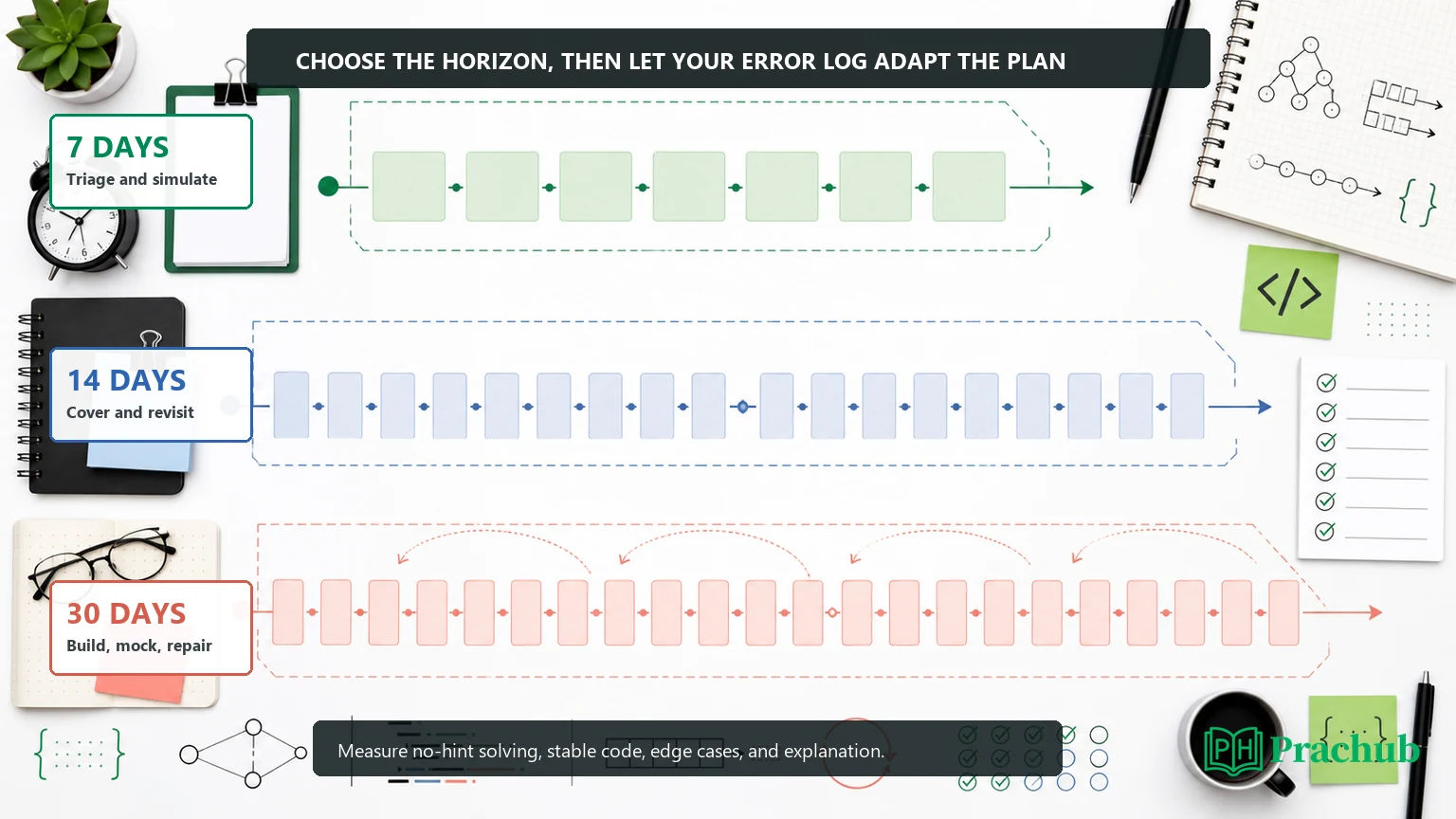
Your 7-day coding interview study plan
Choose the 7-day plan for triage: cover common patterns, remove implementation mistakes, rehearse the environment, and arrive rested. Do not attempt every advanced topic.
| Day | Focus | Required output |
|---|---|---|
| Day 1 | Baseline and logistics | One timed medium, a two-topic weakness list, confirmed platform, language, and interview format |
| Day 2 | Arrays, strings, and hash maps | Two focused solves plus one no-hint redo from memory |
| Day 3 | Two pointers and sliding window | One timed problem, boundary tests, and a spoken complexity explanation |
| Day 4 | Stacks, queues, sorting, and intervals | One mixed set selected from your weakest implementation patterns |
| Day 5 | Trees and graph traversal | One BFS or DFS problem and one short traversal rewrite without notes |
| Day 6 | Full simulation | One realistic timed round, followed by a written error log and two behavioral stories |
| Day 7 | Repair and taper | Redo two misses, verify equipment and rules, then stop heavy study early |
If the interview is senior-level, replace one Day 4 problem with a 35-minute system design outline. If it is an online assessment, use the named platform on Day 6 and practice reading hidden-test failures without changing code randomly.
Your 14-day coding interview study plan
The 14-day plan adds a second review cycle, weak-area repair, and two simulations.
| Day | Focus | Required output |
|---|---|---|
| Day 1 | Baseline and round map | Skills inventory, environment check, and two priority weaknesses |
| Day 2 | Arrays and hash maps | Timed solve plus a clean rewrite |
| Day 3 | Two pointers and sliding window | Pattern comparison and edge-case checklist |
| Day 4 | Linked lists, stacks, and queues | Pointer or state invariants explained aloud |
| Day 5 | Sorting, binary search, and intervals | Boundary-focused implementation practice |
| Day 6 | Trees | Traversal, recursion, and iterative trade-offs |
| Day 7 | Review mock | Mixed timed set and a ranked error log |
| Day 8 | Graphs | BFS, DFS, visited-state, and cycle handling |
| Day 9 | Heaps and priority queues | Selection, scheduling, or streaming problem |
| Day 10 | Backtracking or dynamic programming | One role-relevant pattern, not an advanced-topic marathon |
| Day 11 | Company and role alignment | Questions selected from confirmed rounds and job requirements |
| Day 12 | Full simulation | Complete one uninterrupted round in the expected environment |
| Day 13 | Repair day | Redo failed problems and rehearse behavioral or design follow-ups |
| Day 14 | Final review | One easy confidence solve, logistics, sleep, and no new hard topics |
At the end of Day 7, change Days 8 through 13 if the evidence demands it. A graph-heavy plan is wasteful when your failures are all parsing, testing, and communication.
Your 30-day coding interview study plan
The 30-day plan has four phases: diagnose, build patterns, simulate, and taper. Use it when you have not interviewed recently or face multiple round types.
| Days | Focus | Required output |
|---|---|---|
| Days 1-3 | Baseline, language, and environment | Two timed baselines, an error taxonomy, and confirmed round mix |
| Days 4-7 | Arrays, strings, hashing, and sorting | Core pattern notes and two spaced redos |
| Days 8-11 | Two pointers, sliding window, stacks, queues, and intervals | Mixed timed sets with explicit boundary tests |
| Days 12-15 | Trees and graphs | BFS, DFS, recursion, cycles, and traversal explanations |
| Days 16-18 | Heaps, backtracking, and practical dynamic programming | Role-relevant problems selected from evidence |
| Days 19-21 | Role-specific preparation | System design, SQL, frontend, debugging, or behavioral work as required |
| Days 22-24 | Simulations | Two timed coding rounds and one full debrief |
| Days 25-27 | Weak-area repair | Blank-editor rewrites, failed test cases, and explanation practice |
| Day 28 | Full interview loop | Coding plus the other confirmed round types with realistic breaks |
| Day 29 | Final correction | Review the error log and repeat only the highest-value misses |
| Day 30 | Taper | Easy recall, equipment check, route or meeting details, and rest |
Adapt the generated plan to the interview format
For an online assessment, prioritize parsing, hidden-test discipline, and platform familiarity. The HackerRank Interview Preparation Kit organizes practice by common algorithm categories, while CodeSignal's practice area exposes several question formats and its IDE.
For a live coding interview, spend more time stating assumptions, comparing approaches, and testing while another person follows your reasoning. Microsoft's technical interview guidance similarly emphasizes clarification, planning, working code, and boundary tests. Correct silent code is not the only output.
For a mid-level or senior loop, replace 20% to 35% of coding time with confirmed design, debugging, code-review, or behavioral rounds. Use the current role-specific guidance, such as Amazon's SDE II preparation or Meta's full-loop guide, to decide which non-coding blocks belong in your plan.
Measure progress without chasing a fake pass rate
Track four signals after each timed problem: whether you found the core approach without a hint, how long it took to reach a correct plan, how many implementation or edge-case failures remained, and whether you could explain complexity and alternatives clearly.
A problem counts as "ready" only when you can solve a fresh variant or reproduce the method after a delay. Keep an error log with the problem, error type, correction, and retry date.
Do not convert your practice percentage into an interview pass probability. Companies use different questions, rubrics, resume screens, and hiring bars. The generator helps allocate preparation time; it cannot predict an outcome.
Practice coding interview questions from PracHub
These PracHub question-bank records cover useful patterns for the schedules above. They are practice material, not predictions of your exact assessment or interview.
| PracHub question | Practice focus | Why it belongs in the plan |
|---|---|---|
| Find the Earliest Pair with a Target Sum | Hash maps and index rules | Tests whether you can turn a simple target-sum idea into a precise contract |
| Reconstruct tree from inorder and postorder | Recursion and trees | Tests index boundaries, base cases, and reconstruction invariants |
| Solve grid shortest path with BFS | Graphs and BFS | Trains visited-state decisions, queue discipline, and shortest-path reasoning |
| Merge Overlapping Intervals | Sorting and intervals | Builds boundary handling and a precise merge invariant |
| Design a least-recently-used cache | Data-structure design | Combines API behavior, linked state, hashing, and complexity trade-offs |
Use the first attempt as a baseline, then revisit misses according to the schedule. Keep the complete question titles as your navigation surface so you can return directly to the written solution after each timed attempt.
Frequently asked questions
Is seven days enough to prepare for a coding interview?
Seven days can improve execution if you already program comfortably, but it is not enough to master every data structure from scratch. Use the week to diagnose gaps, cover high-frequency patterns, run one realistic simulation, and eliminate recurring implementation errors. Consider rescheduling only when the interview policy allows it and your baseline shows a fundamental gap.
How many coding problems should I solve each day?
Use time and review quality instead of a universal count. One timed problem with a complete debrief, blank-editor rewrite, and delayed retry can be more valuable than several rushed submissions. A 45-minute session may support one focused problem; a two-hour session may support two, provided you still preserve testing and explanation time.
Should beginners choose the 14-day or 30-day plan?
Choose 30 days if you know one programming language but have limited interview-pattern experience. The longer schedule allows a baseline, topic coverage, spaced review, and simulations. If basic coding itself is still unfamiliar, neither compressed plan is ideal; build programming fluency first, then return to interview-specific preparation.
How should I use this plan while working full time?
Set the weekday schedule from the smallest repeatable block, usually 45 or 90 minutes, and place longer simulations on weekends. Do not borrow sleep to meet an arbitrary problem count. When a workday collapses, move the missed review forward and remove a lower-priority new topic rather than doubling the next session.
Should I practice company-tagged questions only?
Company-specific questions are useful after you confirm the role and round, but they should not replace transferable patterns. Use them to test relevance, wording, and likely follow-ups. Keep part of the schedule for unfamiliar problems so recognition does not become memorization, and remember that stored question reports cannot predict your exact interview.
Final takeaway
The best free coding interview study plan is the one that changes when your evidence changes. Choose 7, 14, or 30 days, protect a realistic daily block, run a baseline, and let missed approaches, unstable code, weak tests, or unclear explanations determine tomorrow's work.
Use PracHub interview questions to fill each day with role- and company-relevant practice. Then measure progress by independent solving, reliable implementation, edge-case coverage, and communication, not by the size of a completed list.
Sources and Further Reading
- HackerRank Interview Preparation Kit
- Amazon software development interview topics
- Amazon SDE II interview preparation
- Meta full-loop software engineering preparation
- CodeSignal practice content overview
- CoderPad candidate preparation guides
- PubMed review of distributed practice
- Psychological Science study on retrieval practice and delayed retention
- Microsoft technical interviewing guidance
Research note: This guide was checked on August 28, 2026. Interview formats, assessment platforms, and employer expectations can change by role, location, and recruiting cycle.
Comments (0)