Google Product Manager Resume Guide: Product Impact, Metrics, and Leadership Examples
Quick Overview
Google Product Manager resume guide with before-and-after bullets for product impact, metrics, launches, technical judgment, and cross-functional leadership.
Many Product Manager resumes read like a tidy Jira history: managed a roadmap, wrote requirements, partnered with engineering, and launched features. That proves activity. It does not yet prove that you found the right problem, made difficult choices, influenced a team, or changed a meaningful product outcome.
A Google PM resume needs a sharper story. Google's public PM job descriptions repeatedly emphasize guiding technical products from conception to launch, understanding users and markets, defining product vision and roadmaps, working cross-functionally, testing performance, and using data to define success. Your resume should make those signals easy to find without pretending there is one secret Google template.
Start by comparing your evidence with Google Product Manager questions and the broader Product Manager interview question bank. Every strong resume bullet should become a product, execution, analytical, or leadership story you can defend in an interview.
Quick Answer: What Should a Google PM Resume Prove?
A strong Google Product Manager resume shows how you turned a user or business problem into a product decision, aligned cross-functional partners, shipped or changed something, and measured the result. The product name matters less than the quality of your judgment and the scope of your influence.
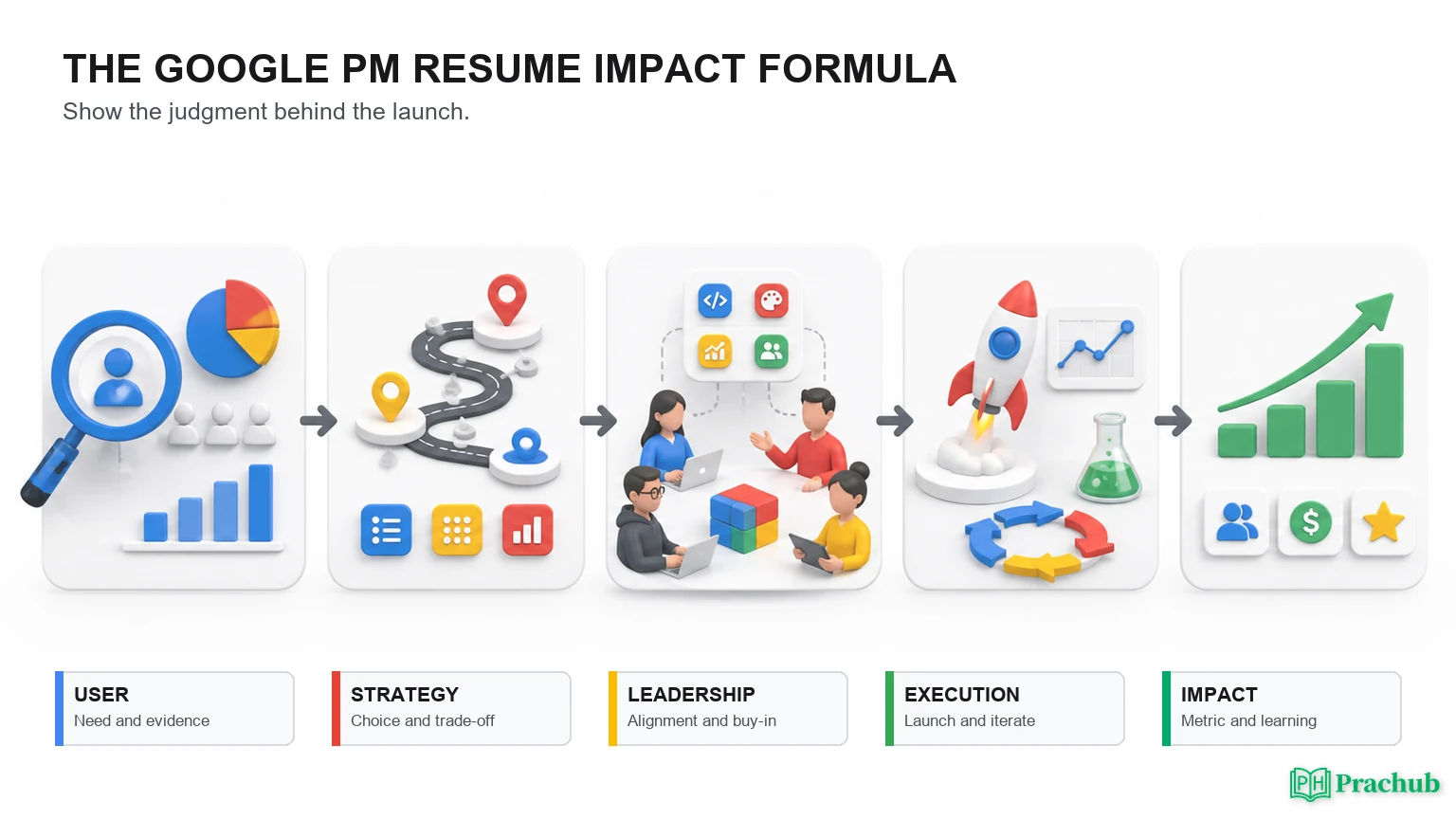
| Signal | Weak evidence | Stronger PM evidence |
|---|---|---|
| User problem | Gathered customer feedback | Identifies the user segment, unmet need, and evidence that changed the roadmap |
| Strategy | Owned the product roadmap | Shows the choice, trade-off, market or technical constraint, and product direction |
| Leadership | Worked with engineering and design | Explains how you created alignment or secured buy-in without relying on authority |
| Execution | Launched a new feature | Names the scope, risks, rollout, experiment, or iteration you drove |
| Impact | Improved engagement | Connects the launch to a defined user, business, quality, or operational metric |
This is an inference from public role requirements, not a claim about an internal resume rubric. Current Google PM postings emphasize vision, roadmaps, opportunity sizing, buy-in, launches, experimentation, success metrics, user empathy, and cross-functional work.
The Product Manager Resume Bullet Formula
A useful structure is:
Product Context + Decision + Cross-Functional Leadership + Launch or Experiment + Measurable Impact
You do not need all five pieces in one sentence. A major product can use one bullet for the decision and another for execution and outcome. Make your contribution distinct from the team's result.
Compare "Led a checkout redesign with design and engineering" with: "Prioritized guest checkout after funnel analysis and 18 customer interviews identified account creation as the largest abandonment point; aligned Design, Risk, and two engineering teams on a phased rollout that increased completed purchases by 11% without raising chargebacks."
The stronger version creates useful follow-ups. Why guest checkout? What alternatives were rejected? How did Risk shape the scope? Which metric was primary? A resume bullet earns attention when it contains evidence that can survive those questions.
Google Product Manager Resume Examples
The examples below are hypothetical. Replace every metric, product detail, and outcome with facts you can explain. Do not borrow scale or impact from a team when your personal contribution was narrower.
Product impact and activation
Before: Improved onboarding for small-business customers.
After: Reframed onboarding around first-value completion after analyzing 240,000 account journeys; removed two low-signal setup steps and launched guided recommendations that increased seven-day activation from 38% to 47%.
The stronger version leads with the product problem, evidence, choice, and outcome.
Zero-to-one product development
Before: Launched a new AI assistant from concept to production.
After: Defined the first use case and success criteria for an AI support assistant after rejecting a broad automation proposal; led a 14-person Engineering, Design, Legal, and Operations team from prototype to limited release, resolving 23% of eligible requests with a 92% human-review acceptance rate.
Strong zero-to-one evidence shows what you narrowed, why, and how quality was measured.
Technical or platform product
Before: Owned the roadmap for an internal data platform.
After: Consolidated three overlapping ingestion roadmaps into a self-service data platform strategy; secured buy-in from six product teams, sequenced migration around reliability constraints, and reduced new-pipeline setup from 12 days to under four hours for 180 engineers.
The PM signal is understanding constraints, defining boundaries, prioritizing leverage, and coordinating adoption.
Experimentation and product metrics
Before: Ran A/B tests to improve recommendations.
After: Defined recommendation quality around long-term saves rather than click-through rate; designed three experiments with Data Science and UX, increasing 28-day retained usage by 6.4% while keeping content-diversity guardrails neutral.
Metric choice is product judgment; show why the success criterion mattered.
Cross-functional leadership and conflict
Before: Collaborated with Sales, Engineering, and Legal to launch enterprise controls.
After: Resolved a six-week impasse over enterprise data controls by separating launch blockers from follow-up requests; aligned Legal, Security, Sales, and Engineering on a two-phase plan that protected the quarter's launch and unlocked $3.8 million in qualified pipeline.
Leadership becomes visible through the conflict, trade-off, and outcome.
Product retirement or strategic subtraction
Before: Managed a portfolio of mobile features.
After: Recommended retiring two low-adoption mobile workflows after quantifying maintenance cost and user overlap; redirected eight engineer-months to the core sharing experience and reduced quarterly support volume by 19%.
Stopping work or avoiding a bad investment can demonstrate strong product judgment.
How to Show Leadership Without Direct Reports
Most PM leadership is influence rather than hierarchy. Team size alone does not prove leadership, and "managed a cross-functional team" can sound inaccurate when those people did not report to you.
Show the mechanism: you clarified an ambiguous goal, reconciled incentives, obtained sponsorship, changed sequencing, or gave partners evidence that made a decision easier.
Use precise verbs such as defined, prioritized, aligned, negotiated, secured, reframed, sequenced, launched, validated, or retired. Reserve "managed" for work you actually managed and "led" for situations where you set direction or carried the outcome.
Choose Metrics That Explain the Product
A PM resume does not need a percentage in every line. It needs enough evidence to show what success meant and whether the work mattered. Choose metrics that fit the product's stage and objective.
User metrics include activation, retention, adoption, satisfaction, and time to value. Business metrics include revenue, conversion, cost, margin, and churn. Quality and trust metrics include error rate, latency, abuse, safety, or accessibility. Execution metrics include launch coverage, migration, cycle time, or support load.
Add scale only when it changes the reader's understanding: users, markets, regions, teams, devices, transactions, or budget. "Improved activation by 8%" is stronger when the reader knows which segment, baseline, time period, and guardrails were involved.
What If You Cannot Share Revenue or User Numbers?
Do not disclose confidential data. Use approved percentages, ranges, generalized scale, or operational outcomes. "Improved weekly activation by a high-single-digit percentage across a six-figure user base" preserves the signal without exposing protected numbers.
If a product was too early for business impact, show the next credible result: pilot adoption, validated demand, design-partner commitments, experiment quality, a decision avoided, technical risk retired, or a documented learning that changed direction.
Never invent attribution. If your research informed a decision, say "informed." If your launch contributed to a broader outcome, narrow the claim. Credibility is more valuable than a dramatic number you cannot defend.
Tailor the Resume to the Specific Google PM Role
Google PM roles vary widely across consumer products, Cloud, AI, infrastructure, hardware, commerce, and internal platforms. A generic Google resume can hide the very experience that makes you relevant.
Start with the minimum qualifications and domain requirements. Then map the responsibilities to evidence already on your resume: user understanding, opportunity, vision, roadmap, technical depth, experiments, launch, and leadership.
Do not copy the posting sentence by sentence. Reorder your strongest relevant bullets, use the role's normal vocabulary, and make domain transfer explicit. A B2B platform PM applying to Google Cloud should lead with technical products, customer workflows, adoption, reliability, and commercial impact rather than burying those under a consumer side project.
Show Technical Depth Without Pretending to Be the Engineer
Google's PM descriptions often mention connecting technical and business worlds, working closely with Engineering, and breaking complex problems into actionable steps. Your resume can demonstrate that through API constraints, platform boundaries, data flows, privacy, latency, model quality, migration risk, or build-versus-buy decisions.
Avoid technology name-dropping. "Partnered on a Kubernetes migration" says little. "Prioritized tenant isolation and rollback support before feature expansion, enabling 40 enterprise customers to migrate with no Sev-1 incidents" explains the product judgment inside the technical work.
Keep the Google PM Resume ATS-Friendly
Use a conventional one-column structure, clear headings, reverse-chronological experience, and concise bullets. Keep the file under Google's stated 2 MB limit, and review every extracted application field because parsing can be incomplete.
A simple DOCX or PDF is usually safer than a design-heavy document. Microsoft's current parser guidance also recommends avoiding heavy tables, images, unusual fonts, and complex sections. Put projects under the role where they happened so the relationship between ownership and outcome remains clear.
One page can work for an APM or early-career candidate. Two pages can be reasonable for an experienced PM when every line adds relevant product evidence. Do not keep old coursework or generic responsibilities merely to fill space.
Turn Resume Bullets Into Interview Stories
Your resume is not separate from interview preparation. Google PM interviews may probe product sense, strategy, execution, estimation, analytical judgment, leadership, and technical trade-offs. A metric without a causal story or a launch without trade-offs will invite difficult follow-ups.
For each major bullet, prepare the user problem, alternatives, decision criteria, disagreement, launch plan, metric design, result, and what you would change. The Google Product Manager interview guide helps map those stories to the interview loop, while PracHub's market sizing questions for Product Managers provide practice turning assumptions into structured decisions.
Common Google PM Resume Mistakes
The first mistake is feature inventory: a list of launches with no problem, choice, or outcome. The second is metric theater: percentages with no baseline, user segment, timeframe, or connection to your contribution.
The third is process-first writing. Running standups, grooming backlogs, and writing PRDs may be part of the job, but they are rarely the reason a PM is hired. Show the decisions those mechanisms enabled.
Finally, avoid inflated leadership claims. A credible story about aligning four stakeholders around one difficult trade-off is stronger than "led company-wide strategy" when your scope was one feature.
A 15-Minute Google PM Resume Audit
| Check | Question to ask | Fix |
|---|---|---|
| User | Can the reader name the user and problem? | Add the segment, unmet need, and evidence. |
| Decision | Is one meaningful product choice visible? | Name the trade-off, prioritization, or direction you set. |
| Leadership | How did I create alignment? | Add the conflict, partner groups, mechanism, and scope. |
| Execution | What did I personally drive? | Clarify the launch, experiment, migration, or iteration. |
| Impact | What changed for users or the business? | Add an appropriate metric, scale, guardrail, or learning. |
| Defensibility | Can I answer follow-ups on every claim? | Narrow anything you cannot explain or attribute. |
Frequently Asked Questions
How long should a Google Product Manager resume be?
Use the shortest version that preserves relevant evidence. One page is common for APM and early-career candidates. Experienced PMs can use two pages when the additional space shows meaningful launches, scope, leadership, and impact.
Does a Google PM resume need an MBA?
No universal Google PM requirement says every candidate needs an MBA. Current postings commonly accept a bachelor's degree or equivalent practical experience and emphasize PM or related technical experience plus product launches. Follow the exact posting you are targeting.
Should I include a product portfolio?
A portfolio can help career switchers or candidates with limited formal PM experience, but it is not a substitute for clear resume evidence. Include only artifacts that demonstrate product thinking, prioritization, metrics, communication, or execution.
Which PM metrics should I put on the resume?
Choose metrics that match the product objective: activation, retention, adoption, conversion, revenue, cost, quality, trust, latency, or time to value. Add a baseline, segment, timeframe, or guardrail when it makes the result more credible.
How do I show leadership if I was not the official PM?
Describe the product decision you owned, the partners you influenced, the conflict or ambiguity you resolved, and the measurable result. Use an accurate title and do not imply direct authority you did not have.
Final Takeaway
A Google Product Manager resume should read like a compact portfolio of judgment. Show the user problem, the consequential decision, how you aligned people, what reached users, and what the evidence said afterward. Product names and frameworks cannot replace that chain.
Then practice the stories behind the bullets. Use PracHub's Google PM questions, product exercises, and behavioral and leadership questions to rehearse trade-offs, conflict, failed launches, stakeholder influence, and metrics before the interview.
Sources and Further Reading
- Google Careers: Product Manager II, Core
- Google Careers: Product Manager, Googler Experience
- Google Careers: Product Manager, Forecasting and Capacity Management
- Google Careers: Product Manager II, Google Maps
- Google Careers Help: Apply for a Job and Resume Parsing
- Microsoft Careers: Resume Parser Formatting Guidance
Research note: Public job descriptions and application guidance were checked on August 24, 2026. Google can change open roles, qualifications, teams, and hiring processes; use the exact posting and recruiter instructions for your application.
Related Articles
Product Alliance Review 2026: Are Its $570 PM Interview Courses Worth It?
Product Alliance review 2026: compare its $570 PM courses, $650 bundle, curriculum, refund policy, strengths, limitations, and alternatives.
Technical Product Manager Interview Questions: APIs, Metrics, Systems, and Product Trade-Offs
Prepare for Technical Product Manager interviews with API design, product metrics, system boundaries, reliability, and practical trade-off frameworks.
Capital One Product Manager Mini Case Interview Guide: Market Sizing, Metrics, and Product Judgment
Prepare for the Capital One PM mini case with market sizing, metrics, product judgment, a worked example, and linked practice questions.
AI Product Manager Interview Questions: LLM Metrics, Safety, Product Sense, and Trade-Offs
Prepare for AI Product Manager interviews with LLM metrics, safety scenarios, product sense, technical trade-offs, and practice questions.
Comments (0)