MakerCode Review: RTL Simulation, Circuit Challenges, and Embedded C Practice
Quick Overview
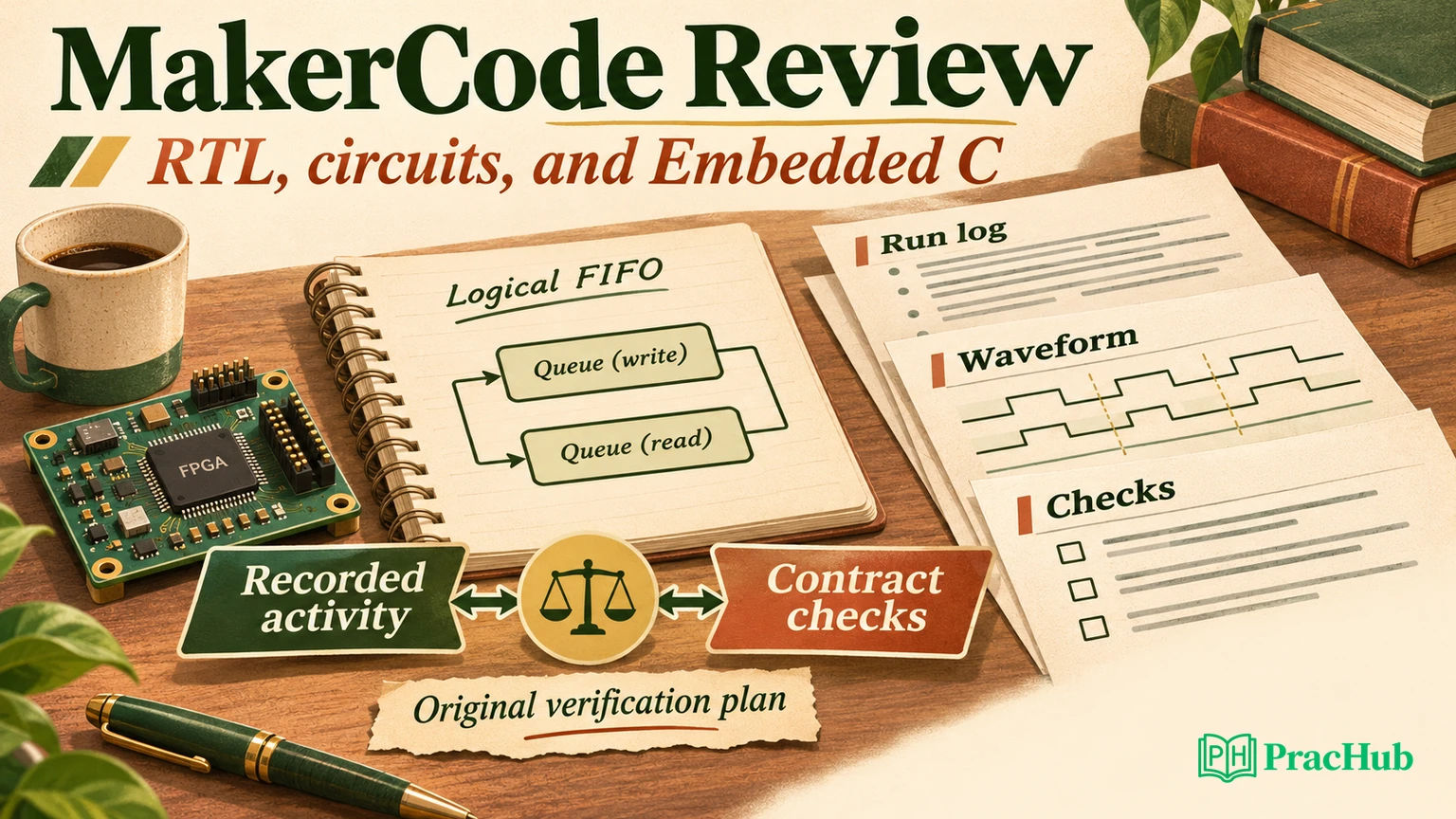
MakerCode hardware-practice review based on current RTL, Circuit and Embedded C routes and a synchronous FIFO workspace. An original local SystemVerilog testbench checks simultaneous full-queue replacement, rejected operations, ordering and reset behavior; an intentional negative control fails the relevant boundary case. Remote simulation, AI feedback, certifications and hardware timing remain unverified.
MakerCode is worth inspecting when a hardware interview requires you to implement and explain behavior across clock cycles. Its public catalog separates RTL, Circuit, Arduino and Embedded C work. We opened a synchronous FIFO workspace and a C FIFO-counting task, then ran an independent RTL testbench locally. Check which behavioral contract each result supports. Visible Run and waveform controls leave execution and correctness to be verified.
PracHub publishes this review and owns the complementary practice links. The PracHub ASIC verification exercise offers another setting for turning a functional promise into checks. Our two-entry FIFO and testbench below are original examples, separate from MakerCode's implementation, remote grader and hidden cases.
Confirm the hardware platform and the specific route
Direct observation, November 3, 2026: the MakerCode hardware platform displayed four practice categories and links to companion ElectroGym and JiJob surfaces. We inspected the hardware domain named here; similarly named programming products should not be substituted for it.
The public RTL catalog included counters, arbiters and FIFOs. The Circuit category displayed SPICE-labeled tasks, while the Embedded C category included both language exercises and firmware-oriented calculations. We did not audit every item, establish a unique catalog count, test a certificate, or evaluate a collaborative interview session.
Provider account: the creator's March 2026 release post describes simulation, waveform analysis, walkthroughs and an AI assistant. That is first-party product positioning from a dated release, not an independently measured current performance result. We used the current visible workspaces to narrow what this review could verify.
Choose the route that matches the evidence you need. A software output, an RTL event trace and a circuit response require different assumptions. Having all three in the navigation does not make them interchangeable demonstrations of competence.
The inspected FIFO workspace exposed a real boundary case
We opened the synchronous FIFO workspace without signing in. It exposed a SystemVerilog editor, Run control, log area and waveform tab alongside a detailed problem statement. We did not run the provider's starter module or submit a remote implementation.
The public contract described configurable depth and width, full and empty flags, and protected push and pop operations. It also explicitly required simultaneous push and pop to be allowed when the queue was full. That last condition matters: a rule that simply rejects every push while full would miss the same-cycle release of capacity.
Before implementing, identify which operations are accepted at the clock edge. An input request is not automatically an accepted transfer. A pop request while empty can be ignored; a push request while full may be accepted when the same edge also accepts a pop, depending on the stated policy.
The workspace specification gives you a particular edge case to explain. Our independent exercise below focuses on that requirement while deliberately narrowing the design to two entries and eight-bit data. It is not a complete parameterized solution for the platform.
Original trace: full does not forbid every simultaneous transfer
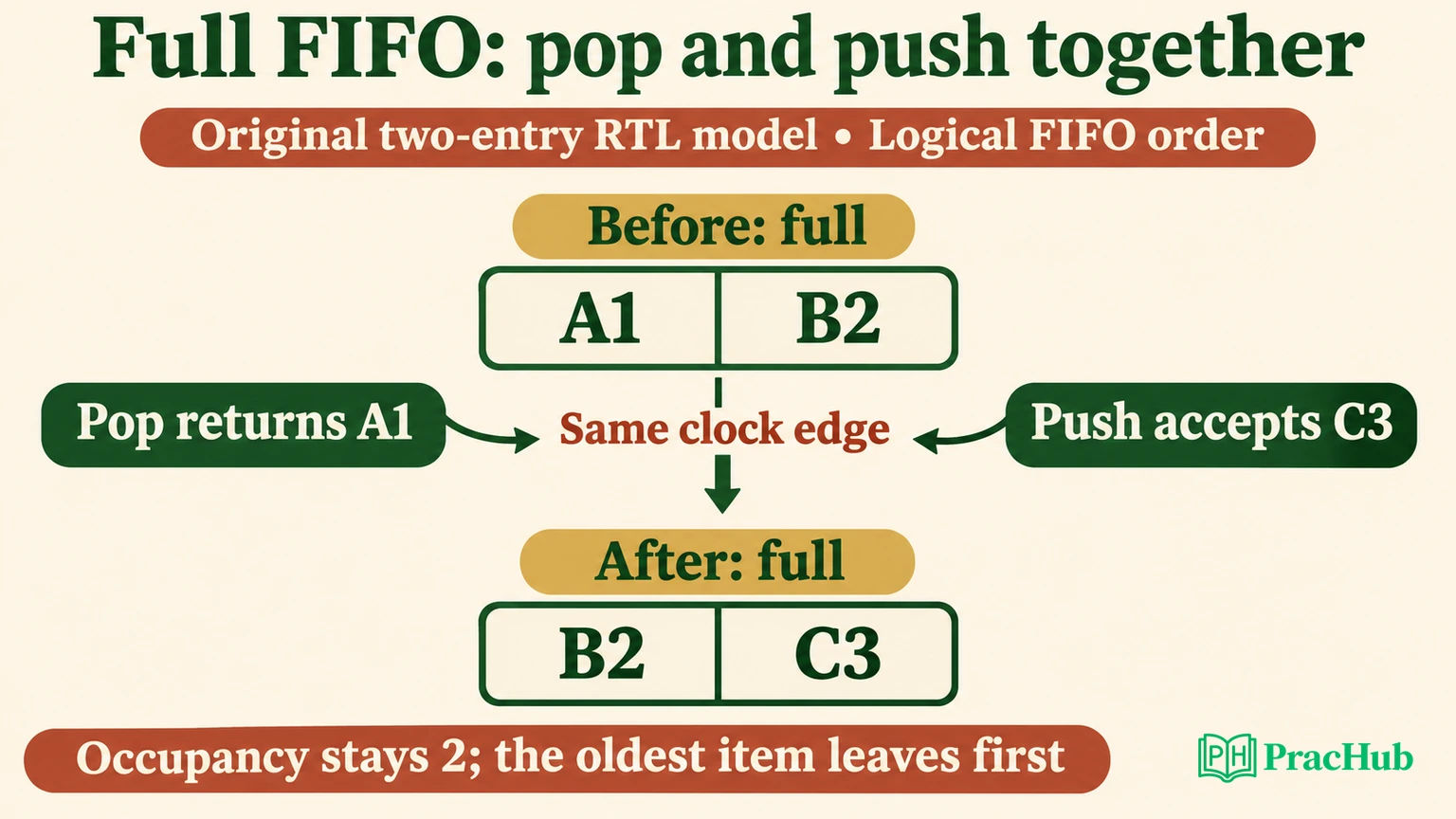
Start with a two-entry queue containing A1 followed by B2. The queue is full. Now request a pop and a push of C3 on the same edge. Under the selected contract, the oldest item A1 is returned, C3 is admitted, and the queue becomes B2 followed by C3. Occupancy remains two.
An incorrect acceptance rule might allow a push only when the pre-edge full flag is false. It would accept the pop but reject C3, leaving only B2. That design avoids overflow yet violates the simultaneous-transfer requirement. Checking capacity safety alone would miss that rejected transfer.
Our original implementation separates accepted operations conceptually as follows:
take_pop  = pop_request and not empty

take_push = push_request and
            (not full or take_pop)

next_count = count + take_push - take_pop
Those rules describe this exercise's contract. They do not define every FIFO interface. We chose no empty bypass: if the queue is empty and both requests arrive, the new item is stored and the invalid pop does not return it immediately. We also chose a registered pop output that holds its previous value when no pop is accepted.
| Original case | Required observation in our exercise | Mistake it can expose |
|---|---|---|
| Read while empty | No item removed; output remains stable | Treating a request as an accepted transfer |
| Write while full without a read | Contents and occupancy unchanged | Overwriting an unread item |
| Full queue, push and pop together | Old head returned, new tail retained, count unchanged | Rejecting the new item using only pre-edge full |
| Drain after replacement | Remaining items emerge in FIFO order | Incorrect pointer or same-slot update behavior |
| Empty queue, both requests | Store the item without immediate bypass | Assuming an unstated interface convention |
| Reset outside the clock edge | State clears under our asynchronous-reset contract | Checking only clocked reset behavior |
The test sequence uses distinct byte values to expose ordering errors. Returning A1, then B2, then C3 makes an overwrite or ordering error visible. A trace containing the same value in every slot would be a weaker check of data integrity even if the flags looked correct.
What our local RTL testbench actually checked
We wrote a small independent SystemVerilog module and testbench and ran them with an existing local Icarus Verilog installation. Ten directed cycles and two asynchronous reset checks passed. The sequence included rejected operations, simultaneous full replacement, draining, an empty simultaneous request, and output hold behavior.
The testbench drove requests away from the active clock edge and checked results after the modeled register updates. That matters because an observation taken at the wrong simulation moment can appear to be a logic failure even when it is a testbench scheduling mistake. Retain when inputs change and when outputs are sampled alongside the expected values.
We also ran an intentional negative control. It disabled admission of a push when the FIFO was full, even if a pop was accepted. The same testbench failed at the full simultaneous-transfer case. That result demonstrates that this particular check can detect the plausible acceptance bug; it does not prove that the remaining design is exhaustively correct.
The Icarus Verilog simulation documentation distinguishes simulation models and testbenches from technology-specific synthesis. Our run establishes only the behavior of the original model under the stated sequence. We did not synthesize it, measure a physical memory, test clock-domain crossing, or validate MakerCode's remote execution service.
Both local runs produced waveform files, including the deliberately incorrect run. A waveform file therefore established that signal activity was recorded; it did not establish a passing result. The negative control still ended in the expected assertion failure. Keep the run status and the requirement check alongside any waveform you inspect.
Our testbench printed its pass marker only after the directed sequence and reset checks completed. It also contained a watchdog to end a stalled simulation as a failure. Those are testbench choices, not features we verified in MakerCode. They make the local artifact easier to interpret: compilation, recorded activity, completed checks and a successful run are separate observations.
If an online run returns a log and a waveform, ask which of those observations it actually reports. Identify the first failing check before modifying the implementation. Otherwise, a valid-looking trace can conceal an untested boundary or an incomplete test sequence.
A waveform needs an acceptance argument
For each edge, relate the visible requests to the accepted operations. If count stays constant, that could mean no transfer or a simultaneous push and pop. Inspect data and acceptance together before concluding that the design made progress.
At full occupancy, our same-cycle read and write can address the same storage slot. The original RTL model defines which old item is captured and which new value is retained. Mapping that behavior onto a particular physical memory can add read-during-write constraints. A local behavioral trace does not establish an implementation's memory mode or timing closure.
The next useful extension is a different depth or a changed interface policy. Before trying it, state what must change in pointer width, wrap behavior or output latency. Our fixed two-entry exercise does not validate arbitrary parameter values just because the inspected platform problem is parameterized.
The Embedded C route asks a different question
The inspected C task counts rejected FIFO writes from a sequence of write and read commands. Its description defines an initially empty queue, full-capacity use, ignored empty reads, and the requested rejection count. The workspace showed a C11 editor with a provided harness and a Run control.
That is a sequential state-simulation problem, rather than a clock-edge RTL interface. A useful answer tracks occupancy and increments the rejection count only when a write cannot be accepted. It does not independently prove simultaneous signal handling, asynchronous reset, or a physical buffer's synchronization.
We did not execute that task remotely or assume the RTL testbench validated it. The public descriptions let us compare their contracts; each would still need its own implementation and checks. The shared FIFO label does not make either result validate the other implementation.
Circuit and AI features need their own evidence
The Circuit catalog's SPICE labels identify another practice route. We did not create a schematic or run an analog simulation. To evaluate a circuit result, identify the analysis, source conditions, component models and the quantity being checked before treating a plot as meaningful. An RTL testbench supplies none of those analog assumptions.
The creator's release account also describes Silica analyzing waveform output and proposing fixes. We saw AI-related controls, but did not send a prompt, supply a provider key, test a suggested patch, or measure feedback accuracy. A visible message allowance is not evidence that a proposed diagnosis is correct or that a private account has a particular entitlement.
If you later evaluate an AI suggestion, preserve a failing case, explain the proposed change, and rerun the relevant check. Then ask what the check leaves unresolved. Our intentional FIFO fault is a useful model of that discipline: an edited line should be connected to a specific accepted-operation failure, not simply to a reassuring summary.
Choose the workspace by its verification contract
This original map connects the observed routes to different preparation artifacts. It separates visible controls from capabilities we did not execute.
| Route | Useful artifact to produce | Boundary retained in this review |
|---|---|---|
| RTL workspace | Edge-by-edge transfer trace and checks | Provider Run and remote evaluation untested |
| Embedded C workspace | State transition and expected output | Provided harness visible; remote result untested |
| Circuit catalog | Stated circuit requirement and analysis assumptions | No schematic or analog run performed |
| Walkthrough or reference material | Explanation tied to a breaking case | Coverage and accuracy not audited |
| AI-assisted debugging | Patch plus a reproducible before/after check | No key, prompt, response or patch evaluation |
For the FIFO example, the contract gives you a concrete place to begin: fill the queue, request both operations, and explain which item leaves and which remains. That is a more defensible practice goal than collecting a waveform without identifying the requirement it should satisfy.
Practice the gaps the product leaves open
These complementary PracHub prompts connect the inspected FIFO workspace to verification, clock domains and memory reasoning. Choose a prompt that challenges the same acceptance or ordering assumption in another context.
| PracHub question | What to examine |
|---|---|
| ASIC Verification Fundamentals Across SystemVerilog UVM CDC and Architecture | Translate a functional promise into assertions and a verification plan. |
| Design signals across power and clock domains | Separate a single-clock model from cross-domain behavior. |
| Answer OoO, caches, and memory-system questions | Name which timing and memory assumptions a model leaves out. |
| Implement a fixed-capacity generic circular buffer | State bounded storage, accepted operations and FIFO order. |
| Verification Plan for a FIFO, a Round-Robin Arbiter and a Valid/Ready Handshake | Extend the simultaneous-transfer trace into a reusable boundary test plan. |
MakerCode may fit a learner who wants hardware-oriented tasks and is prepared to inspect the exact interface rules. Open the relevant workspace, distinguish visible controls from tested execution, and retain a small counterexample. Continue with the PracHub ASIC verification exercise to turn the next functional promise into a test plan. State the clock, reset, parameter and implementation assumptions covered by your checks.
Comments (0)