Who this guide is for
If you're interviewing for a Software Engineer role at Optiver - graduate, new-grad, or experienced - this guide walks you through the full loop, what each round actually tests, and how to prepare for the parts that trip people up. The short version: Optiver runs a coding-heavy process, but what separates strong candidates from average ones is systems depth and the ability to reason out loud about performance and tradeoffs, not just clearing LeetCode problems.
To practice on real questions reported from this loop, see the Optiver question bank and the broader Software Engineer questions.
What to expect
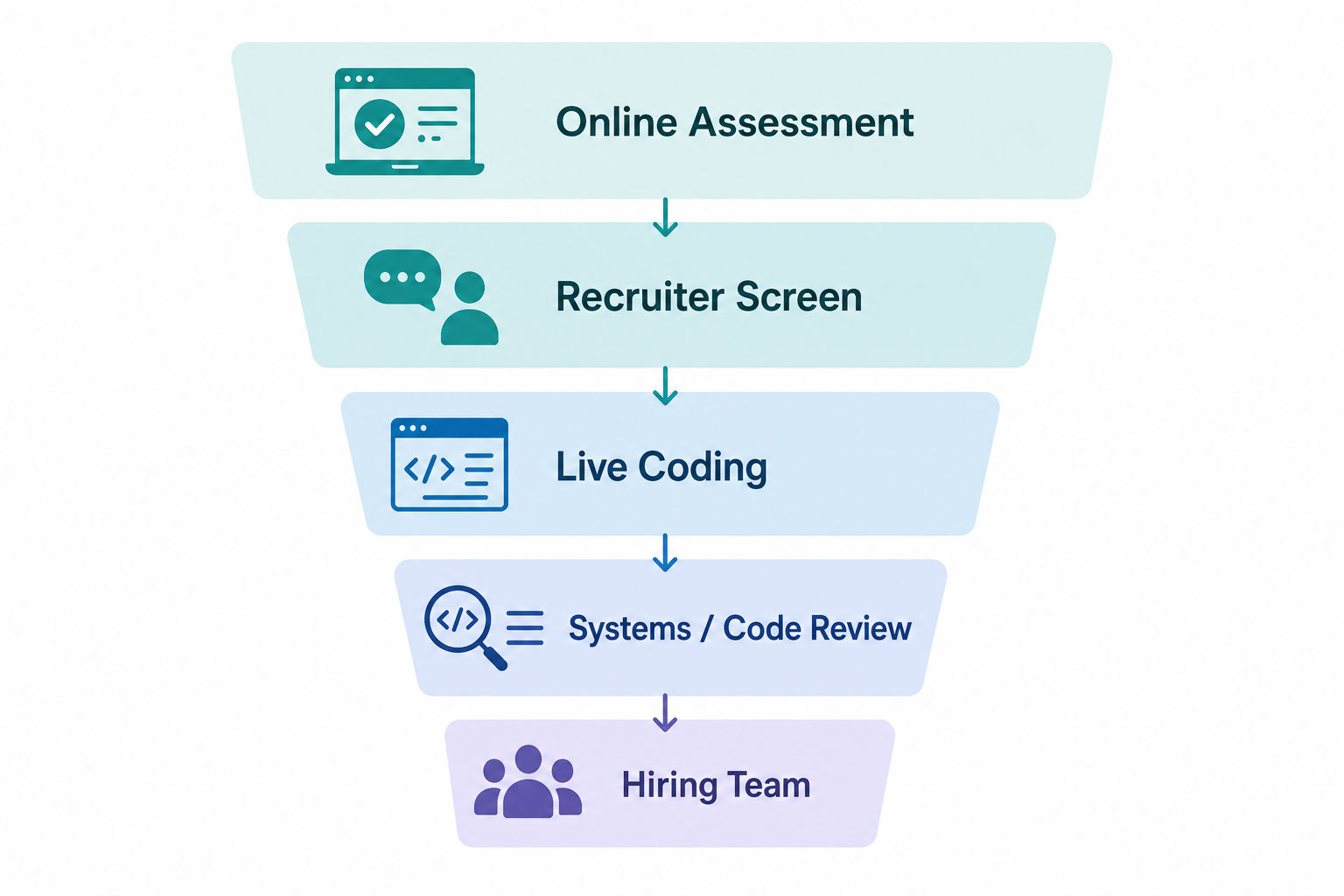
Optiver's Software Engineer interview is a fast-moving funnel of roughly 3 to 5 stages that blends coding, behavioral depth, and practical engineering judgment. What sets it apart from a generic "solve the coding problem" loop is the emphasis on low-latency systems, performance awareness, and clear reasoning about tradeoffs. Beyond writing correct algorithms, you may be asked to discuss system architecture, code quality, and deployment thinking, and to explain why your design choices make sense in a high-performance trading environment.
The exact structure varies by office and seniority, but a common path runs: online assessment → recruiter or virtual screen → technical and behavioral interviews → a final conversation with the hiring team. One thing worth flagging: system design and production-oriented discussion can appear earlier than candidates expect, sometimes even in graduate processes, so don't assume it's only an experienced-hire concern.
Interview rounds at a glance
The table below summarizes the rounds candidates commonly report. Treat names, ordering, and durations as typical rather than fixed - the loop differs across offices, levels, and individual schedules.
| Round | Typical length | Primary focus | Watch out for |
|---|---|---|---|
| Online assessment | ~60-90 min | Algorithms, implementation speed, correctness | Time pressure; misreading the prompt |
| Recruiter / virtual screen | 20-30 min | Logistics, motivation, "why Optiver" | Vague or generic finance answers |
| Behavioral | 25-45 min | Ownership, collaboration, reflection | Stories with no "what I'd change" |
| Live coding | ~60 min | Clean code, communication, optimization | Going silent; not handling edge cases |
| Code review / production reasoning | 45-60 min | Engineering judgment, reliability | Surface-level fixes; ignoring maintainability |
| System design (FT / experienced) | 45-60 min | Architecture, latency, failure handling | Jumping to a design before clarifying |
| Hiring team / final fit | 30-60 min | Team fit, communication under pressure | Treating it as "just a formality" |
The rounds in detail
Online assessment
Usually the first real filter after your application, this is typically a timed, HackerRank-style coding test. Expect algorithm and implementation problems where speed matters - not only in writing code but in parsing the prompt quickly and avoiding mistakes under pressure. The round screens for correctness, data-structure fluency, and your ability to produce working code efficiently.
A common pitfall is optimizing for cleverness when the test rewards getting a correct, complete solution submitted on time. Read every constraint before you start typing.
Recruiter or virtual screen
A short conversation with recruiting, often around 20 to 30 minutes. It usually covers logistics and motivation: work authorization, timing, office preferences, and your interest in Optiver and the trading industry. Be ready for a concise self-introduction and a quick walk through a project you're proud of.
Behavioral interview
Behavioral evaluation may be a standalone round or folded into an earlier screen, often running about 25 to 45 minutes when it stands alone. The focus is on how you work with others, what drives you, how you respond to setbacks, and whether your examples show ownership and reflection. Expect questions about past projects, mistakes, what you would do differently, and times you went beyond your formal role.
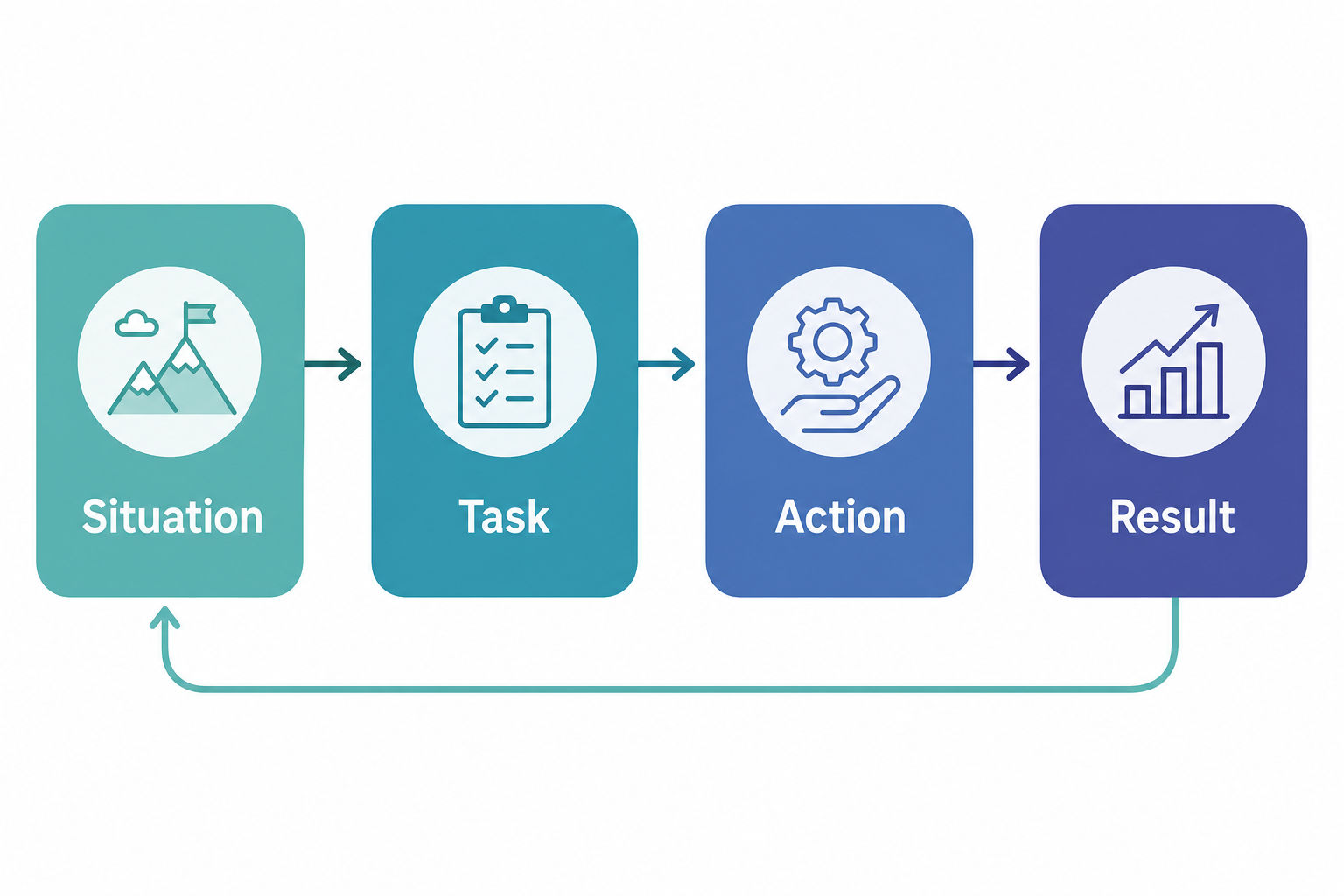
A structured framework like STAR keeps your stories tight and outcome-focused.
Technical screen or live coding
A collaborative coding session with an engineer, often around an hour. You'll solve one or more problems while talking through your reasoning, complexity, edge cases, and possible optimizations. Optiver looks for clean implementation, strong communication, and the ability to improve an initial approach when pushed on it.
The biggest difference from the online assessment: here, how you arrive at the answer matters as much as the answer. Narrate your thinking, state your assumptions, and treat interviewer hints as collaboration, not criticism.
Technical design, code review, or production reasoning
Some processes - especially for graduate or full-time SWE roles - include a practical engineering round that goes beyond pure DSA, usually around 45 to 60 minutes. It may involve reviewing a code snippet, suggesting improvements, and discussing how you would deploy or validate the code in production. The goal is to test engineering judgment, maintainability, and how you reason about reliability and correctness in a real environment.
For instance, given a function with a subtle concurrency bug or an unbounded allocation in a hot path, a strong candidate names the risk, explains the failure mode, proposes a fix, and then talks through how they'd test it and observe it in production.
System design or final technical loop
System design is most common for full-time and experienced roles, though some newer graduate processes include it too. These rounds typically run about 45 to 60 minutes and center on architecture, latency, reliability, scaling, caching, and failure handling. Interviewers care less about one perfect design than about whether you ask good clarifying questions, reason through tradeoffs, and justify each architectural choice.
Hiring team or final fit conversation
The final stage is often a conversation with the hiring team or manager, commonly in the 30 to 60 minute range. It checks whether you'd work well with the team, communicate effectively, and match the role's expectations and pace. You may revisit past projects, your collaboration style, how you handle ambiguity, and how you operate under pressure. It's an evaluation, not a victory lap - keep bringing specifics.
What they actually test
Optiver consistently tests strong coding fundamentals, but its definition of "technical strength" is broader than competitive programming. Be ready for arrays, hashing, trees, graphs, sorting, implementation-heavy tasks, and clean complexity analysis. In live coding, the bar is writing correct code quickly, handling edge cases, and responding well to optimization follow-ups. You should also be fluent in one primary language - commonly C++, Java, or Python - including its standard library, core collections, and the performance implications of your choices.
The differentiator is systems depth. Optiver points candidates toward computer architecture, networking, concurrency, and memory management, and that emphasis shows up in the interview. You may need to discuss low-latency tradeoffs, resource constraints, efficient data handling, and deployment reasoning - how to design services that are fast, reliable, and observable. For full-time roles especially, system design can touch caching, back-pressure, failover, monitoring, and stateful-versus-stateless choices. Across every round, interviewers also watch how you think: whether you reason out loud, ask clarifying questions, explain why you chose a design, and stay structured under time pressure.
Behavioral assessment is more project-driven than generic. Rather than broad culture questions alone, Optiver often wants a detailed account of something you built - the tradeoffs you made, what went wrong, what you learned, and how you collaborated. The traits they tend to value are authenticity, ownership, transparency, intellectual curiosity, and the ability to operate in a fast-moving environment where correctness and speed both matter.
Skills checklist
| Area | What good looks like |
|---|---|
| Algorithms & data structures | Correct, clean solutions; tight complexity analysis; handles edge cases |
| Language fluency | Deep knowledge of one language's stdlib, collections, and cost model |
| Concurrency | Can reason about races, locks, and ordering; knows when shared state is dangerous |
| Memory management | Understands allocation cost, cache behavior, and avoiding work on the hot path |
| Systems & networking | Comfortable discussing latency, buffering, back-pressure, and failure modes |
| Communication | Narrates reasoning, asks clarifying questions, justifies decisions |
| Behavioral depth | Specific project stories with tradeoffs, mistakes, and lessons |
How to prepare
- Practice timed coding, not just untimed problem solving. The online assessment rewards fast comprehension as much as raw algorithm skill, so build the habit of reading a prompt quickly and coding cleanly against a clock. Working through reported Optiver questions under a timer is good calibration.
- Pick one primary language and know it deeply. C++, Java, or Python are all reasonable choices. Be able to explain your collections, standard library, and performance characteristics, and why you reached for a specific approach.
- Be ready to defend every technical decision with a "why." In design and live-coding rounds, interviewers care about your tradeoffs and reasoning, not just the final answer.
- Refresh systems fundamentals - concurrency, networking, memory management, and computer architecture. These matter more here than in many general software interviews.
- Prepare two or three strong project stories covering your role, the technical constraints, collaboration, mistakes, and what you'd change if you rebuilt the system today.
- Rehearse code review and production reasoning - how you'd refactor code, deploy it safely, monitor it, and validate correctness after release.
- Have a specific answer for "why Optiver" that ties your interests to low-latency engineering and performance-sensitive, real-time problems, rather than a generic finance answer.
Example "why Optiver" answer
Example answer: "I like problems where correctness and speed both matter and you can't hide latency behind a cache that's far from the user. I've spent time profiling hot paths in [my project] and chasing down allocation and lock contention, and Optiver is one of the few places where that kind of low-level engineering directly moves the outcome. That's the work I want to get better at."
Notice it's concrete, ties a real interest to the firm, and avoids generic "I want to work in finance" filler.
Common mistakes to avoid
| Don't | Do instead |
|---|---|
| Code in silence during live rounds | Narrate assumptions, complexity, and tradeoffs as you go |
| Give a generic "why finance" answer | Connect your interests to low-latency, performance-sensitive engineering |
| Treat the code-review round as trivia | Name the risk, fix it, and explain how you'd test and monitor it |
| Memorize patterns without fundamentals | Reinforce concurrency, memory, and networking concepts |
| Skip edge cases to "finish faster" | Confirm correctness on boundaries before optimizing |
For a structured study plan that works across firms, see the PracHub interview guides and browse the full question bank.
Takeaways
Optiver wants engineers who write correct code quickly and understand what happens beneath it - concurrency, memory, the network, and the cost of every design choice. Treat the loop as a test of judgment under time pressure, not just algorithm trivia: practice fast and clean coding, ground your systems fundamentals, prepare to justify decisions out loud, and come with concrete project stories and a genuine reason for choosing Optiver.
How to Use This Page as a Prep Plan
Do not treat this as passive reading. Convert the ideas in this page into a short weekly loop: learn one idea, practice it under interview conditions, then write down what changed. That is the fastest way to turn advice into visible interview behavior.
| Prep area | What you need to prove | Practice artifact |
|---|---|---|
| Understand | Turn the prompt into a concrete goal. | Clarifying questions and success criteria. |
| Practice | Use realistic constraints and timed reps. | Worked examples with edge cases. |
| Explain | Make reasoning visible. | Tradeoffs, assumptions, and test strategy. |
| Improve | Review misses quickly. | A short feedback log and next action. |
For Optiver Software Engineer Interview Guide 2026, the strongest candidates usually do three things well: they make their assumptions explicit, they use concrete examples instead of vague claims, and they review mistakes quickly enough that the next practice rep is better than the last one.
FAQ
How many rounds does the Optiver software engineer interview have?
Most candidates report roughly 3 to 5 stages, commonly an online assessment, a recruiter or virtual screen, one or more technical interviews (live coding and sometimes a code-review or systems round), and a final conversation with the hiring team. The exact count varies by office and seniority.
What programming language should I use for the Optiver interview?
Use whichever language you know most deeply - C++, Java, and Python are all commonly accepted. What matters more than the choice is fluency: knowing your standard library, core collections, and the performance characteristics of the code you write.
Is system design part of the new-grad Optiver interview?
It can be. System design and production-oriented discussion are most common for full-time and experienced roles, but some graduate processes include lighter versions earlier than candidates expect. It's safest to prepare at least the fundamentals of latency, reliability, and failure handling even as a new grad.
How hard is the Optiver online assessment?
It's a timed, HackerRank-style coding test that emphasizes both correctness and speed. Many candidates find the difficulty manageable individually, but the time pressure is the real challenge - practicing against a clock and reading prompts carefully helps more than chasing harder problems.
How should I answer "why Optiver"?
Tie your answer to low-latency engineering and performance-sensitive, real-time problems rather than finance in general. A specific, technical reason - backed by something you've actually worked on or want to learn - lands far better than a generic "I want to work at a trading firm."
Where can I find real Optiver interview questions to practice?
Browse reported questions on the Optiver company page, filter by the Software Engineer role, or explore the full PracHub question bank to practice across companies.