Citadel Software Engineer Interview Prep Guide
Everything Citadel actually asks Software Engineer candidates — concept walkthroughs, worked examples, and the real interview questions, drawn from candidate reports. Free to read.
Last updated
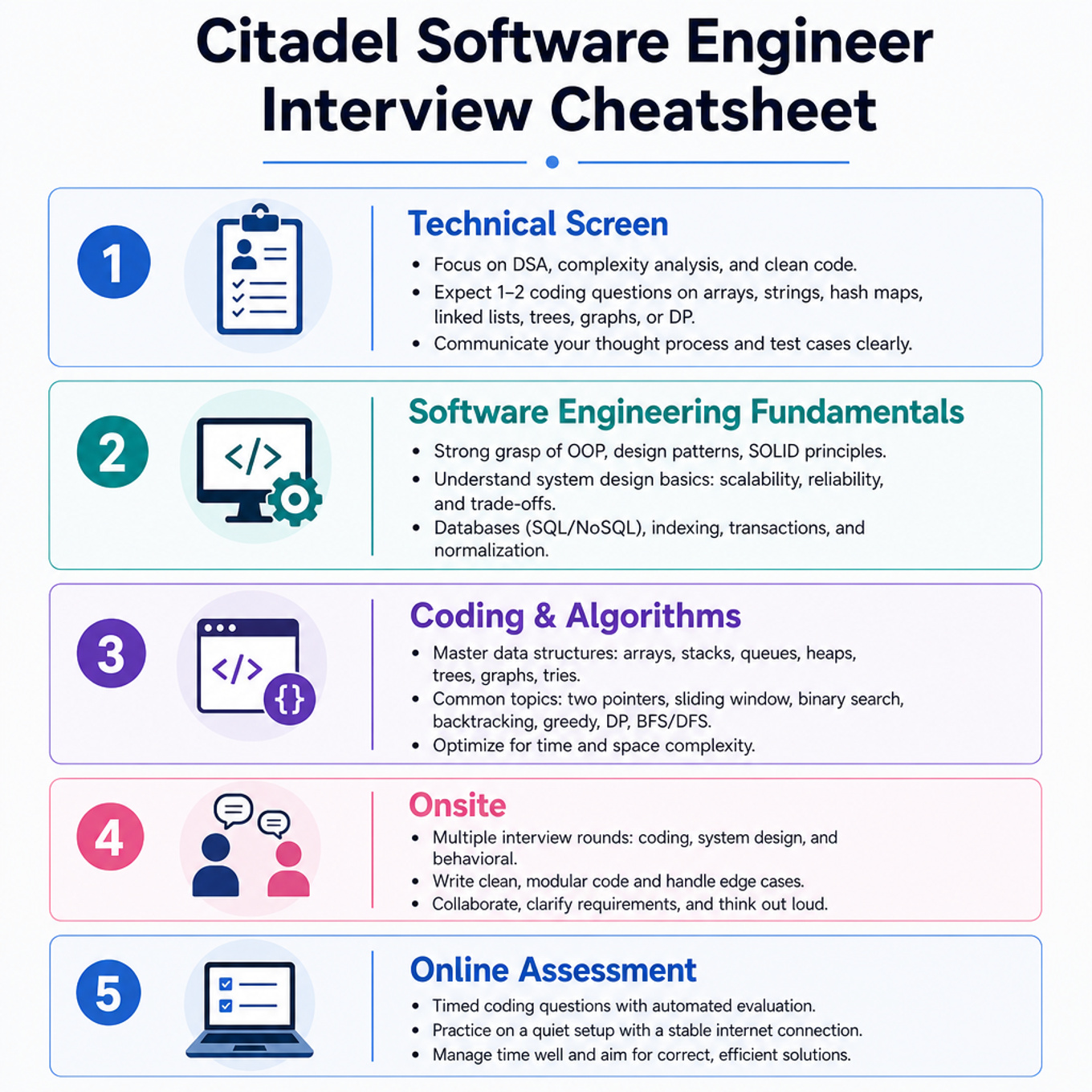
Focus most on Citadel-style concurrency, order-book market data, interval aggregation, and DP/greedy practice because your self-ratings are uniformly 3/5 and there are no solved-question signals yet. Nothing is being treated as a pure skim; C++, heaps, hash maps, system design contracts, distributed messaging, quantitative topics, and behavioral prep stay at normal review depth rather than expanded. The Citadel-specific concepts highlighted are lock-free queues/ring buffers, BBO/NBBO order-book invariants, and low-latency trading-system architecture. With 1–2 weeks, budget roughly one focused pass over each round section, spending the most time on Technical Screen fundamentals and OA-style algorithm drills.
Technical Screen — 33 min
Software Engineering Fundamentals
Focus area — Citadel screens often probe queue semantics and latency; your 3/5 fundamentals rating and no solved concurrency signal justify emphasis.
What's being tested
This topic tests whether you can reason about concurrent data structures rather than merely add a mutex around shared state. The interviewer is probing atomicity, ownership of memory locations, progress guarantees, memory ordering, bounded-capacity behavior, and correctness under contention. For a Software Engineer at Citadel, these skills matter because market-data and task-processing paths often demand both predictable latency and exact behavior when updates, consumers, and failures occur simultaneously.
Core knowledge
-
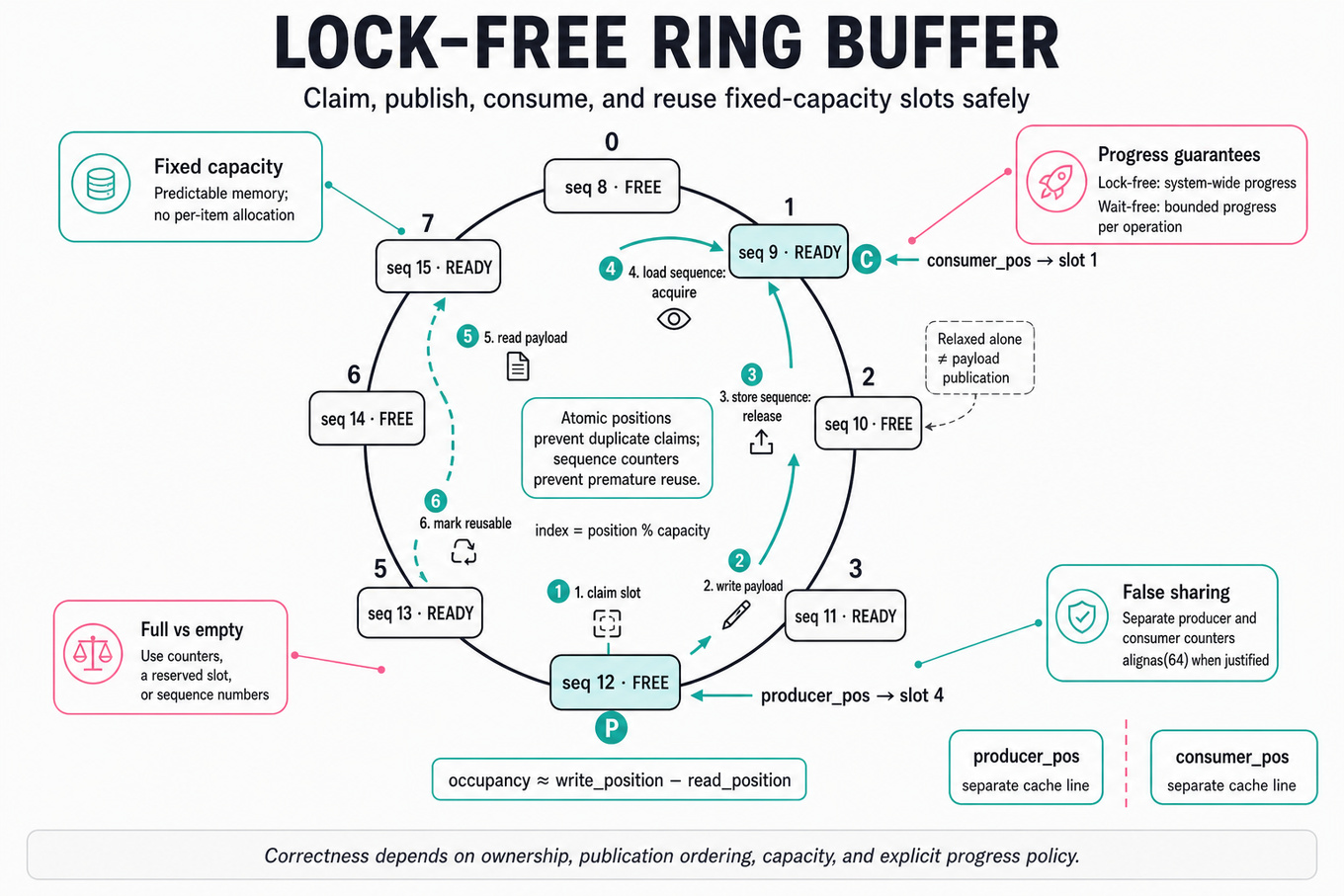
A ring buffer stores elements in fixed-capacity storage, using indices modulo capacity:
index = position % capacity. It avoids allocation and provides predictable memory usage, but must distinguish full from empty using counters, a reserved slot, or sequence numbers. -
For a single producer, only that thread advances the write position; consumers must atomically claim read positions, commonly with
compare_exchange_weak. Claiming before reading prevents two consumers from processing the same element. -
Publication requires correct memory ordering: the producer writes payload data, then performs a
store(..., release)on its publication marker; the consumer performs anacquireload before reading. Relaxed atomics alone do not publish payload writes. -
A lock-free algorithm guarantees system-wide progress: some thread completes in finitely many steps. Wait-free additionally bounds every individual operation. A mutex may be correct but blocking; lock-free does not mean starvation-free or automatically faster.
-
Sequence counters per slot solve both publication and reuse: a producer waits until a slot’s sequence indicates free, writes the payload, then advances the sequence; a consumer validates readiness before reading and marks the slot reusable afterward.
-
Capacity must account for outstanding work. With monotonic unsigned positions, occupancy is approximately
write_position - read_position; ensure counters cannot overflow ambiguously, or use sufficiently wide integers and carefully defined wraparound arithmetic. -
False sharing occurs when independent atomic counters share a cache line, causing cache-coherence traffic. Place producer and consumer positions on separate cache lines using padding or
alignas(64)where the target architecture justifies it. -
A queue’s progress policy must be explicit: spin, yield, block with
condition_variable, or return “full/empty.” Spinning can reducep99latency at low contention but wastes CPU and can starve lower-priority work. -
A conflating queue needs two structures: a map from symbol to its current entry and an ordered container of symbols awaiting delivery. Updating an existing symbol replaces its value without creating a duplicate, while new symbols preserve arrival order.
-
Sentinel values such as
-1are unsafe when negative prices are valid. Usestd::optional, a taggedstd::variant, or an explicit validity bit; define whether zero, negative values, and deletion are valid domain states. -
ABA occurs when a location changes from value A to B and back to A, making a compare-and-swap mistake an old state for an unchanged one. Version tags, per-slot sequence numbers, or ownership schemes reduce this risk.
-
Correctness includes destruction and exception behavior. Decide whether objects are constructed in-place, when destructors run, what happens if a consumer exits after claiming an item, and whether producers may overwrite storage containing an unread object.
Worked example
For “Implement a single-producer multi-consumer ring buffer”, I would first clarify whether each item is consumed exactly once, whether operations may block, whether overwriting is allowed, and whether the expected interface is C++-specific. I would state a bounded-capacity assumption, single producer ownership of writes, and that consumers compete to claim each item rather than broadcasting it to every consumer. I would organize the answer around storage and index layout, producer publication, consumer claim/read/release, and full/empty behavior. The producer would reserve or write the next slot, publish it with release semantics, and advance a sequence or write marker. Each consumer would use CAS to claim a unique read position, acquire the corresponding publication state, copy or move the payload, and make the slot reusable. The explicit tradeoff is between a simple CAS-based shared read index and per-slot sequence numbers: sequence numbers handle wraparound and producer/consumer visibility more robustly at the cost of metadata and complexity. I would mention cache-line padding and bounded spinning as latency considerations rather than hiding them inside correctness logic. If I had more time, I would add stress tests with randomized consumer scheduling, wraparound tests, ThreadSanitizer runs, and benchmarks for contention and p99 latency.
A second angle
For “Conflating Quote Queue That Keeps Only the Latest Price per Symbol”, the central issue shifts from claiming slots safely to defining update semantics under concurrency. A strong design uses a symbol-to-entry map plus an ordered queue, carefully marking whether a symbol is already enqueued so repeated updates do not create duplicate work. The candidate must clarify whether a consumer may observe an intermediate price and whether ordering means first arrival or most recent update. A mutex may be the best initial implementation; lock-free replacement is only worthwhile after measuring contention and latency.
Common pitfalls
Pitfall: Treating
volatileas synchronization is incorrect; it may inhibit some compiler optimizations but does not provide atomicity, inter-thread visibility, or ordering. Usestd::atomicand explain the happens-before relationship.
Pitfall: Saying “the ring buffer is lock-free because it uses atomics” skips the hard parts: multi-consumer index claiming, slot reuse, wraparound, and payload publication. Show who owns each mutation and what prevents overwrite or duplicate consumption.
Pitfall: Jumping directly to a complex lock-free algorithm without clarifying semantics signals poor engineering judgment. Start with a correct mutex-based or single-owner design, state its bottleneck, then justify each atomic optimization and its testing plan.
Connections
The interviewer may pivot to linearizability, memory reclamation such as hazard pointers or epoch-based reclamation, and backpressure under overload. They may also connect the queue to Kafka delivery semantics, priority queues, deadlock avoidance, or cache-coherence effects.
Further reading
-
C++ Concurrency in Action, 2nd Edition — practical treatment of atomics, memory ordering, lock-free structures, and thread coordination.
-
The Art of Multiprocessor Programming, 2nd Edition — rigorous coverage of linearizability, progress guarantees, CAS, ABA, and concurrent queues.
-
cppreference:
std::memory_order— precise reference for C++ acquire/release, relaxed ordering, and synchronization guarantees.
Practice questions
Focus area — Core Citadel domain topic: practice BBO/NBBO invariants, cancels, and aggregation; no solved market-data signals yet.
What's being tested
These problems test whether you can model an order book with the right data structures, preserve price-time priority, and answer best-price and quantity queries efficiently. You must reason about updates—add, cancel, replace, and trade—rather than only computing a snapshot from static rows. Citadel cares because market-data and execution components require predictable `p99` latency, deterministic behavior, correct handling of stale state, and clear complexity tradeoffs under high event rates.
Core knowledge
-
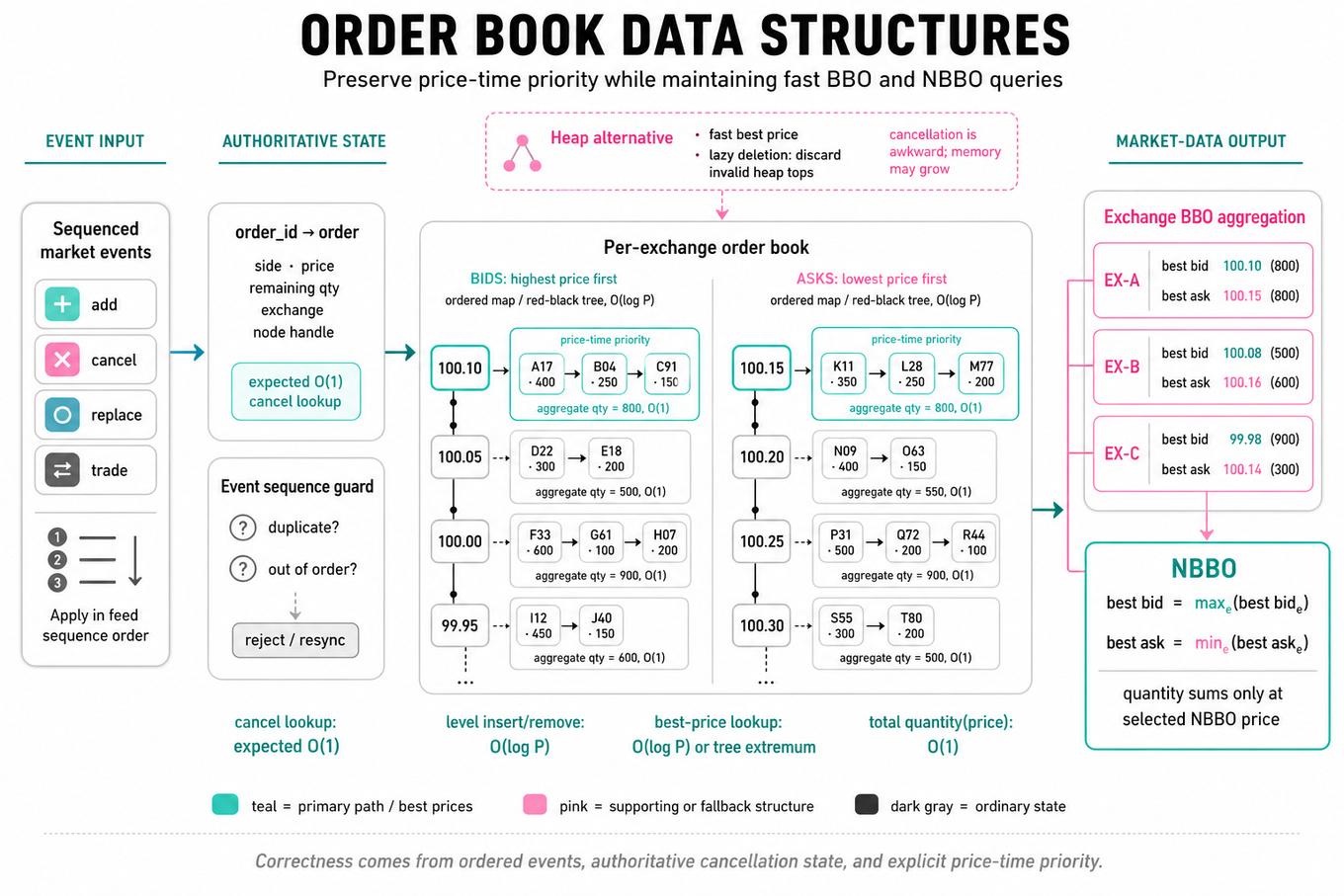
A price level aggregates all live orders sharing
(side, price): bids maximize price, asks minimize price. The BBO is , with missing sides represented explicitly. -
Use an ordered map such as
`std::map`or a balanced red-black tree from price to level. Each insert, cancel-induced cleanup, and best-price lookup costs , where is the number of active price levels. -
For faster best-price access, combine a hash map of
`order_id` → orderwith a price-level map. The hash map gives expected cancellation lookup; the ordered structure locates and removes empty levels in . -
A price-time priority queue stores orders at each level in FIFO sequence, commonly with a linked list or deque. The level’s aggregate quantity is maintained incrementally, so
total_quantity(price)is rather than rescanning every order. -
A heap can provide fast best-price access, but cancellation is awkward because arbitrary removal is not efficient. Use lazy deletion: mark or remove orders in the authoritative map, then discard invalid heap tops while querying; understand possible memory growth and periodic rebuilding.
-
For per-exchange aggregation, maintain state keyed by
(exchange, side, price)and derive exchange BBOs separately. The NBBO is and , while quantity is summed only across venues at the selected NBBO price. -
Cancellation requires an authoritative
`order_id`index, not a scan through price levels. Store side, price, remaining quantity, exchange, and an iterator or node handle when possible; this supports expected lookup and avoids disturbing neighboring orders. -
Event sequencing is part of correctness: apply add, cancel, replace, and execution events in feed sequence order. A duplicate or out-of-order event can double-count quantity unless sequence numbers, session resets, and idempotency rules are defined.
-
Separate authoritative state from derived indexes. The order record or node owns lifecycle state; price totals, best-price caches, and heaps are derived structures that must be updated atomically with the mutation or rebuilt deterministically.
-
In a single-writer design, one thread owns a symbol’s book and processes events sequentially, avoiding locks and making replay deterministic. Shard by symbol or instrument, not arbitrary events, because one book’s ordering must remain serialized.
-
Define semantics before optimizing: whether quantities are integer lots or decimal values, whether prices use fixed-point ticks, how zero or negative quantities are rejected, and whether replace preserves time priority or receives a new timestamp.
Worked example
For “Compute BBO and NBBO from order data”, I would first clarify whether records are a snapshot or an event stream, whether orders can be canceled, whether exchange identity matters, and whether the output needs only prices or also aggregated quantities. I would declare fixed-point integer prices, nonnegative quantities, one sequential pass, and explicit behavior for an empty bid or ask side. I would organize the answer around parsing and validation, per-side/per-venue aggregation, best-price selection, and complexity plus edge-case handling. For a static snapshot, a hash map keyed by (venue, side, price) can accumulate quantities, followed by a best-price scan; for streaming updates, I would retain order IDs and incrementally maintain levels. The global NBBO would select the highest bid and lowest ask across venue-level BBOs, then sum quantities at the winning price where the specification requires it. A key tradeoff is a simple scan— per query and low implementation risk—versus an ordered map or heap, which costs more state but supports frequent queries in or near best lookup. I would explicitly test duplicate IDs, zero quantities, empty books, multiple venues at one price, and a crossed book if validation forbids it. If I had more time, I would add property-based tests comparing the incremental implementation with a slow reference recomputation.
A second angle
For “In-Memory Order Book with Price-Time Order, Level Aggregation and Order Cancel”, the central challenge shifts from aggregating a completed dataset to preserving mutable lifecycle state. The design needs a sorted bid/ask view, FIFO order queues within each price, aggregate quantities, and direct cancellation by ID without changing other orders’ priority. A linked list plus ID-to-node index gives efficient arbitrary cancellation, while a tree or sorted map handles price levels. The interviewer may probe replace semantics, partial fills, empty-level deletion, and whether a canceled order can accidentally remain at the head of a lazy heap.
Common pitfalls
Pitfall: Analytical mistake. A tempting answer is “use a heap for each side and sum the top level when queried,” without explaining cancellation or stale entries. That can return incorrect BBOs or repeatedly scan dead orders; identify the authoritative record, lazy-deletion invariant, and worst-case cleanup behavior.
Pitfall: Communication mistake. Jumping straight to
`TreeMap`or`unordered_map`obscures the required semantics. State assumptions first—snapshot versus stream, update types, price representation, and latency target—then map each requirement to a structure and give operation complexities.
Pitfall: Depth mistake. Saying “make it concurrent for low latency” is not enough and can introduce races in aggregate quantity and best-price state. Prefer a single-writer-per-symbol model, explain sharding and publication boundaries, and mention replay, sequence gaps, and deterministic recovery when persistence or failover is discussed.
Connections
The interviewer may pivot to matching-engine algorithms, event sourcing and replay, lock-free or single-writer concurrency, and market-data normalization. Be ready to distinguish an order book’s live derived state from an append-only audit log and to discuss fixed-point arithmetic, sequence gaps, and recovery snapshots.
Further reading
-
Nasdaq TotalView-ITCH 5.0 — concrete feed-message semantics, sequence handling, order lifecycle events, and replay considerations.
-
Designing Data-Intensive Applications by Martin Kleppmann — useful background on logs, deterministic processing, state reconstruction, and consistency tradeoffs.
Practice questions
4 YOE and 3/5 fundamentals: review lifetime, moves, atomics, and runtime performance, but Citadel-specific concurrency gets more space.
What's being tested
These interviews test whether you can reason from language semantics to observable behavior: object lifetime, ownership, undefined behavior, memory ordering, and synchronization. You must distinguish “works in my test” from behavior guaranteed by the C++ standard, then select the simplest correct implementation before optimizing. Citadel cares because low-latency and high-throughput systems amplify small mistakes: a data race, unnecessary copy, cache-line conflict, or incorrect wakeup can become a correctness failure or a measurable `p99` latency regression.
Core knowledge
-
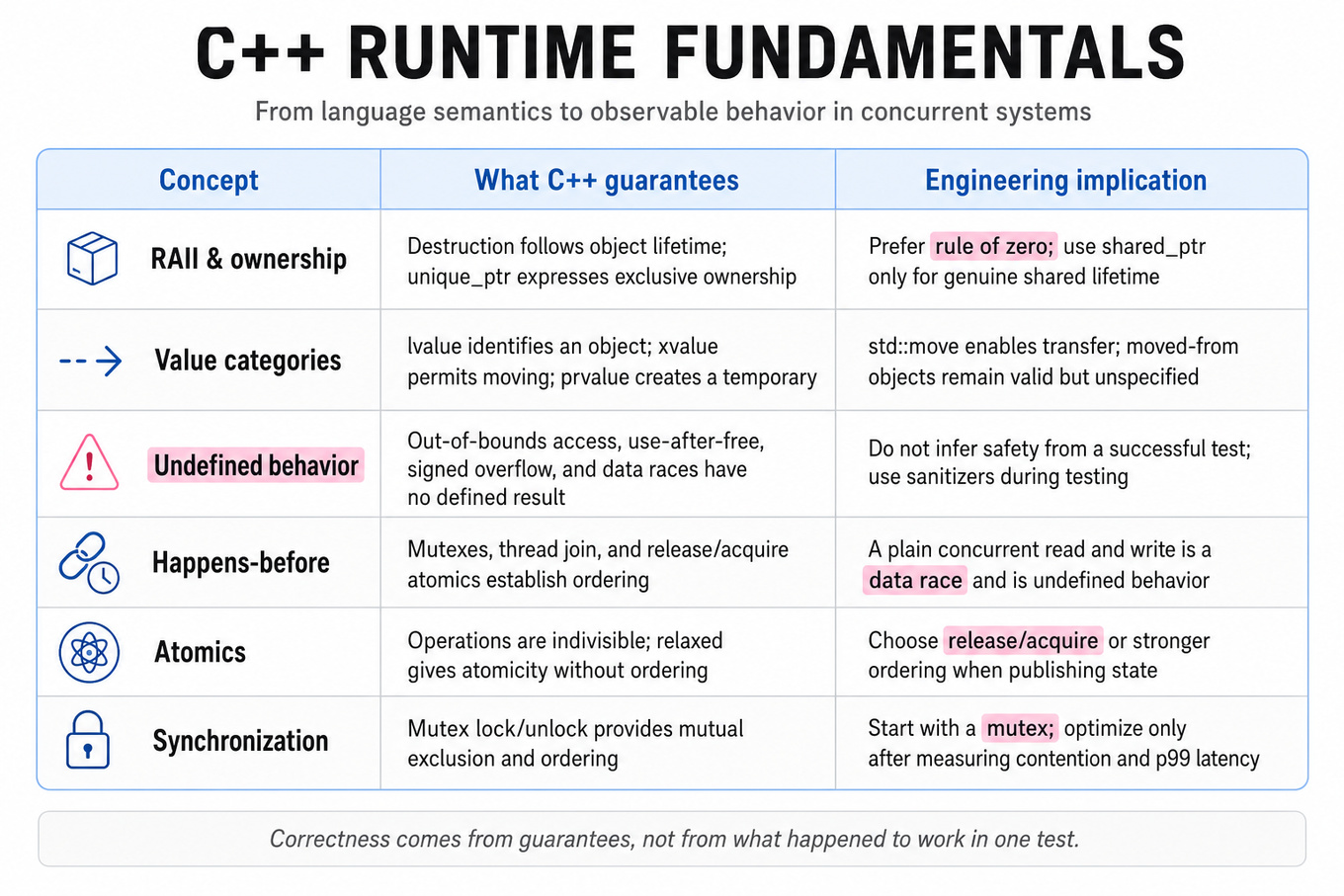
RAII ties resource lifetime to object lifetime: acquire in a constructor and release in a destructor. Prefer
`std::unique_ptr`for exclusive ownership,`std::shared_ptr`only for genuine shared lifetime, and`std::weak_ptr`to break ownership cycles. -
Value categories matter for performance and correctness: lvalues identify persistent objects, xvalues permit moving, and prvalues create temporary values. Use
`std::move`to enable transfer, but remember it only casts; the moved-from object remains valid but has unspecified value. -
Rule of zero is preferable: compose members such as
`std::vector`,`std::string`, and smart pointers instead of manually implementing destructor, copy constructor, and assignment. If a type owns a raw resource, follow the rule of five and define or delete all relevant operations. -
Undefined behavior includes out-of-bounds access, use-after-free, signed overflow, invalidated iterators, and data races. The compiler may assume it never occurs, so sanitizers such as
`-fsanitize=address,undefined,thread`are essential during testing, not substitutes for reasoning. -
The C++ memory model defines happens-before relationships through mutex unlock/lock, thread creation and join, and atomic release/acquire operations. A plain read concurrent with a plain write is a data race and therefore undefined behavior, even if the machine instruction appears atomic.
-
Atomics provide indivisible operations but not automatically a complete protocol.
`memory_order_relaxed`provides atomicity without ordering; release/acquire publishes prior writes; sequential consistency is easier to reason about but can impose stronger compiler and hardware constraints. -
A mutex is usually the right baseline for shared mutable state: it gives mutual exclusion and ordering, while
`std::condition_variable`supports blocking waits. Always usewhile (!predicate) cv.wait(lock)because wakeups may be spurious and another consumer may win the race. -
Lock-free designs require a complete ownership and reclamation story, not merely
`compare_exchange`. ABA, use-after-free, memory reclamation, and false sharing are common failures; techniques include tagged pointers, hazard pointers, epoch-based reclamation, or carefully bounded ring-buffer slots. -
A single-producer multi-consumer ring buffer can use fixed storage and circular indices, but consumers must claim distinct positions atomically. Capacity must distinguish full from empty, and object construction/destruction must be coordinated so a consumer never reads a slot before publication.
-
Mutex, spin lock, and lock-free designs optimize different contention regimes. Spinning can win for waits below roughly a few microseconds on dedicated cores, but wastes CPU and worsens tail latency under oversubscription; blocking is safer for unpredictable waits.
-
Cache coherence makes adjacent frequently-written fields expensive even when logically independent. Use
`alignas(std::hardware_destructive_interference_size)`where appropriate, keep hot data compact, and benchmark on the target hardware rather than assuming lock-free means faster. -
Exception safety has levels: no-throw, strong guarantee, basic guarantee, and no guarantee. For containers and resource-owning types, structure updates as prepare-then-commit so an exception cannot leave partially updated state; mark move operations
noexceptwhen valid to improve reallocation behavior.
Worked example: Design a Thread-Safe Shared Counter
A strong opening would clarify whether counts must be exact, whether keys are bounded, whether updates and reads are per-key or global, and whether the scope is one process or multiple processes. I would declare a baseline assumption: many threads update a bounded key set in one process, reads need exact values, and durability is not required. I would organize the answer around data layout, synchronization strategy, visibility semantics, and verification under contention. For a simple implementation, `std::unordered_map<Key, uint64_t>` guarded by a mutex is easy to prove correct; for a fixed key set, per-key `std::atomic<uint64_t>` avoids one global lock. I would explicitly flag the tradeoff between lower contention and higher memory/cache cost, including padding if adjacent counters are hot. If multiple processes must contribute, process-local atomics are insufficient and I would introduce shared memory with interprocess synchronization or an external service such as `Redis`, while defining crash and durability semantics. I would test with randomized concurrent updates, compare against a serial reference, run `ThreadSanitizer`, and measure throughput plus `p99` latency. If I had more time, I would investigate sharded maps, overflow policy, snapshot consistency, and whether eventual aggregation could replace exact per-update coordination.
A second angle
For Thread-Safe Producer-Consumer Queue: Mutex, Then Spin Lock, Then Lock-Free, the same principles are applied to ownership transfer rather than numeric updates. The key framing questions become queue capacity, blocking versus nonblocking behavior, fairness, shutdown semantics, and whether producers or consumers may be multiple. A mutex-plus-condition-variable queue is the correctness baseline; a spin lock is justified only with short critical sections and controlled core allocation. A lock-free queue additionally requires explicit memory ordering and a safe reclamation strategy, so “replace the mutex with atomics” is not a complete design.
Common pitfalls
Pitfall: Claiming that
`std::atomic`makes an entire compound operation safe.if (count < limit) ++countstill has a check-then-act race unless the reservation is implemented with a suitable compare-exchange loop or protected by a lock.
A tempting analytical mistake is to choose lock-free code immediately because the setting sounds latency-sensitive. A stronger answer first establishes a correct mutex design, identifies the measured bottleneck, then explains whether sharding, batching, padding, or nonblocking algorithms address that bottleneck.
Pitfall: Saying a condition variable “waits until notified” without mentioning the predicate loop. Notifications are not stored as events, wakeups can be spurious, and another thread can consume the condition before the awakened thread reacquires the lock.
A communication mistake is presenting implementation details before stating assumptions. Start with scope, exactness, capacity, lifetime, and failure behavior; otherwise an answer can be technically correct for a different problem.
Pitfall: Treating a successful
`compare_exchange_weak`loop as proof of a correct lock-free structure. You must also explain publication ordering, ABA, object lifetime, reclamation, and what happens on full or empty states.
A depth mistake is discussing benchmark numbers without methodology. State workload, thread count, CPU pinning or scheduling assumptions, contention distribution, warm-up, and metrics such as throughput and `p99`; otherwise “faster” is not meaningful.
Connections
An interviewer may pivot to false sharing, NUMA, memory reclamation, iterator invalidation, or exception safety. They may also connect language-level guarantees to compiler optimization, CPU cache coherence, and profiling with `perf` or sanitizers.
Further reading
-
C++ Core Guidelines — Practical guidance on ownership, RAII, concurrency, and exception safety.
-
cppreference: Memory model — Precise reference for data races, atomics, and happens-before.
-
Anthony Williams, C++ Concurrency in Action, 2nd ed. — Detailed treatment of mutexes, atomics, lock-free structures, and memory reclamation.
Practice questions
Coding & Algorithms
-
Dynamic Programming, Greedy, And Combinatorial Optimization (Focus) — covered in depth under Online Assessment below.
-
Hash Maps, Indexes, And Mutable State Modeling — covered in depth under Online Assessment below.
Onsite — 12 min
Coding & Algorithms
- Hash Maps, Indexes, And Mutable State Modeling — covered in depth under Online Assessment below.
Online Assessment — 15 min
Coding & Algorithms
Focus area — With only 1–2 weeks and a 3/5 algorithms rating, prioritize recurrence recognition and greedy proofs for OA-style tasks.
What's being tested
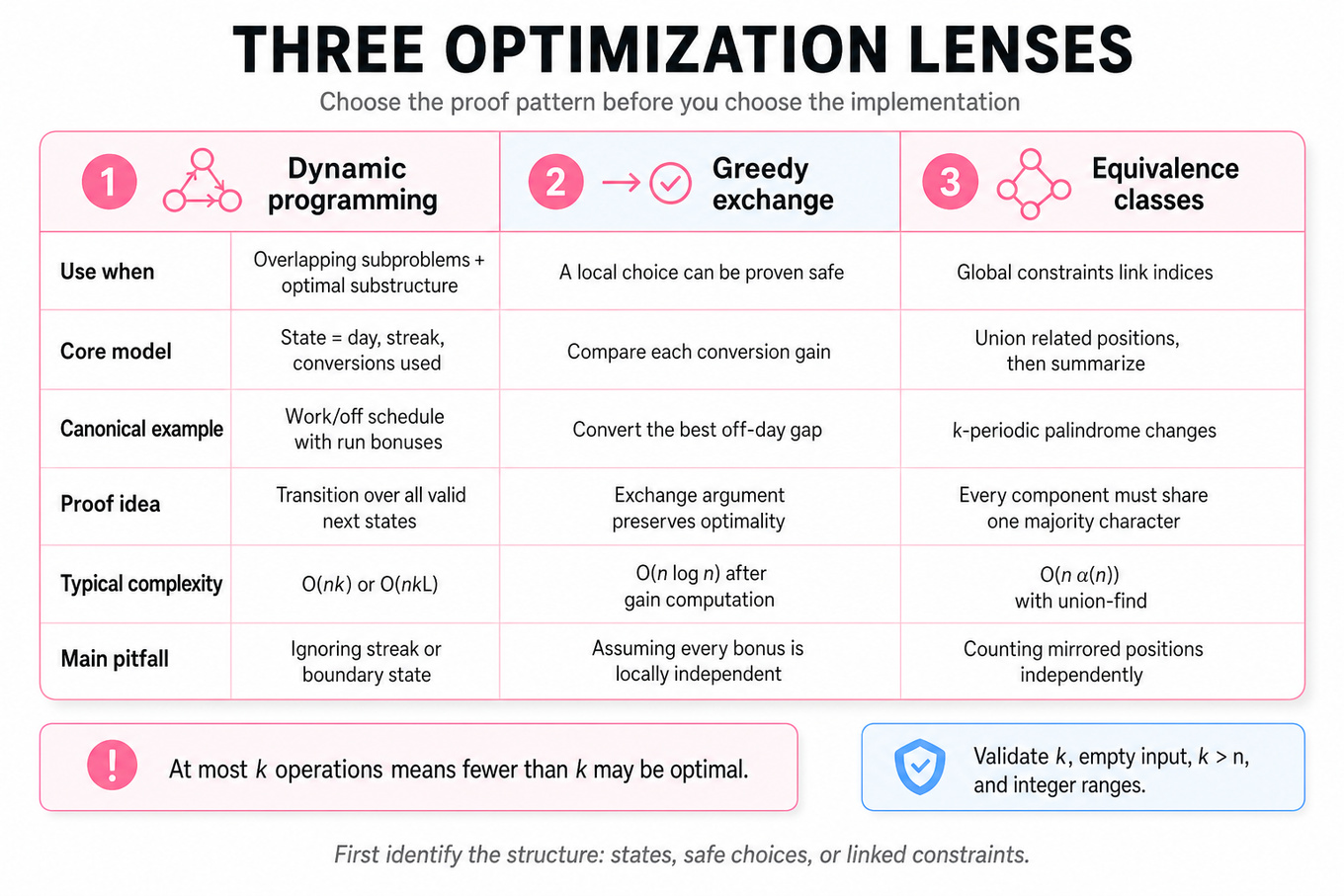
These problems test recognizing when a seemingly exponential schedule or string constraint decomposes into dynamic programming, greedy exchange arguments, or equivalence classes. You must define states precisely, account for global constraints such as palindrome symmetry and periodicity, and justify why local choices are safe. Interviewers also probe boundary handling, complexity, and whether your implementation matches the stated function contract.
Patterns & templates
-
State-machine DP for schedules: track day index, consecutive-work streak, and conversions used; transition work/off in
O(nk)orO(nkL)depending on streak handling. -
Greedy interval selection: when bonuses depend only on runs, compare converting an off-day gap versus extending or merging working blocks; compute each gain before choosing.
-
Palindrome pair counting: mismatched mirrored characters contribute one change; for blocks, precompute costs with
cost[l][r]or expand around centers. -
Disjoint equivalence classes for k-periodic palindromes: union indices related by
i ≡ j (mod k)and reflection; each component takes its majority character. -
Union-find or canonical representatives compress global character constraints; total work is near-linear,
O(n α(n)), after generating all index relations. -
MEX reasoning requires checking presence of every value below the candidate and the effect of the single bounded increment; never increment a value to
n. -
Production-quality implementation validates
k, empty inputs,k > n, zero conversions, and integer ranges; state complexity should be stated explicitly.
Common pitfalls
Pitfall: Assuming every bonus problem is greedy; overlapping run effects often require DP because an early conversion changes multiple future transitions.
Pitfall: Counting mismatched positions independently when periodicity links them globally; first build the complete constraint component.
Pitfall: Forgetting that “at most” permits using fewer than
koperations, especially when conversions can reduce or fail to increase earnings.
Practice these
The practice cards below cover the canonical variants — solve all of them and time yourself.
Practice questions
Important across order cancellation and mutable simulations; rated 3/5, so practice invariants without over-allocating time.
What's being tested
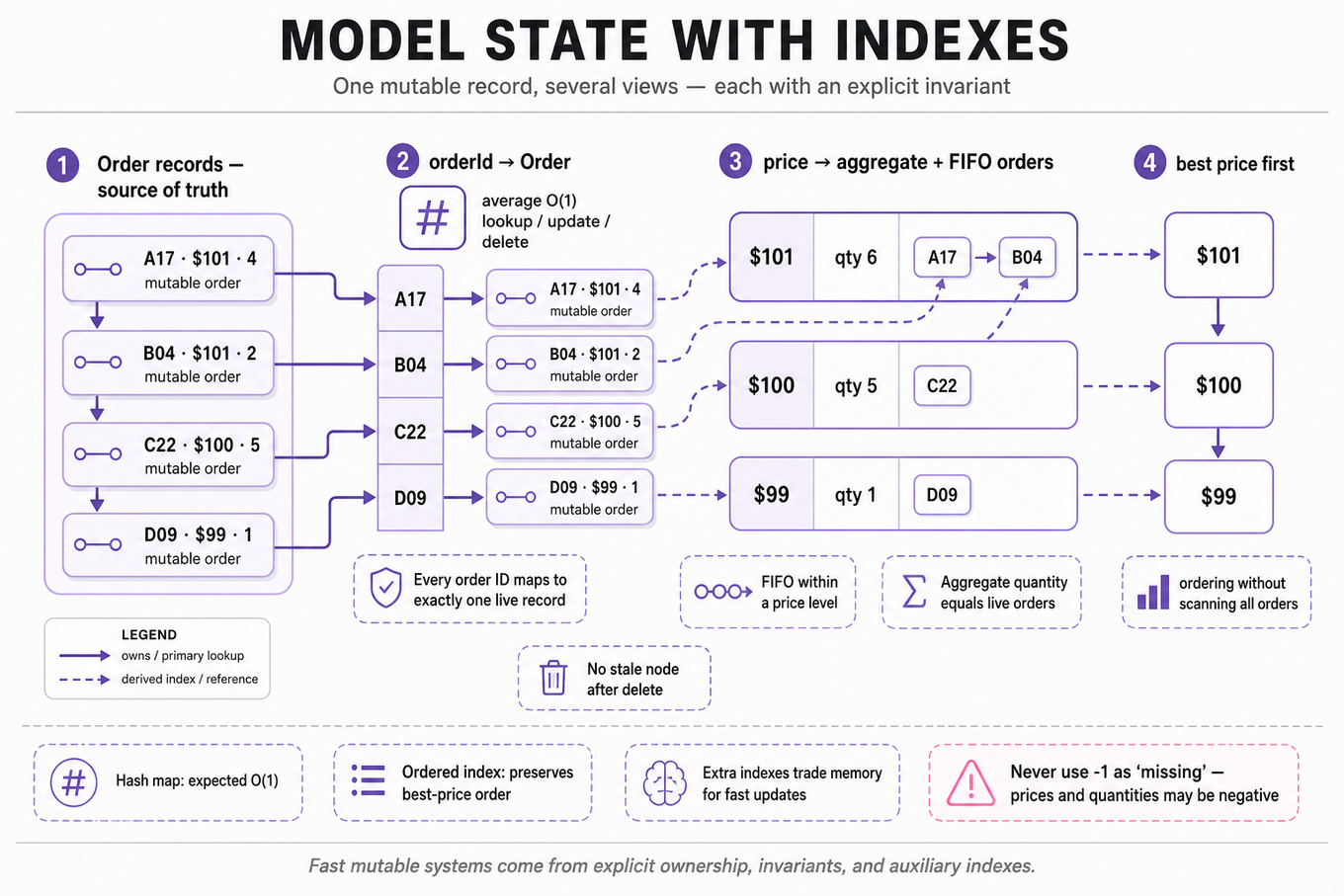
These problems test hash-map indexing, mutable state modeling, and choosing auxiliary structures that preserve required ordering while supporting fast updates, deletes, and lookups. You must explain invariants, complexity, ownership of state, and edge-case semantics rather than merely selecting containers.
Patterns & templates
-
Use a hash map for direct identity lookup: symbol/order ID → record; target average
O(1)lookup, update, and deletion. -
Combine a map with a queue or ordered container when identity lookup and arrival/order semantics must coexist.
-
For latest-value conflation, map each key to one mutable node and remove stale nodes without scanning; define duplicate-key ordering explicitly.
-
For order books, separate price levels from individual orders: price → aggregate quantity plus FIFO orders, and order ID → order record.
-
Track counts or frequencies in maps for array intersection; choose set semantics versus multiplicity semantics before coding.
-
Explain hash-map behavior: bucket layout, collision resolution, load factor, resizing, tombstones, and expected
O(1)versus worst-caseO(n). -
For weighted sampling, maintain cumulative weights with a Fenwick tree: updates and samples cost
O(log n), using a uniform target in[0, totalWeight).
Common pitfalls
Pitfall: Mutating a map while iterating can invalidate iterators or skip entries; collect removals or use an iterator-safe deletion strategy.
Pitfall: Treating a sentinel such as
-1as “missing” fails when prices or quantities may legitimately be negative; use presence checks or an explicit variant.
Pitfall: Claiming
O(1)without stating average-case hashing, collision assumptions, resizing costs, and the extra memory required by auxiliary indexes.
Practice these
The practice cards below cover the canonical variants—solve all of them and time yourself.
Practice questions