Capital One Product Manager Mini Case Interview Guide: Market Sizing, Metrics, and Product Judgment
Quick Overview
Prepare for the Capital One Product Manager mini case with a structured decision framework, market-sizing math, metric trees, a worked product example, common mistakes, and linked PracHub practice questions.
A Capital One Product Manager mini case can feel deceptively simple. You may receive a familiar product, a few data points, and a sequence of questions about customers, market size, metrics, experiments, and business value. The hard part is not producing more ideas. It is moving from ambiguity to a defensible recommendation while showing every important step in your reasoning.
Capital One officially describes case interviews as open conversations that test strategic, analytical, quantitative, and communication skills. Its broader interview guidance says Product Manager roles commonly require a case or mini case, although the exact format varies by position. Start with Capital One Product Manager questions on PracHub, then use this guide to organize your sizing, metrics, and product judgment under time pressure.
Quick Answer: What Should You Expect?
Expect a guided business and product discussion rather than an unstructured product-design brainstorm. The interviewer may give you information in stages, ask you to interpret numbers, and challenge the assumptions behind your recommendation.
Capital One's public student and graduate guidance says mini cases can be conducted in about 30 minutes. Recent PM-focused candidate guides and reports often describe sessions closer to 45-60 minutes. Your recruiter instructions and interview invitation are the source of truth.
| Interview element | What you may need to do | What a strong answer shows |
|---|---|---|
| Market and customer | Segment users and estimate an addressable opportunity | Explicit assumptions and useful order-of-magnitude math |
| Product judgment | Identify a pain point and prioritize an improvement | Customer value connected to business value |
| Metrics | Choose a primary metric, diagnostics, and guardrails | A metric system that can support a decision |
| Experimentation | Compare options or interpret test results | Incrementality, segmentation, and statistical caution |
| Recommendation | Make a clear go, no-go, or test decision | Evidence, risks, and what would change your mind |
What Is the Capital One PM Mini Case?
Capital One says a case interview presents a realistic business problem and asks the candidate to reach a recommendation. The company emphasizes taking notes, asking questions, thinking like a business owner, explaining the reasoning, and defending the answer with data.
For Product Manager candidates, the case can combine skills other companies test separately. Candidate reports describe questions about a product's users, value proposition, monetization, improvements, A/B tests, and economics, often through structured follow-ups.
That does not mean every Capital One PM receives the same product, timing, or sequence. Products and prompts can change, and student programs may use a shorter mini case than experienced-hire loops. Prepare the decision process, not a memorized answer to one leaked scenario.
How This Case Differs From a Consulting Case
A consulting case may emphasize industry structure, profitability, or market entry. A general PM interview may emphasize user discovery and feature ideation. The Capital One PM mini case can sit between them.
You still need customer empathy and product prioritization, but numbers matter. You may need to estimate a market, calculate contribution, interpret an experiment, or explain why a metric moved. A mathematically correct answer is still weak if it ignores trust, risk, feasibility, or whether the product solves a meaningful problem. Prepare product sense plus business arithmetic, and treat the spreadsheet as evidence rather than the entire decision.
Use the CLEAR Framework
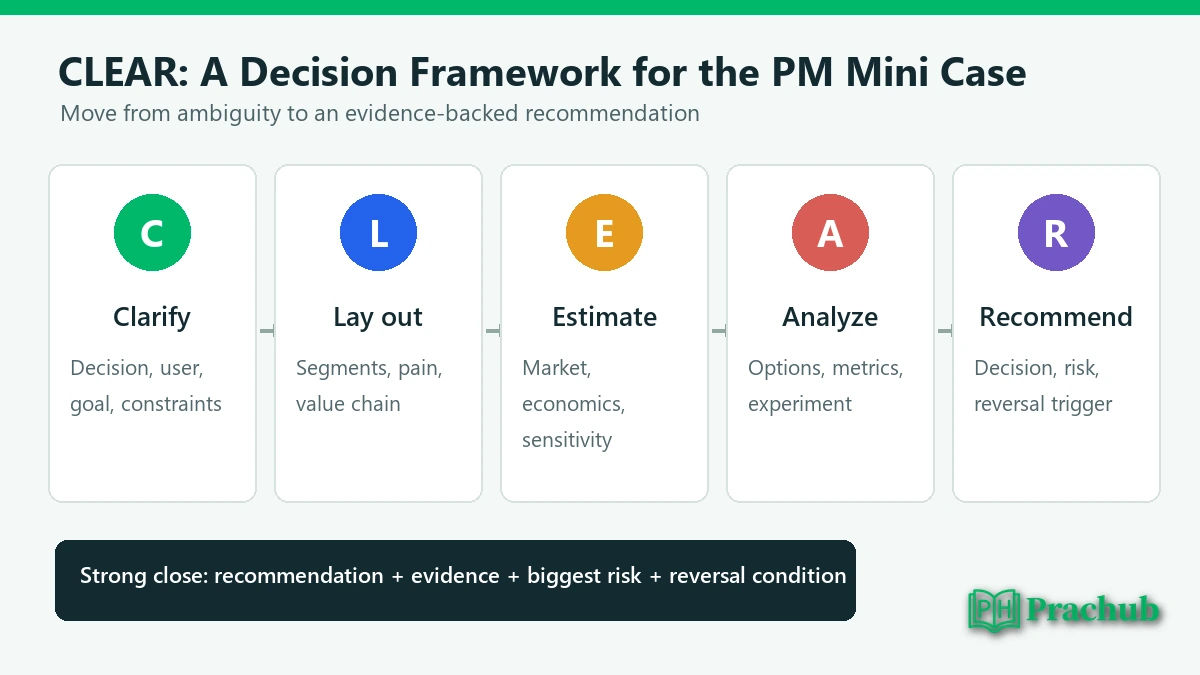
When the interviewer reveals information in stages, use CLEAR to keep your answer coherent.
C - Clarify the decision
Restate the objective, user, time horizon, and decision. Ask questions that can change your approach. “Are we optimizing approved applications or profitable retained accounts?” is useful; demanding every missing number is not.
L - Lay out the customer and value chain
Identify key segments, their problem, current alternatives, and how value is created. Map who pays, who benefits, and where costs or risks enter. A promotion can lift applications while attracting expensive, short-lived customers.
E - Estimate the opportunity and economics
Build a simple equation before choosing numbers. Market size might equal eligible users times reachable share times adoption times annual value. Say assumptions aloud, keep units visible, and calculate in a sensible order.
A - Analyze product options and metrics
Compare two or three options by user value, business value, feasibility, risk, and learning speed. Choose one primary metric, then add diagnostics and guardrails.
R - Recommend and state reversal conditions
End with a decision, not a recap. State the recommendation, evidence, biggest risk, and what would reverse the decision. Be decisive without pretending uncertainty does not exist.
Market Sizing Without False Precision
Market-sizing questions are rarely a test of whether you remember an exact population statistic. They test whether you can define the market, choose a reasonable model, calculate cleanly, and explain what the result means for the product.
Start by naming the unit: annual users, transactions, accounts, revenue, or contribution profit. Then choose either a top-down or bottom-up model. Top-down sizing begins with a broad population and narrows by eligibility, reach, and adoption. Bottom-up sizing starts with channels, capacity, or observed conversion and scales upward.
For an illustrative Capital One Shopping feature, you could say:
Addressable active users = eligible online shoppers x reachable share x expected adoption.
Assume 250 million adults, 70% shop online, 20% are realistically reachable through supported channels, and 10% adopt the feature. That produces 3.5 million active users. If each active user contributes an illustrative $12 per year after rewards and variable costs, the annual contribution opportunity is about $42 million.
Those numbers are assumptions, not claims about Capital One. The useful next step is sensitivity: adoption and incremental contribution drive the result most. If adoption is only 3%, or the activity merely shifts purchases that would have happened anyway, the opportunity shrinks sharply.
Always separate TAM, serviceable market, and obtainable market. A large TAM does not justify a launch if the reachable segment is small, acquisition costs are high, or the feature weakens customer trust.
Metrics That Demonstrate Product Judgment
Avoid listing every metric you know. Build a hierarchy that explains the decision.
The primary metric should represent the intended customer or business outcome. For a shopping improvement, this could be successful savings events per active user, not email open rate. For a card acquisition strategy, it could be profitable activated accounts after a defined period, not raw applications.
Diagnostic metrics explain movement through the funnel: eligible users, impressions, clicks, applications, approvals, activation, first purchase, repeat use, and retention. Guardrails protect against bad growth: failed coupons, complaints, unsubscribe rate, fraud, credit risk, adverse selection, latency, and support contacts.
Finally, connect the metric tree to economics. Ask whether activity is incremental, how long acquisition spend takes to repay, and whether rewards attract customers who remain valuable. Data should inform judgment rather than replace it.
Worked Example: Improve Capital One Shopping
Suppose the prompt is: “Capital One Shopping helps users find coupons, price comparisons, rewards, and price-drop notifications. What would you improve, and how would you measure it?”
Begin with the decision. Assume the goal is to increase repeat successful savings without damaging trust. Segment users into first-time extension users, occasional shoppers, and frequent shoppers. The biggest early risk may be that a new user sees irrelevant offers or a coupon that fails, then decides the product is not trustworthy.
Prioritize a confidence-ranked savings experience. Show the estimated final price, the evidence behind the recommendation, and a clear fallback when a coupon is uncertain. Do not begin with a long feature list; explain why trust in the first two sessions is the bottleneck.
Use successful verified savings events per activated user as the primary metric. Track activation, coupon success, comparison click-through, purchase conversion, repeat use, and incremental affiliate contribution as diagnostics. Add failed-coupon rate, complaint rate, notification opt-out, page latency, and merchant concentration as guardrails.
Run a staged A/B test among eligible new users. Compare the new confidence-ranked experience with the current flow, stratify by merchant and device, and measure downstream purchase and repeat use rather than stopping at clicks. If clicks rise but successful savings fall, do not launch broadly.
Recommend a limited release if successful savings and repeat use improve without a meaningful increase in complaints or latency. Pause if results depend on one merchant, coupon reliability falls, or the contribution gain disappears after rewards and incentives. This answer combines customer value, experimentation, economics, and responsible judgment.
How to Handle Follow-Up Questions
The interviewer may challenge assumptions or introduce new data. Treat that as part of the evaluation, not evidence your first answer was wrong.
When a number changes, update the model visibly and say which conclusion changes. When qualitative feedback conflicts with a metric, check segmentation, data quality, time horizon, and whether the metric measures the real user outcome. Compare new options against the same criteria instead of rebuilding your framework.
Common Mistakes That Lower the Score
The first mistake is solving before defining the decision. The second is hiding assumptions, which makes correct-looking math impossible to audit. Another is optimizing a convenient proxy: more applications, clicks, or redemptions can coexist with lower profit or worse trust.
Finally, weak answers avoid a recommendation. The interviewer needs to see judgment. Choose a direction, acknowledge uncertainty, and state a practical experiment or threshold that would validate the choice.
Practice Capital One Product Manager Questions on PracHub
These question-bank records are not predictions of your exact mini case. They train the same sizing, metrics, experiment, and judgment skills. Each full title in the first column opens the question and written solution.
| PracHub question | Practice focus | Why it helps |
|---|---|---|
| Improve Capital One Shopping | Product improvement, experiments, trust, and monetization | Rehearses a product-specific mini case with downstream metrics. |
| Capital One Credit Card: Acquisition & Promotion Strategy | Segmentation, funnel metrics, promotions, and payback | Connects acquisition growth to profitable retained accounts. |
| Evaluate a Credit Card Partnership | Incremental margin, offer cost, break-even, and pilot design | Trains clean arithmetic followed by strategic judgment. |
| Design a New Credit Card | Market selection, value proposition, economics, and lifecycle | Combines market sizing with product and business trade-offs. |
Attempt each prompt aloud before opening the solution. Write the equation first, label assumptions, and finish with a decision plus a reversal condition.
A Seven-Day Preparation Plan
| Day | Focus | What to do |
|---|---|---|
| Day 1 | Format and product research | Read your recruiter materials and map the users, value, revenue model, and risks of the named products. |
| Day 2 | Market sizing | Complete three top-down and two bottom-up estimates; record every assumption and unit. |
| Day 3 | Business arithmetic | Practice contribution margin, break-even, weighted averages, percent changes, and cannibalization. |
| Day 4 | Metrics and experiments | Build metric trees for Shopping, a credit card, and one digital-banking feature. |
| Day 5 | Product judgment | Run two cases with CLEAR and force a recommendation within the allotted time. |
| Day 6 | Follow-ups and communication | Have a partner challenge assumptions, change numbers, and ask what would reverse your decision. |
| Day 7 | Full simulation | Complete one uninterrupted mock, review the error log, and stop adding new frameworks. |
Frequently Asked Questions
How long is the Capital One Product Manager mini case?
Capital One's general student guidance says mini cases can take about 30 minutes. PM candidate reports often describe 45-60 minutes. Follow the duration in your invitation and recruiter materials.
Is the mini case mostly market sizing?
Not necessarily. Sizing may be one component alongside user segmentation, product critique, metrics, experimentation, business economics, and a final recommendation.
Can I use a calculator?
Candidate reports and third-party guides often say calculators are allowed, but confirm with your recruiter. Even with a calculator, write the equation and explain the units before entering numbers.
Do I need to memorize Capital One products?
Understand the users, value proposition, major features, monetization, trust risks, and plausible metrics for products named in your prep materials. Do not memorize one scripted redesign.
What happens after the mini case?
The sequence varies. Some candidates move to a Power Day or additional matching conversations. If your process includes an earlier assessment, the Capital One Virtual Job Tryout guide covers that separate stage.
Final Takeaway
The Capital One PM mini case rewards candidates who can connect a customer problem to an auditable business decision. Use CLEAR to structure the conversation, expose assumptions, calculate with units, choose connected metrics, and recommend a reversible next step.
Then continue with Product Manager interview questions and behavioral and leadership practice. The goal is not to sound certain about every number. It is to make thoughtful product judgment visible.
Sources and Further Reading
- Capital One: What to Expect During Your Interview
- Capital One: 4 Tips to Ace Your Case Interview
- Capital One: What Does a Product Manager Do?
- Capital One Shopping: How It Works
- Recent Candidate Discussion: Capital One Mini PM Case
Research note: This guide was checked on August 24, 2026. Capital One can change interview stages, products, timing, and case materials by role and recruiting cycle; follow your invitation and recruiter instructions.
Related Articles
Product Alliance Review 2026: Are Its $570 PM Interview Courses Worth It?
Product Alliance review 2026: compare its $570 PM courses, $650 bundle, curriculum, refund policy, strengths, limitations, and alternatives.
Google Product Manager Resume Guide: Product Impact, Metrics, and Leadership Examples
Build a Google Product Manager resume that proves product impact, metrics, technical judgment, launches, and cross-functional leadership with examples.
Technical Product Manager Interview Questions: APIs, Metrics, Systems, and Product Trade-Offs
Prepare for Technical Product Manager interviews with API design, product metrics, system boundaries, reliability, and practical trade-off frameworks.
AI Product Manager Interview Questions: LLM Metrics, Safety, Product Sense, and Trade-Offs
Prepare for AI Product Manager interviews with LLM metrics, safety scenarios, product sense, technical trade-offs, and practice questions.
Comments (0)