Capital One Virtual Job Tryout Guide 2027: Work Scenarios, Behavioral Signals, and What Comes Next
Quick Overview
Prepare for the Capital One Virtual Job Tryout with its official modules, a scenario framework, business-case practice, reuse guidance, and next steps.
A Capital One Virtual Job Tryout can arrive before you know whether a recruiter has reviewed your resume, and the name makes it sound more mysterious than it is. Is it a personality test, a mini case interview, a behavioral screen, or all three?
The most accurate answer is role-dependent. Capital One says candidates may receive a combination of workplace scenarios, a fictitious business case, experience questions, and work-style prompts. Your invitation is the source of truth, but the structure is predictable enough to prepare without hunting for leaked answers.
Start with Capital One interview questions on PracHub. The company question bank helps you practice the business judgment, collaboration, quantitative reasoning, and behavioral evidence that remain useful after the VJT, even when your exact assessment modules differ.
Quick answer: what should you expect?
Capital One officially says its Virtual Job Tryout, or VJT, takes about 20 to 45 minutes on average. The assessment is individualized, and the modules can depend on the role you applied for and exercises you may already have completed.
The VJT is not the same as a live interview or a coding assessment. It is designed to show how you approach realistic work, interpret information, describe your experience, and make professional decisions. A strong response is usually consistent, role-relevant, evidence-aware, and responsible, not artificially perfect.
| Official module | What it asks you to do | Core signal |
|---|---|---|
| Manage Relationships | Respond to situations you could encounter in the role | Collaboration, judgment, communication |
| Work Your Business Case | Integrate information about a fictitious business and recommend a solution | Analysis, prioritization, business reasoning |
| Tell Us Your Story | Describe the experience and background that shaped you | Evidence, ownership, relevant experience |
| Describe Your Approach | Indicate how you prefer to work | Work style, consistency, role alignment |
You may not receive every module. Capital One does not publish one universal question count, timer by section, or passing score, so be skeptical of pages that present a single configuration as guaranteed for all candidates.
What the Capital One VJT is and is not
The VJT is best understood as a job simulation plus structured self-report. It samples how you respond to work situations while previewing aspects of the role.
The assessment can sit inside very different recruiting paths. A Technology Internship candidate may also receive a CodeSignal exercise. A Data Analyst candidate may move from the VJT toward case interviews. Finance, commercial, management, and customer-facing roles may emphasize different scenarios. Do not borrow another role's full process just because it shares the Capital One name.
How to handle Manage Relationships scenarios
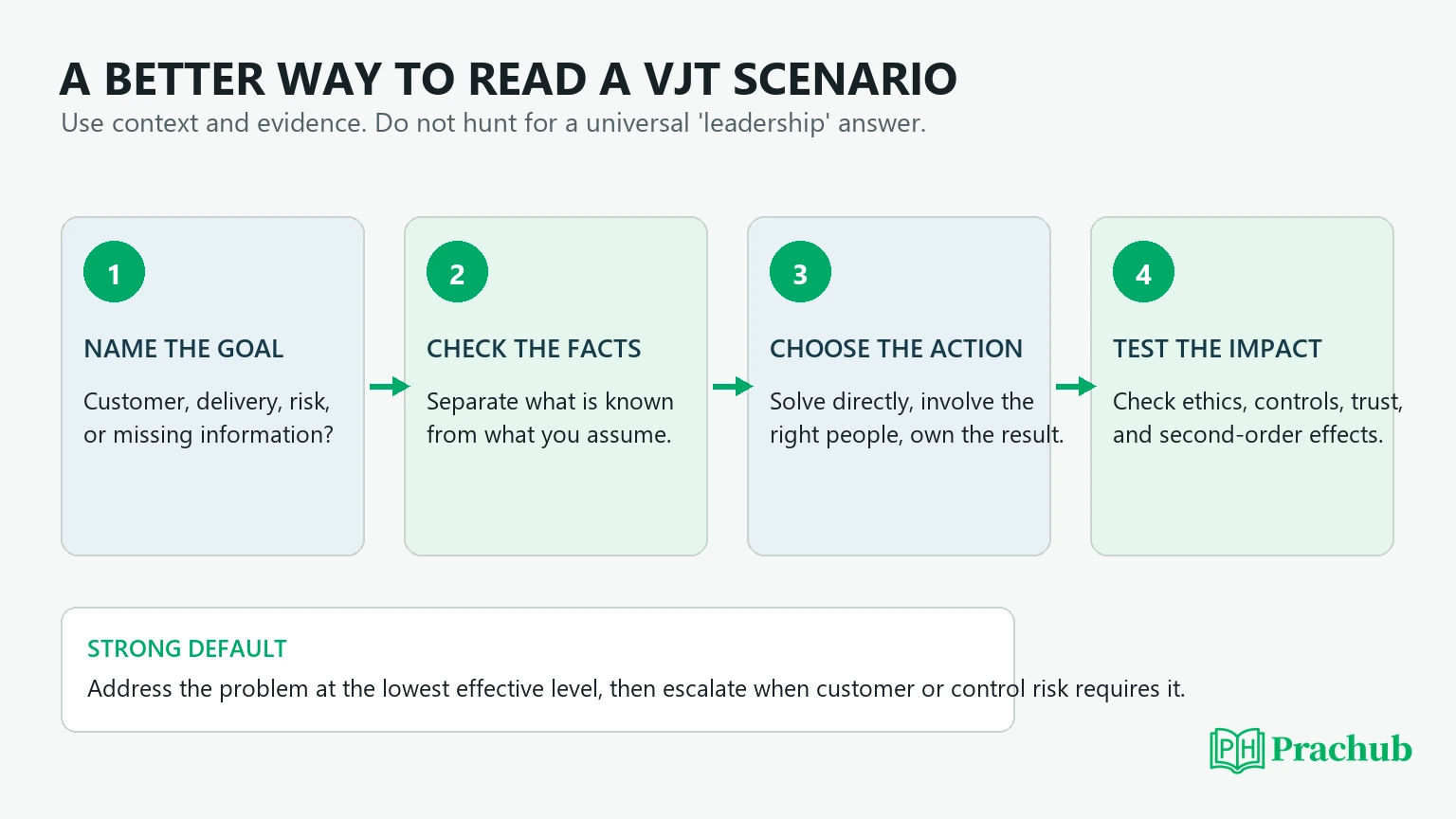
Situational judgment questions usually present several actions that all sound plausible. The goal is not to identify the option with the most corporate language. It is to choose a response that solves the immediate problem while protecting customers, colleagues, controls, and longer-term execution.
Use this reasoning sequence:
- Name the actual objective. Is the issue a customer problem, a delivery risk, a conflict, a compliance concern, or missing information?
- Separate urgency from importance. An angry message may feel urgent, but a security or customer-harm risk can matter more.
- Identify what you know and what you need. Strong decisions rarely invent facts that the prompt did not provide.
- Choose the most direct responsible action. Prefer responses that address the issue, involve the right people, and preserve accountability.
- Check the second-order effect. Ask whether the action creates hidden risk, bypasses a stakeholder, or leaves the same problem for the next person.
Suppose a teammate is late with data needed for a customer recommendation. Escalating immediately may be disproportionate, while quietly doing the work can hide the dependency. A stronger first move is often to clarify the blocker, agree on the minimum deliverable, then escalate with context if customer impact cannot be contained.
Collaboration does not always outrank speed. If the prompt involves fraud, privacy, safety, or a control failure, delaying action can be worse. Solve at the lowest effective level, but escalate when risk requires it.
How to approach Work Your Business Case
Capital One describes this module as reviewing information from multiple sources about a fictitious business and offering solutions. The best preparation is not memorizing a consulting framework. It is practicing a short decision process under imperfect information.
First, define the decision. Then identify the two or three variables that drive it. Calculate carefully, compare alternatives on the same basis, and finish with a recommendation plus the largest uncertainty.
Imagine a business is considering a promotion. Revenue rises, but the promotion discounts existing customers and increases service costs. A weak answer chooses the option with the highest sales. A stronger answer separates incremental demand from cannibalization, calculates contribution rather than gross revenue, and explains what evidence would change the recommendation.
Keep a five-line scratch structure: goal, evidence, math, risk, recommendation. That keeps the calculation connected to the decision instead of becoming an isolated answer.
Read labels and units twice. A percentage change is not a percentage-point change; revenue is not profit; an average can hide different group sizes. If the exercise provides several tabs or documents, write down where each number came from so you do not combine incompatible periods or populations.
Tell Us Your Story: use evidence, not adjectives
This module asks about the experiences and background that shaped you. Treat it as a structured inventory, not a performance where every answer must sound extraordinary.
Be accurate about scope. If you supported a project rather than leading it, say what you personally contributed. If a result was shared across a team, distinguish the team's outcome from your action. Inflated claims can create contradictions later when a recruiter or interviewer asks for details.
Before starting, review four examples from work, school, volunteering, or projects: a difficult problem, a disagreement, a failure, and an evidence-driven improvement. For each one, record your responsibility, two concrete actions, the result, and what you learned. That preparation also feeds directly into later job-fit interviews.
Describe Your Approach: consistency beats performance
Work-style assessments often ask you to choose between statements that both sound positive. Trying to reverse-engineer a hidden ideal profile can make your answers less consistent.
Answer as the dependable version of how you actually work. Use the role description to understand the environment, but do not manufacture a personality. A software role may require independent problem solving and collaboration; an analyst role may require careful evidence and clear recommendations; a customer role may emphasize service and sound escalation. Most jobs require a balance rather than one extreme.
Capital One's culture materials emphasize excellence, doing the right thing, rigor, responsibility, teamwork, respect, and measured boldness. Use those themes as context, not a script. Let your genuine pattern of seeking evidence, involving teammates, owning errors, and protecting customers appear consistently.
What does the VJT invitation mean?
An invitation means Capital One wants you to complete an assessment for that application. It does not necessarily prove that a recruiter has completed a full resume review, and it does not guarantee an interview.
Capital One says candidates receive an individualized assessment by email. Its FAQ also notes that Workday can show a task containing a PDF with the assessment link. If the email is missing, check the email used for the application, spam and quarantine folders, then review the Workday task before contacting recruiting support.
Recent 2027 candidates report moving to another assessment within days or remaining in candidate review for weeks. This variation does not create an official pass/fail definition for a Workday status.
Can Capital One reuse a previous VJT?
Capital One's official FAQ says the module mix can depend on exercises you may already have completed. Recent candidates also report that a prior VJT was reused across applications or that they were not offered a new attempt.
That supports a careful conclusion: reuse can happen, but Capital One does not publicly state one universal validity period or retake rule. Do not withdraw and reapply simply to force a new assessment. Check the Assessment Hub and application tasks, keep screenshots of any missing-link issue, and contact the recruiting channel listed in your materials when the status is unclear.
What comes after the Virtual Job Tryout?
The next step depends on the program. A successful VJT can be followed by recruiter review, another role-specific assessment, a recruiter questionnaire, interviews, or a decision. It is possible to complete the VJT correctly and still be declined after a later resume or eligibility review.
For the Technology Internship, use the Capital One Technology Internship OA 2027 guide for the separate CodeSignal and missing-link questions. Data Analyst candidates should use the Capital One Data Analyst Internship 2027 guide because that role may not follow the Technology path.
If you receive final-round scheduling, move to the Capital One Power Day interview guide. That stage can include case, technical, job-fit, or behavioral interviews depending on the role.
Practice with Capital One questions from PracHub
These PracHub question-bank records train the same reasoning categories without claiming to predict your exact VJT. Each complete title in the first column opens the question and written solution.
| PracHub question | Practice focus | Why it helps |
|---|---|---|
| Should a Restaurant Partner with Groupon? | Unit economics, cannibalization, recommendation | Rehearses a short business case where the biggest number is not automatically the best decision. |
| Analyze Mission Outcomes and Allocate Response Units | Multiple sources, rates, uncertainty, allocation | Trains careful evidence integration and an auditable decision rule. |
| Describe Your Impactful Accomplishment and Learned Lessons | Ownership, impact, reflection | Builds evidence for Tell Us Your Story and later behavioral follow-ups. |
| Influence Stakeholders Using Data: Handle Conflicts, Measure Success | Relationships, influence, measurable outcomes | Connects collaboration with rigorous decision-making instead of vague agreement. |
Attempt each prompt before opening the solution. For the cases, state the decision and the number that could change it. For the behavioral questions, answer aloud in under two minutes, then test whether every claimed result has evidence.
A seven-day VJT preparation plan
Day 1: Read the job description, assessment email, and Workday task. List the role's repeated responsibilities and confirm the deadline and technical requirements.
Day 2: Complete two workplace scenarios. Compare customer impact, collaboration, risk, and second-order effects.
Day 3: Practice one short business case with percentages, profit, and weighted averages. Finish with a recommendation instead of stopping after the calculation.
Day 4: Build four concise experience examples covering problem solving, conflict, failure, and impact. Remove inflated adjectives and add observable evidence.
Day 5: Review Capital One's culture and the role requirements without scripting personality-test answers.
Day 6: Run a 30-to-45-minute simulation without outside help. Record where you rushed, reread the same information, or changed reasoning without new evidence.
Day 7: Review your error log, test the device and browser, choose a quiet environment, and stop cramming. The goal is a consistent decision process, not last-minute answer memorization.
Frequently asked questions
How long is the Capital One Virtual Job Tryout?
Capital One says it takes 20 to 45 minutes on average. Your assigned modules and instructions control the actual experience.
Is the VJT a personality test?
Only partly. Describe Your Approach covers work style, while other modules can include workplace decisions, experience questions, and a business case.
Can you fail the Capital One VJT?
The VJT is an evaluative hiring step, but Capital One does not publish a universal public cutoff or score report. A rejection or continued review can also reflect eligibility, resume fit, headcount, or later screening.
Does candidate review mean I passed?
Not conclusively. A recent candidate reported being told that this status reflected advancement for one finance program, but Capital One has not published that meaning for every role. Do not interpret a portal label as a guaranteed interview.
Should I prepare for CodeSignal after the VJT?
Only if your program commonly uses a coding or analytical assessment, or your invitation says one is next. Technology and some Business Analyst candidates report additional assessments; other roles may move directly to recruiter review or interviews.
Final takeaway
The Capital One Virtual Job Tryout is not a puzzle solved by finding an answer key. It is a structured sample of how you interpret evidence, work with people, describe your experience, and make role-relevant decisions.
Prepare a repeatable reasoning process, read your individualized instructions, and keep role-specific stages separate. Then use Capital One interview questions on PracHub to carry that preparation into the case, technical, and behavioral rounds that may follow.
Sources and Further Reading
- Capital One Candidate FAQs
- Capital One: What to Expect During Your Interview
- Capital One: How We Work
- Current candidate discussion: VJT result and candidate review status
- Current candidate timeline: Business Analyst rotational program
- Current candidate discussion: Financial Analyst VJT preparation
Research note: This guide was checked on August 24, 2026. Capital One can change assessment modules, reuse rules, timing, and follow-up stages by role, location, application, and recruiting cycle. Follow your own invitation and recruiter instructions when they differ from candidate reports.
Related Articles
CodeSignal Business Skills Assessment Guide 2026: AI Interview, Timers, and Employer Reports
Prepare for a CodeSignal Business Skills Assessment: understand AI conversations, question timers, written tasks, submissions, and employer review.
Which Programming Language Should You Use in an OA? Speed, Compatibility, and Employer Preferences
Choose the best programming language for an OA by comparing speed, runtime compatibility, employer preferences, and your own error rate with confidence.
Do Partial Test Cases Count in an OA? Hidden Tests, Weighted Scores, and Cutoffs
Do partial test cases count in an OA? Learn how hidden tests, weighted scores, platform rules, and employer cutoffs affect coding assessment results.
Does Finishing an Online Assessment Early Matter? Completion Time, Accuracy, and Recruiter Review
Does finishing an online assessment early matter? Learn when time affects scoring, what recruiters see, and when accuracy should win in coding tests.
Comments (0)