OpenAI Software Engineer Interview Prep Guide
Everything OpenAI actually asks Software Engineer candidates — concept walkthroughs, worked examples, and the real interview questions, drawn from candidate reports. Free to read.
Last updated
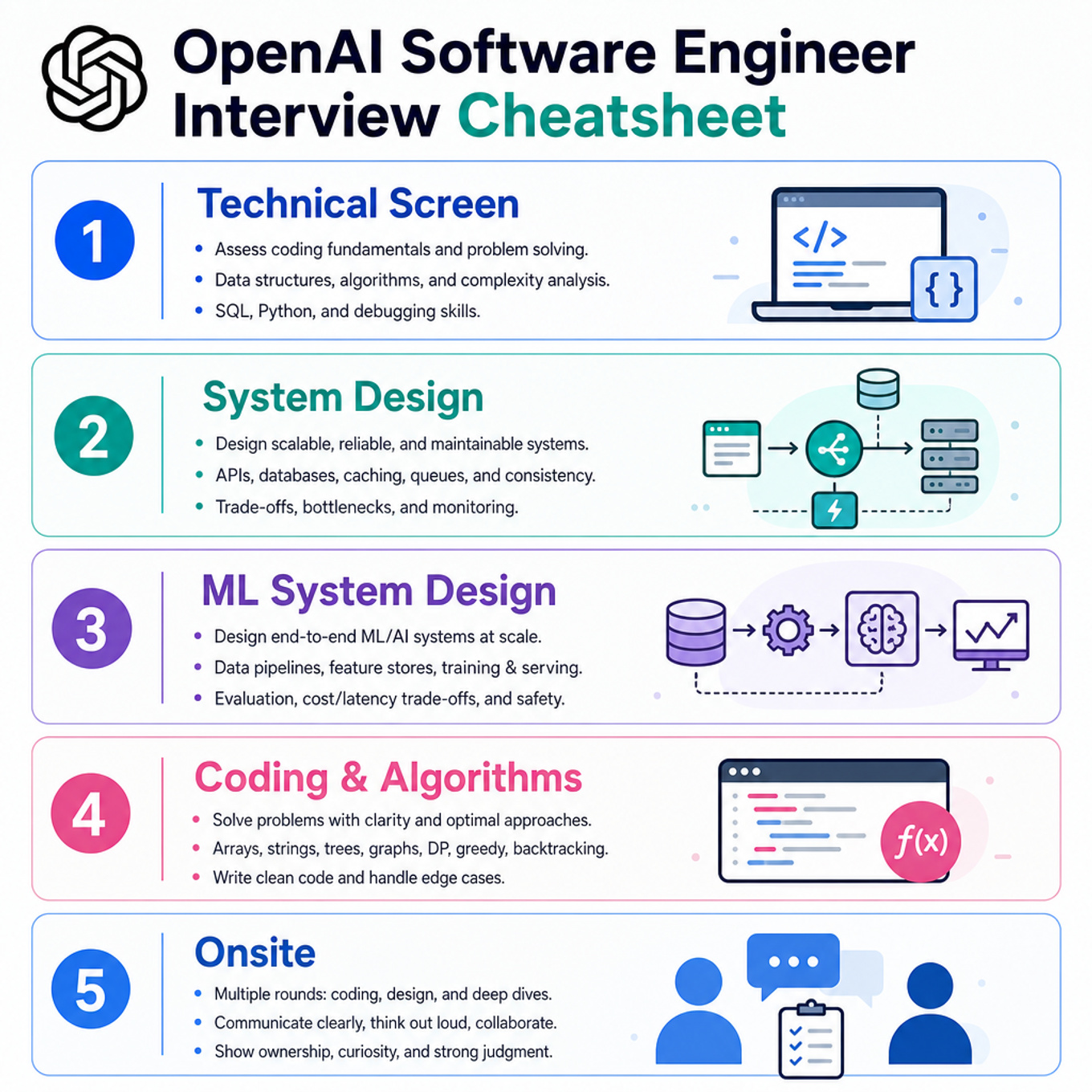
Focus most on coding fundamentals and systems design: you rated Coding & Algorithms 1/5 and System Design 2/5, with no solved-history signal yet, and you explicitly selected graphs, KV stores, concurrency, scheduling, transactions, sharding, observability, and real-time systems. Merely review general software engineering hygiene as supporting material, since Software Engineering Fundamentals is your strongest self-rating at 3/5, especially API design, testing, security, and resource management. For OpenAI, this plan highlights GPU credit scheduling, streaming conversational AI, production ML evaluation/safety, cloud sandboxing, and durable multi-tenant infrastructure patterns. With 1–3 months before the interview, treat this as a 108-minute first-pass map, then spend most practice time implementing coding drills and whiteboarding the emphasized designs.
Technical Screen — 72 min
System Design
GPU Credit Ledgers And Schedulers
Focus areaFocus area — OpenAI-specific infrastructure; matches your selected scheduling, quotas, transactions, and concurrency-control focus with System Design rated 2/5.

What's being tested
Candidates must show practical mastery of designing a multi-tenant, real-time resource accounting and scheduling system that prevents double-spend, enforces budgets, and schedules heterogeneous GPUs. Interviewers probe distributed-systems primitives (consistency, partitioning, idempotency), APIs and failure modes (retries, node failure, clock skew), and scheduler algorithms (gang scheduling, bin-packing, fairness). Expect the interviewer to evaluate clear tradeoffs between strict correctness (no overspend) and scalable, low-latency allocation paths.
Core knowledge
-
Credit ledger data model: per-tenant balance, per-transaction idempotency key, monotonic sequence or vector timestamp to order updates; store in a strongly consistent partition (
etcd,Spanner,PostgreswithSELECT FOR UPDATE) when linearizability is required. -
Idempotency: clients must send an idempotency key; server stores (key -> result) for retry-safe semantics; eviction policy based on TTL and transaction finality to bound storage.
-
Reservation vs commit: implement a two-phase flow: reserve (temporary lease reducing available balance) then commit (final deduction), supporting rollback on node failure; leases expire automatically to avoid stuck resources.
-
Fast-path local checks: use a cached bucket/token (leaky token-bucket) per tenant for sub-second approvals; reconcile with authoritative ledger periodically to bound over-commit risk.
-
Distributed partitioning: partition ledger by tenant-id or account-hash; scale to millions by sharding and routing RPCs to the shard owner, minimizing cross-shard transactions.
-
Heterogeneous GPU costing: normalize GPUs using cost-rate (credits/sec) per device type; billing = sum(cost_rate_i * seconds_used_i). Support preemption and partial refunds with precise time accounting.
-
Scheduler algorithms: for multi-GPU jobs use gang scheduling + bin-packing heuristics (best-fit decreasing) or Dominant Resource Fairness (DRF) for fairness; backfilling reduces fragmentation for short jobs.
-
Atomicity & concurrency control: for strict correctness prefer linearizable updates (compare-and-set, serializable DB txns); for higher throughput consider optimistic allocation with bounded reconciliation windows.
-
Failure modes: handle node crashes (leases expire), network partitions (reject writes if quorum not available for linearizability), and clock skew (use server timestamps or monotonic counters).
-
Observability & SLAs: track
p99allocation latency, double-spend incidents, reconciliation drift, and per-tenant throttles; emit events toKafka/ingestion pipeline for billing pipeline. -
Security & multi-tenancy: authenticate calls via strong identity (mTLS, IAM), enforce RBAC for transfers, and audit every ledger mutation for dispute resolution.
-
Scaling numbers: for N tenants ~10M, keep per-tenant metadata in a scalable KV store; avoid multi-tenant cross-shard txns—they kill throughput. Use asynchronous reconciliation and incremental snapshots for export.
Worked example — "Design GPU credit allocator"
First 30 seconds: ask expected scale (tenants/sec, concurrent allocs), consistency SLA (strict no-overspend vs eventual), GPU heterogeneity, and whether allocations are preemptible. Declare assumptions: target 100k allocs/sec, strict per-tenant no-overspend, heterogeneous GPUs with known cost rates.
Skeleton of an answer:
-
API design:
Reserve(tenant, amount, idempotency_key),Commit(reservation_id),Release(reservation_id); synchronous response for Reserve. -
Ledger implementation: shard by tenant; each shard owner provides linearizable reservations via
SELECT FOR UPDATEoretcdCAS. Store reservations with TTL. -
Fast-path: local token-bucket cache for micro-requests; falls back to authoritative Reserve RPC when cache misses.
-
Scheduler integration: scheduler requests reservations for GPU set (gang), scheduler commits when job starts, releases on preemption.
Explicit tradeoff: using strong linearizability prevents double-spend but requires cross-shard coordination for transfers—choose to ban cross-shard atomic transfers or implement async transfer with temporary credit holds. Closing: if more time, prototype shard-split logic, run chaos-testing (node failures, retries), and design reconciliation jobs to detect and correct drift.
A second angle — "Design credit balance with vector-clock expirations"
This variant emphasizes concurrent updates from multiple disconnected clients and expiry semantics. Use vector clocks or per-shard monotonic counters to track causality of credit events; model balance as an eventually-consistent CRDT only if occasional overspend is acceptable. To support expirations, attach expiry metadata to each credit delta and garbage-collect with causal ordering to avoid prematurely dropping recent updates. The primary shift: when strict single-source ordering is impossible, rely on deterministic merge functions and compensation transactions, and be explicit about allowed windows for inconsistency.
Common pitfalls
Pitfall: Relying solely on a cheap local cache for immediate approvals without any authoritative reconciliation. This leads to silent double-spend when many nodes grant allocations simultaneously; prefer bounded fast-path windows and periodic reconciliation or pessimistic reservations for high-value ops.
Pitfall: Forgetting idempotency keys and storing results only transiently. Retries will create duplicated charges; store idempotency mapping with TTL and ensure idempotent handlers are deterministic.
Pitfall: Designing the scheduler independently from credit semantics. Scheduling multi-GPU jobs requires atomic reservations across multiple GPUs (gang scheduling); otherwise partial allocations result in wasted resources and complex refunds. Flag the need for a coordinated reserve-and-commit for multi-device jobs.
Connections
Interviewers may pivot to adjacent topics: designing the billing/export pipeline and offline reconciliation (data engineering), or to fine-grained scheduler optimization (resource management research like Borg/Omega). They may also ask about monitoring and alerting thresholds (SRE concerns).
Further reading
-
Designing Data-Intensive Applications — Martin Kleppmann — strong treatment of consistency, partitioning, and CRDTs for ledger-like systems.
-
Dynamo: Amazon’s Highly Available Key-value Store — background on partitioning, eventual consistency, and vector-clock techniques.
-
Stripe: Idempotency keys — practical pattern and tradeoffs for retry-safe financial operations.
Practice questions
-
CI/CD Workflow Orchestration (Focus) — covered in depth under Onsite below.
-
Reliable Payment Processing And Idempotency (Focus) — covered in depth under Onsite below.
-
In-Memory Databases And Query Engines (Focus) — covered in depth under Onsite below.
-
Slack-Like Real-Time Messaging (Focus) — covered in depth under Onsite below.
-
Cloud IDE And DevBox Sandboxing (Focus) — covered in depth under Onsite below.
-
Event-Time Telemetry For Unreliable Devices (Focus) — covered in depth under Onsite below.
ML System Design
Focus area — OpenAI interviews strongly value evaluation, monitoring, safety tradeoffs, rollout discipline, and debugging production ML behavior.
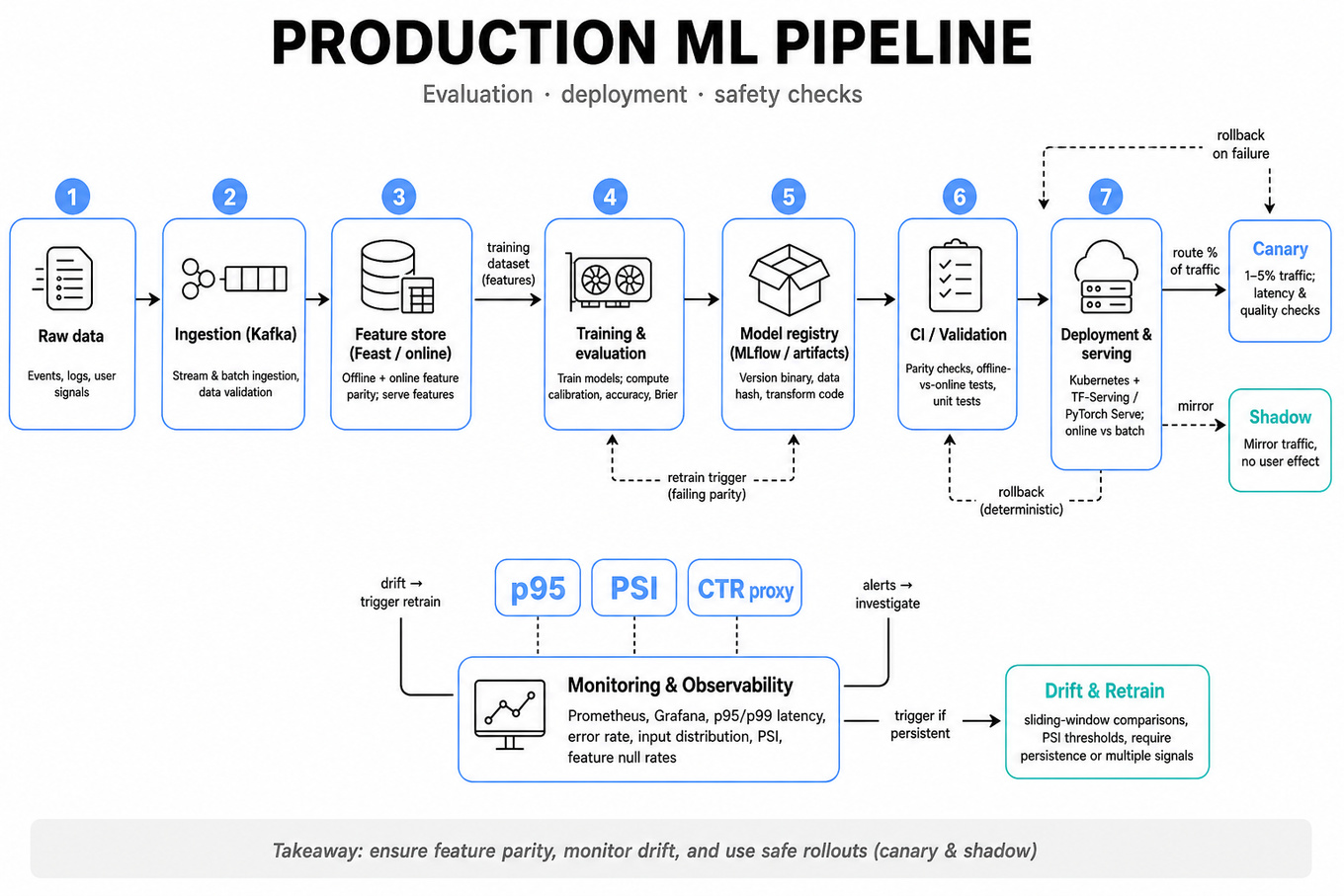
What's being tested
Candidates must show practical, systems-focused debugging and design skills for production ML: diagnosing pipeline and model failures, instrumenting reliable serving, and choosing safe rollout strategies. Interviewers probe the candidate’s ability to structure an investigation, read telemetry, and propose engineering fixes (retries, feature parity, canaries, rollbacks) rather than invent new ML algorithms.
Core knowledge
-
Data drift vs concept drift: know the difference—data distribution change (input features) vs label relationship change (P(y|x)); detect with population statistics, PSI, or simple KS tests on feature histograms.
-
Feature parity: ensure offline-features and online-features are computed identically; mismatches are a top cause of production failures. Reproduce feature pipelines locally before blaming the model.
-
Model versioning and lineage: use
MLflowor artifact stores to track model binary, training data hash, feature-transformation code, and config; make rollbacks deterministic by pinning all artifacts. -
Serving patterns: know the tradeoffs of online inference (low latency, strong consistency) vs batch/async (higher throughput, relaxed freshness). Implement with
Kubernetes+TensorFlow Serving/PyTorch Serveor a lightweight microservice. -
Canary & shadow deployment: route a small % of live traffic to a new model (canary) for latency/quality checks; mirror traffic to a new model with no user effect (shadow) to validate parity.
-
Monitoring & SLOs: instrument
p95/p99latency, error rate, and throughput; add model-specific telemetry: input distribution summaries, feature null rates, and top-10 features by contribution. Alert on threshold breaches. -
Model evaluation signals: track surface metrics (
accuracy,precision,recall) plus calibration (reliability diagrams, Brier score) and production proxies (CTR, downstream conversion) when labels are delayed. -
Drift detection and retraining triggers: use sliding-window comparisons, population-stability-index (PSI), or statistical change detectors; avoid retraining on transient spikes — require persistence or multiple signals.
-
Observability tools: integrate
Prometheusfor metrics,Grafanadashboards, structured logs for request/response, and distributed traces to correlate model latency with upstream/downstream services. -
Operational robustness: implement idempotent requests, graceful degradation (cached fallback model), circuit breakers, and exponential backoff for retriable failures; log inputs that hit fallbacks for analysis.
-
Privacy & safety guardrails: enforce input sanitization and rate limits, redact PII before logging, and add a pre-check to block toxic or out-of-distribution inputs.
Tip: capture a reproducible failing request (input, feature values, model version) so engineers can replay production behavior locally.
Worked example — Debug a failing ML classifier
Start by framing: ask what “failing” means (latency, accuracy drop, calibration drift, or increased false positives), when it started, rollout/versions, and whether labels are available in production. Organize the investigation into three pillars: (1) reproduce the failure locally (replay production requests), (2) inspect pipeline differences (feature-parity, preprocessing), and (3) inspect runtime signals (latency, memory, OOMs, infra errors). Triage steps: check recent deployments and config changes, verify feature histograms for top features against training distribution, and run the model binary on a sample of production inputs to compare predicted scores and confidences. A concrete tradeoff to call out: if retraining is easy, you can quick-retrain on recent data, but that risks reinforcing label bias—prefer validating drift and running a controlled canary retrain. Close by proposing short-term mitigations (canary rollback, serving fallback) and long-term fixes (add feature-parity tests, automated drift alerts, and reproducible replay pipelines), and say: “if I had more time, I’d add a shadow test harness and automated A/B quality gates with live labels.”
A second angle — Design a response-ranking ML system
Ranking introduces high-throughput, latency-critical serving and heavy instrumentation needs. The same debugging primitives apply: ensure feature parity between offline ranker training and online scorer, use shadowing to mirror traffic to new ranking models, and monitor both ranking-specific metrics (NDCG, CTR at k) and system SLOs. Unique constraints include candidate-generation latency (multi-stage pipelines), stateful session features, and the need for online batch scoring or pre-computed candidate scores. A software engineer must design efficient feature lookup (in-memory cache or Redis), ensure deterministic sort order under ties, and provide fast rollbacks because model mistakes directly affect user experience and revenue.
Common pitfalls
Pitfall: Blaming the model first.
Jumping to retrain without checking feature pipelines or infra issues wastes time. A better approach is to first reproduce requests end-to-end and confirm that the model gets the same inputs offline as online.
Pitfall: Relying solely on offline metrics.
Offline evaluation (e.g., cross-val accuracy) can miss production mismatches. Always correlate with production telemetry, shadow experiments, and delayed-label feedback loops.
Pitfall: Over-alerting on transient noise.
Triggering retrains or rollbacks on single spikes causes churn. Require multiple corroborating signals (persisting drift, label degradation, increased error rates) before automating heavyweight changes.
Connections
Interviewers may pivot to adjacent systems topics: feature stores and their consistency semantics, or deployment pipelines like CI/CD for models and canary automation. They might also ask about distributed tracing and SLO-driven incident response for ML services.
Further reading
-
Hidden Technical Debt in Machine Learning Systems — Sculley et al., NIPS 2015 — seminal paper on production ML failure modes and engineering debt.
-
Designing Data-Intensive Applications — Martin Kleppmann — practical reference for durable storage, stream processing, and system reliability patterns relevant to ML serving.
Practice questions
Streaming Conversational AI Systems
Focus areaFocus area — Core OpenAI product pattern; overlaps your focus on real-time messaging, WebSockets, frontend state, API design, privacy, and resilience.
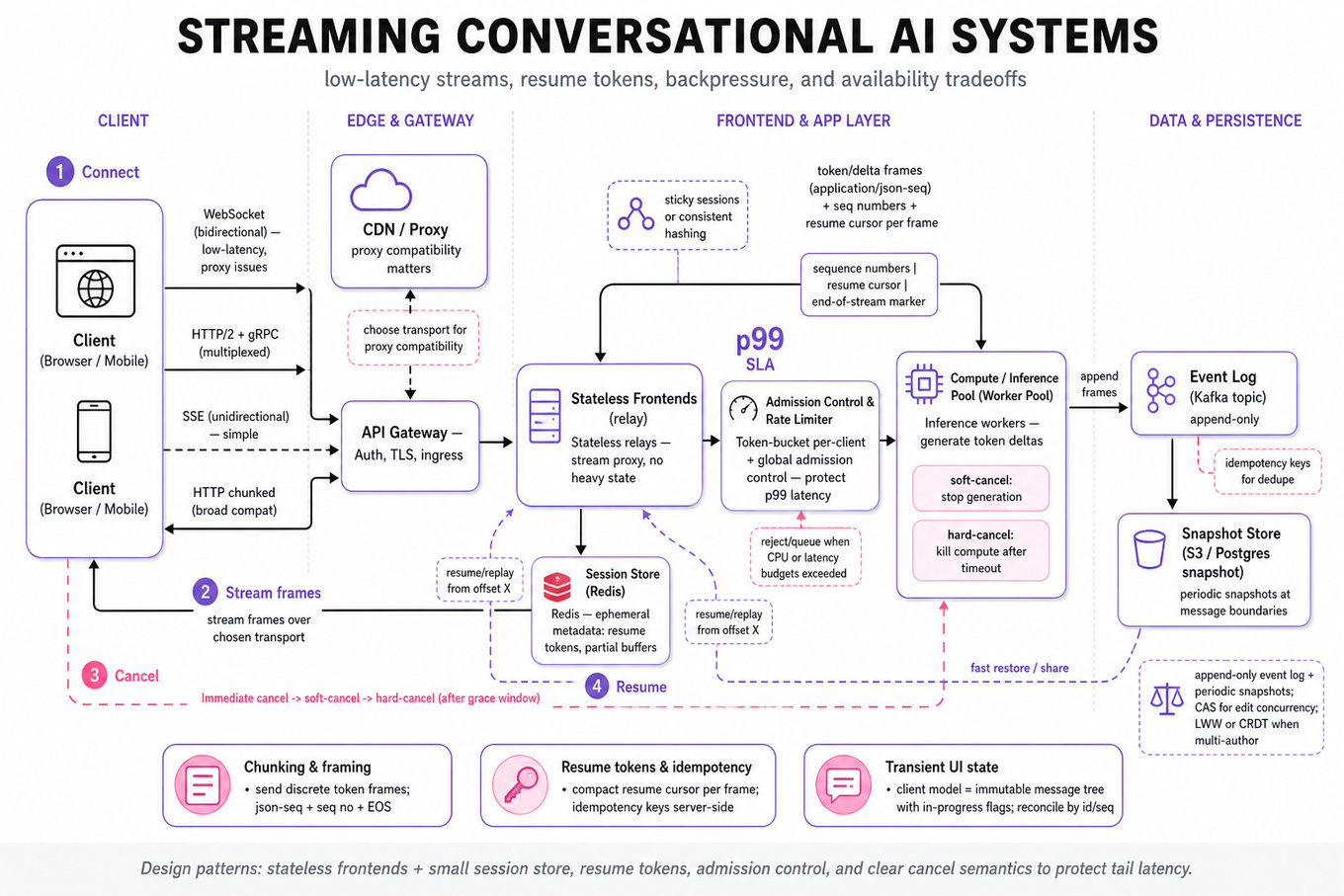
What's being tested
Candidates must show end-to-end engineering judgment for building low-latency, robust streaming chat systems: real-time transport choices, transient client state management, concurrency and cancellation, backpressure/admission control, and availability tradeoffs. Interviewers probe whether you can design practical, testable interfaces (APIs, idempotency, resume tokens), reason about tail latency and resource isolation, and communicate clear failure modes and mitigations a Software Engineer would implement.
Core knowledge
-
Streaming transport options — tradeoffs between
`WebSocket`, Server-Sent Events (SSE),HTTP/2+gRPCstreaming, and HTTP chunked responses; choose by bidirectionality, proxy compatibility, and browser support. -
Chunked transfer & framing — send discrete token/delta frames; include sequence numbers, content-type
application/json-seq, and explicit end-of-stream markers to enable reassembly and resume. -
Resume tokens & idempotency — attach a compact resume cursor or token with each frame so clients can reconnect and request "resume from offset X"; use server-side idempotency keys for request deduplication.
-
Backpressure & admission control — use token-bucket or leaky-bucket per-client rate limiting and global admission control; reject or queue requests when CPU/latency budgets exceed thresholds to protect
p99latency. -
Cancellation semantics — propagate client cancels immediately to compute layer; implement soft-cancel (stop token generation) and hard-cancel (kill compute) with timeout/window for graceful cleanup.
-
Stateless fronting with sticky state — keep frontends stateless relays but use sticky session routing or external session store (small
Redis) for ephemeral streaming metadata (resume tokens, partial buffers). -
Transient UI state model — represent in client as immutable message tree with in-progress flags and append-only token deltas; reconcile streams by id/seq to avoid flicker and duplicates.
-
Persistence model: snapshots & event log — store conversation as append-only event log plus periodic snapshots for reads; snapshotting at message boundaries speeds restores and sharing use-cases.
-
Consistency and concurrent updates — use optimistic concurrency control (CAS) for edits and snapshot writes; design for last-writer-wins or CRDT merge only if multi-author editing required.
-
Latency budgeting — set tight budgets: e.g., client RTT + server queueing + model compute ≤ target (e.g., 500ms for response start), monitor
p95/p99for throttling decisions; expose graceful degrade path (shorter summary instead of full generation). -
Monitoring & observability signals — instrument request lifecycle: enqueue time, start time, token emission rate, bytes streamed, cancellation rate, resume success rate; alert on rising resume/retry counts and
p99token gaps. -
Testing & determinism — add deterministic replay hooks and synthetic load tests that simulate partial-frame loss, reconnects, and slow clients; mock providers with configurable latency and tokenization.
Worked example — Build a Reliable Streaming Chat UI
First 30 seconds: clarify client constraints (browser vs native), expected throughput (users concurrently streaming), allowed transports (`WebSocket` vs SSE), and what “reliable” means (resume on reconnect, no duplicated tokens, consistent UI ordering). Skeleton answer pillars: (1) transport + framing (frame = {msg_id, seq, resume_token, delta}), (2) client state management (immutable message list with an in-progress entry and id/seq reconciliation), (3) resume & idempotency (server issues resume cursors and supports resume API), and (4) admission/backpressure (client-level rate-limits & server-side admission).
One tradeoff to flag: using `WebSocket` gives bidirectional control and built-in backpressure semantics in some stacks, but is harder to proxy and scale through certain load balancers—SSE is simpler but uni-directional. Implementation detail to call out: include sequence numbers and a server-signed resume token to avoid accepting stale resumes after conversation deletion. Close with next steps: if time remains, sketch tests (reconnect fuzzing), performance targets (p95 start latency), and how to instrument for out-of-order or missing frames.
A second angle — Design a Highly Available Conversational AI Service
This question emphasizes availability, regional isolation, and dependency failures. Apply the same streaming principles but shift focus to system-level resilience: front-door load shedding, multi-region routing, replica isolation, and graceful degradation. With streaming, you must plan admission control globally (reject to preserve p99 for existing streams), fall back to cached or summarised responses on dependency failure, and implement cross-region resume tokens so clients reconnect to nearest healthy region without redoing expensive compute. Also design per-tenant quotas and circuit breakers around an external LLM provider: if provider latency spikes, return a short canned reply or progress bar while preserving connection and allowing resume. The core primitives (framing, resume, cancellation, instrumentation) are identical, but you now prioritize isolation, capacity planning, and failover strategies.
Common pitfalls
Pitfall: assuming TCP backpressure is enough — TCP windows don't provide application-level flow control for tokenized JSON frames; you still need explicit rate or frame control and client-side buffering limits to avoid OOM or UI jank.
Pitfall: resuming by raw byte offset — resumes should be by logical token/sequence id with server validation; byte offsets break across different encodings, partial serialization, and middleware rewrites.
Pitfall: client optimistic UI that blindly appends streamed deltas without deduplication — this yields duplicated text after reconnects; reconcile on
msg_id+seqand keep an idempotency filter.
Connections
Interviewers may pivot to adjacent topics like model-serving orchestration (scaling inference backends, warm pools) or data consistency (event sourcing vs relational snapshots) — be prepared to discuss how streaming primitives interact with those systems, especially for admission control and snapshot durability.
Further reading
- Designing Data-Intensive Applications (Martin Kleppmann) — event logs, snapshots, and distributed consistency patterns for conversation stores.
Practice questions
Coding & Algorithms
Versioned Graphs And Snapshotting
Focus areaFocus area — Coding is 1/5, and your selected graph, union-find, transactions, snapshots, and dynamic-connectivity topics need substantial coverage.
What's being tested
These problems test building a mutable directed graph that supports versioning and efficient snapshotting for point-in-time queries alongside live mutations. Interviewers probe data structures (per-edge logs, hash maps, balanced trees), algorithmic complexity for queries and updates, and memory/time tradeoffs when producing recommendations from historical graph state.
Patterns & templates
-
Per-edge event lists: store adds/removes as timestamped ops in sorted arrays; use
binary searchfor membership at version V, O(log m) per edge lookup. -
Immutable snapshots via copy-on-write: keep a root pointer to shared structures so snapshot creation is O(1) and mutations copy only changed nodes, amortized efficient for sparse updates.
-
Sparse version index / change logs: maintain
Map<version, root>or per-node change lists to replay until V; snapshot creation O(1), point-in-time rebuild cost depends on log length. -
In-memory adjacency map:
Map<node, Map<neighbor, List<(ts, op)>>>gives O(1) node access; watch memory for high-degree vertices and prefer compressed neighbor lists. -
Ordered containers for fast range queries: use
TreeMap/skiplist or arrays +bisectto find prefix/suffix of events in O(log n)+O(k) to scan k events. -
Recommendations via mutual intersections: iterate the smaller neighbor list and hash-count candidates, use a size-k heap for top-k, cost ~O(sum small_deg + m log k).
-
Compaction/checkpointing: checkpoint full adjacency at intervals and drop old deltas to bound read/replay cost; tune checkpoint frequency to update rate.
Common pitfalls
Pitfall: Treating unfollow as instantaneous deletion without a timestamp makes point-in-time queries ambiguous and yields wrong historical membership.
Pitfall: Assuming snapshot = deep copy; naive copies are O(N) and blow up memory — prefer structural sharing or periodic checkpoint+delta strategies.
Pitfall: Building recommendations by intersecting all neighbors (all-pairs) — this can be O(n^2) on heavy nodes; always iterate the smaller set or use sampling.
Practice these
The practice cards below cover the canonical variants — solve all of them and time yourself.
Practice questions
Memory Allocator Design
Focus areaFocus area — Your profile flags resource management, pooling, and virtual-memory fundamentals as weak or new, so allocator mechanics need first-principles practice.
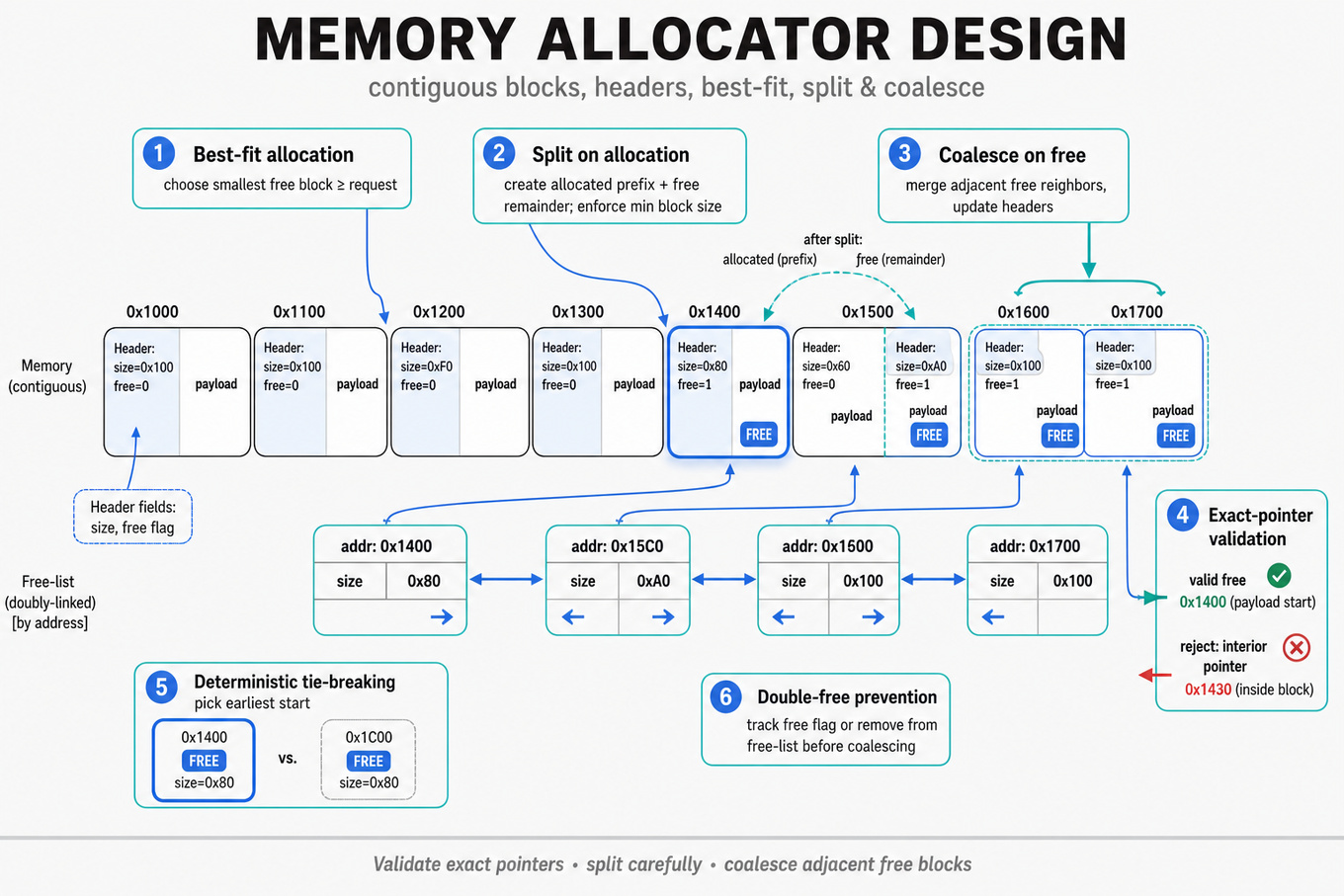
What's being tested
These problems test designing a contiguous memory allocator: managing a linear address space with best-fit allocation, splitting, and coalescing of free blocks. Interviewers probe data-structure choices, correctness for malloc/free semantics (including double-free detection and pointer validation), and deterministic tie-breaking under equal-fit scenarios.
Patterns & templates
-
Free-list as ordered list — maintain a list of (start, size, free) blocks; scan for best-fit in
O(b)time where b = number of blocks. -
Block header layout — store metadata (size, free flag) adjacent to block; use pointer arithmetic for successor/predecessor.
-
Split on allocation — when a free block > requested, carve prefix/suffix and update headers; watch minimum block size to avoid tiny fragments.
-
Coalesce on free — merge adjacent free neighbors by checking neighboring headers in
O(1)if doubly-linked,O(b)otherwise. -
Exact-pointer validation — accept frees only when pointer matches a block's payload start; reject interior or null frees deterministically.
-
Deterministic tie-breaking — prefer earliest-start or lowest-index block on equal sizes to make behavior testable and reproducible.
-
Optional optimizations — use segregated free lists or balanced tree (interval tree / ordered set) to reduce allocation/search to
O(log b)at space cost.
Common pitfalls
Pitfall: Returning an interior pointer or allowing frees of non-exact pointers — always validate pointer equals the block’s payload start.
Pitfall: Forgetting to prevent double-free — track a free flag or remove freed block from free-list before coalescing.
Pitfall: Splitting without enforcing minimum block/header size — leads to unusable tiny fragments and incorrect pointer arithmetic.
Practice these
the practice cards below cover the canonical variants — solve all of them and time yourself
Practice questions
Onsite — 36 min
System Design
CI/CD Workflow Orchestration
Focus areaFocus area — You selected distributed job scheduling, observability, fault tolerance, API design, and sharding; no solved-history signal yet.
What's being tested
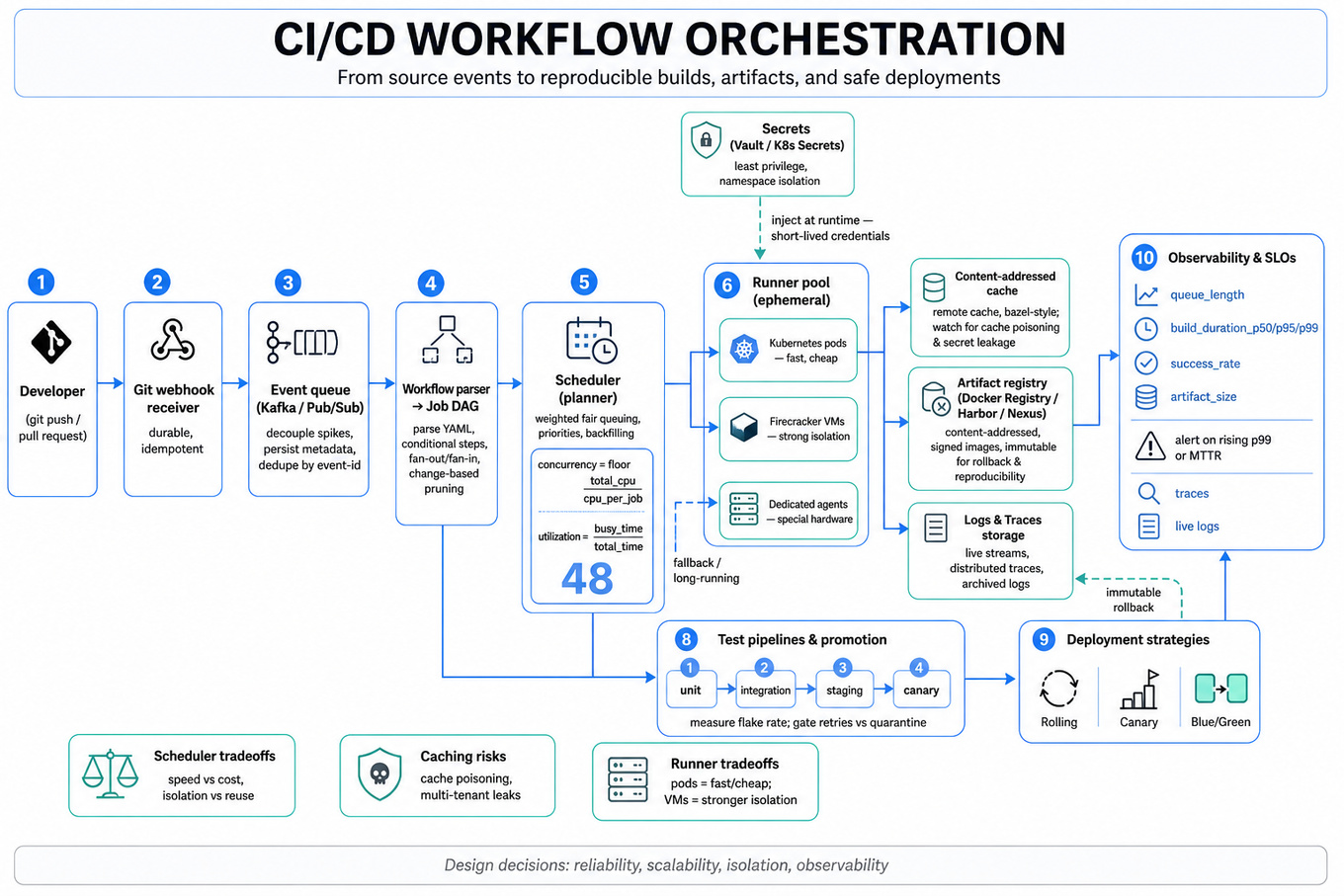
Candidates must show how to design a reliable, scalable CI/CD workflow orchestration system that turns source events into reproducible builds, tests, artifacts, and safe deployments. Interviewers probe architecture decomposition (ingest → planner/scheduler → runners → artifact & log storage), operational tradeoffs (speed vs cost, isolation vs reuse), and practical run-time concerns: scheduling policies, caching, observability, security, and rollback. Demonstrate concrete choices, capacity math, and failure-mode mitigation that a software engineer would own.
Core knowledge
-
Event intake: Git/webhook handling should be durable and idempotent; use a queue (
`Kafka`/Pub/Sub) to decouple spikes, deduplicate by event-id, and persist metadata for auditing and replay. -
Workflow parsing & DAG: Parse YAML into a job DAG; support conditional steps, fan-out/fan-in, and change-based pruning (skip downstream jobs if no affected files).
-
Scheduler & fairness: Scheduler implements priorities, weighted fair queuing, and backfilling; model capacity: concurrency = floor(total_cpu / cpu_per_job); utilization = busy_time/total_time.
-
Runners / isolation: Provide ephemeral runners via
`Kubernetes`pods, lightweight VMs (Firecracker), or dedicated agents; tradeoffs: pods = fast/cheap, VMs = stronger isolation. -
Caching & incremental builds: Use content-addressed caches (remote cache or
`bazel`-style) and artifact caching; beware cache poisoning and secret leakage between tenants. -
Artifact immutability and registries: Store artifacts in a content-addressed registry (
`Docker Registry`,`Harbor`,`Nexus`) and sign images; immutability simplifies rollbacks and reproducibility. -
Security & secrets: Inject secrets at runtime via
`Vault`/`Kubernetes`secrets with short-lived credentials; enforce least privilege and runtime namespace isolation. -
Testing layers & flakiness: Compose unit → integration → staging → canary; quantify flakiness (test flake rate) and gate retries vs quarantine to avoid wasting resources.
-
Observability & SLOs: Emit metrics: queue_length, build_duration_p50/p95/p99, success_rate, artifact_size; logs streamed live, distributed traces for long DAGs, alerts for rising p99 latency or MTTR.
-
Deployment strategies: Implement rolling, canary, and blue/green deployments plus feature-flag integration; ensure idempotent deployment APIs and immutable artifact references.
-
Multi-tenant constraints: Enforce per-tenant quotas, RBAC, logs/artifact scoping, and fair-share scheduling to prevent noisy neighbors; include admission control on resource consumption.
-
Cost & capacity planning: Estimate cost_per_build = CPU_seconds * price_cpu + storage_gb * price_storage + egress; shard scheduler when builds/day > ~10k or concurrency >> cluster size.
Tip: Prefer content-addressed artifact IDs and immutable tags; they make rollbacks and cache reuse deterministic.
Worked example — "Design a CI/CD pipeline with scheduler"
First 30s: clarify scope (single repo vs monorepo? polyglot builds?), SLOs (p95 build latency target), and scale (builds/day, avg duration, concurrency). State assumptions: monorepo, target ~500 builds/day, average 5min build, multi-stage tests.
Skeleton pillars to present:
-
Event ingestion: Git webhooks → validated → enqueue in
`Kafka`with dedupe. -
Workflow planner: YAML → DAG; compute affected tasks with file-change graph to skip irrelevant jobs.
-
Scheduler: global scheduler implements priority, backfilling, and slot accounting (CPU/memory/GPU). Maintain per-project quotas and tenant weights.
-
Runners & execution: ephemeral
`Kubernetes`pods using a sidecar for log streaming and secret injection; cache mounts from remote cache. -
Artifacts & deploy: push content-addressed artifacts to
`Harbor`, sign, then trigger deployment pipeline with canary rollout and automated rollback on health regression.
One tradeoff to flag: shared runner pools maximize utilization but require rigorous sandboxing and secret handling; dedicated runners increase latency and cost but give stronger isolation. Close by saying: if I had more time, I'd prototype scheduler policies with a load simulator, add ML-based prioritization for critical PRs, and detail quorum-based rollout health checks.
A second angle — "Design multi-tenant CI/CD workflow system"
Multi-tenancy shifts priorities: tenant isolation and fairness become first-class. Start by scoping isolation boundaries (logical via namespaces vs physical via clusters). Scheduler must enforce per-tenant quotas, weighted priorities, and admission control; consider hierarchical scheduling (global broker + per-tenant local scheduler) to scale. Artifact and log stores must be multi-tenanted with ACLs and encryption-at-rest; billing meters resource usage (CPU_seconds, storage_gb). Also design for noisy-neighbor mitigation: throttling, preemption, and per-tenant reservation pools.
Common pitfalls
Pitfall: Focusing only on fast median builds (p50) and ignoring p99 latency — this leads to bad SLOs; always present p50/p95/p99 and tail-case mitigation like pre-warmed runners.
Pitfall: Proposing naive shared caches without considering security and cache poisoning; articulate cache scoping and validation (content-addressed + signed artifacts).
Pitfall: Treating scheduling purely as FIFO; interviewers expect tradeoffs between fairness, priority, and cost — describe algorithms (weighted fair queuing, backfill) and capacity math.
Connections
Design conversations often pivot to distributed schedulers, observability/alerting (SRE practices), and build-system internals (remote execution, `bazel` caching). Be ready to dive into runtime security (sandboxing, attestation) or cost-optimization (spot instances, preemptible runners).
Further reading
-
Argo Workflows — practical model for
`Kubernetes`-native DAG execution and workflow controller. -
Tekton Pipelines — a vendor-neutral CI/CD primitives project with pipeline-as-
`Kubernetes`-CRDs, useful for scheduler/running patterns.
Practice questions
Focus area — Emphasized because you selected concurrency control, transactional integrity, offline conflict handling, API design, and fault-tolerant retries.
What's being tested
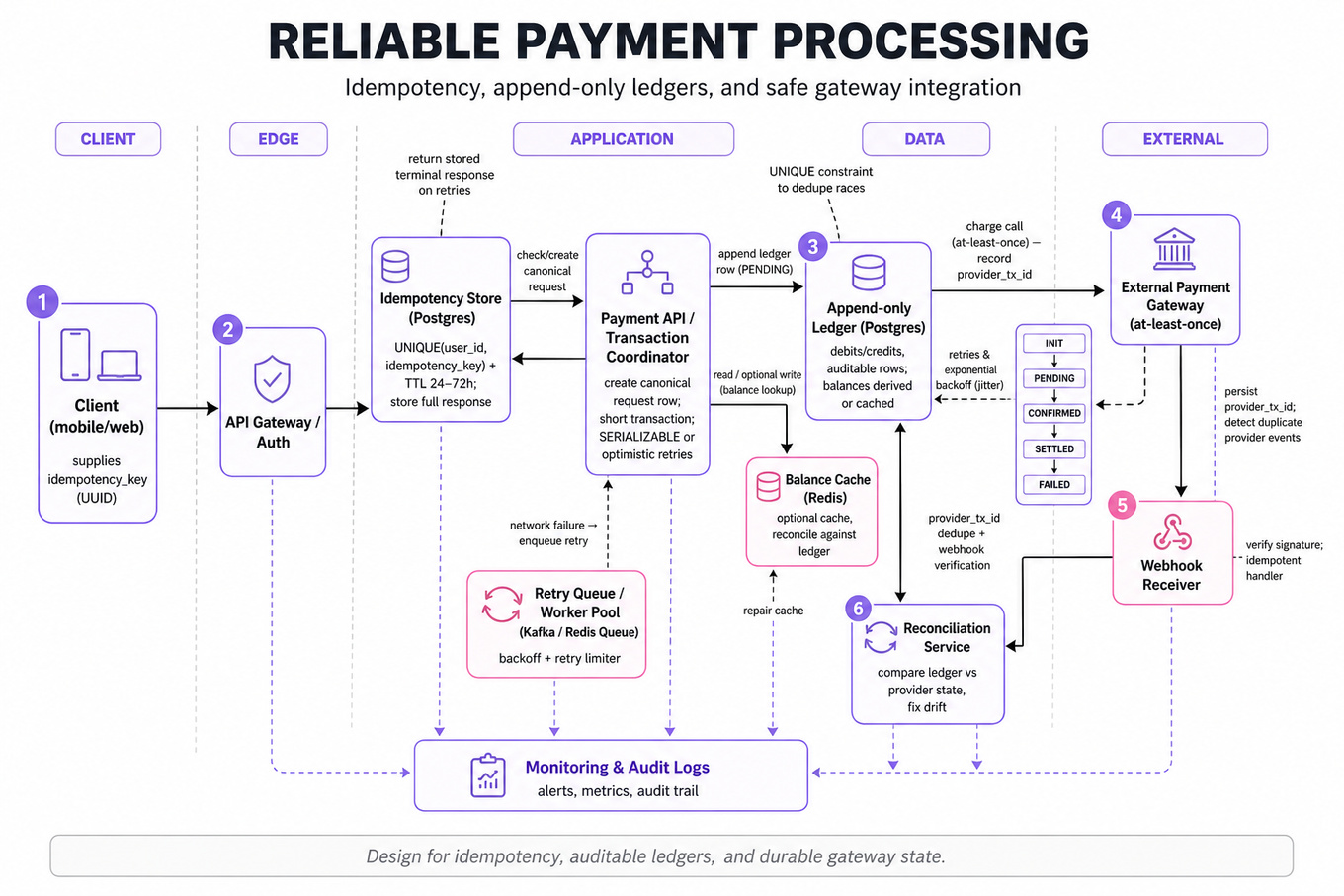
Interviewers expect you to design a reliable, auditable money flow that avoids duplicate charges, recovers from partial failures, and keeps customer-visible state correct. They'll probe your knowledge of idempotency, transactional data models (ledgers vs mutable balances), coordination with external payment processors, and practical tradeoffs between latency, consistency, and operational complexity. At OpenAI they care because money flows must be correct under retries, outages, and scale, and engineers own the code that enforces those invariants.
Core knowledge
-
Money representation: store amounts in the smallest currency unit (e.g., cents) as integer types, never binary float; for multi-currency, record currency code and rounding rules separately.
-
Append-only ledger: prefer an append-only ledger (debits/credits) per account to make state auditable and replayable; balances are derived by summing ledger rows, or maintained as a cache with careful reconciliation.
-
Idempotency vs exactly-once: exactly-once across distributed systems is infeasible without strong coordination; instead guarantee idempotent processing using keys and deduplication to achieve “effectively once” for user-visible effects.
-
Idempotency key pattern: require clients to supply an idempotency key (UUID or hash) and persist (key → outcome) with a unique constraint (e.g.,
UNIQUE (user_id, idempotency_key)) and TTL (24–72 hours) to bound storage. -
Durable response storage: store the full response/decision for an idempotency key and return it on retries; never recompute payment if key exists and outcome is terminal.
-
Database constraints & isolation: use a unique constraint + a short transaction to create a canonical request row; prefer
SERIALIZABLEor optimistic concurrency with retries for race conditions—SELECT … FOR UPDATEis useful for account-locking but can limit concurrency. -
External gateway communication: treat gateway calls as at-least-once; keep an internal state machine (e.g., INIT → PENDING → CONFIRMED → SETTLED → FAILED) and persist the external provider’s transaction id to detect duplicates.
-
Async callbacks & webhooks: verify webhook authenticity, dedupe webhooks using provider transaction id, and reconcile webhook state against your ledger; design idempotent webhook handlers.
-
Retries & backoff: use exponential backoff with jitter; limit total retry window so idempotency key TTL covers retries; retry formula example: retry_delay = base * 2^n + random_jitter.
-
Sagas & compensation: for multi-step flows (authorization, capture, fulfillment), use saga patterns to record steps and run compensating transactions (refunds) rather than distributed two‑phase commit.
-
Scale and data growth: append-only ledgers grow linearly; plan partitioning or sharding when rows exceed ~100M for a single node; maintain daily aggregates and archival strategies.
-
Monitoring and reconciliation: surface mismatches between ledger and external processor with daily reconciliation jobs; instrument
p99latency, failed charge rate, duplicate-charge counters, and reconciliation drift.
Tip: design APIs so retry semantics are explicit (idempotency header, signed requests) and document TTL/behavior for clients.
Worked example — Design a Reliable Payment Processing System
First 30s framing: ask throughput (TPS), expected duplicate/retry behavior, supported flows (auth-only vs immediate capture), external gateways, and SLA for user-visible latency. Declare assumptions: external gateway is at-least-once, 500 req/s peak, and idempotency keys are provided by clients. Skeleton answer pillars: (1) data model (append-only ledger, payments, idempotency table), (2) API semantics (idempotency-key required, synchronous vs async responses), (3) state machine and persistence of external transaction ids, (4) failure/retry handling (dedupe, webhook reconciliation), (5) monitoring and reconciliation plan. One design choice to flag: whether to perform authorization and capture in one transaction (simpler) or split them (needed for places where fulfillment is delayed); splitting requires stronger saga/compensation logic and careful idempotency across steps. Close by promising next steps: sketch partitioning/DB choice (e.g., Postgres primary for correctness, Kafka for eventing), and say you'd prototype the idempotency uniqueness flow and webhook dedupe to validate edge cases.
A second angle — Design a Digital Game Distribution Platform
Here payments are one part of a broader system with entitlements, offline licenses, and large promotion spikes. The same idempotency and ledger ideas apply, but constraints shift: entitlements must be granted atomically with payment confirmation (or compensated on failure), and offline license delivery means you may need signed receipts recorded in the ledger. Add a separate entitlement service that consumes payment-confirmed events from an event stream (e.g., Kafka) and is idempotent on the payment transaction id. For promotion spikes, decouple synchronous checkout from heavy work (download tokens, entitlement indexing) with async workers to keep checkout latency low. Emphasize designing the payment-to-entitlement handoff as an event with idempotent consumers and explicit replay support.
Common pitfalls
Pitfall: relying on floating-point money types.
Usingdoubleorfloatcauses rounding errors and subtle bugs; always use integer smallest-unit or fixed-decimal types.
Pitfall: assuming the external gateway enforces uniqueness.
Gateways may accept duplicate requests; if you don't persist an external transaction id and dedupe, retries can create duplicate charges.
Pitfall: trying to use distributed two-phase commit across services.
Two‑phase commit increases latency and operational complexity; prefer local transactions + sagas/compensation and design for eventual consistency while keeping user-visible invariants intact.
Connections
Payment processing often leads to pivots on event-driven architecture (idempotent consumers, replay), observability (reconciliation dashboards, SLOs), and data partitioning/sharding for scale. Interviewers may ask about optimizing read patterns (caching derived balances) or about message durability (Kafka vs queue).
Further reading
-
Designing Data-Intensive Applications — Martin Kleppmann — strong grounding in logs, replication, consistency patterns used in payment systems.
-
Stripe: Idempotency keys — a production-grade pattern description for idempotent APIs and TTL semantics.
Practice questions
In-Memory Databases And Query Engines
Focus areaFocus area — Matches your selected KV stores, API design, data modeling, transactions, snapshots, indexing, caching, and database fundamentals.
What's being tested
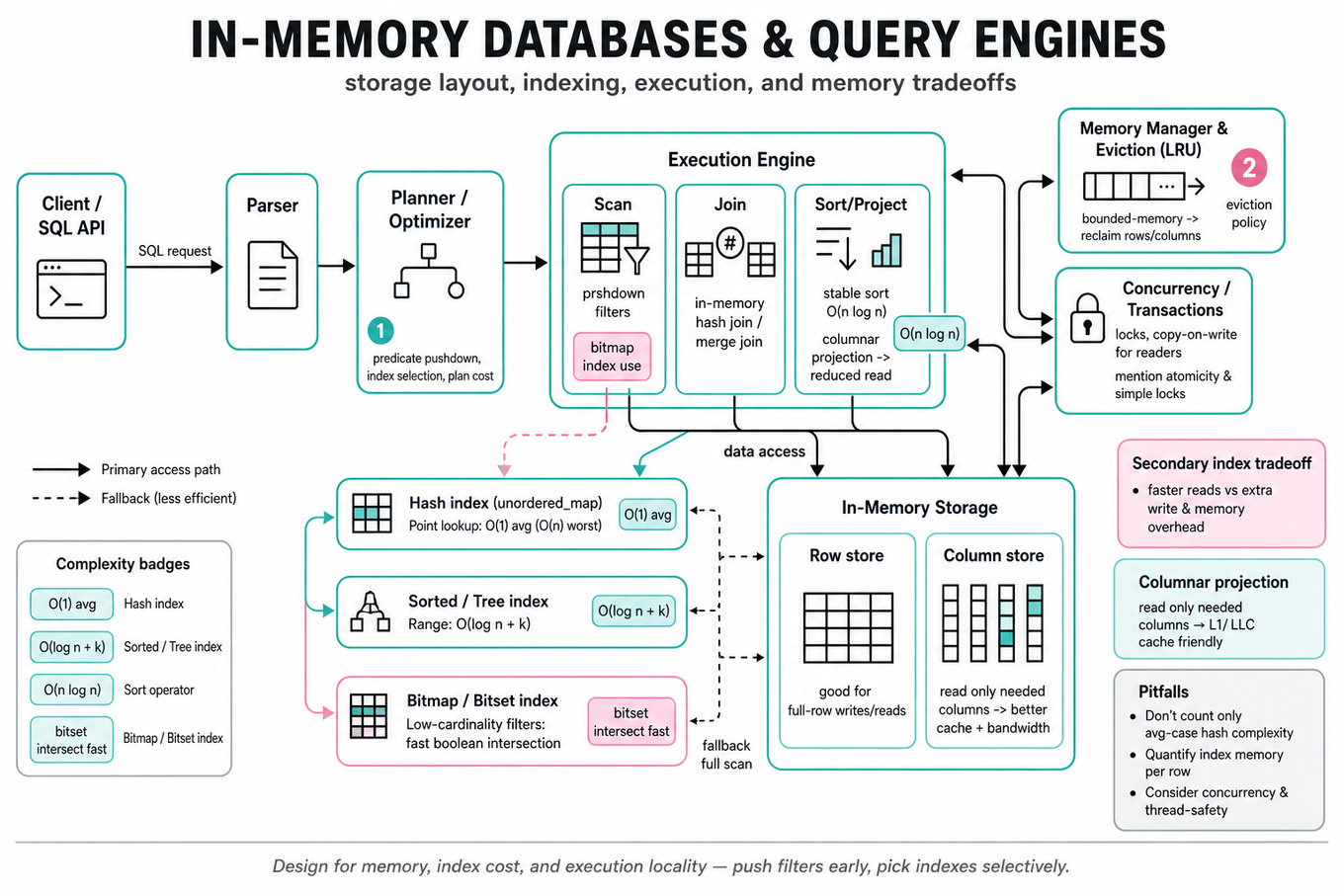
These prompts test translating SQL-like operations into efficient in-memory algorithms: data modeling, indexing, query execution (projection/filter/sort), and complexity reasoning. Interviewers probe choices of data structure (storage layout, indexes), algorithmic cost, and simple API/edge-case handling under memory constraints.
Patterns & templates
-
std::unordered_map/ hash table for point lookups —O(1)average,O(n)worst; good for exact-keyget/putworkloads. -
Sorted array or
std::map(tree) for range queries —O(log n + k)to locate start, then sequential scan forkresults. -
Columnar projection: read only needed columns to reduce memory bandwidth and cache misses; ideal when few columns are selected.
-
Predicate pushdown: apply filters early to shrink working set before expensive operations like sort or join.
-
Bitmap / bitset indexes for low-cardinality filters — fast boolean intersection, memory-efficient for millions of rows.
-
Secondary index tradeoff: faster reads vs extra write + memory; build only on frequently filtered columns.
-
Eviction/LRU for bounded-memory tests — maintain a recency queue and reclaim full rows or columns as configured.
-
Stable sort / tie-breaker: use
std::stable_sortwhen deterministic ordering (multi-key) matters; sorting costsO(n log n).
Common pitfalls
Pitfall: Counting only average-case hash complexity — interviewers will ask about worst-case and adversarial input; mention fallback (tree/hash with rehashing).
Pitfall: Ignoring memory for indexes — adding multiple secondary indexes can double/triple memory; quantify approximate per-row overhead.
Pitfall: Designing only for single-threaded access — at least mention concurrency/atomicity and simple locks or copy-on-write for reads.
The practice cards below cover the canonical variants — solve all of them and time yourself.
Practice questions
Slack-Like Real-Time Messaging
Focus areaFocus area — You explicitly selected real-time messaging, WebSockets, sharding, search indexing, offline sync, authorization, and observability.
What's being tested
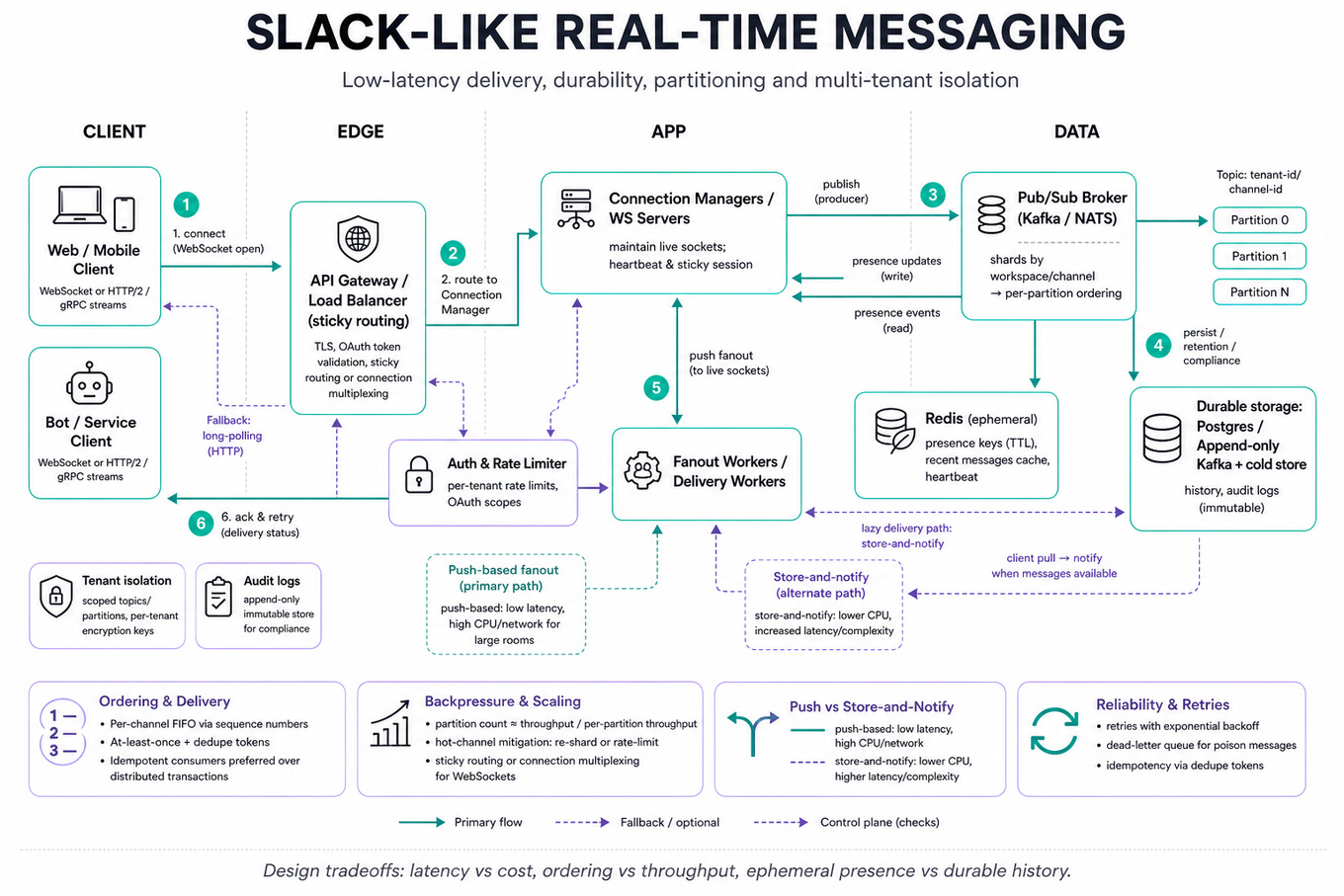
Interviewers probe the candidate’s ability to design a real-time messaging system that balances low-latency delivery, durability, and multi-tenant isolation at scale. Expect to demonstrate distributed-systems patterns (pub/sub, partitioning, backpressure), data modeling for channels/threads, and operational tradeoffs (ordering, retries, and consistency). They're checking for practical decisions—protocols, storage choices, and how you reason about scale, failure modes, and developer-facing APIs.
Core knowledge
-
Transport layer: choose between
`WebSocket`, HTTP long-polling or HTTP/2/gRPC streams;`WebSocket`gives bi-directional low-latency channels but requires sticky routing or connection multiplexing for scale. -
Pub/Sub vs direct: a publish/subscribe broker (e.g.,
`Kafka`,`NATS`) decouples producers/consumers; brokers trade off ordering and latency depending on partitioning and replication. -
Partitioning & sharding: shard by workspace or by channel id to keep ordering and reduce fanout; partitions count ≈ required throughput / per-partition throughput, adjust for hot channels.
-
Fanout strategies: push-based fanout (server pushes to every connected client) is lowest-latency but expensive for large rooms; pull-based or lazy delivery (store-and-notify) reduces CPU at cost of latency and complexity.
-
Ordering semantics: pick application-level guarantees: per-channel FIFO via sequence numbers, or causal ordering with vector clocks; global ordering is expensive and rarely necessary.
-
Durability model: combine a fast ephemeral store (
`Redis`) for presence and recent messages with durable storage (`Postgres`or append-only`Kafka`+ cold store) for history and compliance. -
Delivery guarantees: implement at-least-once with deduplication tokens or exactly-once semantics via idempotent writes where required; prefer idempotent consumers rather than distributed transactions.
-
Presence & typing: maintain presence as ephemeral keys in
`Redis`with TTLs and heartbeat; propagate presence events over the same pub/sub channel to avoid extra endpoints. -
Security & multi-tenancy: tenant isolation via scoped topics/partitions, per-tenant encryption keys,
`OAuth`access tokens, and tenant-aware rate limiting; audit logs stored in immutable append-only stores for compliance. -
Backpressure & flow control: implement per-connection buffers, token-bucket rate limiting, and server-side drop/slow-path (e.g., send only summaries) when clients can't keep up.
-
Observability & SLOs: monitor
`p99`and`p50`end-to-end latency, message loss rate, and consumer lag (`Kafka`offsets) and expose tenant-level SLIs and throttles. -
Scaling calculations: estimate RPS × avg message size × average connected clients to dimension network and broker throughput; use .
Worked example — "Design a Slack-Like Messaging System"
First 30 seconds: clarify requirements — expected number of concurrent users, max channel size, mobile vs web clients, retention/compliance, ordering and durability guarantees, and whether presence/typing is required. Assumptions: support millions of users, per-channel FIFO ordering, message history persisted for 30 days, primary client is `WebSocket`-enabled web/mobile.
Skeleton answer pillars: (1) API & client protocol — auth (token), `WebSocket` for realtime events, REST for history; (2) Realtime layer — stateless frontends with sticky connection routing to a pool of sharding gateways that forward publishes to a message broker; (3) Broker & storage — partitioned append-log (`Kafka`) for durability plus `Redis` for recent messages and presence; (4) Fanout & delivery — brokers push to gateways which manage per-connection buffers and ack/dedup logic; (5) Operational — monitoring, rate-limits, and tenant isolation.
Key tradeoff: choose per-channel partitioning to keep FIFO ordering and minimize coordination, but accept that very large channels (e.g., #general) become hot partitions and need fanout workarounds (replicated fanout nodes or batching). Explain mitigation: backpressure + summarized notifications + archival for heavy channels.
Close: state next steps — prototype with `Kafka` + `Redis`, stress-test hot channels, design migration for sharding splits, and if more time, add end-to-end encryption and per-tenant retention policies.
A second angle — "Design a multi-tenant Slack-like messenger"
Here the framing emphasizes tenant isolation and per-tenant policies. Start by clarifying tenant scale distribution (many small tenants vs few large ones), legal/regulatory requirements, and allowed cross-tenant features (shared apps). The core architecture is similar, but you must add tenant-aware routing (topics prefixed by tenant-id), per-tenant quotas (rate limits, storage caps), and logical isolation in observability/alerts. For noisy neighbors, use per-tenant queues or rate-limited gateways and consider soft vs hard multi-tenant isolation: soft (shared infra with quotas) is cheaper; hard (separate clusters or VPCs) required for high compliance tenants.
Common pitfalls
Pitfall: conflating transport with persistence. Candidates often assume
`WebSocket`implies persistence — you still need durable storage and a replay mechanism; design the retention and replay API explicitly.
Pitfall: promising global ordering. Saying "messages are globally ordered" is tempting but impractical; prefer per-channel ordering and explain why global ordering requires expensive consensus and hurts latency.
Pitfall: ignoring hot channels and backpressure. A common mistake is to assume equal load distribution; instead show how you'll detect hot rooms, shard/split them, and provide degraded UX (summaries) under overload.
Connections
This topic commonly leads to adjacent systems: notification/push services (APNs/FCM) for mobile delivery and search/indexing (message search with `Elasticsearch` or `Opensearch`). Interviewers may also pivot to consistency models, distributed consensus (raft), or designing an audit/logging pipeline for compliance.
Further reading
-
Designing Data-Intensive Applications — Martin Kleppmann — principled tradeoffs for logs, replication, and partitioning.
-
Slack Engineering Blog — How Slack Scales (various posts) — practical notes on real-time design and scaling challenges.
Practice questions
Cloud IDE And DevBox Sandboxing
Focus areaFocus area — Important OpenAI-adjacent infrastructure; reinforces your selected security, secrets, resource limits, pooling, resilience, and API-design gaps.
What's being tested
Candidates must design a multi-tenant, secure, and scalable cloud development environment that balances isolation guarantees, fast developer experience, durable state, and operational cost. Interviewers probe distributed-systems design (scheduling, autoscaling, persistence), runtime sandboxing choices (container vs. microVM vs. VM), networking/security controls (egress/no-egress, RBAC), and observable lifecycle and failure modes. Expect to defend tradeoffs (density vs. safety, cold-start latency vs. resource utilization) with concrete implementation choices.
Core knowledge
-
Isolation model: understand namespaces (PID, MNT, NET), cgroups, and the difference between process-level containers and hardware-virtualized microVMs for attack-surface reduction and kernel-escape risk.
-
Sandbox runtimes: trade
containerd/Docker +gVisor(user-space kernel) vsFirecracker(microVM) vs full VMs (qemu) — density, startup time, surface area, and required kernel features differ. -
Orchestration & scheduling: know
Kubernetespod scheduling, custom schedulers, bin-packing heuristics (first-fit-decreasing), and node affinity/taints for isolating sensitive workloads. -
Ephemeral vs persistent storage: use ephemeral local SSDs for fast compile/cache; durable state via network object storage (
S3-compatible) or block PVs (CSI) with snapshot/versioning for workspace persistence and fast restore. -
Snapshotting & image layering: store base images + user overlay using union filesystems (OverlayFS) or layered container images; snapshot restore time ≈ download bandwidth + mount cost — optimize via shared base layers and lazy fetching.
-
Networking & security controls: apply network policy (CNI plugins like
Calico), per-workspace egress whitelists, per-tenant VPCs, and programmable proxies for logging/mitigation of outbound traffic. -
Authentication & RBAC: map short-lived credentials (OAuth, OIDC) to workspace tokens, implement fine-grained RBAC and ephemeral SSH/port tunneling; rotate keys frequently and enforce least privilege.
-
Hot-reconnect & session continuity: stream editor state over
WebSocket/gRPCand persist terminal output to replay logs; implement checkpointing to allow reconnect within seconds. -
Autoscaling and cost model: autoscale by queue depth and per-workspace metrics (CPU, memory, I/O); compute cost per workspace ≈ (vCPU-hours * vCPU-price) + (GB-month * storage-price); set thresholds to prefer suspend/snapshot for idle > T_idle.
-
Cold-start vs warm-pool tradeoff: keep warm pool size W to target
p90start latency L_target: P(start latency ≤ L_target) ≈ 1 - e^{-λW} for Poisson arrivals, tune W against cost of idle resources. -
Observability & SLOs: collect
p95start time, reconnection latency, storage restore time, resource-usage per-tenant, and security audit logs; usePrometheus+Grafana; ship structured logs to long-term store. -
Operational limits & multi-tenancy: partition tenants by quota (CPU, memory, storage) and by node-pools for noisy-neighbor isolation; enforce secure defaults and resource request/limit enforcement in the runtime.
Worked example — Design a sandboxed cloud IDE
First 30 seconds: ask about expected concurrency (typical and peak), required persistence semantics (durable home dir vs ephemeral), security level (untrusted code?), and allowed network egress. Skeleton answer pillars: (1) runtime isolation (choose microVMs Firecracker for untrusted code, containers + gVisor for trusted tenants for higher density), (2) lifecycle & orchestration (use Kubernetes with a custom controller that provisions workspace images and manages warm pools), (3) storage & snapshotting (shared base images + per-user overlay on S3 with block PV for hot caches), (4) networking & RBAC (per-workspace network policies, ephemeral credentials), (5) observability & autoscaling (track start latency, idle metrics, warm-pool sizing). Explicit tradeoff: choosing microVMs gives stronger isolation but ~2–10x higher resource cost and slower cold starts; containers improve density but require stronger kernel-hardening and runtime sandboxing. Close with: if more time, detail eviction strategy for long-idle workspaces, CI integration, and experiments to tune warm-pool size by arrival-rate telemetry.
A second angle — Design a Cloud DevBox Platform
For longer-lived DevBoxes, emphasize durable user customization and higher-weight persistence guarantees: provide custom images, pre-installed packages, and per-user secrets management. Shift architecture toward image builder pipelines, immutable image registries, and incremental snapshot storage to allow fast restore of entire environment. Operationally, add quota-based billing, retention policies, and RBAC for shared team-devboxes. The scheduling focus becomes placement for disk-heavy boxes (local SSD binding) and ensuring backups/snapshots have RPO/RTO SLAs; security pivots to secret injection and auditability rather than purely runtime escape prevention.
Common pitfalls
Pitfall: Underestimating kernel attack surface — choosing plain containers without user-space sandboxing or seccomp filters can leave the system vulnerable to container-to-host escapes; prefer
gVisor/microVMs for untrusted code paths.
Not asking about persistence semantics is a communication mistake: many candidates design ephemeral-only systems; interviewers often expect clarifying whether "workspace state" includes dotfiles, installed packages, databases, or only source files, since each choice changes storage and snapshot design.
Pitfall: Over-optimizing for density without amortizing cold-start cost — packing maximum containers per node increases cold-start latency and noisy neighbors; show measurement-driven warm-pool sizing and prefetch strategies instead.
Failing to describe observability and SLOs is a depth mistake: don't claim "it will be fast" — define metrics (p95 start time, reconnection time), alert thresholds, and how they map to autoscaler triggers and incident responses.
Connections
Interviewers can easily pivot to adjacent systems: remote CI/CD runners and build caches (same scheduling and sandboxing tradeoffs), or secure multi-tenant compute for model serving (similar egress controls and auditing). Be ready to discuss how workspace snapshots integrate with backup/restore and image-building pipelines.
Further reading
-
Firecracker: Lightweight Virtualization for Serverless Workloads — explains microVM tradeoffs and startup characteristics.
-
gVisor Overview (Google) — details user-space kernel sandboxing for container workloads.
-
Gitpod Architecture Blog — practical reference architecture for cloud IDEs (image layering, persistence, and orchestration).
Practice questions
Focus area — You selected observability, logging, metrics, offline sync, conflict resolution, time-series aggregation, and distributed resilience.
What's being tested
Candidates must show they can design a resilient, event-time-aware telemetry system for intermittently connected devices: define clear APIs, choose stateful streaming semantics, reconcile late or duplicate events, and ensure safe command dispatch with idempotency and auditing. Interviewers probe distributed-state choices, event-time vs processing-time reasoning, tradeoffs between latency and correctness, and concrete failure modes (clock drift, network partitions, device reboots).
Core knowledge
-
Event time vs processing time: event time is the timestamp generated by the device; processing time is when the server sees it. Correct historical metrics require event-time semantics and handling of out-of-order arrivals.
-
Watermarks & allowed lateness: a watermark = max_seen_event_time − lateness_bound (L). Use watermarks to emit windows; keep state for an extra L to accept late arrivals and trigger retractions if needed.
-
Windowing and retention math: if average ingress = R events/sec and allowed lateness = L seconds, expected late-state memory ≈ R * L * average_event_size. Quantify to choose memory vs eviction policies.
-
Idempotency & deduplication: require clients to include monotonic event IDs or
(device_id, sequence, device_time); store recent IDs in compacted store (e.g.`RocksDB`or`Postgres`) to dedupe, with TTL based on allowed lateness. -
Append-only event store + compacted view: persist raw events immutably (for reprocessing/backfill). Maintain a compacted, materialized view for fast reads; rebuild via replay when late events arrive or schema changes.
-
Exactly-once vs at-least-once: prefer at-least-once ingestion with application-level idempotency; exactly-once across distributed components is expensive (2PC, transactions) and often unnecessary for telemetry.
-
Command dispatch semantics: commands need idempotency keys, sequence numbers, and ack semantics (
ACK,NACK,UNKNOWN). Use optimistic command TTL and device-side de-dup logic; track per-device last-applied command version. -
Safety & auditability: for safety-critical control, include immutable audit logs of commands and telemetry, digital signatures or HMACs on device messages, and operator-facing explainability for retracted metrics.
-
Reconciliation & backfills: build scheduled reconciliation jobs to scan raw events, re-evaluate aggregates, and write deltas or retractions into the materialized view; optimize with incremental computation.
-
Stateful stream processing options:
`Flink`/`Beam`/`Spark Structured Streaming`offer built-in event-time windows and state with checkpoints; local embedded state (e.g.,`RocksDB`) plus checkpointing simplifies recovery. -
Clock drift and trust model: never blindly trust device clocks; allow device-side monotonic counters or server-assigned ingestion timestamps plus device clocks for ordering. Define behavior when device time differs by >X minutes.
-
Operational SLOs & metrics: monitor
`p99`ingestion latency, fraction of late events, dedupe rate, reconciliation lag, and command success/failure rates; these guide tuning of lateness bounds and retention.
Tip: require devices to include both a device-generated timestamp and a sequence number; server uses sequence for ordering and device timestamp for event-time semantics and audits.
Worked example — Design an IoT Logging Platform with Late-Arriving Metrics
Start by clarifying SLAs: acceptable reporting latency, maximum tolerable correction window (allowed lateness L), and scale (devices, events/sec). Organize the design around three pillars: (1) ingestion and durable raw storage (append-only topic + object store or `Postgres`/S3), (2) event-time stream processing that uses watermarks and maintains materialized aggregates with a lateness-bound L, and (3) reconciliation/backfill that replays raw events to correct aggregates and emits retractions or deltas. Define concrete APIs: client PUT includes (device_id, seq, device_ts, payload, signature) and server returns (ingest_id, server_ts). Flag the main tradeoff: larger L increases correctness but requires more state and delays final metrics; choose L from device connectivity patterns (e.g., 1 hour vs 24 hours). Also describe client behavior on network loss (buffer to disk with exponential backoff) and server dedupe using (device_id, seq) plus TTL. Close by noting next steps: implement end-to-end tests with simulated late arrivals, and if time permits add adaptive watermarks (advance faster for stable devices).
A second angle — Design Command Dispatch and Telemetry Reconciliation for Unreliable Devices
Here the same event-time and reconciliation concepts apply, but the system must treat commands as first-class, safety-critical state. Ask whether commands must be guaranteed delivered, executed exactly once, or only best-effort. Build a command ledger (append-only) with per-command idempotency keys and per-device sequence numbers; dispatch through a broker that persists until device ack. Use event-time telemetry to reconcile whether commands had the intended effect—telemetry events should reference the command id. For retries, cap attempts and escalate to human operators if no ack within a time budget. Explicitly surface the tradeoff: strict guarantees (exactly-once execution) require device-side transactional semantics and fencing tokens; most systems accept at-least-once execution plus idempotent handlers and compensating actions.
Common pitfalls
Pitfall: Treating processing-time as equivalent to event-time. Relying on ingestion timestamps produces incorrect historical metrics and incorrect command/telemetry order when devices are offline or clocks drift.
Pitfall: Not specifying client-side guarantees early. Failing to ask whether devices can persist state, include sequence numbers, or sign messages leads to brittle server designs that can't dedupe or verify authenticity.
Pitfall: Over-engineering exactly-once across the entire stack. Proposing distributed two-phase commits or synchronous cross-service transactions wastes time; prefer immutable logs + idempotency and selective transactional boundaries.
Connections
Interviewers may pivot to stream-processing internals (checkpointing, state backends), distributed consensus for leader election/fencing (e.g., `ZooKeeper`/`etcd`), or data-engineering concerns like efficient compaction and schema evolution for the raw event store.
Further reading
-
[“Designing Data-Intensive Applications” — Martin Kleppmann] — chapters on logs, stream processing, and reprocessing explain append-only stores and event-time concepts.
-
Apache Flink: Event Time & Watermarks (blog/documentation) — practical details on watermarks, lateness, and state management.
Practice questions