Anthropic Software Engineer Interview Prep Guide
Everything Anthropic actually asks Software Engineer candidates — concept walkthroughs, worked examples, and the real interview questions, drawn from candidate reports. Free to read.
Last updated
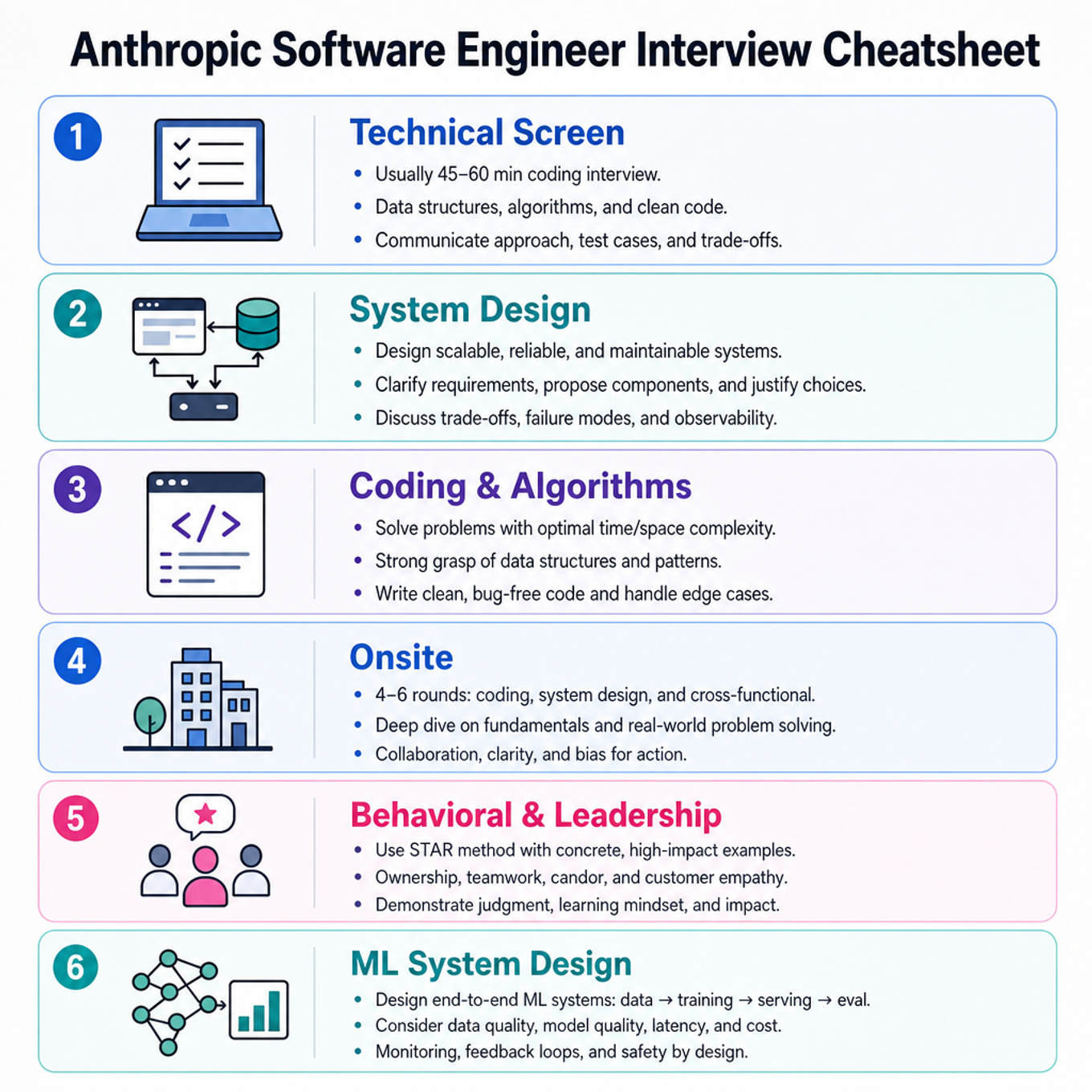
Focus most on Anthropic-style system design: real-time messaging/WebSockets, transactional integrity/key-value stores, distributed job scheduling/work queues, plus ML serving. Your selected intervals, DSU, grid traversal, fuzzy matching, and concurrency concepts are marked solid, so review them as refreshers rather than rebuilding from first principles. I’m highlighting GPU inference, model-weight distribution, prompt systems, AI-safety leadership judgment, LLM evaluation/red-teaming, safety policy enforcement, and large-context retrieval. With one month, budget roughly two-thirds of study time for system/ML design and the rest for coding refreshers plus concise behavioral practice.
Technical Screen — 27 min
System Design
-
Concurrent Web Crawlers and Work Queues (Focus) — covered in depth under Onsite below.
-
Chat System Design and Message Delivery (Focus) — covered in depth under Onsite below.
Coding & Algorithms
- Stateful In-Memory Ledgers and Versioned Stores (Focus) — covered in depth under Onsite below.
Onsite — 75 min
Behavioral & Leadership
Focus area — Anthropic screens heavily for safety judgment; with a 3/5 behavioral rating and one viewed behavioral item, this deserves extra practice.

What's being tested
Interviewers are probing judgment under ambiguity: how you prioritize safety trade-offs, own mistakes, and influence technical and cultural changes as a Software Engineer. Expect to demonstrate practical systems-level approaches to reduce risk, measurable outcomes you drove, clarity in trade-offs, and how you mentored or influenced others without overstepping. Anthropic cares because engineers build the runtime, observability, and guardrails that make AI systems safe in practice.
Core knowledge
-
Risk quantification: express risk as expected harm: ; use rough orders-of-magnitude to prioritize mitigations when precise numbers are unavailable.
-
Layered defenses: implement defense-in-depth: compile-time checks, runtime assertions, input validation, rate limiting, and a
circuit breakerto contain unexpected behavior without single-point failures. -
Observability primitives: instrument via
OpenTelemetry/Prometheusfor metrics (error_rate,latency_p99), structured logs, and distributed traces; define alert SLOs and clear ownership for each alert. -
Safe deployment patterns: use
canaryrollouts,feature flags, progressive exposure, and automated rollback criteria (e.g., 3x baselineerror_rateorlatency_p99increase) to limit blast radius. -
Testing strategy: combine unit tests, integration tests, property-based tests, and deterministic replay tests for critical paths; include fuzzing for unexpected inputs and adversarial examples at the interface layer.
-
Post-incident process: run blameless postmortems with timeline, root causes, and action items; convert fixes into tests/monitoring and track completion in code reviews and PRs.
-
Tradeoffs: latency vs safety: quantify added safety checks' cost (ms, CPU, dollars) and justify when to inline vs offload (e.g., async validation for non-blocking requests).
-
Least privilege and access controls: enforce principle of least privilege across services and keys, rotate credentials, and log access attempts to make human/agent misuse auditable.
-
Communication & influence: surface technical risk with concrete metrics and remediation plans; propose incremental changes (PR + testable rollout) — engineers influence by shipping defensible, reviewable artifacts.
-
Ownership boundary: as a SWE, implement the systems, tests, and observability; defer product-level risk-benefit thresholds to PM/lead but provide clear technical recommendations backed by data.
-
Measurable outcomes: specify targets (reduce
error_rateby X%, cut mean time to detectMTTDto <Y minutes) and map each mitigation to measurable indicators. -
Escalation & decision rules: define explicit abort criteria and who can trigger emergency rollback; document them in runbooks and CI/CD playbooks.
Worked example — "Describe a Strongly Held View That Proved Wrong"
Frame the first 30 seconds: succinctly state the original position, context (project, scope, constraints), and why the view was reasonable (constraints, data, precedent). Clarifying questions: what stakeholders were impacted, what metrics measured success, and timeline for correction. Organize the answer into three pillars: (1) Evidence that overturned your view (logs, user metrics, incident timeline), (2) Actions you took to remediate and own the outcome (rollback, follow-up fixes, tests), (3) Lessons institutionalized (runbooks, new tests, team norms). Call out one technical tradeoff explicitly — e.g., you chose a fast inline validation for speed, but it increased latency and failed under load; you then moved to async validation with compensating checks. Close with accountability: describe how you communicated to stakeholders, tracked action items, and say "if I had more time, I'd add automated canary metrics and a replay test to prevent regression."
A second angle — "Discuss culture and mission alignment"
When asked about culture and mission alignment, translate mission language into tangible engineering practices: ship with clear safety SLOs, require safety-focused code review checklists, and ensure PR templates capture risk assessment and rollback plans. Emphasize mentorship: pair juniors on safety-critical diffs, run regular cross-team tabletop exercises, and maintain a rotating incident commander to distribute institutional knowledge. Show how you balance shipping velocity with mission by proposing measurable guardrails (e.g., every new surface must have a canary and a monitoring dashboard) and describe how you escalate unresolved trade-offs to leads with data-backed options.
Common pitfalls
Pitfall: claiming full ownership for cross-functional decisions.
Mistake: saying you “decided” a product-level safety threshold without involving PMs or legal. Better: describe how you recommended technical thresholds, provided data, and clarified whose decision it was.
Pitfall: vague mitigation actions without measurable follow-through.
Mistake: answering with "I fixed it" but not stating what tests, metrics, or dashboards prevented recurrence. Better: tie each remediation to a specific metric, test, or runbook.
Pitfall: over-technical or under-technical answers.
Mistake: dumping low-level details irrelevant to leadership judgment, or giving only high-level platitudes. Better: present a concise technical change plus its organizational impact and how you influenced adoption.
Connections
Interviewers may pivot to incident response and on-call practices, asking for a concrete runbook or escalation flow. They might also ask system-design safety tradeoffs (e.g., sandboxing vs. throughput) or for examples of mentoring and code-review process improvements that institutionalize safe behavior.
Further reading
-
Concrete Problems in AI Safety (Amodei et al., 2016) — catalogs pragmatic failure modes and mitigation strategies relevant to engineering controls.
-
Site Reliability Engineering (Google) — actionable practices for monitoring, SLOs, blameless postmortems, and incident management.
Practice questions
System Design
Concurrent Web Crawlers and Work Queues
Focus areaFocus area — Matches your distributed job scheduling focus; system design is 3/5 with no solved signal, so emphasize worker queues and backpressure.

What's being tested
Candidates are evaluated on designing a concurrent web crawler that is correct, efficient, and robust: concurrency control for fetching, URL normalization and deduplication, polite per-host rate-limiting, frontier organization, and failure / retry behavior. Interviewers want to see the candidate ask the right scope questions (scale, single vs multi-domain, freshness), decompose into clear subsystems, and trade off practical choices (async vs threads, Bloom filters vs exact sets, centralized vs sharded frontier).
Core knowledge
-
URL normalization / canonicalization: normalize scheme/host (lowercase), remove default ports, resolve relative paths, drop fragments, and canonicalize query params (sort or whitelist) to avoid combinatorial explosion from session IDs and tracking parameters.
-
Same-domain / same-origin differences: same-domain may include subdomains; same-origin requires identical scheme+host+port. Clarify which constraint governs link acceptance and cookie/robot behavior.
-
Frontier design: the URL frontier is a prioritized work queue; implement per-host queues with a global scheduler to enforce politeness and fairness (round-robin or weighted). For N up to ~10M, a single-machine in-memory frontier is OK; beyond that, shard by host to multiple machines.
-
Duplicate detection: Bloom filter for large-scale membership with tunable false-positive p. Use bits and hashes; e.g., , bits (∼360MB).
-
Concurrency models: choose between thread pool, async/await (
aiohttp), or event-loop + worker processes. Async scales better for high I/O; thread pools are simpler when CPU-bound parsing dominates. -
Per-host politeness / rate-limiting: implement token-bucket or leaky-bucket per host and a global
max_outstanding_per_hostsemaphore to avoid DOSing sites and respectrobots.txtCrawl-delay. -
Retry / failure semantics: use lease/visibility timeouts (like
SQS), exponential backoff for 5xx, idempotent storage for successful fetches, and a retry limit with a dead-letter queue for permanent errors. -
Cycle safety & depth control: maintain a visited set (or Bloom filter) and enforce max depth and per-domain URL caps to avoid infinite calendar or calendar-like traps.
-
Politeness sources: parse
robots.txt, honor crawl-delay, and respectSitemaphints; cache DNS results and respectHTTPRetry-After. -
Storage & dedupe at content level: use content hashing (e.g., SHA-256) or canonical HTML signatures to detect duplicate pages with different URLs; store
(url, content-hash, last-fetched)for freshness checks. -
Metrics & SLAs: track
pages/sec,p99 fetch latency, queue depth, successes/failures, and per-host rate metrics; surface slow hosts and crawled-domain coverage. -
Scaling & sharding: shard by host hash to keep politeness local; coordinate frontier assignment via consistent hashing or a small master to avoid multi-master races.
Worked example — Design a Concurrent Domain Crawler
First 30s framing: clarify whether “domain” means exact hostname or includes subdomains, expected scale (pages/day), freshness requirements, and allowed content types (HTML only?). State assumptions: single logical domain, target 10M URLs, need politeness and breadth-first behavior. Organize the answer around four pillars: (1) frontier with per-host queue and global scheduler, (2) fetchers as async workers with per-host semaphores and token buckets, (3) deduplication using a Bloom filter for visited URLs plus content-hash dedupe, and (4) storage & retry with visibility leases and DLQ. Flag tradeoff: using Bloom filter saves memory but yields false positives (lost crawls); choose p based on acceptable misses and keep a small exact secondary store for recent URLs. Close by noting follow-ups: shard the frontier for higher scale, add politeness heuristics per subdomain, and instrument p95/p99 latency and coverage metrics for tuning.
A second angle — Crawl Same-Domain Links
This problem narrows to graph traversal inside one domain, emphasizing URL normalization, cycle-safe traversal, and depth constraints. The same core systems apply, but scale is smaller so you can use an exact Postgres visited table rather than probabilistic structures. Decide traversal strategy: BFS gives even coverage for site-mapping and search-indexing, while DFS uses less memory but risks deep traps. Here emphasize canonicalization (drop tracking params) and per-path heuristics to avoid calendaring traps (detect repeating numeric patterns). Rate-limiting and politeness are simpler (single host), so more budget can go to parsing and link extraction accuracy.
Common pitfalls
Pitfall: Underestimating duplicate-address space — assuming exact-string dedupe is sufficient will explode when query parameters or session IDs vary widely; always canonicalize and whitelist query parameters.
Pitfall: Not asking scope questions — failing to clarify single-domain vs multi-domain, scale, or freshness misses critical design constraints and leads to wrong architecture choices.
Pitfall: Overengineering concurrency — prematurely designing a distributed sharded system for a small crawl wastes time; start with async workers and per-host semaphores, then shard when throughput or memory demands justify it.
Connections
Interviewers often pivot to adjacent topics: designing a distributed task-queue with leasing semantics (visibility timeout, idempotent retries), or discussing content extraction/parsing performance and storage schema for crawled content. They may also shift into rate-limiting and backpressure strategies used broadly in distributed systems.
Further reading
-
The Anatomy of a Large-Scale Hypertextual Web Search Engine (Brin & Page) — classic crawler/indexer architecture and tradeoffs.
-
[Bloom Filters — Wikipedia / original references] — concise formulas and tradeoffs for probabilistic membership testing.
-
Heritrix (Internet Archive crawler) docs — practical production crawler design and politeness implementation.
Practice questions
Focus area — Prompt products map directly to Claude workflows; emphasize versioning, provenance, permissions, and streaming execution.

What's being tested
Candidates must demonstrate end-to-end system design skills for a multi-tenant prompt playground: modeling metadata vs. large blobs, durable and consistent run records, low-latency execution and streaming, caching strategies, and operational concerns (storage costs, backup, observability). Interviewers probe tradeoffs between durability, latency, and cost; clear consistency boundaries; and pragmatic component choices you’d actually implement as a Software Engineer.
Core knowledge
-
Metadata vs blob separation: store small indexed fields (owner, name, version, ACLs, tags, pointers) in
`Postgres`/`CockroachDB`; store large prompt bodies and attachments in object store like`S3`or`GCS`with content-addressed keys (SHA-256). -
Content-addressable storage (CAS): use SHA-256 for deduplication; keep immutable blobs and a small metadata table mapping logical versions to blob keys; reference counting or GC tombstones for lifecycle.
-
Versioning model: represent versions as immutable objects (commit id, parent pointer) and maintain a mutable head pointer for convenience; use optimistic concurrency (
`ETag`/`version`column) for updates. -
Run records / provenance: write immutable run records to a durable store (append-only
`Postgres`table or`Kafka`topic) containing prompt version, model adapter, runtime config, timestamps, and pointers to output blobs; ensure idempotent run submission with client-generated`run_id`. -
Streaming & durable execution: separate control plane (API) and execution plane (worker pool). Use gRPC or websockets for streaming tokens; persist intermediate outputs to ephemeral cache (
`Redis`) and flush final output to`S3`+ run record. -
Caching strategy: cache small, hot prompt templates and recent run outputs in
`Redis`; for very large prompts, cache parsed/chunked representations and pre-warmed model-provider payloads; size-aware eviction (LRU with max-blob-size cutoff). -
Latency vs cost tradeoffs: cold fetch from
`S3`adds tens to hundreds ms; prefetching and edge-caching reduce`p99`latency at higher storage/transfer cost. Quantify: if 1k requests/sec and average blob 1MB, bandwidth and egress costs dominate. -
Chunking & pagination: for very large prompts (>10s MB), chunk at storage time (e.g., 4–8MB) with index records so replay/streaming can fetch partial content; support range GETs to avoid reading entire blob.
-
Consistency boundaries: enforce strong consistency for metadata (
`Postgres`transactions), eventual consistency for blobs (object store achieves read-after-write for new keys in many providers; otherwise add verification), and causal links via run records referencing specific committed metadata version. -
Multi-tenant isolation & quotas: implement per-tenant namespaces for metadata keys and enforce read/write quotas at API gateways; use tenant-id in keys and in RBAC checks performed against the metadata DB.
-
Security & privacy: encrypt blobs at rest with KMS; store sensitive fields (PII) in encrypted columns; implement audit logs for read/write and run execution; provide programmatic revocation by marking metadata versions revoked and enforcing at retrieval.
-
Observability & SLOs: emit metrics:
`create_prompt_latency`,`run_submission_p50/p99`, cache hit rate,`S3_get_latency`and error rates; trace end-to-end via distributed tracing (context through API → worker → provider).
Worked example — "Design An AI Playground For Very Large Prompts"
First 30 seconds: clarify scale (prompts size distribution, requests/sec, tenants, durability SLAs) and whether outputs must be immutable and reproducible. Assume multi-tenant, up to 1GB prompt sizes rarely, and reproducible runs required. Organize answer into three pillars: (1) storage/modeling (metadata DB + CAS blobs in `S3` with chunking), (2) execution model (API → durable queue → worker pool → streaming with ephemeral `Redis`), (3) correctness & ops (immutable run records, idempotency keys, observability). Flag an explicit tradeoff: storing full prompt in `Postgres` simplifies transactions but fails at scale and increases DB cost—prefer `S3` for blobs and keep only pointers in the DB. If time allows, add provider adapters (transformations, retries), background GC for orphaned blobs, and a migration plan for evolving schema.
A second angle — "Design a Prompt Sharing Product"
Here the core is similar but focus shifts to collaboration workflows, permissions, and safe execution. Model immutable prompt versions with provenance (author, parent, forks), and implement ACLs in the metadata layer for private/public visibility; use the same CAS blobs for storage. Add RBAC checks at read/write paths and ensure revocation semantics: marking a version revoked should prevent new runs and optionally delete blobs after legal hold checks. The sharing product also needs attribution metadata and immutable run records for auditability; streaming execution and caching strategies remain the same but with stricter access checks and possibly per-user encryption keys.
Common pitfalls
Pitfall: Treating the metadata database as a place to store large prompt text. This leads to poor performance, high storage costs, and long backup/restore times. Use object storage and keep metadata lean.
Pitfall: Assuming object stores have the same consistency semantics as transactional DBs. Don’t rely on eventual consistency for metadata references without verification; design transactions to write metadata pointing at a committed blob key.
Pitfall: Over-optimizing for
`p99`without quantifying cost. Interviewers expect explicit tradeoff quantification (cache size vs`p99`gains vs egress/storage cost), not just "cache everything".
Connections
This topic often connects to provider adapters and model-serving interfaces, and to data-governance/audit systems (retention, deletion, legal hold). An interviewer might pivot to pipeline scaling (worker autoscaling, backpressure) or to secure multi-tenant key management.
Further reading
-
[Designing Data-Intensive Applications — Martin Kleppmann] — deep treatments of storage, replication, and consistency tradeoffs.
-
[AWS S3 Best Practices / Object Storage Patterns] — practical patterns for large-blob storage, chunking, and lifecycle (search "S3 multipart upload" in provider docs).
Practice questions
Chat System Design and Message Delivery
Focus areaFocus area — You selected real-time messaging/WebSockets, so prioritize delivery semantics, reconnects, fanout, and ordering.
What's being tested
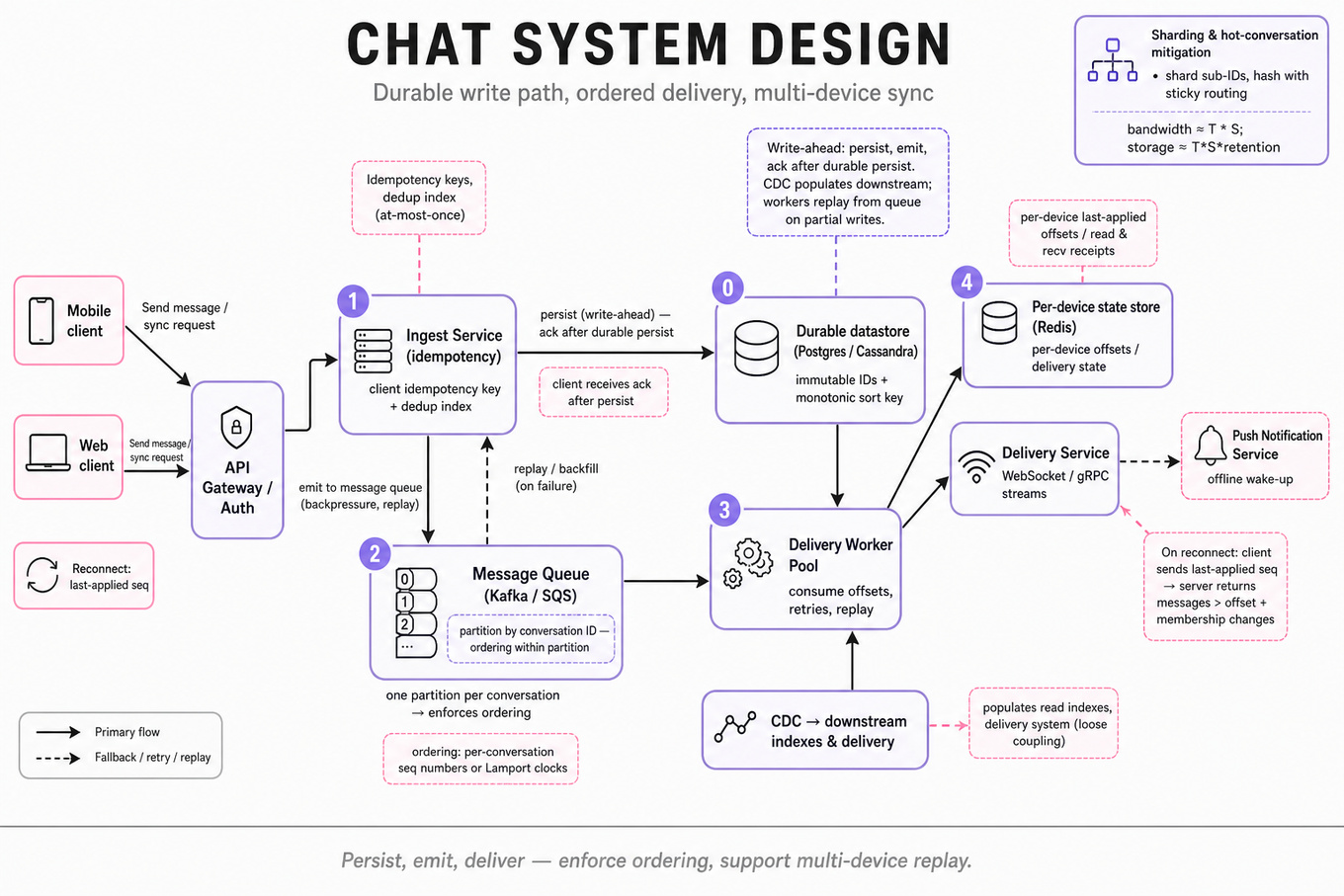
Interviewers are checking practical mastery of designing a real-time, durable messaging pipeline that balances ordering, durability, and multi-device delivery under partial failures. Expect to demonstrate distributed-systems primitives (persistence, replication, partitioning), client sync protocols, and operational tradeoffs (latency vs durability, ordering vs throughput). Anthropic cares because chat is a microcosm of reliable, user-facing backend services requiring strong correctness, scalability, and clear tradeoff communication.
Core knowledge
-
Message persistence: store canonical messages in a durable datastore (e.g.,
Postgres,Cassandra) with immutable IDs and a monotonic sort key; choose row-store for small scale, wide-column for high write fan-out and TTL requirements. -
Delivery vs storage separation: decouple write path (persist) from fan-out/delivery via a message queue like
KafkaorSQSto provide backpressure, retries, and replayable offsets. -
Ordering models: per-conversation causal/total ordering vs per-sender ordering; implement per-conversation sequence numbers or Lamport clocks for causal ordering; enforce ordering within a partition (e.g., one
Kafkapartition per conversation). -
Idempotency: use client-supplied idempotency keys and server dedup index to guarantee at-most-once semantics for sends; follow Stripe-style idempotency patterns for retries.
-
Multi-device delivery: maintain per-device delivery state and offsets; send messages via persistent
WebSocket/gRPCstreams for online devices and use push notifications for offline wake-up, with server-side replay on reconnect. -
Sync & reconciliation: store per-recipient read/recv receipts and last-seen offsets; on reconnect, client sends last-applied sequence number and server replies with messages > offset plus any membership changes.
-
Failure & partial-write handling: prefer a write-ahead pattern: persist, emit to queue, acknowledge to client only after durable persist; use CDC to populate downstream indexes and delivery systems to avoid tight coupling.
-
Scalability & partitioning: partition by conversation ID (hot-conversation mitigation by sharding sub-IDs or hashing with sticky routing); model throughput: if avg msg size S bytes and traffic T msgs/sec, bandwidth ≈ TS, and storage growth ≈ TS*retention.
-
Consistency vs availability tradeoffs: for global low-latency, accept eventual delivery and reconcile via vector timestamps; for strict ordering across regions, prefer synchronous replication (higher
p99s). -
Receipts & read-state: store receipts as compact metadata (per-user highest-seq or per-device set) to avoid per-message writes; for optional per-message receipts, amortize writes with batched updates to indexes.
Tip: keep the canonical message store authoritative and use change-data-capture to feed delivery pipelines and search/index services.
Worked example — Design a One-to-One Chat System
Frame quickly: ask about expected scale (messages/sec, messages/user), retention policy, ordering guarantees (per-conversation total order?), multi-device behavior, and whether receipts are required. Skeleton: (1) persist messages durably with immutable IDs and per-conversation sequence numbers; (2) emit to a queue (Kafka) for fan-out and replay; (3) deliver via per-device streaming connections (WebSocket/gRPC) and push notifications for offline devices; (4) sync on reconnect using last-seen sequence and reconciliation of membership/edits; (5) observability/ops: metrics for p99 delivery latency, consumer lag, and dead-letter queues. Flag a tradeoff: choosing single-partition per conversation simplifies ordering but limits throughput for extremely large groups or extremely hot one-to-one pairs; a sharded sequence or batching protocol can mitigate. Close by saying: if more time, detail schema (message payload, seq, idempotency key), partitioning plan, and sketches of failure scenarios (duplicate, reorder) with recovery protocols.
A second angle — Design a Resilient Chat System
With resilience and group chat emphasis, prioritize fan-out and membership-change handling: use an append-only canonical store plus a fan-out service that builds per-recipient delivery cursors, supporting idempotent replay. For groups, per-conversation ordering becomes harder; pick ordering semantics (per-sender or causal) and implement by assigning logical timestamps and using per-recipient queues to avoid global stalls. Membership changes require careful replay rules: new members should start at join time, removals stop delivery but require audit trails. Also emphasize monitoring consumer lag and automated repairs (rehydrate per-recipient cursors from canonical store when lag exceeds threshold).
Common pitfalls
Pitfall: A tempting design is to directly write to every recipient device synchronously; this blows up latency and availability when any recipient is slow or offline. Instead, persist first and fan-out asynchronously.
Pitfall: Assuming a single global sequence solves ordering; it creates a distributed bottleneck and complex leader election. Prefer per-conversation sequences or partitioned clocks.
Pitfall: Over-indexing per-message receipt writes for every delivery causes write amplification and costs; aggregate receipts into per-user highest-applied offsets or batch updates to reduce pressure.
Connections
This area naturally connects to stream processing and CDC (change-data-capture), mobile sync and conflict-resolution strategies, and observability for distributed systems (consumer lag, p99 delivery latency). Interviewers may pivot to rate-limiting, encryption/key management, or moderation pipelines.
Further reading
-
Martin Kleppmann — Designing Data-Intensive Applications — chapters on replication, partitioning, and logs are directly applicable to chat systems.
-
Apache Kafka documentation — Exactly-once semantics — practical patterns for durable emit-and-consume pipelines.
Practice questions
Focus area — New Anthropic-specific addendum: practice policy enforcement, audit logs, human review, and safe degradation around model outputs.
What's being tested
Interviewers are probing your ability to design reliable, scalable policy enforcement and audit systems that operate in production: low-latency enforcement in the request path, durable tamper-evident recording for later review, and clear tradeoffs between correctness, performance, and observability. They want to see system decomposition, consistency/availability reasoning, capacity and cost estimates, error/edge-case handling, and test/operational plans a backend engineer would own.
Core knowledge
-
Enforcement point vs audit trail separation: enforcement must meet strict latency/SLA (often synchronous), while audit storage can be asynchronous and optimized for durability and queryability.
-
Synchronous vs asynchronous enforcement tradeoff: synchronous provides immediate correctness but increases
p99latency; asynchronous reduces request latency but requires reconciliation and eventual consistency. -
Idempotency & deduplication: use unique request identifiers and idempotency keys persisted in a small low-latency store (
`Redis`, unique DB constraint) to achieve exactly-once semantics or safe retries under at-least-once delivery. -
Append-only audit logs: store events in an immutable append-only stream (
`Kafka`, WORM`S3`with versioning); append-only simplifies tamper-evidence, replayability, and schema evolution via version tags. -
Storage sizing and retention math: estimate storage: bytes/day = events/sec * avg-event-bytes * 86400; multiply by retention days. For example, 1000 eps * 1KB * 86400 ≈ 86.4GB/day; choose partitioning and compaction accordingly.
-
Indexing and partitioning for audit queries: design partitions by time + primary keys (e.g., day + account_id) so ad-hoc queries and replays scan minimal partitions; maintain materialized views or OLAP replicas for heavy query loads.
-
Tamper-evidence mechanisms: use cryptographic hashes/MACs or Merkle trees over batched logs, signed by a key in
`KMS`to prove integrity; separate write and read roles via strict RBAC to prevent admin tampering. -
Exactly-once vs at-least-once in distributed pipes: prefer idempotent consumers and deduplication over heavyweight distributed transactions; use transactional producers (
`Kafka`transactions) when strong ordering/atomicity is required. -
Latency budgets and SLAs: set clear
p50/p95/p99targets for the enforcement path (e.g.,p99< 100–300ms). Monitor end-to-end latency including policy evaluation, network, and I/O. -
Observability & testing: instrument with histograms, counters, and distributed tracing for enforcement calls; populate rule coverage and false-positive/negative metrics; include synthetic traffic, replay tests, and chaos tests for partial-failure resilience.
Worked example — "Design a low-latency policy enforcement service that blocks prohibited content and provides an audit trail"
Frame first: clarify SLA (p99 latency target), expected throughput (req/sec), types of decisions (binary block/allow or actions), and retention/compliance requirements. Skeleton: (1) a lightweight enforcement service in the request path that performs a cached policy check and short-circuits, (2) a policy evaluation engine that fetches rules from a config store and supports versioning, (3) an append-only audit publisher to `Kafka` (or direct DB write for small scale) to stream events, and (4) an asynchronous worker that persists enriched audit records into long-term storage (`S3` + partitioned Parquet). Flag tradeoffs: synchronous publishing to audit store increases request latency and coupling; prefer fire-and-forget to a fast local buffer with background flush and durable write to `Kafka` to avoid lost events. Close by describing operational controls: rollout via canary, metric dashboards for enforcement rate and false positives, and a replay harness. If more time: add tamper-evidence (signed batches), per-tenant retention, and multi-region replication for compliance.
A second angle — "Design an offline auditing system that replays historical interactions to detect missed violations"
Here the service is oriented to high-throughput batch processing, not low-latency decisioning. Use the append-only event stream as the source of truth and build a scalable replay pipeline with consumer groups reading time-partitioned topics. Important constraints change: ordering within keys matters for correct re-evaluation, so partition by subject-id; compute nodes should be stateless and idempotent, writing findings to an OLAP store for analysts. Emphasize cost/throughput tradeoffs: prefer bulk-compute frameworks (e.g., `Spark`/`Flink`) for large backfills; for continuous detection use stream processors with windowed state and retention. Ensure the pipeline supports schema evolution (versioned event payloads) and reconciliation hooks for recovered events.
Common pitfalls
Pitfall: Assuming synchronous writes to an external audit DB are free.
Synchronous writes amplifyp99latency and create cascading failures. Design a durable local buffer or use`Kafka`with producer retries; treat the audit path as a critical-but-asynchronous dependency unless SLA dictates otherwise.
Pitfall: Treating audit logs as mutable application data.
Allowing ad-hoc edits destroys forensics. Enforce append-only writes, strict RBAC, and cryptographic integrity checks. Provide correction records (new events marking rollbacks) rather than mutating history.
Pitfall: Skipping replayability and schema/versioning upfront.
Without version metadata and backward-compatible event schemas, re-processing historical events becomes brittle. Embed schema version, provide per-event timestamps, and maintain a schema registry or simple`version`field.
Connections
This area ties closely to observability & tracing (distributed traces help trace enforcement decisions), storage & partitioning (OLTP vs OLAP separation), and security/compliance (RBAC, `KMS`, and data-retention policy). Interviewers may pivot to distributed consensus (Raft) or exactly-once semantics in message systems.
Further reading
-
[Designing Data-Intensive Applications — M. Kleppmann] — excellent grounding on logs, partitioning, replication, and durability strategies.
-
[
`Kafka`documentation — exactly-once semantics & transactions] — practical reference for implementing durable, ordered streams and transactional producers/consumers.
Practice questions
Focus area — New Anthropic-specific addendum: large prompts and documents need ingestion, retrieval, provenance, and latency-aware context assembly.
What's being tested
Candidates must design and reason about scalable pipelines that ingest large documents, produce and store dense representations, and return relevant results with low latency and high recall. Interviewers probe system-design skills: data partitioning, indexing algorithms, consistency and update strategies, cost/latency tradeoffs, and operational concerns (monitoring, backfills, throttling). Anthropic cares because large-context retrieval is core to safe, performant assistant behavior at scale.
Core knowledge
-
Ingestion pipeline stages: source connectors → normalization (HTML→text, language detection) → chunking → deduplication → embedding generation → vector upsert + metadata write; each stage must be idempotent and observable.
-
Chunking heuristics: prefer 512–2,048 token chunks with 10–30% overlap to preserve context; choose chunk boundary by semantic units (paragraphs, headings) not arbitrary bytes to avoid losing meaning.
-
Vector storage cost: vector bytes ≈ dim × 4 (float32). Example: 1,536-dim → ~6 KB/vector; 100M vectors → ~600 GB raw; plan for compression/quantization or sharding beyond tens of millions.
-
ANN algorithms & tradeoffs: HNSW gives high recall and sub-ms to low-ms latencies at memory cost; IVF+PQ (FAISS) reduces RAM via disk-backed centroids and product quantization but raises probe latency and tuning complexity.
-
Hybrid retrieval: combine sparse retrieval (
BM25/Elasticsearch) as narrow prefilter and dense retrieval (ANN) for semantic matching to cut ANN cost and improve precision on keyword queries. -
Indexing/upsert semantics: use tombstones and versioned IDs for deletes/updates; for vector stores without cheap in-place updates, use soft-delete + background compaction; strong consistency is expensive—prefer eventual consistency with clear SLAs.
-
Batching & throughput: amortize embedding model calls with batching (e.g., 128–1024 sequences), but limit batch latency; backpressure via
Kafka/Pub/Suband controlled concurrency for the embedding workers. -
Sharding & routing: shard vectors by document namespace or hashed ID; maintain routing metadata in a small
Postgres/Redistable to locate active shards; re-shard offline with coordinated cutover to avoid long stalls. -
Cache & rerank: use a
RedisLRU cache for hot queries and store candidate lists; apply a cheap cross-encoder reranker only on top-K to raise precision while controlling inference cost. -
Monitoring & quality metrics: track p95/p99 latency, QPS, recall@k, MRR, index fill rate, and embedding queue lag; set alerts on recall regressions, queue backlog, or rapid drift in embedding norms.
-
Backfills & versioning: tag vectors with an embedding-version; allow multi-version co-existence and support rolling re-embeds using streaming jobs to avoid global downtime.
-
Security & privacy: redact PII at normalization, encrypt vectors at rest, and separate metadata access controls from vector access (RBAC for
Milvus/FAISSendpoints).
Worked example — "Design a scalable document ingestion and retrieval system for 100M documents with ≤200ms P95 retrieval"
Frame first: clarify SLA (200ms p95), QPS, update rate, query types (semantic vs keyword), budget, and allowable staleness for updates. Skeleton answer pillars: (1) ingestion pipeline with durable queue (Kafka) and idempotent processors, (2) chunking + dedupe + batched embedding generation, (3) sharded ANN indexes (HNSW per shard) with a lightweight metadata DB for routing, (4) hybrid retrieval: keyword filter → ANN candidate fetch → rerank, (5) monitoring, backfills, and versioning. Key tradeoff: choose HNSW for low-latency at cost of RAM; if budget constrained, use IVF+PQ and accept higher p95 for cold queries. Close by describing operational tasks: automated compaction, versioned re-embed pipeline, and tests (synthetic recall evaluation); if more time, discuss dynamic shard rebalancing and adaptive query caching.
A second angle — "Handle near-real-time updates and deletions in the vector index with strong correctness guarantees"
Same core idea but different constraint: low staleness and frequent deletes. Use an append-only event log (Kafka) with per-document version numbers and tombstone events. Upserts write new vectors and set previous versions’ tombstone flags; index nodes accept idempotent upserts and expose a per-shard "applied-offset" to track replication. For strong read-after-write, route queries that require freshness to a leader shard or read through a write buffer that merges recent events before ANN lookup. Tradeoffs: strong freshness increases tail latency and reduces throughput; often better to offer selectable consistency levels. Also plan for efficient compaction since tombstones bloat memory—schedule offline rebuilds during low load.
Common pitfalls
Pitfall: Treating embeddings as immutable text IDs — forgetting to version embeddings leads to silent mismatches when the model changes; always store an embedding-version and support coexisting versions during rollout.
Pitfall: Chunking with fixed byte sizes — that causes semantic breaks and poor retrieval; prefer token/semantic-aware chunking with overlap and preserve headings.
Pitfall: Rebuilding entire ANN for small updates — rebuilding 100M vectors for every change is infeasible; use upserts, soft-deletes, and periodic compaction/rebuild windows with incremental pipelines.
Connections
This area often pivots to adjacent infra concerns: data-engineering topics like durable streaming, partitioning, and schema evolution, or MLE topics such as embedding drift detection and model-staging strategies. Interviewers may ask about tradeoffs in cost vs. latency or about integrating with full-text search layers.
Further reading
-
FAISS (Facebook AI Similarity Search) — implementations and tuning guidance for IVF/PQ and HNSW.
-
HNSW paper (Malkov & Yashunin) — core algorithm and memory/recall tradeoffs.
Practice questions
Coding & Algorithms
Focus area — Matches your key-value-store and transactional-integrity focus; emphasize atomic validation, TTLs, history, and lifecycle rules.

What's being tested
These problems test implementing stateful in-memory ledgers and versioned stores: deterministic, time-ordered mutation application, per-key version history, and efficient historical reads. Interviewers probe correctness under ties/edge timestamps, read performance (historical snapshots), and simple concurrency/atomicity patterns a backend engineer should own.
Patterns & templates
-
Event sourcing append-only log per-entity — store
(timestamp, seq, op)and order by(ts, seq)for deterministic tie-breaking; append is O(1). -
Per-key history index: keep a vector or linked list per key and binary-search by timestamp for
getBalanceAt(ts)in O(log m) where m is versions for that key. -
Tombstones & TTL: record delete markers with expiry metadata; treat tombstone as immutable state and purge lazily to avoid expensive synchronous GC.
-
Atomic validation: implement
applyEvent()as validate-then-commit using either per-key locks or optimistic CAS; ensure invariants (e.g., balance >= 0) hold before publishing. -
Prefix/range scans: keep keys in a sorted structure (
std::map/B-tree) so prefix scans cost O(k + log n) and can iterate historical entries quickly. -
Scheduled jobs: schedule future payments in a time-priority queue (min-heap or calendar queue) and materialize them at execution time with idempotency keys.
-
Merge/snapshot semantics: when merging accounts or applying promotions, snapshot rates/balances at effective timestamp to prevent retroactive changes to past reads.
Common pitfalls
Pitfall: assuming in-memory write order equals deterministic commit order — ties must be explicitly broken (timestamp+sequence).
Pitfall: scanning entire history per read — costly; use indexed per-key histories and binary search.
Pitfall: mutating past events (changing earlier ledger entries) instead of emitting compensating events or tombstones, which breaks reproducibility.
Practice these
The practice cards below cover the canonical variants — solve all of them and time yourself.
Practice questions
ML System Design
GPU Inference API Serving
Focus areaFocus area — Anthropic-specific serving systems are likely; 3/5 system design warrants emphasis on batching, SLOs, routing, and failures.

What's being tested
Interviewers test your ability to design a multi-tenant GPU-backed inference service that meets explicit latency SLOs while maximizing accelerator utilization and operational reliability. Expect to demonstrate end-to-end thinking: API contract and lifecycle, scheduling/admission control, batching and accelerator-level optimizations, model/version management, and observability for p99 latency and cost. Anthropic cares about pragmatic tradeoffs (latency vs throughput, isolation vs utilization) and clean, testable designs a Software Engineer can implement and operate.
Core knowledge
-
API modes: synchronous streaming vs asynchronous / batch. Synchronous streaming (text-generation) needs low tail latency and chunked responses; asynchronous accepts job submissions and returns a job id for later polling or callback.
-
SLO/SLI design: define
p50,p95,p99latency SLOs, throughput SLO, and error-rate; instrumentrequest_latency,queue_time,inference_time,gpu_utilization. Use these to drive admission control and autoscaling. -
Queueing & admission control: model arrivals with , service rate per GPU; utilization . Use Erlang-C or M/M/c approximations to estimate queue wait and dimension capacity for a target
p99. -
Batching math: throughput ≈ batch_size / batch_service_time; batch_service_time grows sublinearly in batch_size until memory/compute saturation. Optimize batch size to hit a target latency budget while maximizing throughput.
-
GPU runtime constraints: CUDA context creation is expensive; memory fragmentation, model size, and kernel launch overheads limit effective concurrency. Use MIG, CUDA MPS, or container-level isolation for multi-tenancy tradeoffs.
-
Model placement & sharding: small models fit on one GPU; large LLMs require tensor/model parallelism or pipeline parallelism across multiple GPUs, increasing inter-GPU communication (NVLink, NCCL) and latency.
-
Dynamic batching & sequence batching: for autoregressive workloads, dynamic batching must respect token-level latency; implement sequence-aware batching that groups similar-length sequences and supports early flushing when latency budget is reached.
-
Memory & input constraints: model + activation footprint must fit GPU memory; use quantization (int8, fp16) and offloading (CPU/RAM or NVMe) carefully: quantization reduces memory and latency but can alter quality.
-
Scheduler & placement policies: implement a centralized scheduler (or per-cluster agent) that considers GPU memory, compute load, model residency, queue lengths, and tenant isolation; support pre-warmed models to avoid cold starts.
-
Autoscaling & warm pools: scale at two levels: stateless worker replicas (if using model server) and GPU cluster capacity (node autoscaler). Maintain a warm-pool of preloaded models to avoid cold-starts for
p99-sensitive paths. -
Failure modes & retries: detect OOM, driver resets, and preemption; isolate failures per request, use idempotency keys, and circuit-breakers to avoid retry storms that harm GPUs.
-
Observability & debugging: correlate traces across
API gateway -> scheduler -> model server -> GPUfor a single request. Exportgpu_memory,gpu_utilization,queue_depth, andbatch_size_histogramfor root-cause ofp99spikes. -
Cost & accounting: attribute GPU time per tenant/model using wall-clock and batch accounting. Consider spot/preemptible GPUs for non-SLO workloads and on-demand for SLO-critical paths.
Worked example — Design a GPU inference API
First 30 seconds: clarify SLOs (target p99 latency), supported API patterns (streaming vs non-streaming), concurrency characteristics, model sizes (single-GPU or multi-GPU), multi-tenancy/isolation requirements, and cost constraints. Skeleton pillars: (1) API contract & lifecycle (endpoints for POST /v1/generate synchronous, POST /v1/jobs asynchronous with job_id); (2) Request router & admission control that accepts/queues requests, enforces per-tenant rate limits, and computes batch eligibility; (3) Scheduler & runtime that places models into GPU resident pools, performs dynamic batching, and invokes Triton-style model servers; (4) Observability & autoscaling driving warm-pools and node scaling. A specific tradeoff: prioritize p99 by capping batch size and pre-warming models at the cost of lower throughput and higher GPU idle time; alternatively maximize utilization with larger batches but accept higher p99. Close: propose short experiments and metrics (simulate workloads, measure p99 vs throughput) and say "if more time, I'd design the exact admission-control policy, simulate it with traces, and prototype dynamic batching thresholds."
A second angle — Design a batch inference API
Batch inference is primarily asynchronous and throughput-first; design focuses on job lifecycle, chunking, checkpointing, and idempotent retries. Key changes: expose POST /v1/batches returning job_id, support resumable checkpoints for large datasets, and provide progress and partial-result streaming. Worker pool design uses a job queue with parallel workers that can aggregate multiple small inputs into GPU batches internally, but scheduling is simplified because strict p99 latency is relaxed. Emphasize durable storage for inputs/outputs (S3), rate-limits to avoid runaway costs, and cost-aware scheduling (spot instances for low-priority batches, guaranteed capacity for high-priority jobs). Also plan for per-job SLAs and shardability of large datasets to parallelize across GPUs.
Common pitfalls
Pitfall: Designing for average latency or throughput only. Many candidates tune batch sizes to maximize throughput and ignore queueing effects on
p99, causing SLO misses under bursty traffic. Always dimension by tail latency and simulate with realistic variance.
Pitfall: Treating GPUs like infinitely shareable CPUs. Ignoring CUDA context costs, memory fragmentation, or multi-tenant interference leads to noisy neighbors and unpredictable
p99spikes. Explicitly model GPU residency and use hardware isolation primitives.
Pitfall: Over-architecting without measurable signals. A tempting deep design adds complex model-parallel pipelines; better answers first propose measurable experiments (traces, A/B of batching strategies) and incremental rollout plans with observability hooks.
Connections
Interviewers often pivot to adjacent topics: model rollout & canary deployments, feature-store/real-time retrieval for contextualized inference, or scheduling/resource management at cluster scale. Be ready to discuss how the inference design ties into CI/CD for models, monitoring regression in generation quality, and cost allocation per tenant.
Further reading
-
NVIDIA Triton Inference Server docs — practical model-serving patterns and batching/runtime features.
-
Ray Serve docs — patterns for scalable deployment and request routing for Python-first model servers.
-
Google Borg paper — cluster scheduling principles useful for large-scale GPU placement and multi-tenant policies.
Practice questions
Focus area — Strong Anthropic fit: safe rollout of large model artifacts; emphasize integrity, activation, rollback, and partial-state protection.
What's being tested
Candidates must demonstrate practical distributed-systems design for reliably delivering very large, immutable artifacts to thousands of workers while preventing partial or inconsistent activation. Interviewers probe system decomposition, transfer and verification algorithms, rollout/rollback strategies, and operational controls (timeouts, capacity, monitoring) that a Software Engineer would design and implement.
Core knowledge
-
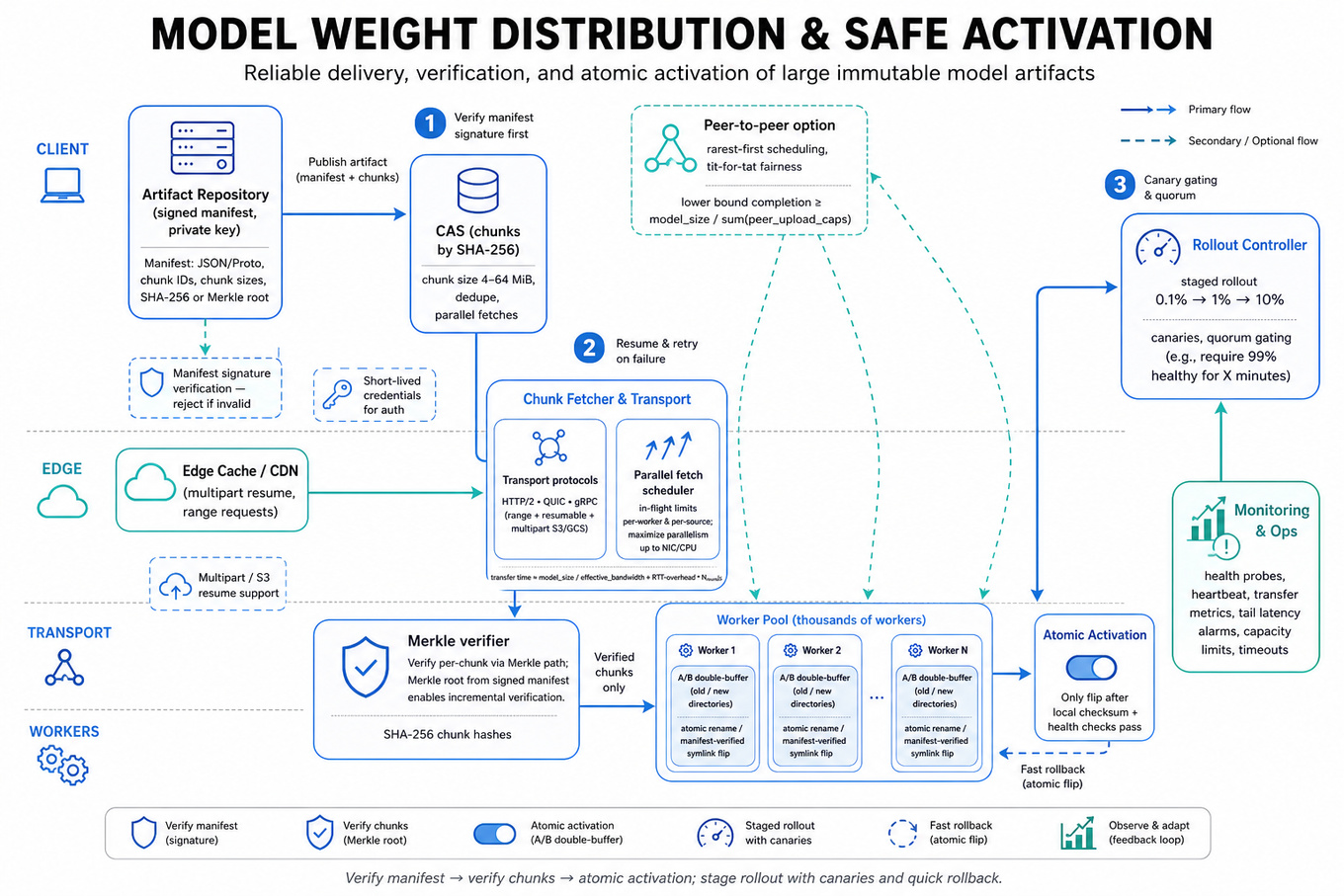
Artifact manifest: a signed JSON or protobuf listing chunk IDs, sizes, and chunk-level SHA-256 hashes (or Merkle root). The manifest is the single source of truth for integrity and versioning; verify signature before trusting any chunks.
-
Content-addressable storage (CAS) and chunking: split files into fixed-size chunks (e.g., 4–64 MiB) and store by chunk-hash to enable deduplication, parallel fetches, and chunk-level retries; chunk size trades off metadata overhead vs. parallelism.
-
Merkle tree: use a Merkle tree to allow incremental verification as chunks arrive; store the Merkle root in the signed manifest so you can verify partial downloads without rehashing the whole file.
-
Transport protocols & resume: support range requests and resumable uploads/downloads via
HTTP/2,QUICor chunkedgRPC; use server-side multipart APIs (S3/gcsstyle) so workers can resume without restarting from zero. -
Parallelism & scheduling: transfer time ~ model_size / effective_bandwidth + RTT-overhead * Nrounds; maximize parallel chunk fetches up to NIC/CPU limits while avoiding tail saturation; implement in-flight limits per-worker and per-source.
-
Peer-to-peer considerations: for P2P, schedule by rarest-first and enforce fair-upload with tit-for-tat; lower bound completion time is at least model_size / sum(peer_upload_caps) ignoring protocol overhead and scheduling inefficiencies.
-
Activation / atomic switch: implement A/B double-buffering (keep old and new directories) and an atomic
renameor manifest-verified symlink flip; only flip when local checksum and health checks pass to avoid partial exposure. -
Rollout, canaries, and quorum gating: staged rollout (e.g., 0.1%, 1%, 10%) with health probes; require a quorum (e.g., 99% of canary group healthy for X minutes) before next stage; provide fast rollback path with atomic flip.
-
Version integrity & auth: sign manifests with a private key and use short-lived credentials or signed URLs for chunk fetches; use mutual
TLSbetween control-plane and workers to prevent man-in-the-middle. -
Dealing with stalls & failures: detect stalled transfers with per-chunk timeouts + exponential backoff; blacklist bad sources; fall back to alternative mirrors or CAS stores; cap retry budget to avoid wasting bandwidth.
-
Capacity planning & CDN/caching: push artifacts to an edge cache/CDN for faster distribution; for large internal fleets, a two-tier strategy (seed storage + regional caches) reduces cross-region egress and load on origin.
-
Observability & SLOs: instrument
p50/p95/p99distribution time, chunk verification failures, activation latency, and rollback rates; implement alert thresholds and automated circuit-breakers to halt rollouts on anomalies.
Worked example — Design Safe Distribution and Activation of Model Weights
Start by clarifying constraints: maximum artifact size, worker disk and RAM, acceptable activation outage window, network topology, and security (who can sign). Organize the design into four pillars: (1) immutable artifact + signed manifest stored in CAS and edge caches; (2) resumable chunked transfer with parallelism and per-chunk SHA-256 verification (or Merkle proof); (3) safe activation via A/B double-buffering and atomic rename, gated by local checksum and health checks; (4) staged rollout & rollback controlled by a central controller that enforces quorum rules and can abort/rollback. For tradeoffs, explicitly discuss chunk size: larger chunks reduce metadata and hash overhead but increase wasted work on retries; pick 8–16 MiB for typical fleets as a balanced default. Closing: note operational controls — thresholded alerts, kill-switch to freeze activation, and a plan to handle partial rollouts; if more time, add adaptive chunk sizing based on per-region RTT/bandwidth and implement Merkle-tree-based fast verification.
A second angle — Design Peer-to-Peer Model Distribution Under a Shared Link Cap
When peers share strict upload/download caps, the problem shifts from pure server scaling to scheduling under constrained aggregate link budgets. The core primitives remain: signed manifest, chunking, and verification. The key differences are scheduling policies (rarest-first with upload quotas), a lower-bound argument on completion time using network flow (you cannot finish faster than model_size / sum(upload_caps) aggregated over time), and incentives/fairness to prevent freeloaders. Implementation details include splitting workers into swarms by region, seeding regional supernodes with high upload capacity, and using upload-token accounting so each peer contributes proportionally. Also add monitoring to detect slow swarms and fallback to origin fetch for stragglers.
Common pitfalls
Pitfall: underestimating tail latency and bandwidth variability.
Designs that assume uniform bandwidth will suffer long tails; always simulatep95/p99bandwidth and plan parallelism and retries to reduce tail impact.
Pitfall: exposing partial model state during activation.
An atomic flip using a signed manifest and double-buffered file layout avoids serving from a partially-downloaded directory; a naivecp-then-delete approach can expose inconsistent artifacts.
Pitfall: skipping cryptographic integrity or key-management details.
Saying "use checksums" is not enough—explain manifest signing, key rotation, revocation, and short-lived credentials for chunk fetches; otherwise an integrity threat model is incomplete.
Connections
Deployment pivots often lead to adjacent topics like model serving (hot-reload vs. cold-restart strategies) and CI/CD for large artifacts (retention, promotion pipelines). Interviewers may also pivot to network QoS and regional cache design or operational runbooks (automated rollback, disaster recovery).
Further reading
-
Amazon S3 Multipart Upload — practical reference for resumable, chunked uploads and part verification.
-
BitTorrent BEP 3 (protocol) — rarest-first scheduling and peer exchange principles for P2P distribution.
-
Merkle tree (Wikipedia) — concise explanation of incremental verification and root-based integrity.
Practice questions
LLM Evaluation and Red-Teaming Platforms
Focus areaFocus area — New Anthropic-specific addendum: design scalable evaluation and red-team pipelines for model safety and quality gates.
What's being tested
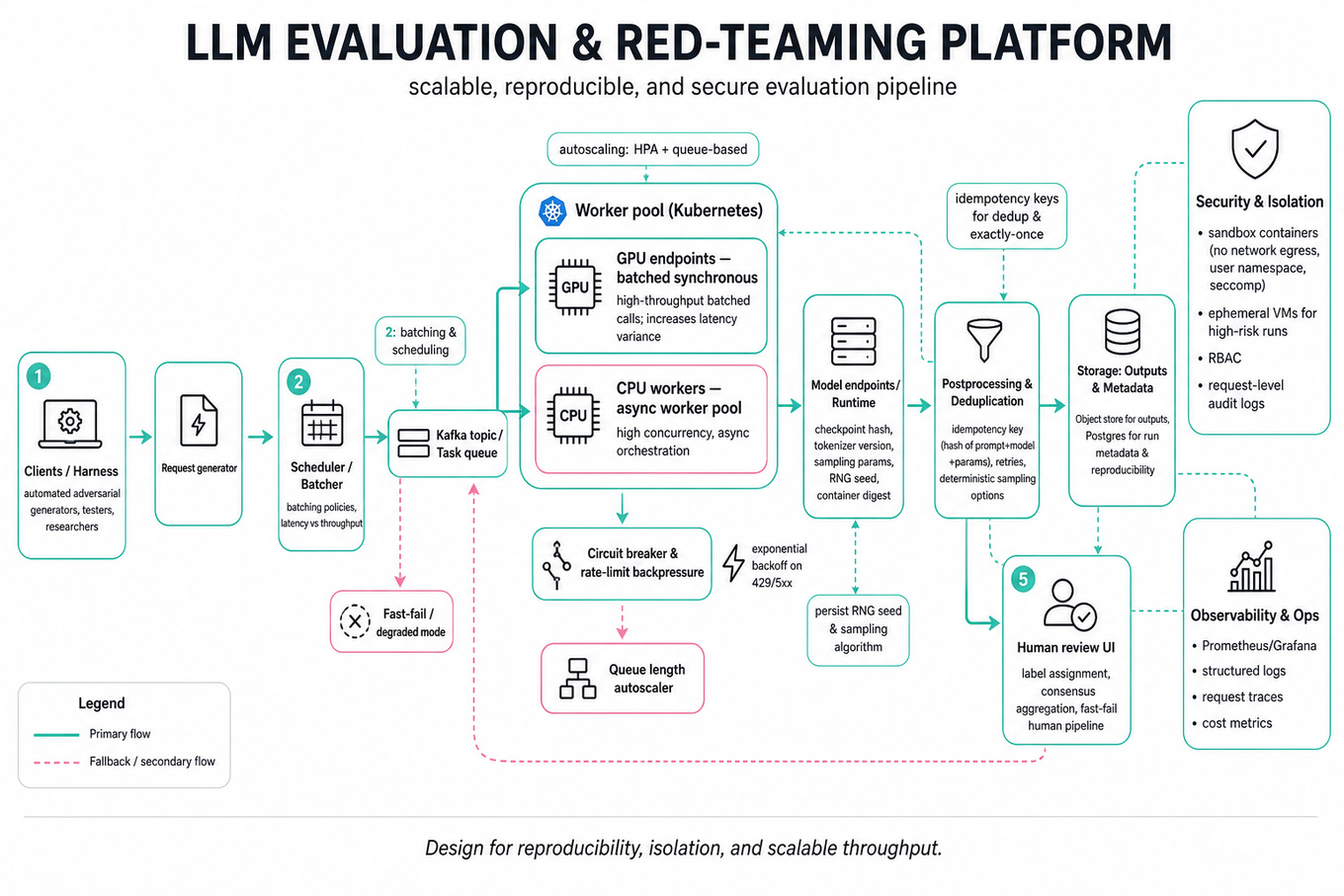
Interviewers are probing your ability to design and implement robust, scalable evaluation and red‑teaming platforms for large language models — the systems that generate, run, collect, and analyze adversarial and routine prompts at scale. Expect to show system-design skills (throughput/latency tradeoffs, orchestration, isolation), reproducibility and versioning practices, and operational concerns (cost, observability, security) that make such a platform production-ready for engineering teams.
Core knowledge
-
Evaluation pipeline stages: request generation, batching/scheduling, model invocation, postprocessing, human review, and metric aggregation; each stage must expose clear interfaces and retry semantics for failure isolation.
-
Orchestration primitives: use message queues like
`Kafka`or task queues for decoupling, and run workers on`Kubernetes`with autoscaling, resource requests/limits, and pod disruption budgets to balance throughput and cost. -
Model invocation patterns: prefer batched synchronous calls for throughput on GPU-backed endpoints, or asynchronous calls with worker pools for high-concurrency CPU endpoints; batching increases throughput but adds latency variance.
-
Idempotency and retries: issue an idempotency key per evaluation item (hash of prompt + model + params) so retries, deduplication, and exactly-once semantics are achievable at the application layer.
-
Reproducibility metadata: store model checkpoint hash, prompt text, tokenizer version, sampling params (temperature,
`top_k`,`top_p`), RNG seed, runtime binary/version, and container image digest alongside outputs for each run. -
Handling nondeterminism: to reproduce sampled outputs, persist the RNG seed and sampling algorithm; for batch-parallel hidden nondeterminism, prefer deterministic sampling or run with multiple seeds and aggregate behaviors.
-
Failure / rate‑limit backpressure: implement exponential backoff for 429/5xx responses, circuit breakers around endpoints, and queue length-based autoscaling; expose fast-fail modes for critical human-review pipelines.
-
Security and isolation: execute adversarial prompts in sandboxed containers (no network egress, user namespace, seccomp), use ephemeral VMs for high-risk content, and enforce RBAC and request-level auditing.
-
Human-in-the-loop UX and guarantees: label assignment, consensus aggregation, duplicative reviews for calibration, per-annotator quotas, and optimistic batching so humans review only deduplicated, filtered examples.
-
Storage and data lineage: store raw requests and responses in cheap object storage (
`S3`) and indexed metadata in`Postgres`/`Elasticsearch`; maintain immutable run artifacts and content-addressed identifiers for easy rollback. -
Metrics and aggregation: compute deterministic metrics (latency
`p50/p95/p99`, throughput), and behavioral metrics (failure rates, category-wise pass/fail); aggregate with time windows and export to`Prometheus`/`Grafana`. -
Sampling math for rare behaviors: to observe a rare behavior with true rate r at confidence c, sample size n satisfies , so . This informs budgeting for red-team effort.
Worked example — "Design a scalable LLM evaluation and red‑teaming platform with human review and reproducible runs"
Frame the problem: clarify throughput targets, acceptable latency for human-in-loop, threat model (malicious prompt classes), and what counts as a "finding" (binary flag, severity). Architect around three pillars: (1) ingestion & orchestration using `Kafka` to accept prompts and a controller that partitions workloads by risk/priority; (2) execution layer with autoscaled `Kubernetes` workers that support both CPU and GPU models with batching and idempotency keys; (3) storage & review where raw artifacts go to `S3`, metadata to `Postgres`, and a reviewer UI pulls deduplicated candidates. Explicit tradeoff: choose between aggressive batching (better GPU utilization) and low-latency human review — document SLA and let autoscaler weight worker types accordingly. For nondeterministic behaviors, show you’ll persist RNG seeds and model versions; for cost, add a caching layer keyed by content-addressed hashes to avoid re-evaluating identical prompts. Close by saying: if more time, you’d add automated prioritization (active learning) to surface high-value examples and implement offline A/B analyses for evaluation policies.
A second angle — "Implement a low-latency online safety filter for model responses"
Same fundamentals apply but constraints shift: strict `p99` latency budget (tens to hundreds of ms) and near-zero false negatives matter. You’d move from batch GPU invocations to lightweight, compiled filter models served on CPU or via distilled networks, colocated with the serving tier. Orchestration emphasizes synchronous validation with fallback strategies (safe template responses), and observability focuses on per-request traces to detect drift. Reproducibility needs are lighter (no human review immediate), but audit logs and cryptographic request signing become more critical for postmortem and compliance.
Common pitfalls
Pitfall: Ignoring nondeterminism — developers re-run a failing prompt and get different outputs; solution: require and log RNG seeds, sampling alg, model binary digest so individual runs are reproducible.
Pitfall: Designing for peak throughput only — teams forget human-review SLAs and latency-sensitive paths, causing reviewer queues to blow up; solution: explicitly model separate pipelines for high‑throughput automated tests and low‑latency human review.
Pitfall: Over-indexing on model internals in a systems interview — describing training changes or loss functions instead of concrete system tradeoffs (batching, idempotency, sandboxing) loses points; focus on engineering levers and measurable SLAs first.
Connections
These systems naturally pivot to adjacent problems: model serving and canary deployment (blue/green model rollouts with traffic splitting) and data pipeline engineering (streaming ingestion, schema evolution, and backfills). Interviewers may ask you to integrate evaluation outputs into CI/CD and monitoring stacks next.
Further reading
-
Designing Data-Intensive Applications (Martin Kleppmann) — strong treatment of distributed systems patterns useful for evaluation pipelines.
-
SRE Book — Monitoring Distributed Systems — practical guidance on SLAs, observability, and alerting patterns that apply directly.
Practice questions