Reddit Machine Learning Engineer Interview Prep Guide
Everything Reddit actually asks Machine Learning Engineer candidates — concept walkthroughs, worked examples, and the real interview questions, drawn from candidate reports. Free to read.
Last updated
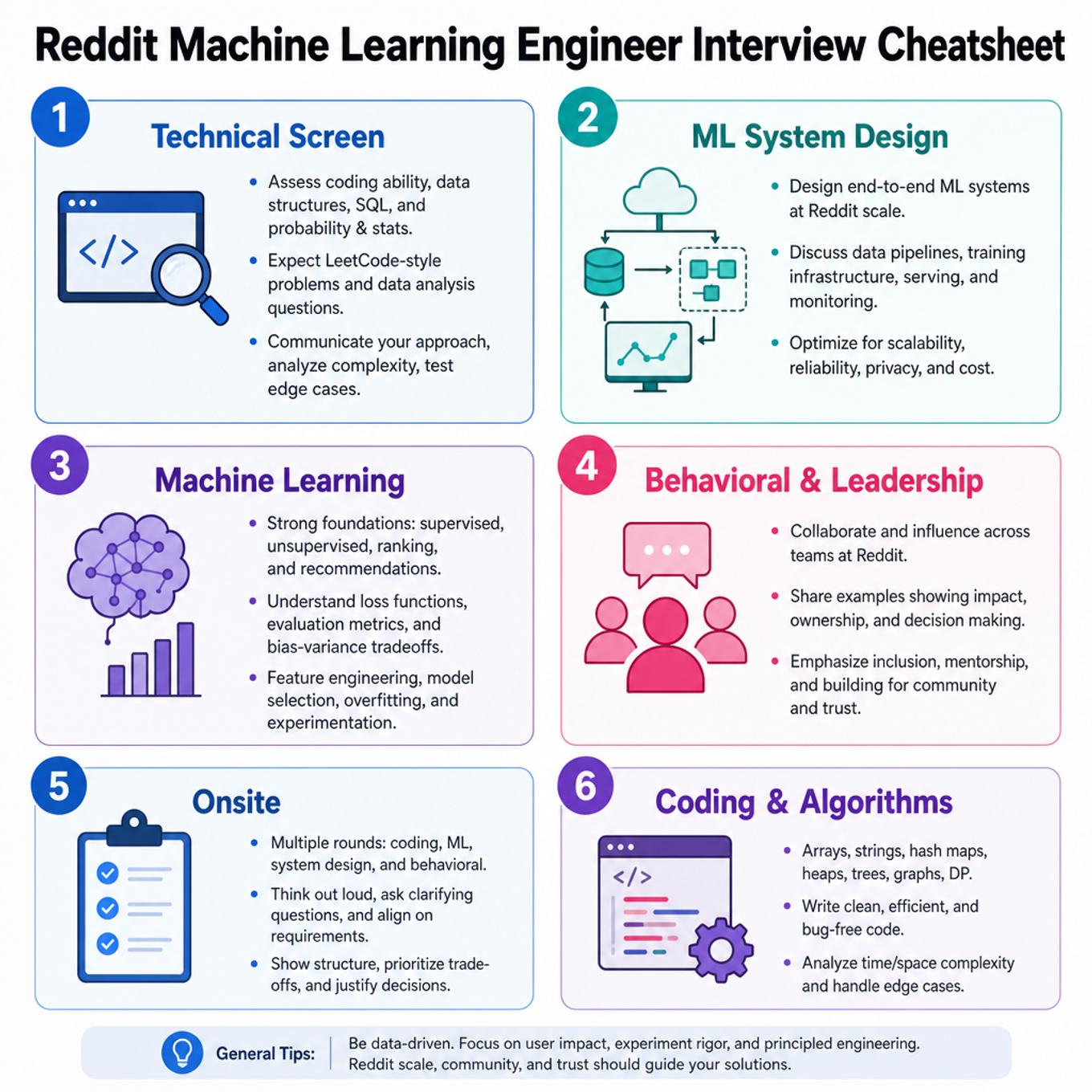
Your biggest focus is ML system design: you rated it 1/5 and selected candidate generation, retrieval/reranking, feature-store consistency, low-latency serving, rollout, and monitoring. You're strongest in core ML at 4/5 with heavy ML viewing, so baselines, preprocessing, embeddings, and traversal are shorter refreshers rather than the main lift. For Reddit, the plan highlights feed/ranking systems, engagement prediction, position bias, subreddit/user/post embeddings, semantic retrieval, and safety-aware ranking. With one month, budget most weekly practice toward onsite system design and behavioral storytelling, then use technical-screen ML topics as maintenance.
Technical Screen — 30 min
ML System Design
- Recommendation And Ranking Systems (Focus) — covered in depth under Onsite below.
Machine Learning
- Click And Engagement Prediction (Focus) — covered in depth under Onsite below.
Behavioral & Leadership
Onsite — 60 min
ML System Design
Recommendation And Ranking Systems
Focus areaFocus area — ML system design is your lowest self-rating, and you selected candidate generation, retrieval, reranking, and calibration; Reddit feeds make this central.
What's being tested
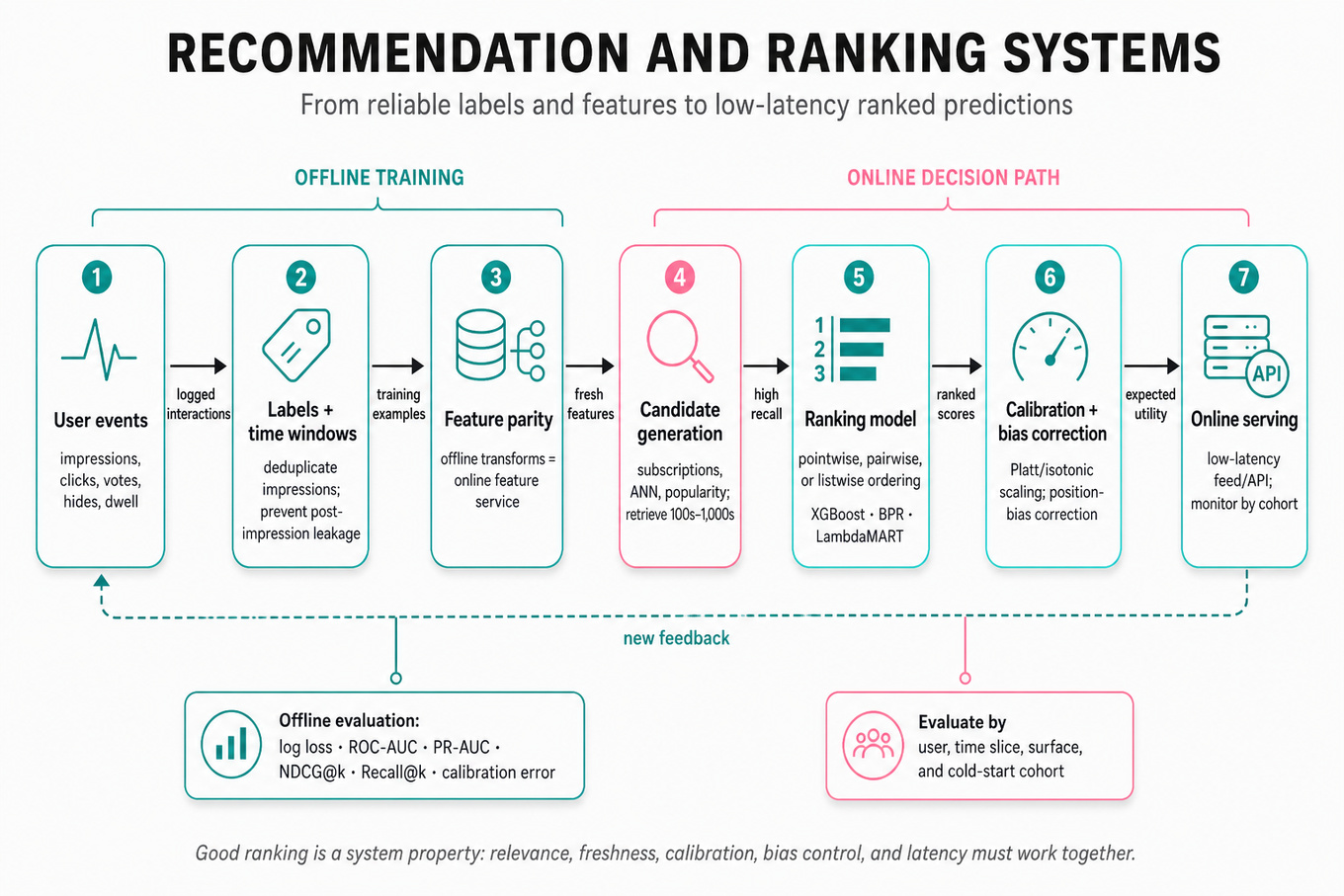
These systems test whether you can connect recommendation modeling with reliable training, feature, evaluation, and serving infrastructure. You should be able to define prediction targets precisely, choose models and metrics appropriate to ranking, and explain how offline artifacts become low-latency online predictions. Reddit cares because ranking quality depends not only on model accuracy, but also on feature freshness, calibration, position-bias correction, cold-start behavior, and safe deployment at high traffic.
Core knowledge
-
Candidate generation and ranking are separate stages: retrieve hundreds or thousands of candidates using subscriptions, approximate nearest neighbors, or popularity, then apply a richer ranker to meet latency budgets. Retrieval optimizes recall; ranking optimizes ordering quality.
-
Label definition must match the product decision and prediction horizon. For click prediction, define when a user clicks within a fixed window, deduplicate impressions, and prevent post-impression features from entering training. Comments, votes, dwell, hides, and reports may be separate labels.
-
Pointwise, pairwise, and listwise learning-to-rank make different assumptions. Logistic regression or
XGBoostwith binary cross-entropy predicts individual outcomes; pairwise losses such as Bayesian Personalized Ranking optimize relative order;LambdaMARTor listwise losses directly optimize ranking positions. -
Offline metrics should include
log loss,ROC-AUC,PR-AUC, calibration error, and ranking metrics such asNDCG@k,MRR, orRecall@k. A model can improve AUC while worsening top-of-feed quality, so evaluate by user, time slice, surface, and cold-start cohort. -
Calibration matters when scores are combined across models or converted into expected utility. For predicted probability , log loss is ; use Platt scaling or isotonic regression on a temporally held-out set when necessary.
-
Position bias means observed clicks reflect both relevance and examination probability: . Randomized swaps, inverse-propensity weighting, or click models estimate and reduce this confounding.
-
Feature parity requires the training pipeline and online feature service to compute identical semantics, transformations, defaults, and time cutoffs. A feature store such as
Feastcan manage materialization, but validation must still detect training-serving skew, stale values, missing entities, and inconsistent categorical vocabularies. -
Online serving commonly uses a low-latency feature lookup, model server, and fallback path behind an API. Cache stable item features, keep user/session features fresh, publish versioned models, enforce
p99latency budgets, and fall back to a prior model or deterministic ranking when dependencies fail. -
Embeddings represent users, communities, posts, authors, or categorical IDs in dense vectors. For high-cardinality IDs, use hashing, frequency thresholds, shared embeddings, or partitioned tables; bound memory and support versioned vocabulary changes rather than allowing unbounded embedding growth.
-
Cold start requires content and metadata features available before interactions: text or multimodal encoders, subreddit, author, language, age, and moderation signals. Blend learned and content-based scores, use exploration carefully, and avoid treating missing history as a meaningful negative signal.
-
Monitoring and deployment should track feature freshness, missingness, prediction distributions, calibration, latency, error rates, and segment-level ranking metrics. Use shadowing, canary rollout, rollback, and drift detection; distinguish covariate drift from label or behavioral drift before retraining automatically.
Worked example: Build and evaluate click prediction models
For Build and evaluate click prediction models, a strong candidate first clarifies the surface, prediction horizon, serving latency, traffic scale, and whether the model ranks candidates or only estimates click probability. They would explicitly define impression-level labels and leakage-safe feature cutoffs, including how repeated impressions and users with no clicks are handled. The answer can be organized around data and labels, feature generation and online parity, model selection and calibration, offline evaluation, and production monitoring. They might start with regularized logistic regression as an interpretable baseline, then compare XGBoost or a neural model using time-based validation rather than random splitting. A key tradeoff is richer interaction features versus serving cost and freshness: a complex model is not useful if it violates the p99 latency budget or relies on stale features. They would evaluate log loss and calibration for probability quality, plus NDCG@k or online ranking metrics if scores determine feed order. They should mention position bias and the danger of training directly on historical clicks generated by an older ranker. They would close by saying that, with more time, they would design an interleaving or controlled online experiment, inspect segment regressions, and validate rollback behavior.
A second angle: Design a Comment-Likelihood Prediction System with a Focus on Feature and Model Serving
For Design a Comment-Likelihood Prediction System with a Focus on Feature and Model Serving, the central prediction is an engagement propensity rather than merely a click, so the label horizon and extreme class imbalance become especially important. The serving design should distinguish slowly changing post and author features from rapidly changing user-session features, with explicit timestamps and defaults for missing history. A calibrated probability can feed a larger utility function, but the model should not silently become a proxy for popularity or exposure. The candidate should emphasize online/offline feature parity, model versioning, fallbacks, and monitoring for stale or unavailable features. The main constraint differs from a generic click model because comments are sparse, delayed, and affected by community context, making delayed labels and temporal validation especially important.
Common pitfalls
Pitfall: Treating historical clicks as unbiased relevance labels. Clicks are affected by position, exposure, thumbnail, and prior ranking; propose randomized data, propensity correction, or a clearly scoped limitation.
Pitfall: Listing “use deep learning and monitor accuracy” without defining the serving contract. State feature freshness, latency, model fallback, versioning, and the exact offline and online metrics tied to the decision.
Pitfall: Going deep into
Kafkaschemas, partitioning, or ETL retries. For an MLE answer, discuss the feature and model interfaces, training-serving skew, deployment strategy, and failure behavior rather than owning data-platform internals.
Connections
An interviewer may pivot to counterfactual evaluation, exploration versus exploitation, feature-store consistency, or fairness and safety constraints in ranking. Be ready to connect ranking metrics to online experimentation and model monitoring without drifting into product strategy or data-pipeline implementation.
Further reading
-
Counterfactual Risk Minimization: Learning from Logged Bandit Feedback — foundations for evaluating and learning from biased logged interactions.
-
Deep Learning Recommendation Model for Personalization and Recommendation Systems — practical architecture for sparse features, embeddings, and interaction modeling.
-
Practical Lessons from Predicting Clicks on Ads at Facebook — calibration, feature engineering, and production CTR modeling lessons.
Practice questions
Feature Stores And Feature Serving
Focus areaFocus area — Exact match to your selected training-serving consistency focus, and ML system design is the weakest self-rated category.
What's being tested
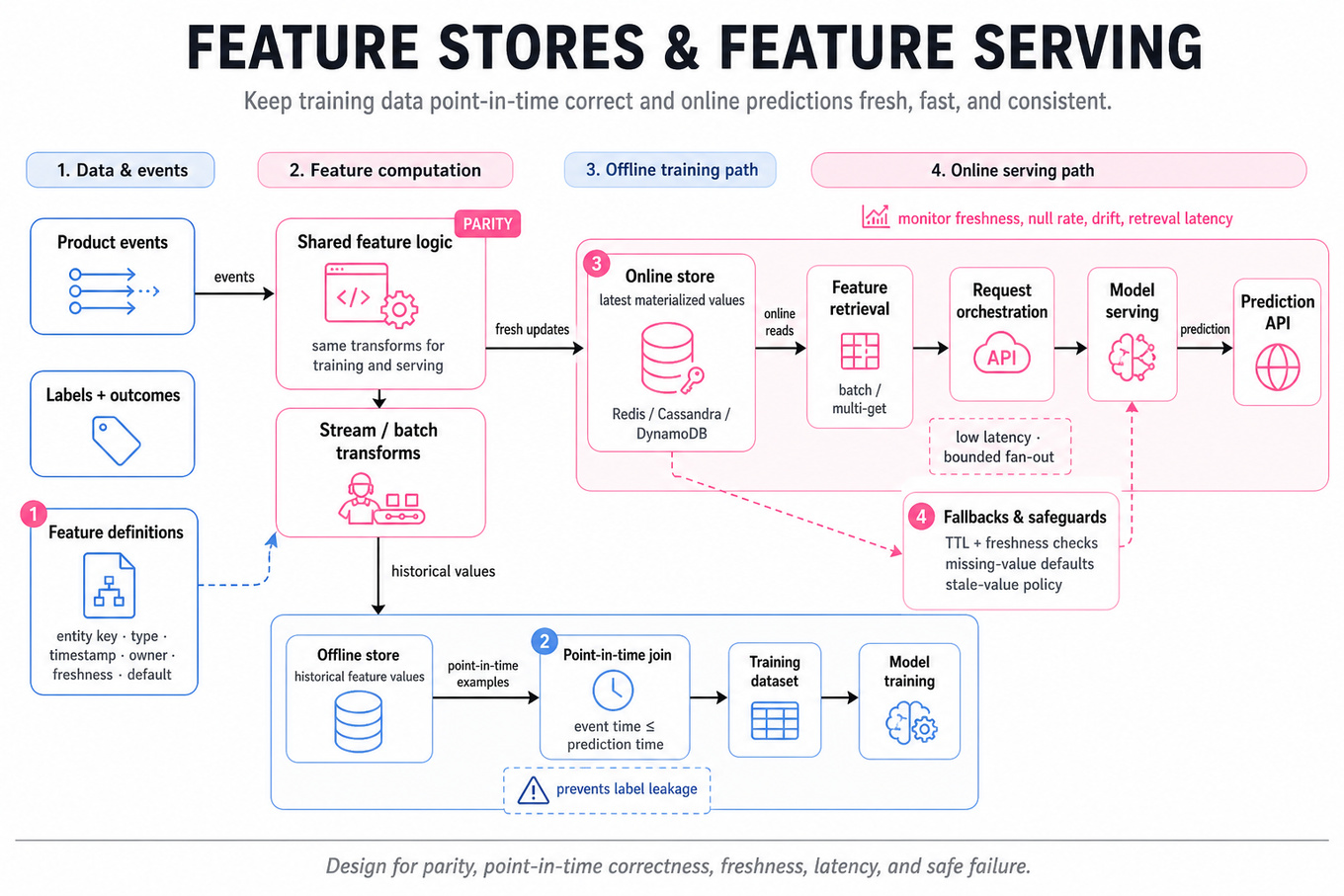
The interviewer is testing whether you can design feature computation and serving as part of a production ML system, not merely list useful predictors. You should demonstrate training-serving parity, point-in-time correctness, freshness guarantees, latency-aware retrieval, and safe handling of missing or stale values. Reddit cares because ranking and engagement models make high-volume, low-latency predictions where a small feature inconsistency can degrade quality globally or create biased feedback loops. They will probe how your choices connect model quality, reliability, deployment, and observability.
Core knowledge
-
A feature store usually has an offline store for historical training data and an online store for low-latency inference.
`Feast`,`Tecton`, or an internal equivalent may manage definitions, materialization, metadata, and retrieval; the store is not automatically the feature-computation engine. -
Point-in-time joins prevent label leakage: for an entity at prediction time , use only feature values whose event time is . Training examples should resemble serving with , not the latest value of each feature. Late corrections require explicit backfill policy.
-
Define every feature with an entity key, value type, timestamp semantics, owner, expected freshness, and default behavior. Distinguish event time from processing time; “user comments in the last 24 hours” must use the intended window boundary and timezone consistently.
-
Online/offline parity means identical transformation logic, feature names, units, categorical mappings, and null semantics during training and inference. Shared computation, generated code, or validated feature contracts is safer than independently reimplementing Python training logic and Java or Go serving logic.
-
Choose storage by access pattern:
`Redis`or`Aerospike`can provide very low-latency key-value reads, while`Cassandra`,`DynamoDB`, or`Bigtable`offer durable, horizontally scalable access. A request-level feature fetch should meet the model’s latency budget, including network fan-out and serialization. -
Model serving should separate request orchestration, feature retrieval, preprocessing, model execution, and response formatting. Batch or multi-get retrieval is preferable to one remote call per feature; cache stable features, but enforce TTLs so popularity or safety signals do not become silently stale.
-
Establish an explicit latency budget, such as 50 ms at
`p99`for feature retrieval and 20 ms for inference within a 100 ms end-to-end target. Measure`p50`,`p95`, and`p99`, timeout rates, cache hit rate, and fallback frequency rather than only average latency. -
Missing features need typed defaults and an observable policy: zero may mean “none,” “unknown,” or “pipeline failure.” Track missingness indicators when absence is informative, and use model-compatible fallbacks such as global, subreddit-level, or user-segment statistics.
-
Feature freshness is a model-quality contract. A feature with a five-minute SLA may be suitable for comment likelihood, while a rapidly changing abuse or inventory signal may require seconds; expose feature age and reject, degrade, or route predictions when it exceeds a threshold.
-
Evaluate more than aggregate offline metrics. Compare
`AUC`, log loss, calibration, and ranking metrics such as`NDCG@k`or`MRR`; slice by new users, new posts, subreddit, device, and traffic tier. Online impact should be validated with controlled experiments, while guarding latency and error-rate regressions. -
Feature drift describes changes in feature distributions, while concept drift changes the relationship between features and labels. Monitor distribution statistics, null rates, age, cardinality, and prediction calibration; use PSI, KL divergence, or robust quantile comparisons with alert thresholds tied to retraining decisions.
-
For high-cardinality entities and embeddings, avoid fetching thousands of individual values per request. Use compact representations, bounded histories, approximate counters, or precomputed aggregates; version embedding models and dimensions because incompatible vectors can break both storage and inference.
Worked example: Design a Comment-Likelihood Prediction System with a Focus on Feature and Model Serving
For Design a Comment-Likelihood Prediction System with a Focus on Feature and Model Serving, I would first clarify whether the prediction is per impression, whether it ranks posts or only supplies a score, the freshness target, and the acceptable online latency. I would state assumptions such as one score per user-post impression, a binary label defined as a comment within a chosen horizon, and a strict requirement that training features reflect the impression timestamp. I would organize the answer around label and feature definitions, offline training and point-in-time data construction, online feature retrieval and model serving, and monitoring plus rollout. Candidate features might include user and subreddit aggregates, post text or embedding signals, time context, and recent interaction features, with explicit defaults for cold-start users and posts. I would use a versioned feature registry and shared transformations, materialize aggregates into an online key-value store, and retrieve user, post, and context features through batched calls. The key tradeoff is freshness versus latency and cost: real-time counters improve recency but introduce more operational dependency, so I would classify features by freshness tier and provide bounded fallbacks. I would monitor feature age, missingness, retrieval `p99`, calibration, log loss, and slice performance, while comparing online engagement against guardrails such as latency and downstream comment quality. If I had more time, I would detail experiment design, rollback behavior, feature backfills, and protection against feedback loops caused by showing content predicted to generate comments.
A second angle
For Design a video recommendation system, the same principles apply, but retrieval and ranking usually operate at much larger candidate volumes and may include sequential behavior and video embeddings. The candidate-generation stage favors precomputed, compact features and approximate nearest-neighbor retrieval, while the final ranker can afford richer user-video cross features for a smaller set. Freshness, watch-time labels, playback context, and position bias become especially important because a click or impression is not equivalent to meaningful consumption. I would also separate candidate-generation feature SLAs from final-ranking SLAs and evaluate both recall and ranking quality. The central tradeoff shifts toward representation size, throughput, and multi-stage latency rather than only per-request feature freshness.
Common pitfalls
Pitfall: Treating the feature store as a magic fix for leakage. Saying “we load the latest user features into training” is wrong when those values include behavior after the label timestamp; describe point-in-time joins and time-aware aggregation instead.
A communication mistake is jumping straight to `Redis`, `Kafka`, or a model framework without clarifying prediction granularity, latency, freshness, and cold-start behavior. A stronger answer states assumptions first, then ties each technology choice to a measurable requirement.
Pitfall: Staying too shallow on serving by saying “cache features and call the model.” Explain batching, timeouts, stale-value policy, version compatibility, observability, and what happens when one dependency fails; these are the decisions that distinguish production design from a model notebook.
Connections
The interviewer may pivot to training-serving skew, data and concept drift, model rollout and canarying, online experimentation, or cold-start recommendation. Be ready to connect feature quality to calibration, ranking metrics, feedback loops, and rollback decisions.
Further reading
-
Feast documentation: Point-in-time joins — concrete guidance on constructing leakage-resistant historical features.
-
Michelangelo: Uber’s Machine Learning Platform — a production-scale perspective on feature pipelines, training, and serving.
Practice questions
ML Model Serving Architecture
Focus areaFocus area — You selected low-latency inference, batching, deployment, versioning, and safe rollout; these are high-yield onsite system-design gaps.
What's being tested
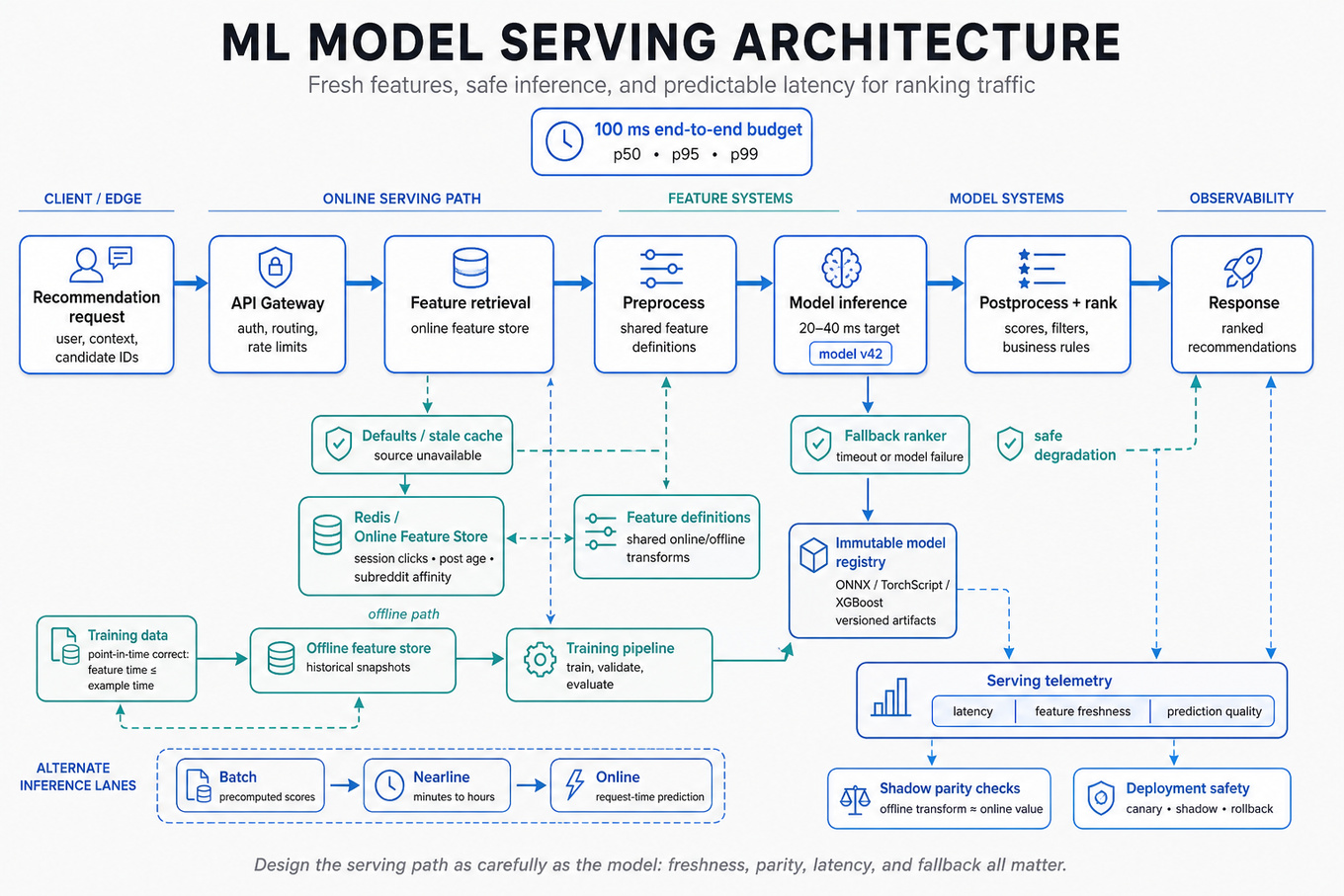
These interviews test whether you can turn an ML model into a reliable, low-latency product capability rather than stopping at model selection. The interviewer is probing feature serving, model serving, online/offline parity, deployment safety, and operational evaluation under realistic recommendation traffic. Reddit cares because ranking and engagement predictions must serve millions of requests with fresh community, user, and content signals while avoiding latency regressions, stale features, and training-serving skew.
Core knowledge
-
Serving-path decomposition separates request handling, feature retrieval, preprocessing, inference, postprocessing, and fallback behavior. State an explicit latency budget, such as 100 ms end-to-end with 20–40 ms allocated to model inference, then measure each component at
`p50`,`p95`, and`p99`. -
Online features are computed or retrieved during inference: recent impressions, session activity, post age, subreddit affinity, and creator statistics. Use a low-latency key-value store or online feature store such as
`Redis`, while keeping the feature definition shared with offline training. -
Offline features support training and batch scoring from historical data. Point-in-time correctness is mandatory: for an example at time , a feature must satisfy ; otherwise future activity leaks into training and produces deceptively strong validation metrics.
-
Training-serving skew occurs when transformations differ between training and inference—for example, training uses a log-transformed count while production sends a raw count. Centralize feature definitions, validate distributions, and run shadow comparisons between offline transformations and online values.
-
Feature freshness should match feature semantics. A user’s long-term subreddit affinity may tolerate hourly updates, while session clicks may require seconds; document each feature’s TTL, default value, ownership, and behavior when the source is unavailable.
-
Model serving commonly uses a stateless inference service behind a load balancer, with a serialized artifact such as
`ONNX`,`TorchScript`, or a native`XGBoost`model. Keep model artifacts immutable and versioned; horizontally scale replicas and avoid per-request model loading. -
Batch, nearline, and online inference are different design choices. Precompute expensive scores for stable user-item pairs, refresh them nearline when behavior changes, and reserve online inference for context-sensitive features; a hybrid often gives better cost and latency than scoring every candidate synchronously.
-
Candidate generation and ranking should be separated for recommendation systems. Retrieve hundreds or thousands of candidates using subscriptions, collaborative filtering, embeddings, or popular-content retrieval, then apply a more expensive ranker; do not run a deep model across the entire corpus per request.
-
Caching reduces repeated feature and prediction work, but cache keys must include all prediction-relevant context and model version. Short TTLs help freshness, while stale-while-revalidate or a popularity fallback can preserve availability during cache or feature-store failures.
-
Model evaluation needs both predictive and system metrics. For comment likelihood, track log loss, calibration, and PR-AUC alongside online latency, timeout rate, and fallback rate; for ranking, use NDCG or Recall@K offline, then validate impact on comments, watch time, quality, and negative feedback online.
-
Deployment safety uses canary traffic, shadow inference, versioned models, and rapid rollback. A shadow model receives production requests but does not affect decisions, allowing comparison of score distributions, feature availability, latency, and disagreement before exposure.
-
Drift and reliability monitoring should distinguish data drift, concept drift, and infrastructure failure. Monitor feature missingness, range violations, score/calibration changes, label delay, throughput,
`p99`, timeouts, and segment-level behavior; alerting should have actionable thresholds rather than every small distribution change.
Worked example: Design a Comment-Likelihood Prediction System with a Focus on Feature and Model Serving
In the first 30 seconds, clarify whether the prediction is per user-post pair, whether it is used for ranking or notification, the allowed latency, prediction horizon, and what “comment” excludes, such as deleted or automated comments. I would declare an initial target such as a calibrated probability of commenting within 24 hours, with labels generated only after that window closes. I would organize the answer around label and evaluation design, feature computation and point-in-time storage, online inference architecture, and deployment/monitoring. The request path would retrieve user, post, subreddit, and recent-session features, apply the exact shared transformations, invoke a versioned ranker, and return a score with a defined fallback. A key tradeoff is freshness versus availability: session features may be fetched online for better responsiveness, while slower community aggregates can be materialized hourly and served from cache. I would explicitly handle missing features, cold-start users, feature-store timeouts, and model timeouts with defaults or a baseline model rather than failing the ranking request. I would close by saying that, with more time, I would design a shadow-evaluation plan, calibration analysis by subreddit and user cohort, and a replay test for online/offline parity.
A second angle
For Design a video recommendation system, the same serving principles apply, but scale and candidate volume make a two-stage architecture central. Candidate retrieval can combine followed communities, collaborative filtering, embedding nearest-neighbor search, and freshness or popularity sources before a heavier ranking model scores a bounded set. Video-specific features such as completion rate, watch time, skips, and content embeddings introduce delayed labels and stronger freshness requirements than a simple comment event. I would also address privacy-aware feature use, content safety filtering, and diversity constraints before final ranking. The main framing shift is optimizing a feed under repeated exposure, not merely returning one calibrated user-post probability.
Common pitfalls
Analytical mistake: Treating offline AUC as proof that the serving design works is tempting, but it ignores calibration, ranking position bias, feature freshness, and latency-induced fallbacks. A stronger answer connects offline log loss or NDCG to online experiments and explicitly measures prediction quality by important cohorts.
Pitfall: Saying “use the latest feature value” without enforcing point-in-time joins creates leakage and invalidates the evaluation.
Communication mistake: Jumping directly into `Kafka`, `Redis`, or Kubernetes components before clarifying the prediction contract makes the design sound infrastructure-led rather than ML-led. Start with label, horizon, request rate, latency, freshness, and failure assumptions, then justify each serving component against them.
Depth mistake: Saying “put the model behind an API” is insufficient for an MLE interview. Explain artifact versioning, preprocessing parity, batching or caching, canary/shadow deployment, timeout behavior, drift monitoring, and rollback ownership.
Connections
The interviewer may pivot to feature stores, training-serving skew, ranking evaluation, model monitoring, or A/B experimentation. They may also ask how delayed labels, counterfactual exposure, cold start, and privacy constraints change the serving design.
Further reading
-
TFX: Data Validation and Model Analysis — Practical patterns for validating features, detecting skew, and evaluating deployed models.
-
Hidden Technical Debt in Machine Learning Systems — Explains why serving dependencies, feedback loops, and monitoring matter beyond model code.
-
[Designing Machine Learning Systems](https://www.oreilly.com/library/view/designing-machine-learning/978 media) — A broad treatment of data, deployment, monitoring, and production tradeoffs.
Observability And ML Incident Management
Focus areaFocus area — You selected monitoring, on-call, incidents, and postmortems; combine ML observability with Reddit launch and rollback scenarios.
What's being tested
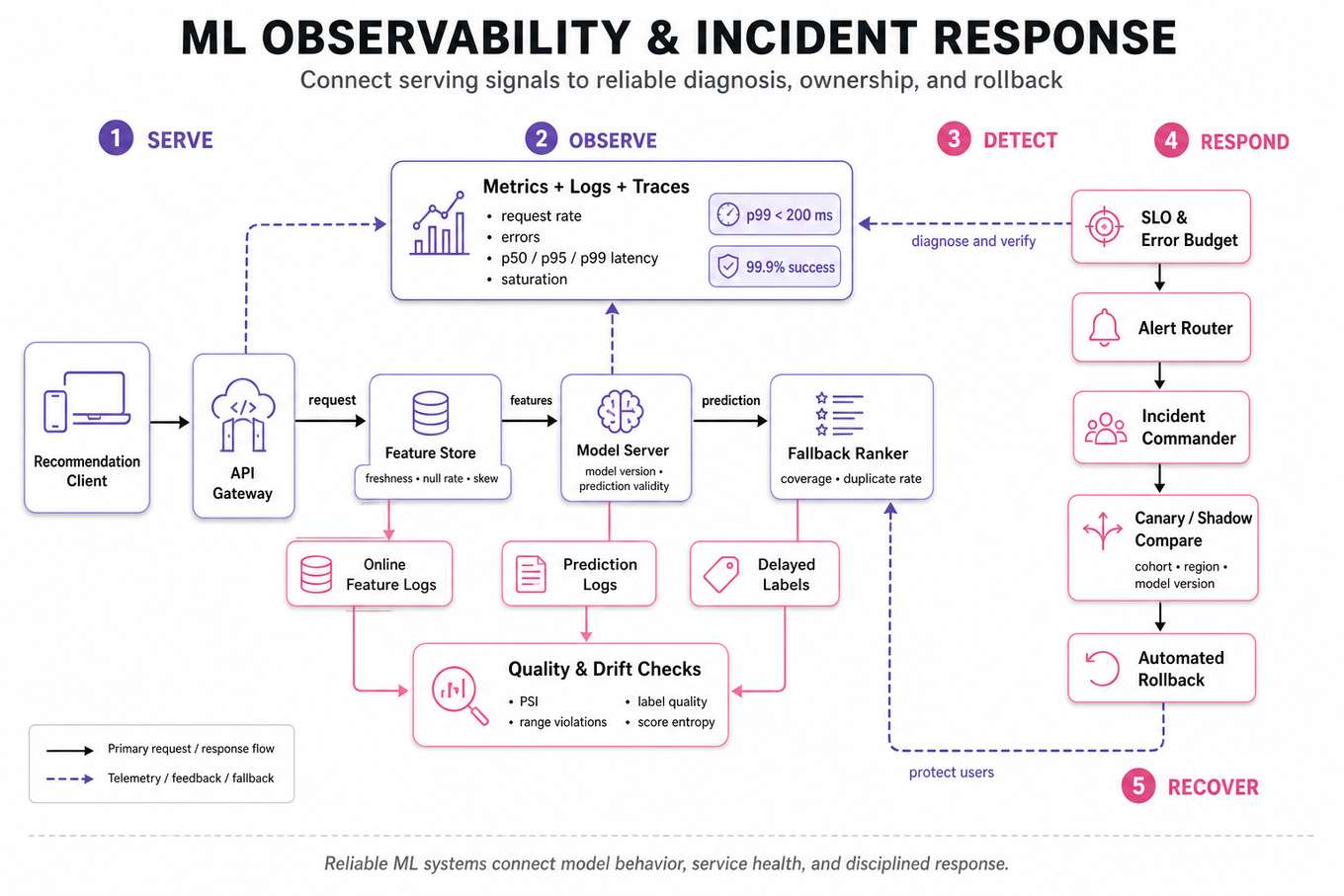
These interviews test whether you can make ML systems observable, detect failures before they materially harm users, and lead a disciplined response when they do. Reddit cares because recommendation and ranking models influence what communities see at high volume, while failures can affect relevance, latency, safety, and trust simultaneously. The interviewer is probing for an MLE who connects model behavior to service-level signals, distinguishes infrastructure failures from data and model failures, and communicates ownership without overclaiming certainty.
Core knowledge
-
Observability combines logs, metrics, and traces to explain system behavior; for ML, add feature distributions, prediction distributions, label-based quality metrics, model versions, and training-serving skew rather than monitoring only CPU and error rate.
-
Track the golden signals: request rate, errors, latency, and saturation. For recommendation serving, segment
p50,p95, andp99latency by endpoint, model version, region, device, cache status, and fallback path; averages hide tail failures. -
Define SLOs before alerts: for example, 99.9% successful responses and
p99latency below 200 ms over a rolling window. An error budget converts reliability into a deployment constraint: repeated budget burn should pause launches. -
Monitor data quality at feature and prediction boundaries: null rate, range violations, cardinality, freshness, and distribution changes. A useful drift statistic is PSI: ; thresholds require calibration, not blind adoption.
-
Detect training-serving skew by computing the same feature transformation in both paths where possible, then comparing sampled online feature values with offline-recomputed values. Version feature definitions and record transformation metadata so incidents are reproducible.
-
Separate model quality from proxy health. Monitor delayed labels such as watch time or engagement when available, but also use immediate proxies—fallback rate, recommendation coverage, score entropy, duplicate rate, and block or hide feedback—to detect degradation before labels arrive.
-
Use canary releases, shadow traffic, and automated rollback. A canary should compare treatment and control by model version and important cohorts; rollback criteria can combine latency, error rate, prediction validity, and statistically significant quality regression.
-
Design fallbacks deliberately: a previous-known-good model, cached recommendations, popularity within a relevant community, or a chronological feed. Validate that fallback content remains safe, policy-compliant, and available when dependencies such as feature stores fail.
-
Make incidents diagnosable with structured logs containing request ID, model version, feature-set version, experiment assignment, candidate count, retrieval source, timeout reason, and fallback reason. Avoid logging raw private content or unnecessary user identifiers.
-
Use distributed tracing to attribute latency across retrieval, feature lookup, ranking, policy filtering, and response assembly. Trace sampling must preserve rare failures, and high-cardinality dimensions should be bounded to avoid making telemetry itself expensive or unusable.
-
Establish an incident lifecycle: detect, triage, mitigate, validate, communicate, and conduct a blameless postmortem. During mitigation, freeze risky changes, assign an incident owner, preserve evidence, and record a timeline; afterward, create concrete owners and due dates for corrective actions.
-
Treat alert quality as an ML problem: tune thresholds using historical incidents, require persistence or multi-signal confirmation, and page only on actionable symptoms. A drift alert without a user-impact hypothesis is investigation work, not necessarily an emergency.
Worked example — Design a video recommendation system
For “Design a video recommendation system,” I would first clarify the target surface, latency and availability SLOs, recommendation objectives, privacy constraints, traffic scale, and whether labels such as watch completion arrive quickly enough for online monitoring. I would state an assumption such as a two-stage system: candidate retrieval followed by a ranking model, with policy and safety filtering before serving. I would organize the answer around feature and event logging, offline training and evaluation, online serving and fallback, and observability with incident response. For observability, I would track request success, p99 latency, candidate count, feature-store timeout rate, model-version prediction distributions, filtering rate, and delayed quality metrics such as completion or meaningful watch time. I would connect each alert to a response, such as routing to a previous model when feature freshness breaks or rolling back when a canary shows a quality regression. One explicit tradeoff is between richer real-time features and reliability: I would prefer bounded-time lookups plus a safe default over allowing personalization dependencies to violate the serving SLO. I would also explain cohort-level monitoring because aggregate metrics can hide failures affecting a language, device type, community, or cold-start users. If I had more time, I would specify alert thresholds from historical baselines, runbook ownership, privacy-safe logging, and a post-launch rollback drill.
A second angle — Describe a failure and a success
For “Describe a failure and a success,” the same concept is evaluated through operational judgment rather than architecture: choose an incident involving a model launch, feature issue, or monitoring gap and explain impact with measured evidence. A strong response follows situation, action, result, and learning, while distinguishing your decisions from the team’s broader work. Include how you detected the problem, narrowed the hypothesis, mitigated user impact, communicated uncertainty, and prevented recurrence through a test, alert, dashboard, or runbook. The success should demonstrate reliable delivery and measurable improvement, not merely that a model had a better offline score.
Common pitfalls
Analytical mistake: Treating feature drift as proof that model quality has declined is tempting but incorrect; user mix can change without harmful predictions. Pair drift with calibration, proxy outcomes, cohort slices, and serving-health signals, and state which labels are delayed or unavailable.
Pitfall: “The dashboard turned red, so I rolled back” omits diagnosis and may cause unnecessary reversions. Explain the trigger, blast radius, confidence, mitigation, and validation step.
Communication mistake: Blaming the data pipeline, platform team, or a vague “bad deployment” weakens an incident answer. State what you owned, how you collaborated, what users experienced, and how you communicated status while facts were still incomplete.
Depth mistake: Listing Kafka, tracing, or alerting tools without defining actionable thresholds is not observability design. Tie every important signal to a failure mode, an owner, a response, and a tradeoff such as alert sensitivity versus fatigue.
Connections
An interviewer may pivot to offline/online evaluation, feature-store consistency, canary deployment, data drift, calibration, or privacy-aware telemetry. Be ready to connect observability to SLOs, experiment guardrails, rollback automation, and postmortem-driven reliability improvements.
Further reading
-
Google SRE Book — Monitoring Distributed Systems — practical guidance on signals, symptoms, and actionable monitoring.
-
Machine Learning: The High-Interest Credit Card of Technical Debt — explains why hidden dependencies and weak monitoring make ML systems difficult to operate.
-
Hidden Technical Debt in Machine Learning Systems — a foundational framing for maintenance, monitoring, and failure modes in production ML.
Practice questions
Reddit Semantic Search And ANN Retrieval
Focus areaFocus area — Reddit search and recommendations increasingly use embeddings; you selected ANN, RAG, chunking, and retrieval system topics.
What's being tested
A strong candidate must connect semantic embedding models, approximate nearest-neighbor (ANN) indexes, and production model-serving constraints into one reliable retrieval pipeline. The interviewer is probing whether you can choose an index, define recall and latency targets, preserve offline/online parity, and handle Reddit-specific issues such as rapidly changing content, deletions, moderation state, and noisy user-generated text. They also want evidence that you can diagnose failures with measurements rather than treating “better embeddings” as the universal solution.
Core knowledge
-
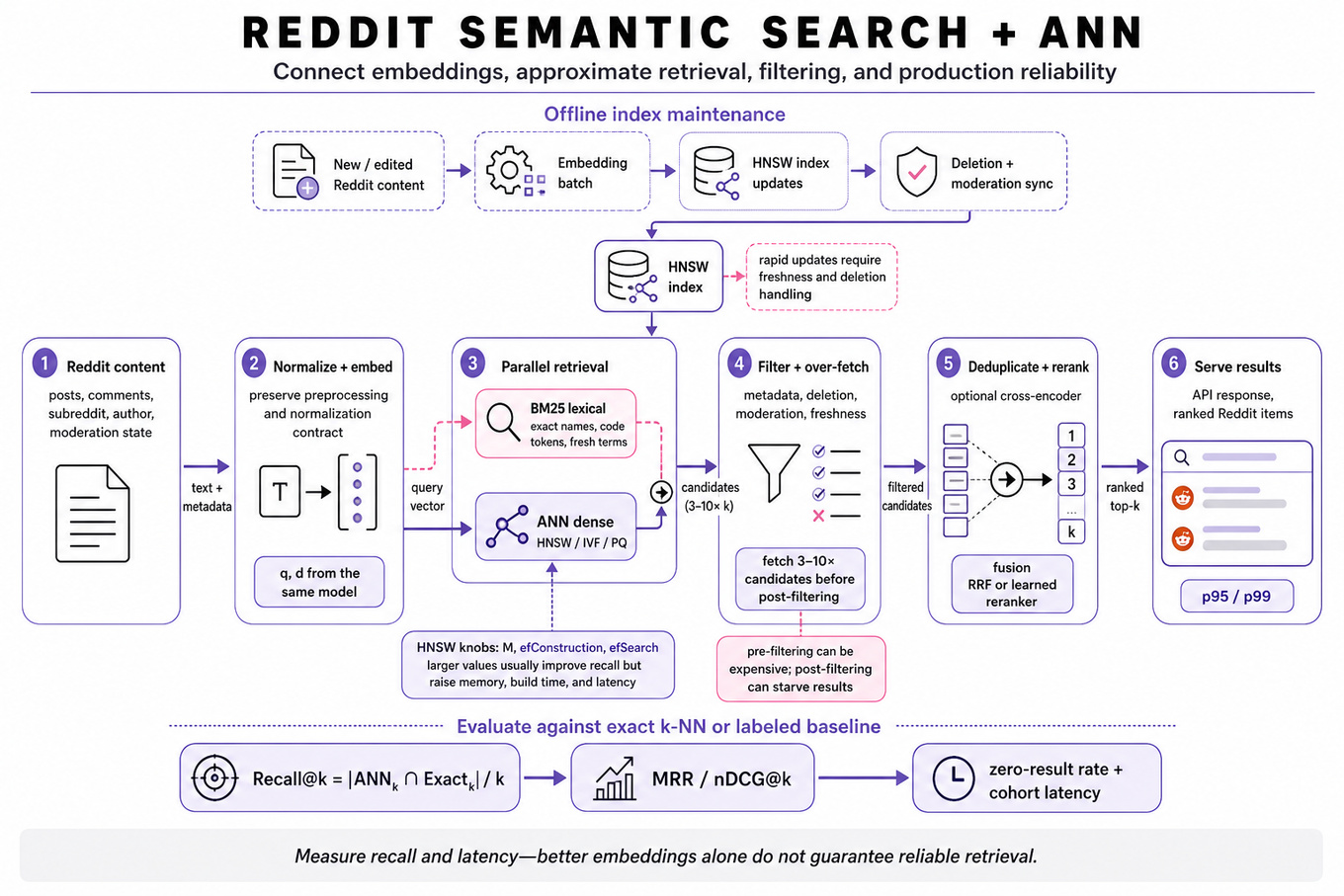
Dense retrieval represents a query and document with vectors from the same embedding model, then ranks candidates by similarity. For normalized embeddings, cosine similarity is equivalent to inner product: ; always preserve the model’s preprocessing and normalization contract.
-
ANN indexes trade exactness for speed by avoiding exhaustive comparison against every vector.
HNSWoffers strong recall and flexible updates through graph search;IVFpartitions vectors into centroids and probes selected cells;PQcompresses vectors to reduce memory, usually at some recall cost. -
HNSWtuning centers onM,efConstruction, and query-timeefSearch. Larger values generally improve recall but increase memory, build time, and latency; exposeefSearchas a controlled runtime knob and benchmark it againstp95andp99, not only averages. -
Retrieval recall should be measured against an exact nearest-neighbor or high-quality labeled baseline: . Also track downstream
MRR,nDCG@k, success rate, zero-result rate, and latency by query cohort. -
Hybrid retrieval combines lexical matching, such as
BM25, with dense retrieval. Lexical search protects exact entities, subreddit names, usernames, code tokens, and fresh terms that embeddings may miss; fusion can use reciprocal-rank fusion or a learned reranker. -
A practical pipeline is query normalization → embedding generation → parallel lexical and ANN retrieval → metadata filtering → deduplication → optional cross-encoder reranking. Filtering before ANN can be difficult or expensive; post-filtering may return too few results, so over-fetch candidates by a factor such as 3–10 and measure the effect.
-
Embedding quality depends on training data and objective, not merely vector dimension. Use hard negatives that are lexically similar but semantically wrong, sample across subreddits and languages, and prevent temporal leakage by training and evaluating with time-based splits.
-
Freshness and index updates require an explicit policy. New posts may enter a mutable delta index or a separate recent-content index while periodic bulk indexes are rebuilt; query both, merge results, and remove deleted or moderated content through tombstones or filtering.
-
Online/offline parity means the serving path uses the same tokenizer, model version, normalization, language handling, truncation limits, and metadata rules as evaluation. Store model and index versions with every result so regressions can be reproduced and rollbacks are safe.
-
Capacity planning must include vector memory, replicas, rebuild overhead, and embedding-generation cost. A rough dense-memory estimate is bytes for
float32, before ANN graph or index overhead;float16or product quantization reduces memory but requires recall validation. -
Evaluation sets should include head, torso, and tail queries; spelling errors; long natural-language questions; exact-name queries; multilingual content; and adversarial or unsafe text. Slice recall and ranking quality by language, subreddit, content age, query length, and traffic tier.
-
Monitoring should separate model, index, and serving failures: embedding norm or distribution drift, query-to-document similarity shifts, ANN recall sampled against exact search, index age, missing-vector rate, filter rejection rate,
p50/p95/p99latency, timeout rate, and zero-result rate.
Worked example — Design a Reddit semantic search and ANN retrieval system
First, clarify whether the goal is related-post discovery, user-facing search, or candidate generation, and establish corpus size, freshness SLA, top-, languages, filters, and p99 latency budget. I would state an initial architecture of query embedding, parallel BM25 and ANN retrieval, metadata filtering, fusion, and optional reranking. The main pillars would be embedding-model training and versioning, ANN index selection and update strategy, offline/online evaluation, and production monitoring with rollback. I would choose HNSW for a high-recall mutable index if memory permits, while keeping a lexical path for exact terms and a delta index for recent posts. A key tradeoff is whether to post-filter ANN candidates, which simplifies index management but may lose recall under restrictive subreddit or moderation filters. I would validate the design with exact-search recall, judged relevance, age and language slices, and load tests at target concurrency. I would explicitly test deleted and moderated posts so stale vectors cannot surface content. If I had more time, I would compare a cross-encoder reranker against a cheaper feature-based reranker and quantify its incremental quality per millisecond.
A second angle — Debug a semantic-search recall regression
Here the framing shifts from initial architecture to fault isolation: first determine whether the regression is in embeddings, index construction, filtering, candidate fusion, or labels. Compare the affected model and index against the previous versions using identical queries, then measure exact-neighbor recall before applying downstream filters. Check for tokenizer changes, normalization mismatches, truncated inputs, stale or missing vectors, reduced efSearch, altered shard routing, and a larger corpus that changed candidate competition. Slice the drop by query type, language, content age, and subreddit to distinguish a global model problem from a coverage or freshness problem. The best answer proposes a safe rollback or dual-read comparison while identifying the root cause with versioned artifacts and targeted metrics.
Common pitfalls
Pitfall: Claiming ANN “returns the nearest neighbors” without qualification is analytically wrong. State that it approximates exact search and define recall against an exact or trusted high-quality baseline.
Pitfall: Jumping straight to
HNSWparameters without asking about corpus size, update frequency, filtering, and latency makes the answer sound memorized. Tie every parameter choice to a measurable constraint.
Pitfall: Treating embedding quality as the only source of relevance ignores lexical misses, stale indexes, moderation filters, and reranking. Explain how you would localize failures across each pipeline stage.
Connections
The interviewer may pivot to cross-encoder reranking, hybrid lexical-dense retrieval, contrastive learning with hard negatives, or feature and model drift monitoring. They may also connect retrieval quality to online experimentation while expecting you to preserve offline/online parity and guardrail metrics.
Further reading
-
Efficient and Robust Approximate Nearest Neighbor Search Using Hierarchical Navigable Small World Graphs — The foundational
HNSWpaper and its graph-search tradeoffs. -
The Faiss Library — Practical implementations of
IVF,PQ, and other vector-index approaches. -
Dense Passage Retrieval for Open-Domain Question Answering — A useful reference for dual-encoder training and retrieval evaluation.
Practice questions
Focus area — Reddit ranking must account for spam, policy, NSFW, and moderator signals; this adds product constraints beyond pure engagement optimization.
What's being tested
This topic tests whether you can design and operate a moderation-aware ranking system that optimizes relevance without allowing unsafe or policy-violating content to surface. The interviewer is probing how you separate hard safety constraints from soft ranking signals, handle uncertain or delayed moderation labels, and preserve online/offline feature parity. At Reddit’s scale, a strong answer must connect model quality to serving latency, rollback safety, drift monitoring, and failure modes such as brigading, adversarial content, and distribution shifts.
Core knowledge
-
Policy enforcement layers should be explicit: remove or suppress definitively violating content before ranking, apply calibrated safety penalties to uncertain content, and let ordinary relevance models rank content that passes safety gates. Never rely on a single blended score to enforce non-negotiable policy constraints.
-
A practical pipeline is candidate generation → safety filtering → ranking → post-ranking constraints. Candidate generation may use retrieval, subscriptions, embeddings, or popularity; safety filtering consumes moderation labels and model scores; ranking combines predicted engagement with quality and safety features; post-ranking applies diversity and exposure limits.
-
Separate hard constraints from soft objectives. A hard block might be
policy_violation_probability > τ, while a soft score could be where is relevance, harmfulness, and low-quality probability. -
Safety predictions require calibration, not merely high AUC. Measure reliability with expected calibration error, Brier score, precision at the operational threshold, and recall for severe violations. A model predicting 0.8 should correspond roughly to an 80% empirical violation rate within comparable cohorts.
-
Optimize and evaluate by severity-weighted cost, because a false negative for dangerous content is not equivalent to a false positive on benign content. Define an explicit cost matrix and report metrics by policy type, language, subreddit, account age, and content format rather than only aggregate accuracy.
-
Treat moderation labels as delayed, selective, and noisy. Human reports and moderator actions overrepresent exposed or controversial content; labels arrive after ranking has already affected exposure. Use time-based splits, label maturity windows, and carefully defined negatives to avoid training on future information.
-
Prevent online/offline skew by logging the exact feature values, model version, moderation-label version, and eligibility decision used at serving time. Feature stores should support point-in-time retrieval for training; serving should have bounded staleness and deterministic handling for missing or timed-out safety features.
-
Design for low-latency safety inference. Cache slowly changing content-level predictions, precompute embeddings and moderation scores, and use a lightweight online model for user-context effects. Define fail-closed behavior for severe-risk checks, while avoiding a total feed outage when noncritical ranking features are unavailable.
-
Use counterfactual exposure-aware evaluation where possible. Logged engagement is biased by the previous ranker: low-ranked content receives fewer opportunities. Compare models with replay or propensity weighting when assumptions hold, and validate high-risk changes with shadow traffic, canaries, and controlled experiments.
-
Monitor both model and system behavior: feature and score drift, calibration drift, violation prevalence, false-negative audit rates, exposure by policy category, latency, timeout rate, and rank-position distributions. A stable aggregate safety rate can hide severe degradation in a small language or community cohort.
-
Build adversarial robustness into training and evaluation. Test obfuscation, coded language, image-text combinations, coordinated reporting, reposts, and distribution shifts across communities. Deduplication, near-duplicate detection, robust text normalization, and human review queues can reduce evasion without putting all responsibility on the ranker.
-
Use model and policy versioning with rollback. Every prediction should be attributable to a model artifact, feature schema, threshold configuration, and policy version. Keep shadow evaluation and kill switches for regressions; changing a threshold can materially alter exposure even when model weights are unchanged.
Worked example — Design a moderation-aware home-feed ranking system
A strong candidate first clarifies whether the system must block only confirmed violations or also reduce exposure to uncertain content, what latency and freshness targets apply, and which safety errors are more costly. They would state an assumption such as “severe policy violations are hard-filtered, while uncertain borderline content receives a calibrated penalty and may enter human review.” The answer can then be organized around four pillars: candidate retrieval, safety scoring and gating, relevance ranking with constraints, and deployment and monitoring. They should describe point-in-time training data, delayed-label handling, calibration, and an evaluation suite that reports both ranking quality and severity-weighted safety metrics. A key tradeoff is fail-open versus fail-closed behavior when the safety service times out: fail-closed protects against severe exposure but can suppress legitimate content and harm availability, so the policy should vary by severity and use cached predictions where safe. They should also mention shadow traffic, canary rollout, model-versioned logs, and rollback thresholds. If they had more time, they would add exposure-aware counterfactual evaluation and adversarial tests for obfuscated or multimodal content.
A second angle — Debug a sudden increase in harmful-content exposure
Here the framing is incident diagnosis rather than greenfield architecture: first localize whether the change came from labels, thresholds, candidate mix, ranking weights, feature freshness, or a serving failure. Segment the increase by language, subreddit, content type, model version, rank position, and traffic cohort before changing the model. Compare online feature distributions and safety-score histograms with the training baseline, then inspect false negatives through sampled human review. The candidate should distinguish a real prevalence increase from a logging or denominator error and use shadow replay or an immediate threshold rollback to contain risk.
Common pitfalls
Pitfall: Treating moderation as another engagement feature is analytically unsafe; a high predicted click probability must not outweigh a hard policy violation. Explicitly define constraint precedence and severity-specific thresholds.
Pitfall: Saying “we evaluate with AUC” is incomplete because class imbalance and calibration determine operational behavior. Add precision/recall at serving thresholds, calibration, severity-weighted costs, and cohort-level slices.
Pitfall: Hand-waving deployment with “serve the model in real time” misses the MLE depth being tested. Explain feature freshness, timeout behavior, caching, versioned artifacts,
p99latency, canaries, rollback, and offline/online parity.
Connections
The interviewer may pivot to learning-to-rank, feature-store point-in-time correctness, counterfactual evaluation, calibration and threshold selection, or model drift and fairness monitoring. They may also ask how to handle human-in-the-loop labels and adversarial distribution shift.
Further reading
-
Learning to Rank for Information Retrieval — foundational treatment of ranking objectives, losses, and evaluation.
-
Practical Lessons from Predicting Clicks on Ads at Facebook — useful discussion of large-scale prediction, calibration, and production ranking.
-
A Unified Approach to Interpreting Model Predictions — background on SHAP-style diagnostics for investigating feature-driven model behavior.
Practice questions
Machine Learning
Click And Engagement Prediction
Focus areaFocus area — You selected class imbalance, sampling, metric design, and calibration; engagement prediction is the supervised core of Reddit ranking.
What's being tested
These problems test whether you can build a reliable probabilistic prediction system end to end: define an impression-level label, choose a model and loss, evaluate discrimination and calibration, and deploy it with consistent features. The interviewer is probing judgment around biased feedback loops, delayed or missing labels, feature freshness, online/offline parity, and latency—not merely whether you can train a classifier. Reddit cares because click, comment, and watch predictions directly influence ranking, and a small serving or calibration error can affect millions of feed decisions.
Core knowledge
-
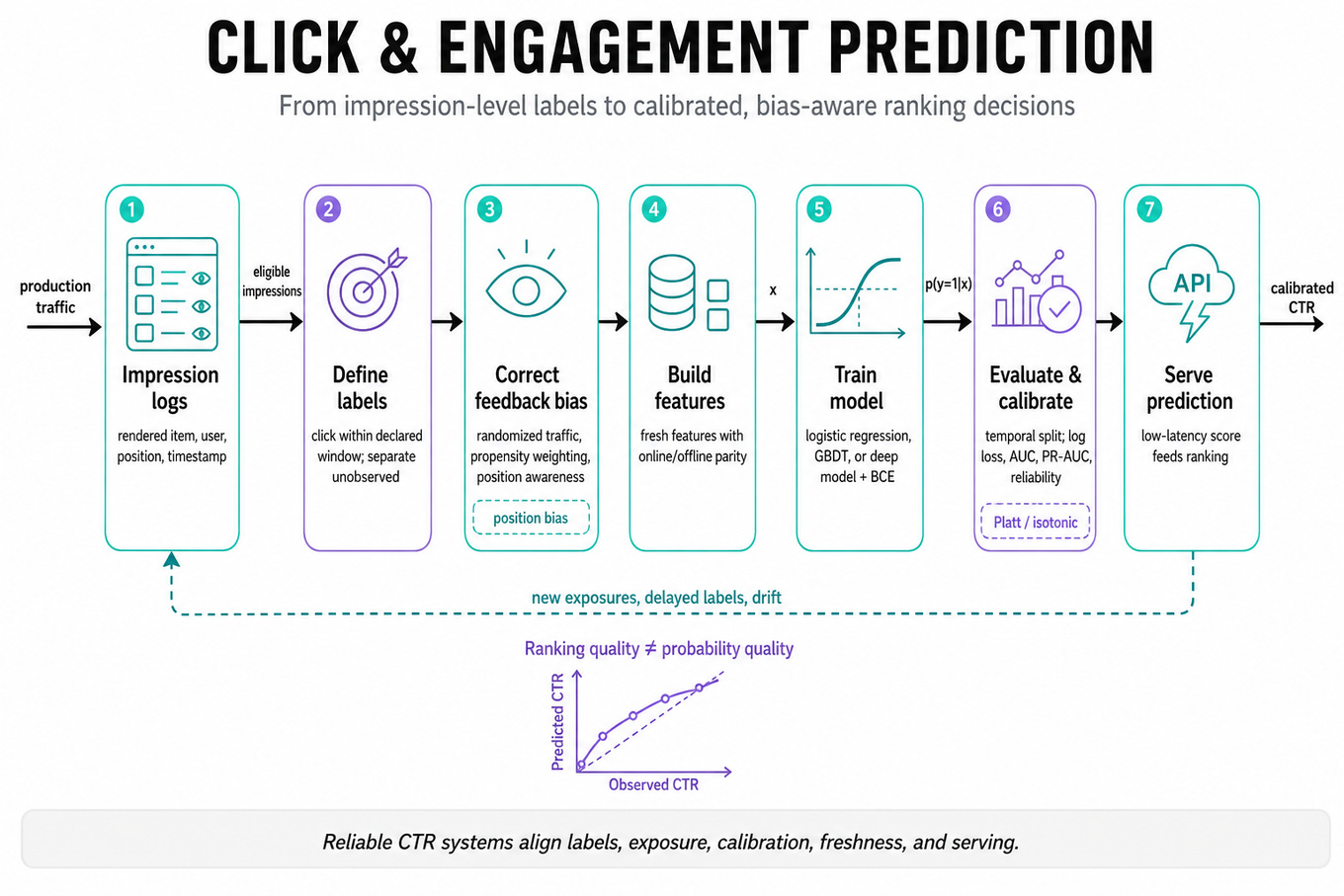
Label definition must match the serving decision: for click prediction, label when an eligible impression receives a click within a declared window; distinguish “not clicked” from unobserved, filtered, or never-rendered content.
-
Position bias makes observed clicks non-random: higher-ranked items receive more exposure. Use randomized traffic, propensity weighting, position features cautiously, or counterfactual estimators; otherwise the model learns “shown high” rather than genuine relevance.
-
A strong baseline is logistic regression: , trained with binary cross-entropy. Sparse crossed features can work well;
LightGBMorXGBoostcaptures nonlinear interactions, while deep models help with large-scale embeddings and sequences. -
Log loss evaluates probabilistic accuracy: . AUC-ROC measures ranking across thresholds, but can look strong while probabilities are poorly calibrated; use PR-AUC for rare positive events.
-
Calibration matters when scores feed expected-value ranking or downstream budgets. Inspect reliability diagrams and expected calibration error, then apply Platt scaling or isotonic regression on a temporally separate validation set; never calibrate on training predictions.
-
Use temporal validation rather than random cross-validation when behavior, inventory, or policies change. Train on earlier impressions and validate later; split by user or author when leakage through repeated entities would inflate offline performance.
-
Negative sampling changes the effective class prior. If training negatives are sampled, correct probabilities using the sampling ratio or calibrate against production traffic; otherwise ranking may remain useful while predicted CTR is systematically wrong.
-
Feature parity requires the same definitions, transformations, defaults, and time cutoffs offline and online. A point-in-time feature such as recent clicks must exclude events after the impression; online feature stores need freshness, TTLs, and explicit missing-value behavior.
-
A serving path commonly includes candidate retrieval, feature lookup, model inference, post-processing, and fallback. Set a latency budget such as
p99under 50–100 ms, parallelize independent lookups, cache stable features, version models and features together, and fall back to a simpler model when dependencies fail. -
Drift monitoring should cover input distributions, missingness, feature freshness, score distributions, calibration, and delayed label metrics. Compare production slices by device, subreddit, locale, new versus returning users, and content age; alert on both data drift and performance degradation.
-
For comment or click likelihood, prevent label leakage from post-impression actions, moderation outcomes, future engagement, or aggregate counters computed using the target window. Log the feature timestamp and model version with each prediction so failures are reproducible.
-
Evaluate beyond aggregate metrics: measure calibration by segment, ranking quality such as NDCG or MRR where appropriate, and operational metrics including timeout rate, CPU/memory, feature-store errors, and fallback frequency. Guard against optimizing clicks at the expense of long-term engagement or content diversity.
Worked example: Build and evaluate click prediction models
A strong candidate first clarifies whether the target is click-through rate for every rendered impression, the prediction horizon, traffic volume, latency budget, and whether the score is used for ranking or expected-value estimation. They would explicitly state that impressions—not page views or sampled clicks—are the unit of training, and that exposure and delayed labels must be handled. The answer can then be organized around label and data construction, baseline/model selection, offline evaluation and calibration, and production deployment and monitoring. They might begin with regularized logistic regression, compare it with LightGBM, and use a time-based holdout with log loss, AUC, PR-AUC, and calibration error. A key tradeoff is that a richer model may improve offline ranking while increasing inference latency and worsening calibration, so the choice depends on the downstream use of the score. They should call out position bias and explain how randomized exposure or propensity weighting would make evaluation more trustworthy. If they had more time, they would add slice-based analysis, shadow deployment, online A/B validation, and drift thresholds tied to rollback procedures.
A second angle
Design a Comment-Likelihood Prediction System with a Focus on Feature and Model Serving
Here the same modeling principles are constrained more heavily by feature serving and model serving than by model comparison. The candidate should frame the online path around user, post, community, and recent-interaction features, with explicit freshness, TTL, fallback, and point-in-time semantics. A useful distinction is between precomputed features that tolerate minutes of staleness and request-time features that require low-latency retrieval. The design should preserve offline/online parity through shared transformations, feature versioning, and replayable prediction logs. Compared with click prediction, comments are typically sparser and more delayed, so cold-start defaults, calibration, and delayed-label monitoring deserve extra emphasis.
Common pitfalls
Pitfall: Treating every non-click as a clean negative and reporting only AUC is tempting but wrong. A stronger answer separates unobserved impressions, exposure bias, class-prior changes from negative sampling, log loss, calibration, and time-based validation.
Pitfall: Jumping directly into
Kafka, feature stores, or a neural architecture before clarifying the prediction target makes the response feel unfocused. Start with the unit of prediction, label window, decision latency, and downstream use; then organize the design around those constraints.
Pitfall: Saying “monitor drift” without naming what is monitored is too shallow. Specify feature missingness and freshness, score distribution, delayed log loss/calibration, slice-level metrics, serving
p99, timeout rate, and rollback or fallback behavior.
Connections
An interviewer may pivot to learning to rank, counterfactual evaluation, feature-store consistency, or online experimentation. They may also ask about cold-start handling, delayed feedback, multi-objective ranking, and how model predictions interact with exploration and recommendation diversity.
Further reading
-
Practical Lessons from Predicting Clicks on Ads at Facebook — influential discussion of CTR modeling, calibration, and large-scale production tradeoffs.
-
A Survey on Accuracy-Oriented Evaluation of Recommender Systems — useful context for ranking metrics and the limits of offline evaluation.
-
Reliable Evaluation of Recommender Systems — foundational treatment of offline evaluation bias and recommendation feedback loops.
Practice questions
Behavioral & Leadership
Cross-Functional Product Leadership
Focus areaFocus area — Behavioral self-rating is 2/5 and you selected ownership, stakeholder management, prioritization, mentorship, governance, and escalation.
What's being tested
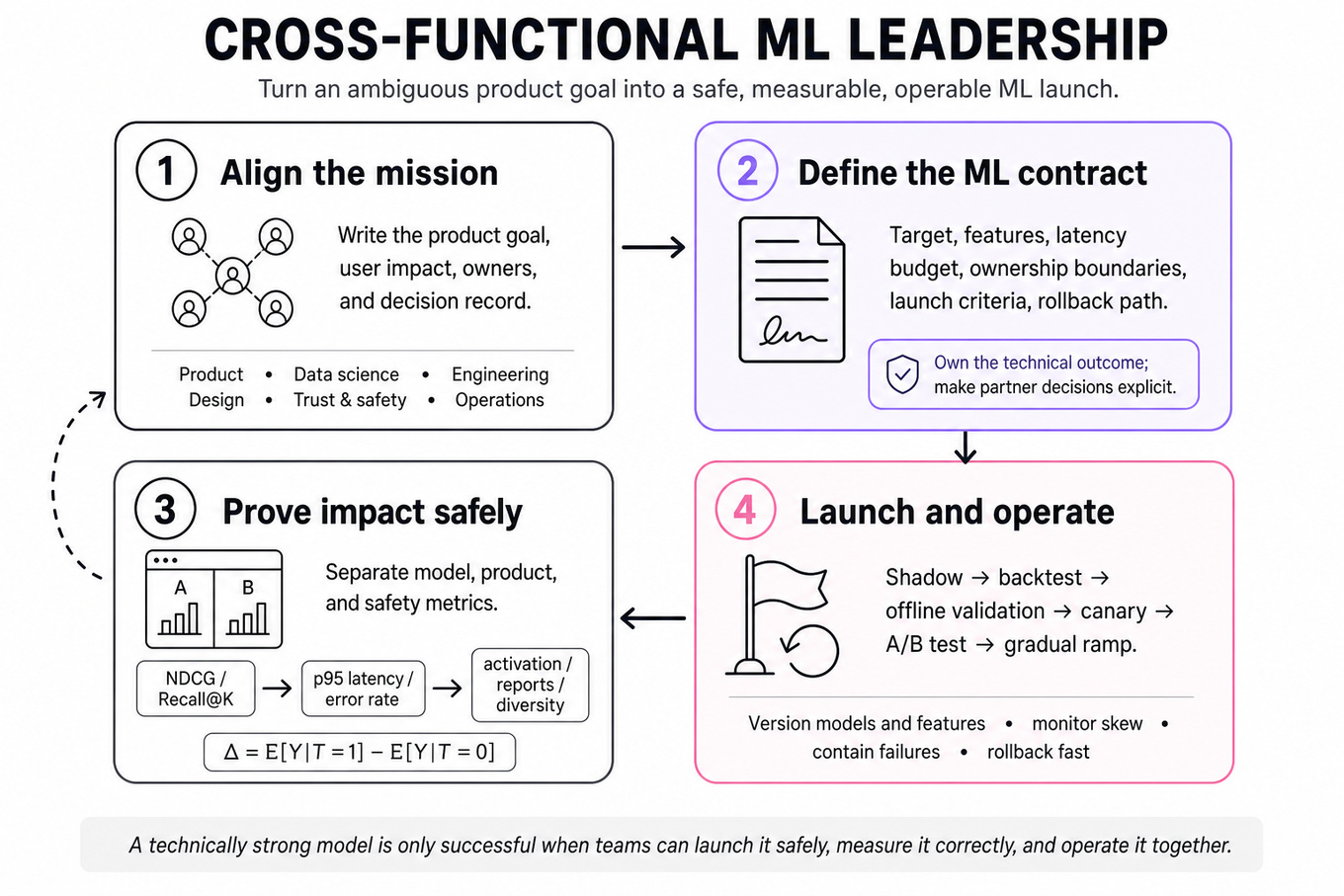
This evaluates whether you can lead an ML initiative across product, data science, software engineering, design, trust and safety, and operations while retaining ownership of the technical outcome. The interviewer is probing for structured communication, honest accountability, stakeholder alignment, and judgment about model quality, reliability, launch risk, and user impact. Reddit cares because recommendation and ranking systems affect community health at scale: a technically strong model is still a failure if it cannot be deployed safely, measured correctly, or operated by partner teams.
Core knowledge
-
Cross-functional technical leadership means converting an ambiguous product goal into an ML contract: objective, prediction target, features, latency budget, ownership boundaries, launch criteria, and rollback path. You should distinguish decisions you own from product, policy, and infrastructure decisions owned by partners.
-
Use a written decision record to align teams asynchronously: problem statement, alternatives, assumptions, evaluation results, risks, owner, and deadline. For contentious choices, document the disagreement and the evidence that would change your mind rather than forcing premature consensus.
-
Define offline/online parity explicitly. Training features, feature-store values, transformations, model versions, and serving-time defaults must match; otherwise a strong offline AUC can coexist with poor production behavior from training-serving skew.
-
Separate model metrics from product and safety metrics. Ranking quality might use
NDCGorRecall@K, while production health needsp95/p99latency, error rate, freshness, and CPU cost; user impact may include activation, retention, reports, hides, or community diversity. -
Establish a launch ladder: shadow mode, backtest, offline validation, canary, small randomized experiment, and gradual ramp. A canary detects operational regressions; an A/B test estimates user impact. Neither alone proves the model is safe or beneficial.
-
A useful experiment target is an intention-to-treat effect, such as Guard against interference, novelty effects, treatment contamination, and Simpson’s paradox across new users, logged-out users, and established communities.
-
Treat rollback and failure containment as part of the design, not incident paperwork. Version models and feature definitions, preserve the last-known-good artifact, define automated thresholds, and ensure a fallback ranker or heuristic can serve within the latency budget.
-
For model incidents, use a blameless postmortem with timeline, customer impact, detection gap, contributing conditions, and corrective actions. “The model was bad” is incomplete; identify whether review, data validation, deployment, monitoring, or ownership failed.
-
Drift monitoring should cover input distributions, prediction distributions, calibration, missingness, feature freshness, and delayed-label performance. Population Stability Index or distributional tests can flag change, but alerts require an owner, severity, and response runbook.
-
In onboarding, expect cold-start constraints: a new user has little behavioral history, while a new community may have sparse engagement. Use robust defaults, content and community metadata, exploration, and explicit uncertainty rather than overfitting to the first few clicks.
-
Make tradeoffs explicit with a decision matrix: expected user value, model quality, latency, operational complexity, privacy or safety risk, and reversibility. A simpler model that reliably meets
p99and has interpretable failure modes may beat a marginally better but fragile architecture.
Worked example: Improve Reddit onboarding
In the first 30 seconds, I would clarify which onboarding outcome matters—successful account activation, first meaningful community interaction, week-one retention, or reduced early abandonment—and which surfaces and user cohorts are in scope. I would state that, as the MLE, I would own the recommendation or ranking implementation, offline and online evaluation, deployment safety, and monitoring, while partnering with product on the user journey and with trust and safety on policy constraints. I would organize the answer around four pillars: cold-start feature and model design, training-serving consistency, an experiment and guardrail plan, and staged rollout with operational ownership. For cold start, I might combine selected interests, locale or language where appropriate, community metadata, and popularity or quality priors, while preserving exploration so the system does not immediately lock users into narrow recommendations. I would propose a primary activation or meaningful-engagement metric, with guardrails for hides, reports, diversity, latency, and short-term versus longer-term retention. A key tradeoff is personalization depth versus privacy, latency, and sparse-signal risk; I would prefer a simpler, resilient fallback for users without enough history. I would close by saying that, with more time, I would inspect cohort-level effects, validate community-health impacts, and run a post-launch review of drift and false-positive recommendations.
A second angle
For “Describe a failure and a success,” the same concept is framed around ownership under imperfect execution rather than designing a future launch. A strong response should explain the technical context, the observable impact, how you communicated uncertainty, and the concrete remediation that prevented recurrence. For example, a model launch that improved offline ranking but degraded p99 latency should include detection, rollback, partner coordination, and what evaluation or capacity test was added afterward. The success story should still credit collaborators while making your individual technical decisions and measurable contribution clear.
Common pitfalls
Pitfall: Treating onboarding as a pure product-strategy exercise. Saying “add a better interest picker” without explaining the model contract, cold-start behavior, evaluation, and rollout leaves the MLE contribution unclear; connect every proposal to implementability and measurable system behavior.
Pitfall: Reporting only aggregate improvement. A global activation lift can conceal harm to new communities, language cohorts, or users exposed to low-quality recommendations; propose cohort analysis and guardrails for safety, diversity, retention, and latency.
Pitfall: Describing failure as someone else’s fault or claiming a flawless launch. “Data scientists gave me a bad model” signals weak ownership; explain your validation gap, escalation, rollback, and the durable engineering or process change that followed.
Connections
The interviewer may pivot to model monitoring, A/B experimentation, feature-store design, recommender cold start, or incident response. Be ready to connect leadership behavior to concrete artifacts: evaluation dashboards, launch checklists, model cards, runbooks, and postmortems.
Further reading
-
Google, “The ML Test Score” — A practical rubric for production readiness and ML-specific technical debt.
-
Google, “Hidden Technical Debt in Machine Learning Systems” — Explains why integration, monitoring, and dependency management often dominate model code.
-
Google SRE Book: “Postmortem Culture” — Concrete guidance for blameless incident learning and corrective action.
Practice questions